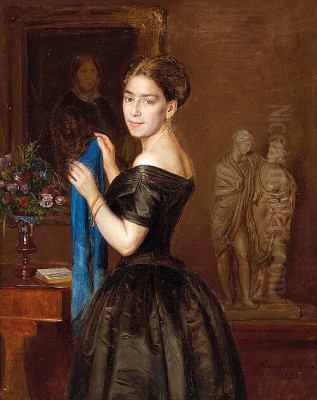
Josef Mansfeld (1819-1894) stands as a notable figure in 19th-century Austrian art, a painter whose work captured the nuances of everyday life, the character of individuals through portraiture, and the quiet beauty of still lifes. Born and educated in Vienna, the vibrant cultural heart of the Austro-Hungarian Empire, Mansfeld's career unfolded during a period of significant artistic and social transformation. His adherence to a detailed, realistic style places him firmly within the traditions fostered by the esteemed Vienna Academy of Fine Arts, an institution that shaped generations of artists.
While perhaps not as internationally renowned as some of his more revolutionary contemporaries, Mansfeld's contributions offer a valuable window into the artistic sensibilities and social fabric of his time. His paintings, found in collections such as the Mint Museum in North Carolina and the USC Fisher Museum of Art in Los Angeles, particularly within the Oscar and Maria Salzer Collection, attest to a lasting appreciation for his skillful depictions and quiet narratives.
Early Life and Artistic Grounding in Vienna
Josef Mansfeld was born in Vienna in 1819, a city that was then the capital of a vast empire and a crucible of artistic and intellectual activity. His birthplace was reportedly near the Vienna Academy of Fine Arts (Akademie der bildenden Künste Wien), an institution that would play a pivotal role in his artistic development. This proximity may have exposed him to the world of art from a young age, fostering an early inclination towards the visual arts.
Further embedding him in an artistic milieu was his lineage; it is understood that Mansfeld was the grandson of Josef Georg Mansfeld (1764-1817), a respected engraver. This familial connection to the arts likely provided both inspiration and a supportive environment for the young Josef to pursue his own artistic path. Engraving, with its emphasis on precision and detail, may have subtly influenced his later meticulous approach to painting.
Mansfeld received his formal artistic training at the Vienna Academy of Fine Arts. During the early to mid-19th century, the Academy was a bastion of academic tradition, emphasizing rigorous training in drawing, anatomy, perspective, and the study of Old Masters. The prevailing aesthetic often leaned towards Neoclassicism initially, gradually incorporating elements of Romanticism and, significantly during Mansfeld's formative years, the Biedermeier style. Teachers at the Academy during this period, such as the history painter Leopold Kupelwieser or the Nazarene-influenced Joseph von Führich, would have instilled in their students a respect for technical skill and established compositional principles.
The Biedermeier period (roughly 1815-1848 in Central Europe) particularly shaped the cultural landscape of Mansfeld's youth and early career. This era, characterized by a focus on domesticity, the middle class, sentimentality, and a realistic yet often idealized depiction of everyday life, would have been a strong current in the Viennese art world. Artists like Ferdinand Georg Waldmüller, a towering figure at the Academy and a master of Biedermeier genre scenes, portraits, and landscapes, would have been a significant presence and potential influence.
The Emergence of an Artist: Exhibitions and Style
Josef Mansfeld began to establish his presence in the Viennese art scene around 1845, the year he reportedly started to exhibit his works more widely. This marked his transition from student to professional artist, entering a competitive but vibrant artistic community. Vienna, at this time, offered various venues for artists to showcase their work, from Academy exhibitions to private galleries and art societies (Kunstvereine), which were growing in importance for connecting artists with patrons and the public.
His chosen specializations – genre scenes, portraits, and still lifes – were all popular and commercially viable categories in the 19th century. Genre painting, in particular, resonated with the Biedermeier sensibility, offering charming, narrative, or anecdotal glimpses into the lives of ordinary people. These scenes often celebrated simple virtues, family life, or picturesque moments, appealing to the tastes of a burgeoning middle-class clientele.
Mansfeld's style was characterized by a commitment to realism and meticulous attention to detail. This approach was in line with the academic training he received, which valued accurate representation and polished execution. His brushwork was likely controlled and precise, aiming for a smooth finish that allowed the subject matter to take precedence. In portraiture, this detailed realism would have been essential for capturing a likeness and conveying the sitter's personality and status. In still lifes, it allowed for the celebration of textures, forms, and the play of light on various objects.
As the 19th century progressed, the artistic landscape evolved. While the Biedermeier spirit lingered, new currents emerged. The latter half of Mansfeld's career would have witnessed the rise of Historicism in Vienna, with grand-scale history paintings and opulent decorative schemes becoming fashionable, exemplified by artists like Hans Makart. Realism also took on different dimensions, sometimes becoming more socially critical or unvarnished, as seen in the work of French artists like Gustave Courbet, whose influence spread across Europe. Mansfeld, however, appears to have remained largely true to the more intimate and polished realism associated with his earlier training, a style that continued to find an appreciative audience.
Themes and Subjects: A Mirror to Society
Josef Mansfeld's oeuvre revolved around three principal themes: genre scenes, portraiture, and still life painting. Each of these allowed him to explore different facets of the human experience and the visual world, reflecting the tastes and values of his era.
Genre Scenes: These paintings formed a significant part of Mansfeld's output and were central to the Biedermeier tradition he inherited. Genre scenes typically depict moments from everyday life, often focusing on domestic interiors, rural activities, or social gatherings. They could be sentimental, humorous, or quietly observational. Mansfeld's genre works likely captured the customs, attire, and social interactions of 19th-century Viennese society. These scenes provided viewers with relatable narratives and a sense of connection to their own lives or to an idealized version of them. The appeal of such works lay in their charm, their storytelling potential, and their ability to evoke a sense of nostalgia or comfort. Artists like Peter Fendi and Josef Danhauser were also prominent Viennese creators of genre scenes in the earlier part of Mansfeld's career, establishing a strong local tradition.
Portraiture: In an age before widespread photography, painted portraits were crucial for preserving likenesses and commemorating individuals. Mansfeld's skill in detailed representation made him well-suited for portraiture. His subjects likely ranged from members of the Viennese bourgeoisie to perhaps more prominent figures. A successful portrait in the 19th century needed to capture not only the physical features but also something of the sitter's character, status, and aspirations. The meticulous rendering of clothing, accessories, and setting all contributed to the overall impression. His contemporary, Friedrich von Amerling, was one of Vienna's most sought-after portraitists, setting a high standard in this field.
Still Life Painting: The tradition of still life painting has a long and distinguished history in European art, and it remained a respected genre in the 19th century. Mansfeld's still lifes would have showcased his technical prowess in rendering textures, colors, and the effects of light on various objects, such as flowers, fruit, tableware, or hunting trophies. These compositions could be simple arrangements or more elaborate displays, often carrying symbolic meanings or simply celebrating the beauty of the material world. Still life painting allowed for a focused exploration of form and composition, and for many artists, it was a field for demonstrating virtuosity.
Through these themes, Mansfeld provided a visual record of his time, capturing both the intimate moments and the public faces of 19th-century Vienna. His work, while not revolutionary, contributed to the rich tapestry of European realist painting.
"Visiting the Saw Mill, Late Afternoon": A Representative Work
Among Josef Mansfeld's known works, "Visiting the Saw Mill, Late Afternoon," painted in 1852, stands out as a significant example of his engagement with genre painting and his ability to capture a specific moment in time with atmospheric detail. The title itself evokes a narrative and a particular mood, characteristic of the storytelling impulse often found in 19th-century genre scenes.
While a detailed visual description of this specific painting is not readily available in the provided context, one can infer certain qualities based on its title, date, and Mansfeld's general artistic approach. The year 1852 places the work firmly within the period when Biedermeier influences were still strong, though evolving towards a more straightforward Realism.
A "saw mill" setting suggests an interest in scenes of labor or rural industry, a theme that gained traction with Realist painters across Europe who sought to depict the unvarnished realities of everyday life. However, the "visiting" aspect and "late afternoon" light might imply a more picturesque or anecdotal treatment rather than a stark depiction of industrial toil. It could feature figures observing the mill's operations, perhaps a family outing or a moment of social interaction in a semi-rural setting. The "late afternoon" light would offer opportunities for Mansfeld to showcase his skill in rendering atmospheric effects, with long shadows and warm hues potentially imbuing the scene with a sense of tranquility or nostalgia.
The composition would likely be carefully structured, with attention paid to the details of the mill machinery, the surrounding landscape, and the attire and gestures of the figures. Mansfeld's academic training would ensure a high degree of finish and a clear, legible narrative. Such a scene would appeal to contemporary audiences interested in depictions of local customs, picturesque landscapes, and the intersection of human activity with the natural or semi-industrial environment. It reflects a broader 19th-century fascination with the changing world, where traditional ways of life coexisted with emerging industrial processes.
This painting, by its very subject, aligns Mansfeld with other European artists who depicted scenes of labor or rural life, such as the French Barbizon School painters like Jean-François Millet, who often portrayed peasants at work, or German artists like Adolph Menzel, who meticulously documented aspects of urban and industrial life. However, Mansfeld's approach was likely less focused on social commentary and more on the narrative and visual appeal of the scene, in keeping with the generally more conservative and less overtly political nature of Austrian Biedermeier and Realist painting of the period.
Artistic Style: Realism and Academic Precision
Josef Mansfeld's artistic style was firmly rooted in the realist traditions of the 19th century, shaped significantly by his academic training at the Vienna Academy of Fine Arts. His approach emphasized verisimilitude, meticulous attention to detail, and a polished finish, qualities highly valued within the academic system of the time.
The core of his style was a commitment to depicting the world as it appeared, whether in the portrayal of human figures, the rendering of textures in clothing and objects, or the capturing of light and atmosphere in a scene. This realism was not necessarily the gritty, socially charged realism of some of his French contemporaries like Gustave Courbet, but rather a more refined and often sentimentalized version, particularly in his genre scenes, which aligned with the Biedermeier ethos prevalent in his formative years.
His academic training would have instilled a strong foundation in drawing, which is the bedrock of representational art. This would be evident in the clear definition of forms, correct anatomical rendering of figures, and a sound understanding of perspective. Compositions were likely carefully planned and balanced, following established principles designed to create harmonious and legible images.
Mansfeld's brushwork was probably smooth and controlled, minimizing visible strokes to create an illusion of reality. This technique, often referred to as a "licked finish," was characteristic of academic painting and aimed to make the artist's hand subservient to the subject matter. This contrasted with the more expressive or visible brushwork that would later become a hallmark of Impressionism and other avant-garde movements.
In his portraits, this detailed realism would have been paramount in achieving a convincing likeness and conveying the sitter's social standing through the careful depiction of attire, accessories, and demeanor. In still lifes, the same meticulous approach would allow him to revel in the varied textures of flowers, fruit, fabrics, and other objects, showcasing his technical virtuosity.
While Mansfeld operated within a broadly realist framework, his art likely also incorporated elements of sentimentality and narrative clarity, especially in his genre paintings. These qualities made his work accessible and appealing to a wide audience, particularly the middle class, who appreciated art that reflected their values and experiences in a recognizable and aesthetically pleasing manner. His style represents a continuation of the strong representational tradition that characterized much of 19th-century European art before the more radical departures of modernism.
Contemporaries and the Wider Artistic Milieu
Josef Mansfeld's career unfolded within a rich and diverse European artistic landscape. His work can be understood more fully when considered in relation to his contemporaries, both in Vienna and across the continent, who were exploring similar themes or reacting to the same cultural currents.
In Vienna:
Ferdinand Georg Waldmüller (1793-1865): A dominant figure in Viennese art, Waldmüller was a master of Biedermeier genre scenes, luminous landscapes, and insightful portraits. His emphasis on direct observation from nature and detailed realism would have been a significant influence and a benchmark for artists like Mansfeld.
Peter Fendi (1796-1842): Known for his charming and often sentimental genre scenes, Fendi captured the intimate domestic life of Vienna. His work epitomized the Biedermeier spirit and provided a popular model for genre painting.
Josef Danhauser (1805-1845): Another key Biedermeier painter, Danhauser's genre scenes sometimes carried subtle social commentary. His narrative clarity and attention to contemporary life resonated with the period's tastes.
Friedrich von Amerling (1803-1887): The leading portrait painter in Vienna for much of the 19th century, Amerling's elegant and psychologically astute portraits set a high standard. Mansfeld, working in portraiture, would have been well aware of Amerling's success.
Hans Makart (1840-1884): Representing a later, more flamboyant phase of Viennese art, Makart's large-scale historical and allegorical paintings, characterized by opulent color and dramatic compositions (the "Makartstil"), dominated the Ringstrasse era. While different in style, Makart's prominence illustrates the evolving artistic tastes during Mansfeld's later career.
Broader European Context:
Carl Spitzweg (1808-1885): A German Biedermeier painter, Spitzweg was renowned for his humorous and anecdotal genre scenes, often featuring eccentric characters in picturesque settings. His work shares thematic similarities with the Biedermeier aspects of Mansfeld's art.
Adolph Menzel (1815-1905): A leading German Realist, Menzel was known for his meticulous depictions of historical events, scenes of courtly life, and later, the industrial world. His commitment to detailed observation parallels the academic precision valued by Mansfeld.
Gustave Courbet (1819-1877): A pivotal figure in French Realism, Courbet challenged academic conventions with his unidealized depictions of ordinary people and rural life, often on a grand scale. His assertive realism had a profound impact across Europe, though Mansfeld's realism was generally more polished and less confrontational.
Jean-François Millet (1814-1875): Associated with the Barbizon School in France, Millet famously depicted scenes of peasant life with dignity and pathos, influencing the portrayal of rural labor in art.
Wilhelm Leibl (1844-1900): A prominent German Realist, Leibl was influenced by Courbet and known for his unvarnished portraits and scenes of peasant life, rendered with great technical skill.
Franz Xaver Winterhalter (1805-1873): A German painter who became one of the most sought-after portraitists of European royalty and aristocracy. His elegant and flattering style was immensely popular, representing a more formal and idealized approach to portraiture than Mansfeld's likely more bourgeois subjects.
James Tissot (1836-1902): A French painter who later worked in England, Tissot specialized in meticulously detailed and fashionable genre scenes depicting contemporary high society. His attention to costume and social nuance offers an interesting comparison to Mansfeld's genre work.
Mansfeld's art, therefore, was part of a broader European movement towards realism and the depiction of contemporary life, albeit interpreted through a distinctly Viennese lens, colored by the enduring legacy of Biedermeier sentiment and academic rigor.
Legacy, Collections, and Art Historical Standing
Josef Mansfeld's legacy is that of a skilled and dedicated painter who contributed to the artistic fabric of 19th-century Vienna. While he may not have achieved the revolutionary status of some avant-garde figures, his work holds a secure place within the traditions of Austrian Realism and genre painting. His commitment to detailed representation and his focus on accessible, relatable subjects ensured his popularity during his lifetime and a continued appreciation by collectors and art enthusiasts.
The inclusion of his paintings in public collections is a testament to their enduring quality and historical significance. Notably, his works are held in the Mint Museum in Charlotte, North Carolina, and the USC Fisher Museum of Art at the University of Southern California, Los Angeles. The presence of his art in the latter is particularly linked to the Oscar and Maria Salzer Collection. The Salzers were significant collectors of Austrian art, and their acquisition of Mansfeld's pieces indicates a discerning eye for the quality and importance of his work within that national school. Such collections play a crucial role in preserving the art of painters like Mansfeld and making it accessible for study and public viewing outside their country of origin.
In Austrian art history, Mansfeld is recognized as a competent representative of the academic and realist tendencies that flourished in Vienna throughout much of the 19th century. He successfully navigated the artistic tastes of his time, producing works that appealed to the sensibilities of the Viennese public, particularly the growing middle class that favored genre scenes, portraits, and still lifes. His art provides valuable insights into the social customs, aesthetic preferences, and everyday life of the period.
While some sources have anecdotally or perhaps mistakenly referred to him as an "Australian painter," the primary evidence of his birth, education at the prestigious Vienna Academy of Fine Arts, and his artistic output firmly root him in the Austrian, specifically Viennese, artistic tradition. It is possible that some of his works found their way to Australia through collectors or émigrés, or that there is confusion with other artists, but his formative and professional life was centered in Vienna.
His art may not have radically altered the course of art history, but Josef Mansfeld was a diligent chronicler of his era, a craftsman who upheld the standards of his academic training while capturing the spirit of 19th-century life with sensitivity and skill. His paintings remain as quiet witnesses to a bygone era, valued for their technical accomplishment and their gentle narratives.
Conclusion: A Viennese Eye on the 19th Century
Josef Mansfeld (1819-1894) carved a respectable niche for himself in the bustling art world of 19th-century Vienna. As a product of the esteemed Vienna Academy of Fine Arts and the grandson of an engraver, he was steeped in a tradition that valued technical proficiency, meticulous detail, and representational accuracy. His chosen genres—everyday scenes, insightful portraits, and carefully composed still lifes—resonated with the prevailing tastes of the Biedermeier period and the later Victorian era, offering a blend of realism, narrative charm, and often, a touch of sentimentality.
While not an artistic revolutionary in the vein of the Impressionists or later modernists who were beginning to challenge academic norms during his lifetime, Mansfeld's contribution lies in his consistent and skillful depiction of his contemporary world. Works like "Visiting the Saw Mill, Late Afternoon" (1852) exemplify his ability to capture specific moments and imbue them with atmospheric quality and narrative interest. His paintings served as a mirror to Viennese society, reflecting its customs, its people, and its aesthetic preferences.
The presence of his art in collections such as those at the Mint Museum and the USC Fisher Museum of Art, particularly through discerning collectors like Oscar and Maria Salzer, underscores a lasting appreciation for his artistic merits. Josef Mansfeld remains a significant figure for those studying Austrian art of the 19th century, a painter who, through his dedicated craftsmanship, provides a valuable and engaging visual record of his time. His work stands as a testament to the enduring appeal of well-executed realist painting that captures the human element and the quiet beauty of the everyday.