John Sturgess (c. 1839 – 1908) stands as a significant figure in the realm of British sporting art, a painter and illustrator whose work vividly captured the dynamism and social fabric of equestrian pursuits in the latter half of the 19th century. His canvases and illustrations are not merely depictions of horses and hounds; they are windows into the passions, traditions, and vigorous outdoor life that characterized Victorian England. Sturgess's ability to convey movement, anatomical accuracy, and the distinct atmosphere of the hunt, the racecourse, and the coaching road earned him considerable acclaim during his lifetime and a lasting place in the annals of this specialized genre.
Early Life and Artistic Foundations
Born around 1839, John Sturgess's formative years were spent at Gumley Hall Estate in Leicestershire. This rural upbringing undoubtedly immersed him in the equestrian culture that would become the cornerstone of his artistic career. The Leicestershire countryside, renowned for its fox hunting, provided a rich tapestry of sights and experiences that would later translate into his art. His father's profound understanding of horses is noted as a significant early influence, instilling in the young Sturgess an appreciation for the animal's form, temperament, and movement that went beyond superficial observation.
A pivotal moment in his artistic development came in 1865 when he began his studies under the tutelage of John Frederick Herring Sr. (1795-1865). Herring Sr. was himself a highly respected and commercially successful painter, particularly famed for his coaching scenes, racehorses, and farmyard animals. Though Herring Sr. passed away in the same year Sturgess began his studies, the association, however brief, or perhaps with one of Herring's artist sons (John Frederick Herring Jr., Charles Herring, or Benjamin Herring Jr.), would have provided invaluable insight into the techniques and traditions of animal and sporting painting. The Herring family legacy was deeply entrenched in the accurate and spirited portrayal of horses, a tradition Sturgess would carry forward and adapt with his own distinct style.
The Illustrator's Eye: Capturing Action for a Wider Audience
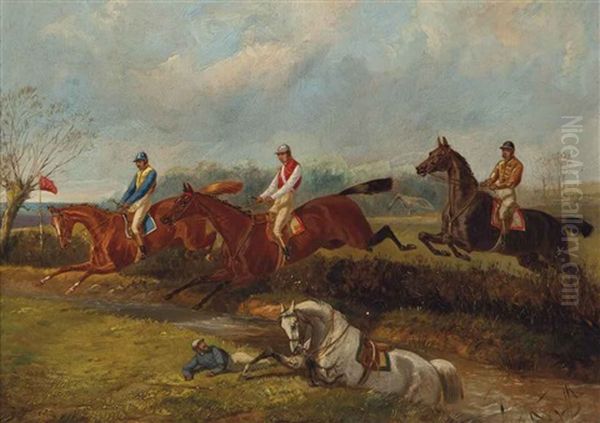
A significant portion of John Sturgess's fame and output was derived from his work as an illustrator, particularly for The Illustrated London News. Between 1875 and 1885, he was a prolific contributor to this highly popular pictorial newspaper. In an era before the widespread use of photography in print, illustrated journals were the primary means by which the public could visualize current events, social scenes, and sporting occasions. Sturgess's black and white illustrations were lauded for their clarity, dynamism, and ability to convey the excitement of the moment.
His work for publications like The Illustrated London News required not only artistic skill but also an ability to work to deadlines and translate complex scenes into legible and engaging images. These illustrations, often depicting thrilling steeplechases, bustling race meetings, or the pageantry of the hunt, were considered among the finest of their time. He also contributed illustrations to other periodicals and books, including the prestigious Badminton Library of Sports and Pastimes, a comprehensive series of books on sports and pastimes published in the late 19th century. His contributions here, such as "A View Holloa" and "Chased the Fox as Vigorously as He did," further cemented his reputation. This field also saw talents like Randolph Caldecott, known for his charming and humorous illustrations, and George du Maurier, whose work graced the pages of Punch.
Master of Equestrian Art: Style and Themes
John Sturgess was, above all, a painter of horses. His works, whether in oil or watercolour, or as lithographs, demonstrate a profound understanding of equine anatomy and locomotion. He possessed a keen ability to capture the subtle nuances of a horse's musculature, the strain of exertion, and the animal's individual character. Unlike some animal painters who might overly sentimentalize or anthropomorphize their subjects, Sturgess generally maintained a focus on the horse as a powerful, athletic creature, often making the human figures secondary, though integral, elements within the composition.
His style is characterized by energetic brushwork and a strong sense of narrative. He excelled in depicting horses in full flight – galloping across fields, leaping fences, or thundering down the racetrack. His hunting scenes are particularly noteworthy, capturing the thrill of the chase, the pack of hounds in cry, and the riders navigating challenging terrain. Coaching scenes were another specialty, evoking the romance and adventure of pre-railway travel, with teams of horses expertly handled by their drivers. His paintings often feature a meticulous attention to detail in terms of tack, attire, and the specific settings of the events.
Representative works that showcase his talent include "The Start, Punchestown," a Gouttelette print that captures the tense anticipation before a race. Another notable piece, "Over the Brook," demonstrates his skill in landscape as well as animal depiction, likely showing a hunting scene with riders and hounds navigating a water obstacle. These works highlight his ability to combine accurate portrayal with a sense of atmosphere and excitement.
Exhibitions and Recognition
Sturgess's talent did not go unnoticed by the established art institutions of his day. He exhibited his works at several prestigious venues, which was crucial for an artist's reputation and commercial success. In 1884, he made his debut at the Royal Society of British Artists (RBA) with a painting titled "A Lady to a Mile," which was well-received. The RBA, under the presidency of James McNeill Whistler for a period in the 1880s, was an important alternative exhibiting society to the Royal Academy.
He also exhibited at the Royal Academy of Arts in London, the pre-eminent art institution in Britain. To have work accepted and displayed at the Royal Academy's annual Summer Exhibition was a mark of significant achievement. While the provided information mentions the "Royal Art Society" and "Royal Animal Society," these are likely general references or slight misnomers for established bodies such as the Royal Academy, the RBA, or perhaps the Royal Institute of Painters in Water Colours (RI) or the Society of Equestrian Artists (though the SEA was founded later, in 1979). His works were also collected by institutions such as the "Garrard Metropolitan Borough Council" (possibly a reference to a local council collection or a specific gallery).
Artistic Circle and Contemporaries
While detailed records of Sturgess's day-to-day interactions with all his contemporaries are scarce, it is known that he moved within artistic circles. He reportedly first met the influential and often controversial American-born artist James McNeill Whistler around 1895. Whistler, known for his aestheticism and "art for art's sake" philosophy, was a towering figure in the London art world. Their shared acquaintances included the novelist Henry James and the American philanthropist George Washington Vanderbilt, indicating Sturgess had connections beyond purely sporting art circles. The Pennells (Joseph Pennell and Elizabeth Robins Pennell), close associates and biographers of Whistler, were also part of this wider network.
In the specific field of sporting art, Sturgess was working during a vibrant period. He followed in the tradition of earlier masters like George Stubbs (1724-1806), whose scientific approach to equine anatomy set a new standard, and Henry Alken (1785-1851), renowned for his lively hunting, coaching, and racing scenes. Contemporaries or near-contemporaries in British sporting and animal art included Sir Edwin Landseer (1802-1873), immensely popular for his depictions of animals, often with a sentimental or narrative leaning; Heywood Hardy (1842-1933), who painted elegant hunting and 18th-century genre scenes; and John Emms (1844-1912), particularly noted for his depictions of hounds. Later figures like Alfred Munnings (1878-1959) would carry the torch of British equestrian art into the 20th century, building on the foundations laid by artists like Sturgess. The Wright brothers of sporting art, George Wright (1860-1942) and Gilbert S. Wright (1880-1958), also produced popular coaching and hunting scenes.
The broader Victorian art world was diverse, ranging from the detailed realism and moral narratives of the Pre-Raphaelites like Dante Gabriel Rossetti and John Everett Millais, to the classical subjects of academic painters like Lord Frederic Leighton. Sturgess's work, with its focus on contemporary life and action, offered a distinct contrast yet catered to a significant and appreciative audience.
Specific Activity Areas and Later Life
John Sturgess's artistic activities were primarily centered in Britain. His upbringing in Leicestershire provided an early immersion in equestrian life. London was naturally a hub for his career, given its galleries, publishers, and exhibiting societies like the Royal Academy and the Parker Gallery, which is noted as having exhibited his work "Over the Brook."
An interesting mention is his potential involvement or observation at Larkhill, Salisbury Plain, in connection with the 1912 British Military Aeroplane Competition. If this date is accurate and refers to our John Sturgess, it would place him at the event after his commonly cited death year of 1903 or 1908. This could be a slight discrepancy in dates, or perhaps he had an interest that extended to new forms of transport and competition. However, given his primary focus and the more consistent biographical data, his main activities revolved around traditional equestrian sports.
John Sturgess spent his life dedicated to his art, primarily in London. He passed away in 1908 due to what was described as a "spasmodic disease" and was buried in Hampstead Cemetery.
Legacy and Influence
John Sturgess left a considerable body of work that continues to be appreciated by collectors and enthusiasts of sporting art. His paintings and illustrations serve as valuable historical documents, offering insights into the sporting traditions, attire, and social customs of Victorian and Edwardian England. His ability to capture the energy and spirit of equestrian events set a high standard for the genre.
His influence can be seen in the continued tradition of sporting art, where accuracy, dynamism, and an understanding of the animal subject remain paramount. While photography would eventually supplant illustration for reportage, the artistic interpretation of sporting scenes continued, and Sturgess's work provided a benchmark. Artists who followed in the field of equestrian and sporting illustration would have been aware of his significant contributions to publications like The Illustrated London News.
His dedication to portraying the horse with both accuracy and vitality ensured his place among the notable British sporting artists of his era. His works are a testament to a lifelong passion for the equestrian world, translated onto canvas and paper with skill and dedication, providing a lasting visual record of a quintessential aspect of British heritage. His art continues to evoke the thrill of the chase and the thud of hooves on turf, a vibrant echo from a bygone era.