José de Páez stands as one of the most prolific and significant painters of 18th-century New Spain, a period characterized by vibrant artistic production and complex cultural exchanges. Active primarily in Mexico City, Páez navigated the rich artistic currents of his time, blending European influences with a distinctly local sensibility. His vast output, predominantly religious in theme, graced countless churches, convents, and private chapels, shaping the devotional landscape of colonial Mexico and beyond. His work, often characterized by its delicate charm, soft color palettes, and emotive figures, offers a window into the spiritual and aesthetic values of a society on the cusp of profound change.
The Artistic Crucible of 18th-Century New Spain
The 18th century in New Spain, particularly in its bustling capital, Mexico City, was a period of immense artistic activity. The Catholic Church remained the principal patron of the arts, commissioning vast altarpieces, series of narrative paintings depicting the lives of saints, and individual devotional images. Wealthy Creole families also sought artworks for their private homes, reflecting both their piety and their social standing. This era witnessed the full flowering of the Mexican Baroque, which gradually gave way to the lighter, more graceful aesthetics of the Rococo, and eventually, the more austere principles of Neoclassicism by the century's end.
Painters' guilds, or gremios, still played a role in regulating the profession, though their influence was waning. Artists often ran large workshops, employing apprentices and assistants to meet the high demand for paintings. The exchange of ideas and styles was facilitated by the arrival of European artworks, particularly prints, which served as models and sources of inspiration. Masters like Bartolomé Esteban Murillo, with his tender depictions of the Virgin Mary and saints, exerted a profound and lasting influence on New Spanish painters. Similarly, the dramatic compositions of Peter Paul Rubens, often known through engravings, found echoes in local productions. The legacy of earlier New Spanish masters such as Cristóbal de Villalpando and Juan Correa also formed part of the artistic heritage upon which 18th-century painters built.
A Glimpse into the Life of José de Páez
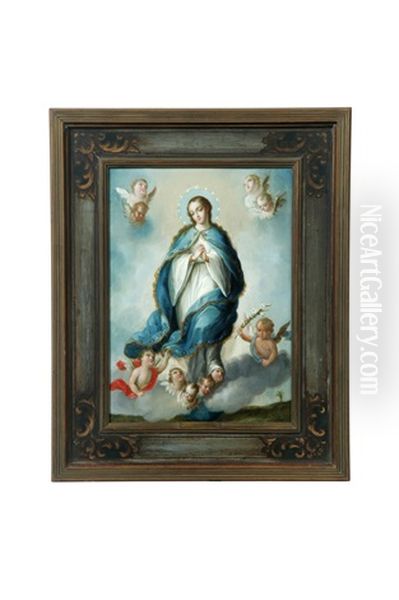
José de Páez was born in Mexico City around 1720, into a society where art was deeply interwoven with daily life and religious practice. While specific details about his early training remain somewhat obscure, it is widely believed that he was a follower, and possibly a student, of Miguel Cabrera (1695-1768), one of the most celebrated painters of New Spain. Cabrera's workshop was a dominant force in the mid-18th century, and his style, characterized by its sweetness, technical finesse, and adherence to established iconographies, undoubtedly left an imprint on Páez.
Páez's most active period as a painter spanned from approximately 1750 to 1780. During these decades, he produced an astonishing number of works, demonstrating remarkable industry and a consistent ability to satisfy his patrons. His paintings were not confined to Mexico City; they were exported to other regions of New Spain, including the northern frontier missions in what is now California, and even further afield. He passed away in Mexico City in 1818, having witnessed significant shifts in artistic tastes and the political landscape, including the early stirrings of the Mexican War of Independence.
The Signature Style: Devotion, Delicacy, and Drama
José de Páez developed a distinctive artistic style that, while rooted in the broader traditions of New Spanish painting, possessed its own unique characteristics. His work is often recognized for its gentle piety, its preference for soft, luminous colors, and its graceful, often idealized figures.
Thematic Focus and Narrative Clarity
The vast majority of Páez's oeuvre consists of religious subjects. He painted countless images of the Virgin Mary in her various advocations (Guadalupe, Immaculate Conception, Our Lady of Sorrows), scenes from the life of Christ, and portraits of saints. His narrative paintings, such as those depicting episodes from the lives of saints like Saint Francis of Assisi or Saint John of Nepomuk, are typically clear and legible, designed to instruct and inspire devotion in the faithful. He often followed established iconographic conventions, ensuring that his images were readily understandable to his contemporary audience.
A Palette of Light and Tenderness
One of the most appealing aspects of Páez's style is his use of color. He favored a palette of soft pastels – delicate blues, pale yellows, rosy pinks, and gentle lavenders – often accented with touches of gold. This color scheme contributes to the overall sense of sweetness and tenderness that pervades many of his works. He was skilled in creating a sense of luminosity, with figures often appearing bathed in a soft, divine light. His application of paint was typically smooth, with subtle gradations of tone that enhanced the three-dimensionality of his figures and the richness of their draperies. This careful handling of color and light imbued his paintings with an ethereal quality, well-suited to their sacred subjects.
Compositional Grace and Idealized Forms
Páez's compositions are generally well-balanced and harmonious. He often arranged his figures in graceful, flowing lines, characteristic of the Rococo aesthetic. His figures, particularly female saints and the Virgin Mary, tend to be idealized, with sweet, delicate facial features and elegant postures. There is a certain gentleness and approachability to his sacred personages that would have resonated deeply with the devotional sensibilities of his time. While not always anatomically rigorous in the academic sense, his figures possess an undeniable charm and emotional appeal. He paid considerable attention to the rendering of fabrics, depicting silks, velvets, and brocades with a sensitivity to texture and sheen.
Rococo Sensibilities in a New World Context
The influence of the European Rococo style is palpable in Páez's work. This style, which originated in France with artists like Jean-Antoine Watteau and François Boucher, emphasized elegance, asymmetry, curvilinear forms, and a lighthearted or sentimental mood. In Páez's hands, these Rococo elements were adapted to the religious context of New Spain. The S-curves in his figural arrangements, the delicate ornamentation, and the overall sense of grace and charm in his paintings reflect this influence. He also, at times, incorporated elements that suggest an awareness of Chinoiserie, the European fascination with Chinese artistic motifs, which could be seen in details like the patterns on fabrics or decorative elements, possibly influenced by imported Chinese porcelains that were highly valued in New Spain.
Subtle Neoclassical Undercurrents
While predominantly a Rococo artist, some of Páez's later works may show subtle hints of the emerging Neoclassical style, which began to gain traction in Mexico City with the founding of the Royal Academy of San Carlos in 1781 (officially opened in 1783). This style, championed by European artists like Anton Raphael Mengs, emphasized clarity, order, and a return to classical forms. Any Neoclassical influence in Páez's work would likely be seen in a slightly more restrained emotionalism or a greater emphasis on linear definition in some figures, though he never fully abandoned his Rococo inclinations.
Masterpieces of Devotion: Key Works by José de Páez
Given his prolific output, selecting a few representative works can only hint at the breadth of José de Páez's achievements. However, certain paintings stand out for their artistic quality, historical significance, or typicality of his style.
The Adoration of the Kings
This popular biblical theme was one that Páez painted on multiple occasions. His renditions typically feature a rich, warm palette, with the Magi adorned in sumptuous, exotic garments. The Virgin Mary is depicted with her characteristic sweetness, and the infant Christ is the focal point of divine light and adoration. Páez excelled at creating a sense of reverence and wonder in such scenes, often employing a sophisticated layering of colors, such as yellows and golds, to convey a sense of luxury and sacred importance. The composition is usually dynamic, guiding the viewer's eye towards the central figures.
The Sleeping Virgin (La Dormición de la Virgen)
This subject, depicting the Virgin Mary on her deathbed surrounded by apostles, was a common theme in Catholic art. Páez's interpretations are often imbued with a quiet pathos and profound devotion. He would typically portray the Virgin with a serene expression, her hands clasped in prayer, while the apostles exhibit varying degrees of grief and reverence. The use of soft lighting and tender expressions enhances the emotional impact of the scene, inviting contemplation on the Virgin's peaceful passage.
San Juan Nepomuceno (Saint John of Nepomuk)
Saint John of Nepomuk, a 14th-century Bohemian martyr who refused to divulge the secrets of the queen's confession, became a popular saint in New Spain, particularly associated with the Jesuit order and the sacrament of confession. Páez painted numerous images of this saint, often depicting him in priestly vestments, holding a crucifix and a palm frond (symbol of martyrdom), with a finger to his lips symbolizing silence. One notable example is housed in the Los Angeles County Museum of Art (LACMA). These paintings underscore Páez's ability to convey specific iconographic attributes clearly and devotionally.
Life of San Francisco Solano (Vida de San Francisco Solano)
Series depicting the lives of saints were important commissions, often intended for monasteries or churches dedicated to a particular saint. Páez is known to have painted a series on the life of Saint Francis Solano, a Franciscan missionary known for his work in South America. Such narrative cycles allowed the artist to showcase his storytelling abilities, depicting various miracles and significant events from the saint's life. These works would have served as visual catechisms, instructing the faithful and promoting the cult of the saint.
The Glory of Heaven (La Gloria del Cielo)
This monumental work, painted between 1771 and 1772, was specifically commissioned for the California missions, intended to instruct indigenous converts about Catholic teachings on the afterlife. It was installed in the San Carlos Borromeo de Carmelo Mission in 1774. The painting vividly contrasts the horrors of hell with the sublime joys of heaven, serving as a powerful didactic tool. Such a commission highlights the reach of Páez's reputation and the role of art in the evangelization efforts on the frontiers of New Spain.
Paintings for the California Missions
Beyond The Glory of Heaven, Páez produced other significant works for the burgeoning Franciscan missions in Alta California. These include a depiction of San Antonio de Padua (c. 1771-1773), now in the Archdiocese of Monterey, and a painting of San Juan Capistrano (c. 1775) for the mission of the same name. The presence of his works in these remote outposts attests to his workshop's capacity and the demand for his art across vast distances. These paintings were crucial in establishing a visual religious culture in the newly founded missions.
Another theme that Páez treated with his characteristic grace was the Assumption or Ascension of the Virgin. These compositions typically show the Virgin Mary being carried aloft by angels, surrounded by celestial light. Páez's skill in rendering ethereal figures and creating a sense of upward movement would have been particularly effective in these depictions of heavenly glory.
Páez in the Context of His Contemporaries
José de Páez did not work in an artistic vacuum. He was part of a vibrant community of painters in Mexico City, each contributing to the rich tapestry of New Spanish art.
The Shadow of Miguel Cabrera
As mentioned, Miguel Cabrera was the dominant figure in Mexican painting for much of the mid-18th century. His influence on Páez is undeniable, particularly in the sweetness of expression, the idealized figural types, and certain compositional formulas. Many artists of Páez's generation, including Francisco Antonio Vallejo and Andrés López, also operated within Cabrera's stylistic orbit to varying degrees. While Páez was a follower, he developed his own nuances, often favoring a slightly softer, more overtly Rococo sensibility than Cabrera, whose work retained a stronger Baroque foundation.
Other Notable Contemporaries
The artistic scene in Mexico City during Páez's active years included other talented painters. José de Ibarra (1685-1756), Cabrera's own master, was a leading figure in the first half of the century, known for his more robust Baroque style. Juan Patricio Morlete Ruiz (1713-1772) was another contemporary known for his meticulous technique and varied subject matter, including landscapes and casta paintings. Nicolás Enríquez (active c. 1720-1770) also produced a significant body of religious work. These artists, along with Páez, catered to the diverse demands of patrons, from grand altarpieces to smaller devotional panels. The interplay of influences and individual styles among these painters created a dynamic artistic environment.
The Role of Guilds and Workshops
Like his contemporaries, Páez likely ran a substantial workshop to manage his numerous commissions. Apprentices would learn the craft by grinding pigments, preparing canvases, and painting backgrounds or less critical parts of compositions under the master's supervision. This workshop system allowed for a high volume of production. While the painters' guilds still existed, their strict control over artistic practice was diminishing, allowing for greater individual expression and stylistic variation, though adherence to iconographic propriety remained paramount, especially in religious art.
The Impact of the Royal Academy of San Carlos
The establishment of the Royal Academy of San Carlos in the 1780s marked a significant turning point in Mexican art. Founded with the aim of promoting Neoclassicism and reforming artistic training along European academic lines, it brought Spanish artists like Jerónimo Antonio Gil (its first director) and later Rafael Ximeno y Planes and Manuel Tolsá to Mexico. While Páez was already an established master by this time and likely did not receive formal training at the Academy, its presence would have begun to shift artistic tastes and expectations. The Academy emphasized drawing from classical sculpture and live models, a different approach from the traditional workshop apprenticeship. Younger artists, such as José María Vázquez, would be more directly shaped by the Academy's teachings. Páez's art, therefore, represents the culmination of the pre-Academic, workshop-based tradition of New Spanish painting.
European Echoes: Influences from Across the Atlantic
The art of New Spain was deeply connected to European artistic traditions, primarily Spanish, but also Flemish and Italian, often transmitted through prints. Páez's work clearly reflects these transatlantic dialogues.
The Enduring Legacy of Spanish Masters
The influence of Spanish Golden Age painters, particularly Bartolomé Esteban Murillo, was pervasive in New Spain. Murillo's tender Madonnas, his sentimental depictions of saints, and his soft, atmospheric style found a ready audience and many imitators. Páez's sweet facial types, his use of soft light, and the gentle piety of his figures owe a considerable debt to Murillo. The dramatic intensity of Francisco de Zurbarán, known for his powerful depictions of monks and martyrs, also resonated, though Páez's temperament leaned more towards Murillo's gentleness.
Flemish and Italian Prints as Visual Currency
Engravings after works by major European artists, especially from Flanders (e.g., Peter Paul Rubens, Anthony van Dyck) and Italy (e.g., Raphael, Titian), circulated widely in the Spanish colonies. These prints served as invaluable sources for compositions, figural poses, and iconographic details. Artists like Páez would have had access to such prints, adapting and transforming these European models to suit local tastes and devotional needs. This practice was not seen as mere copying but as a creative engagement with esteemed artistic traditions.
The Rococo Wave from France
As discussed, the French Rococo style, with its emphasis on elegance, grace, and decorative charm, found its way into Páez's art. This influence likely arrived through various channels: imported luxury goods, prints after French Rococo painters like Watteau, Boucher, and Jean-Honoré Fragonard, and perhaps even through Spanish artists who had absorbed Rococo tendencies. Páez's adoption of Rococo elements demonstrates the interconnectedness of the art world in the 18th century and his ability to synthesize international trends with local traditions.
Patronage, Piety, and Proliferation
The sheer volume of José de Páez's output speaks to a consistent and widespread demand for his work. His patrons were diverse, reflecting the various sectors of colonial society that commissioned art.
The Church as Primary Patron
The Catholic Church, in its myriad forms – cathedrals, parish churches, monastic orders (Franciscans, Dominicans, Jesuits, Augustinians, etc.), and convents – was the most significant patron. Páez produced large-scale altarpieces, series of paintings for cloisters and sacristies, and individual canvases for chapels. These works served liturgical, didactic, and devotional purposes, adorning sacred spaces and instructing the faithful. His ability to work efficiently and deliver paintings that met the Church's iconographic and aesthetic requirements made him a sought-after artist.
Private Devotion and Creole Elite
Wealthy Creole families also commissioned paintings from Páez for their private chapels and homes. Devotional images of favorite saints, scenes from the life of Christ, and portraits of the Virgin Mary were common in domestic settings. These artworks not only expressed the piety of their owners but also served as markers of social status and cultural refinement. The more intimate scale and often tender sentiment of Páez's work would have been well-suited for such private devotional contexts.
Export and Frontier Missions
The fact that Páez's paintings were found in the California missions and other parts of New Spain indicates a well-organized system of production and distribution. His workshop was clearly capable of handling large orders and shipping them over considerable distances. For the frontier missions, these paintings were essential tools for evangelization, providing visual narratives of the Catholic faith to indigenous populations.
Critical Reception: Then and Now
José de Páez enjoyed considerable popularity during his lifetime, as evidenced by his prolific output and the wide dissemination of his works. However, like many artists whose styles fall out of fashion, his critical fortunes have varied over time.
Contemporary Acclaim and Prolificacy
In his own era, Páez was undoubtedly a successful and respected painter. His ability to consistently produce appealing and devotionally effective images ensured a steady stream of commissions. He was a master of the prevailing Rococo-inflected style, which resonated with the tastes of his 18th-century audience.
Nineteenth and Early Twentieth-Century Criticisms
With the rise of Neoclassicism and the establishment of the Academy, tastes began to shift. Later critics, particularly in the 19th and early 20th centuries, sometimes viewed the art of the late colonial period, including Páez's, with a degree of condescension. Figures like Manuel Romero de Terreros, an influential historian of colonial art, while acknowledging Páez's productivity, criticized his work for what he perceived as excessive imitation of European models, a lack of profound originality, and a color palette that, though soft, could seem unnatural or overly sweet. Bernardo de Couto, another 19th-century commentator, also pointed to perceived weaknesses in drawing and composition in the works of some late colonial painters. Such criticisms often reflected the aesthetic biases of their own times, which valued academic rigor and nationalistic expression differently.
Modern Re-evaluation and Appreciation
More recent art historical scholarship has taken a more nuanced and appreciative view of José de Páez and his contemporaries. Scholars now recognize the importance of his work within its specific historical and cultural context. His paintings are valued for what they reveal about the religious beliefs, aesthetic preferences, and artistic practices of 18th-century New Spain. There is a greater appreciation for the technical skill involved in his smooth brushwork, his delicate color harmonies, and his ability to convey genuine emotion and piety. His role in shaping the visual culture of a vast territory is now better understood. Art historians like Marcus Burke and Rogelio Ruiz Gomar have contributed significantly to a deeper understanding of this period.
His works are now seen not as mere imitations of European art but as creative adaptations that reflect a unique New Spanish sensibility. The blend of European Rococo elegance with a local devotional intensity is recognized as a distinctive achievement. Exhibitions and scholarly publications have helped to bring his art to a wider audience and to secure his place as a key figure in the history of Mexican art.
The Enduring Legacy of a Devotional Painter
José de Páez's legacy is multifaceted. He was, above all, a master of devotional painting, whose works inspired piety and adorned sacred spaces for generations. His prolific output ensured that his artistic vision reached a wide audience, contributing significantly to the visual landscape of late colonial Mexico.
His art represents a high point of the Rococo style in New Spain, adapted and infused with a local spirit. He successfully navigated the demands of his patrons, producing works that were both aesthetically pleasing and doctrinally sound. While perhaps not an innovator on the scale of some European masters, he was a highly skilled and sensitive painter who excelled within the established conventions of his time.
Today, the paintings of José de Páez are found in major museum collections, including the Museo Nacional de Arte (MUNAL) in Mexico City, the Denver Art Museum, and LACMA, as well as in numerous churches and private collections. They continue to be studied for their artistic merit, their historical significance, and the insights they offer into the rich cultural heritage of Mexico. His delicate figures, luminous colors, and gentle piety ensure that his art continues to resonate with viewers, offering a glimpse into the soul of 18th-century New Spain. He remains a testament to the vibrancy and unique character of art produced in the Americas during the colonial period, a painter whose brush brought forth images of tender devotion and ethereal beauty.