José Moreno Carbonero: A Luminary of Spanish Historical and Genre Painting
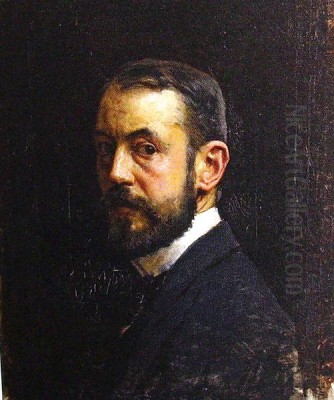
José Moreno Carbonero stands as a significant figure in the annals of Spanish art, a painter whose canvases brought to life the grandeur of history, the charm of genre scenes, and the character of his sitters. Active during the late nineteenth and early twentieth centuries, a period of transition and dynamism in European art, Moreno Carbonero carved a distinct niche for himself, primarily as a history painter, but also as a skilled portraitist and landscape artist. His meticulous attention to detail, dramatic compositions, and vibrant palette earned him acclaim in his lifetime and a lasting place in the story of Spanish art.
Early Life and Artistic Genesis in Málaga
Born in Málaga, Spain, with records variously citing 1858 or 1860 (though 1858 is more commonly accepted by institutions like the Prado Museum), José Moreno Carbonero's artistic journey began in a city with a burgeoning artistic environment. He died in Madrid in 1942. His prodigious talent was evident from a young age, leading him to the Escuela de Bellas Artes de Málaga (Málaga School of Fine Arts). This institution was a crucible for artistic talent in Andalusia, and it was here that Moreno Carbonero received his foundational training.
A pivotal figure in his early development was Bernardo Ferrándiz Bádenes (1835-1885), a prominent painter and one of the founders of the Málaga School. Ferrándiz, known for his historical and genre paintings, instilled in his students a respect for academic principles, including strong draughtsmanship and compositional clarity. Under Ferrándiz's tutelage, Moreno Carbonero honed his skills, absorbing the prevailing artistic currents that emphasized realism and historical accuracy. The Málaga School itself, while rooted in academic tradition, also encouraged an engagement with local themes and Costumbrista elements, depicting everyday life and customs, a strand that would subtly weave through some of Moreno Carbonero's later work.
Parisian Sojourn: Broadening Horizons
Recognizing his exceptional promise, Moreno Carbonero was awarded a scholarship by the Málaga Provincial Council in 1875, enabling him to travel to Paris, then the undisputed capital of the art world. This move was transformative. In Paris, he enrolled in the prestigious studio of Jean-Léon Gérôme (1824-1904), one of the most celebrated academic painters of the era. Gérôme was renowned for his highly finished historical scenes, Orientalist subjects, and meticulous attention to archaeological and historical detail.
Studying under Gérôme provided Moreno Carbonero with rigorous training in the academic style, emphasizing anatomical precision, polished surfaces, and the dramatic staging of historical narratives. Gérôme's influence can be seen in Moreno Carbonero's later historical works, particularly in their elaborate compositions and the careful rendering of costumes and settings. Beyond Gérôme's studio, the vibrant Parisian art scene exposed Moreno Carbonero to a wider range of artistic influences, though he remained largely committed to the academic tradition. During this period, he also established a crucial connection with Adolphe Goupil, a leading art dealer whose firm, Goupil & Cie, played a significant role in promoting academic and Salon artists internationally. This association helped to bring Moreno Carbonero's work to a broader audience.
Roman Interlude and Artistic Maturation
Following his formative years in Paris, Moreno Carbonero spent time in Rome, another essential destination for aspiring artists seeking to immerse themselves in classical antiquity and the legacy of the Renaissance masters. Rome offered a different kind of artistic nourishment, a direct encounter with the masterpieces that had shaped Western art. This period allowed him to further refine his technique and deepen his understanding of historical painting.
In Rome, he achieved academic status, a testament to his growing reputation. The city's rich historical tapestry and its community of international artists provided a stimulating environment for his development. It was during these years of study and travel in Paris and Rome that Moreno Carbonero consolidated his artistic vision, blending the rigorous academicism of Gérôme with a distinctly Spanish sensibility and a flair for dramatic storytelling. He also began to develop a reputation for his skill in capturing light and shadow, a quality that some critics linked to the influence of an earlier Spanish master, Mariano Fortuny Marsal (1838-1874), whose brilliant technique and luminous canvases were highly admired.
Return to Spain: A Celebrated Master
Upon his return to Spain, Moreno Carbonero settled in Madrid, the nation's capital and artistic center. By this time, his reputation was firmly established, and he quickly rose to prominence as one of Spain's leading history painters. His works were exhibited regularly and received critical acclaim. His mastery of historical subjects, combined with his technical virtuosity, made him a sought-after artist.
A significant milestone in his career was his appointment as a professor at the prestigious Real Academia de Bellas Artes de San Fernando in Madrid. This position allowed him to influence a new generation of Spanish artists, passing on the academic traditions he had mastered. He became a respected figure in the Madrid art world, known for his dedication to his craft and his contributions to the cultural life of the city. His studio became a hub of artistic activity, and he received numerous commissions, including portraits of the Spanish King and members of the aristocracy, further cementing his status.
Artistic Style: Realism, Historicism, and Romantic Flair
José Moreno Carbonero's artistic style is characterized by a compelling fusion of Realism, Historicism, and a subtle Romantic sensibility. His commitment to Realism was evident in the meticulous accuracy with which he rendered figures, costumes, and architectural settings. He undertook extensive research to ensure the historical veracity of his scenes, a hallmark of the academic tradition championed by Gérôme. This dedication to detail lent an air of authenticity and immediacy to his historical narratives.
Historicism, the artistic movement that drew inspiration from historical styles and subjects, was central to his oeuvre. Moreno Carbonero excelled at reconstructing past eras, from ancient Rome to medieval Spain and the Age of Discovery. He possessed a remarkable ability to populate his canvases with convincing historical figures, capturing their emotions and motivations within grand, often complex, compositions. His paintings were not merely illustrative; they aimed to evoke the spirit and drama of the historical moments they depicted.
While grounded in academic Realism, his work often displayed a Romantic flair, particularly in his dynamic compositions, dramatic use of light and shadow (chiaroscuro), and the emotional intensity of his figures. He was adept at creating a sense of spectacle and movement, drawing the viewer into the heart of the action. His palette was rich and varied, capable of conveying both the somber tones of a dramatic interior and the bright light of an outdoor scene. Early in his career, elements of Costumbrismo, depicting scenes of everyday Spanish life and customs, were present, but his focus increasingly shifted towards grand historical narratives and portraiture.
Masterpieces and Notable Works
Moreno Carbonero's oeuvre is rich with significant paintings that showcase his diverse talents. Among his most celebrated works is "La Fundación de Buenos Aires" (The Foundation of Buenos Aires). Painted around 1910 (though some sources suggest it was completed for the 1910 centenary and worked on between 1909-1924), this monumental canvas depicts the second, and permanent, founding of the city by Juan de Garay in 1580. The painting is a tour-de-force of historical reconstruction, featuring a multitude of figures, from Spanish conquistadors and officials to indigenous people, all rendered with meticulous attention to historical detail. The composition is dynamic, leading the eye towards the central act of foundation, and the landscape captures the vastness of the New World. This work is a prime example of his ability to manage large-scale compositions and imbue them with historical significance and dramatic power. It is housed in the Buenos Aires City Legislature's Salón Dorado.
Another significant aspect of his work was his engagement with Spanish literature, most notably through his illustrations for "Don Quijote de la Mancha." Moreno Carbonero created numerous paintings and drawings depicting scenes from Cervantes' masterpiece. These works demonstrate his deep understanding of the novel's characters and themes, capturing the humor, pathos, and idealism of Don Quixote and Sancho Panza. His Quixote illustrations are celebrated for their vivid characterizations and their faithful evocation of seventeenth-century Spain. He also created illustrations for "The Story of Rodrigo de Flor."
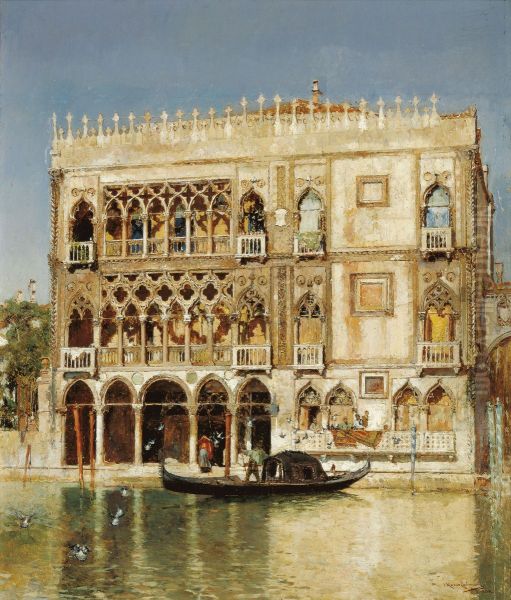
His talent as a landscape painter is evident in works like "Ca d'Oro," a depiction of the famous Venetian palace. This painting showcases his skill in capturing architectural detail and the interplay of light and water, evoking the unique atmosphere of Venice. While perhaps less known than his historical scenes, his landscapes reveal a sensitive eye for nature and the built environment. Other notable genre and historical paintings include "El jaleo" and "Un huerto de Murcia," which reflect his earlier engagement with Costumbrista themes and his ability to capture the essence of Spanish regional life. His portraiture, often commissioned by prominent figures, was characterized by its psychological insight and technical polish, reflecting the dignity and status of his sitters.
The Educator: Shaping Future Generations
Moreno Carbonero's influence extended beyond his own artistic production through his long tenure as a professor at the Real Academia de Bellas Artes de San Fernando. He was a respected and influential teacher, and his studio attracted many aspiring artists. While he himself was a staunch advocate of academic principles, his students would go on to explore vastly different artistic paths, a testament perhaps to the fundamental skills they acquired under his guidance, or simply the changing tides of art.
Among his most famous pupils were three towering figures of twentieth-century art: Pablo Picasso (1881-1973), Salvador Dalí (1904-1989), and Juan Gris (José Victoriano González-Pérez, 1887-1927). While all three would ultimately break radically with academic tradition to become pioneers of Cubism (Picasso and Gris) and Surrealism (Dalí), their early training involved exposure to academic methods. Picasso, who also hailed from Málaga, encountered Moreno Carbonero's influence early on, though his time at the San Fernando Academy was brief and reportedly frustrating for the young iconoclast. Dalí, too, studied at the Academy in the 1920s, where Moreno Carbonero was still a prominent figure. Juan Gris studied more directly with Moreno Carbonero around 1904-1905 before moving to Paris and embracing Cubism.
The fact that such revolutionary artists passed through the orbit of an academic painter like Moreno Carbonero highlights the complex interplay of tradition and innovation in artistic development. While they diverged dramatically from his style, their foundational training would have included the rigorous drawing and compositional skills emphasized by the academic system he represented.
Interactions with Contemporaries and the Spanish Art Scene
José Moreno Carbonero was an active participant in the Spanish art scene of his time. His studies with Jean-Léon Gérôme in Paris connected him to the international academic network. In Spain, he was a contemporary of other notable artists. While he primarily represented the academic tradition of history painting, the late nineteenth and early twentieth centuries in Spain also saw the rise of artists like Joaquín Sorolla (1863-1923), whose luminous, impressionist-influenced depictions of Spanish life offered a vibrant contrast. Another significant history painter of the era was Francisco Pradilla Ortiz (1848-1921), known for works like "Joanna the Mad."
Moreno Carbonero's interactions with fellow artists included figures like Rafael Murillo Carreras (1860-1942), with whom he reportedly shared an interest in certain themes, such as depictions of Málaga's urban development, like the Reding Fountain. He also had a collegial relationship with Ignacio Pinazo Camarlench (1849-1916), another Valencian painter known for his looser, more impressionistic style. It is recorded that Moreno Carbonero once recommended Pinazo for an honorary award, indicating mutual respect within the artistic community despite stylistic differences.
His position at the Academy and his regular participation in national exhibitions placed him at the center of artistic discourse in Madrid. He navigated a period where traditional academic art coexisted, sometimes uneasily, with emerging modernist tendencies. While artists like Santiago Rusiñol (1861-1931) and Ramón Casas (1866-1932) were exploring Modernisme in Catalonia, and younger artists were beginning to look towards Parisian avant-garde movements, Moreno Carbonero remained a steadfast proponent of historical and academic painting, a style that continued to enjoy official patronage and public appreciation. His work can be seen as a continuation of the grand tradition of Spanish painting, echoing, in its ambition and narrative power, earlier masters like Diego Velázquez (1599-1660) and Francisco Goya (1746-1828), albeit through the lens of nineteenth-century academicism. Even the spiritual intensity found in the works of El Greco (1541-1614) finds a distant echo in the dramatic fervor of some historical scenes.
Later Years and Enduring Legacy
José Moreno Carbonero continued to paint and teach into his later years, remaining a respected, if increasingly traditional, figure in a rapidly changing art world. He received numerous accolades throughout his career, including an honorary mention at an exhibition in 1895. His works were acquired by major collections, including the Prado Museum in Madrid and various institutions in Spain and abroad, particularly in Argentina due to the significance of "The Foundation of Buenos Aires."
His legacy is multifaceted. As one of the last great exponents of nineteenth-century history painting in Spain, he represents the culmination of a genre that sought to narrate national and universal history with grandeur and verisimilitude. His dedication to historical accuracy, his compositional skill, and his technical mastery set a high standard for academic painting. His depictions of "Don Quijote" have become iconic, shaping popular visual interpretations of Cervantes' characters.
While the avant-garde movements of the twentieth century would eventually overshadow academic art, Moreno Carbonero's contributions remain significant. His role as an educator, even for students who would later rebel against his teachings, underscores his impact on the development of Spanish art. His paintings continue to be studied for their historical content, their artistic merit, and as exemplars of a particular moment in art history. They offer a window into the cultural values and artistic tastes of late nineteenth and early twentieth-century Spain, a period that valued narrative clarity, technical skill, and the depiction of significant historical and literary themes.
Conclusion: A Master of Narrative and Detail
José Moreno Carbonero was an artist of considerable talent and dedication, a master of the grand historical narrative and the meticulously rendered detail. From his early training in Málaga to his influential professorship in Madrid, he remained committed to the principles of academic art, creating a body of work that celebrated Spanish history, literature, and culture. His paintings, whether monumental historical canvases, intimate genre scenes, or insightful portraits, are characterized by their technical brilliance, dramatic intensity, and profound respect for the subjects they depict. While artistic fashions have evolved, the power and artistry of Moreno Carbonero's work ensure his enduring importance in the rich tapestry of Spanish art history. He stands as a vital link in the chain of Spanish painters, a guardian of tradition who also, through his teaching, inadvertently played a role in the education of those who would redefine art in the century to come.