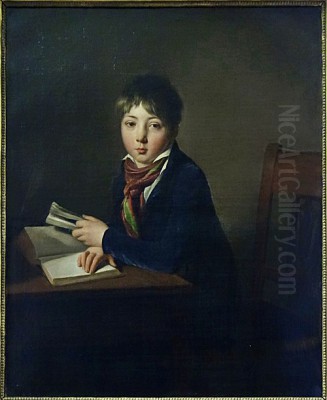
Louis-Léopold Boilly stands as a remarkable figure in French art, a painter and printmaker whose career astutely navigated the turbulent decades from the Ancien Régime, through the French Revolution and the Napoleonic Empire, into the Bourbon Restoration and the July Monarchy. Born in 1761 and passing in 1845, Boilly was a prolific and versatile artist, celebrated for his meticulously detailed genre scenes depicting the everyday life of the Parisian middle class, his insightful portraits, and his pioneering work in lithography and trompe-l'oeil. His vast oeuvre serves as a vivid chronicle of French society, capturing its customs, fashions, and transformations with wit, precision, and an unerring eye for human character.
The Budding Artist: Early Life and Formation
Julien Léopold Boilly, who would become known as Louis-Léopold Boilly, was born on July 9, 1761, in La Bassée, a small town in northern France, near Lille. His father was a local wood sculptor, providing an early exposure to artistic craftsmanship, though not directly to painting. Boilly displayed a precocious talent for art, largely self-taught from a young age. It is said he began painting around the tender age of twelve or thirteen.
His formal artistic education was minimal but formative. In 1774, at about thirteen, he was sent to Douai to study with Dominique Doncre, a painter of religious scenes and portraits. This apprenticeship, though perhaps not extensive, would have grounded him in the technical fundamentals of painting. He also spent time in Arras, further honing his skills before making the pivotal decision to move to the artistic epicenter of France.
Parisian Aspirations: Establishing a Career
In 1785, at the age of twenty-four, Boilly relocated to Paris. This move was crucial for any artist with ambitions, as Paris was the undisputed center of the European art world, home to the Royal Academy of Painting and Sculpture, influential patrons, and a discerning public. Boilly quickly set about establishing himself, initially focusing on small, polished genre scenes and portraits that appealed to the tastes of the burgeoning middle class.
His early Parisian works often featured amorous encounters, moralizing narratives, or intimate domestic scenes, executed with a smooth finish and careful attention to detail reminiscent of 17th-century Dutch masters like Gabriël Metsu or Gerard ter Borch. These cabinet-sized pictures found a ready market among private collectors who appreciated their charm, technical skill, and relatable subject matter. He began exhibiting at the Parisian Salons, the official art exhibitions, which were vital for an artist's reputation and commercial success.
Navigating the Revolution's Turmoil
The outbreak of the French Revolution in 1789 profoundly reshaped French society and, consequently, the art world. The old systems of patronage tied to the monarchy and aristocracy were disrupted, and new themes reflecting republican ideals and contemporary events came to the fore. Boilly, like many artists, had to adapt to this new, often dangerous, political climate.
A notable anecdote from this period highlights Boilly's resourcefulness. During the Reign of Terror, he was denounced to the Committee of Public Safety, likely by a rival artist, for painting works considered to have "an obscenity of subject revolting to republican morals." The accusation was serious and could have led to imprisonment or even execution. Showing considerable presence of mind, Boilly is said to have defended himself by quickly painting The Triumph of Marat (1794). This work depicted the then-martyred revolutionary hero Jean-Paul Marat being carried in triumph, a subject highly palatable to the revolutionary authorities. This timely display of patriotic fervor reportedly saved him, restoring his reputation and allowing him to continue his work. This painting, now in the Musée des Beaux-Arts de Lille, is a testament to his ability to navigate perilous times.
Chronicler of the People: The Genre Scenes
Boilly's most enduring fame rests on his genre paintings, which offer an unparalleled visual record of Parisian life across several decades. He possessed an acute observational skill, capturing the nuances of social interaction, fashion, and public and private spaces with remarkable vivacity. His canvases teem with life, depicting Parisians in their homes, at the theater, in cafes, strolling in parks, or engaging in street entertainments.
His street scenes are particularly noteworthy. Works like The Arrival of the Diligence in the Cour des Messageries (c. 1803, Louvre) are bustling compositions filled with diverse characters from various social strata, each meticulously rendered. He captured the crowds at the entrance to the Théâtre de l'Ambigu-Comique for a free performance in L’Entrée au Théâtre Ambigu-Comique pour une Free Performance (1819), showcasing the popular appeal of theater. Les Conscrits de 1807 Parading past the Saint Denis Gate (1807) documents a specific historical moment, while Les Politiciens aux Jardin de Tuileries offers a satirical glimpse into political discussions in public spaces.
Boilly's genre scenes often contain a subtle humor or gentle satire. He observed human foibles and social customs with an amused detachment, never overtly moralizing but allowing the scenes to speak for themselves. His paintings like Les Déménagements (Moving Day, 1822) capture the chaos and comedy of everyday urban life. He was also interested in the dissemination of news, as seen in Le Liseur de l’Announcement of the Grande-Bank (The Reader of the Announcement).
The Intimate Gaze: Boilly's Portraiture
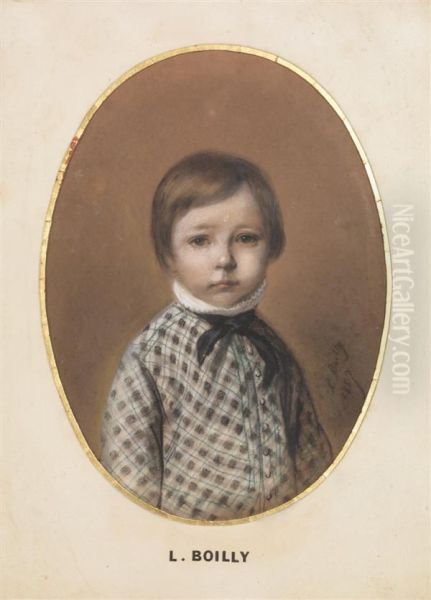
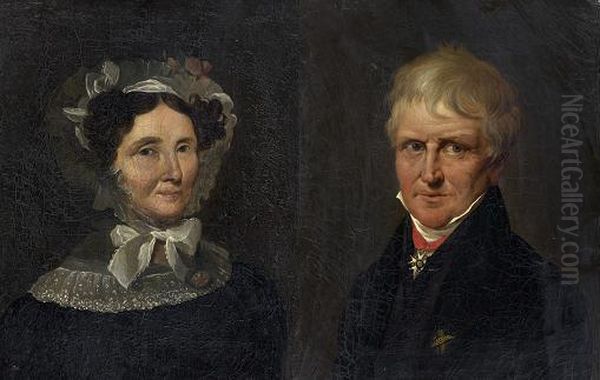
Alongside his genre scenes, Boilly was a highly sought-after portraitist. He is reputed to have painted around 5,000 portraits, an astonishing number that speaks to his efficiency and popularity. Many of these were small-scale, affordable likenesses, often executed with remarkable speed – sometimes in as little as two hours. This made portraiture accessible to a wider segment of the population beyond the wealthy elite.
His portraits are characterized by their directness, psychological acuity, and smooth, enamel-like finish. He captured not just the physical likeness of his sitters but also a sense of their personality. Examples include the sensitive Portrait d’enfant (Portrait of a Child) and numerous depictions of bourgeois men and women, such as Madame Saint-Ange Chevrier. He painted individuals like Joseph Red and Gabriel Arno, contributing to a broad visual archive of the faces of his time. His Portrait de femme (Portrait of a Woman) and Portrait d’une Jeune Fille (Portrait of a Young Girl) showcase his ability to render both youthful innocence and mature character.
Boilly's approach to portraiture was innovative. He often used a limited palette and focused on the play of light and shadow to model faces, giving them a distinct three-dimensionality. His ability to work quickly without sacrificing quality was a significant factor in his commercial success as a portrait painter.
Master of Illusion: Trompe-l'oeil
Boilly was a celebrated master of trompe-l'oeil (French for "deceive the eye") painting. This genre aims to create optical illusions, making painted objects appear as if they are real and three-dimensional, often seeming to exist beyond the picture plane. While trompe-l'oeil had a long history, Boilly revitalized it and brought it to a new level of popularity in the early 19th century.
His trompe-l'oeil works, often depicting arrangements of everyday objects like letters, prints, coins, or artists' tools seemingly tacked to a wooden board, were exhibited at the Salons to great acclaim. One such work, exhibited at the Salon of 1800, reportedly caused a sensation, with viewers marveling at the deceptive realism. These paintings were not just technical exercises; they were witty and engaging, playing with the viewer's perception and the nature of representation itself. This skill in creating illusionistic effects also informed the meticulous realism of his genre scenes and portraits.
A fascinating aspect of Boilly's work is his tendency to include himself in his crowd scenes, often as a subtle observer. This self-referential practice, somewhat akin to Alfred Hitchcock's later cinematic cameos, adds another layer of playful engagement with the viewer and underscores his role as the orchestrator of these painted worlds.
Pioneering Prints: The Rise of Lithography
Boilly was also an early adopter and prolific practitioner of lithography, a printmaking technique invented in the late 1790s by Alois Senefelder. He recognized the potential of this new medium for creating affordable, mass-produced images. He produced his first lithograph in 1823 and went on to create numerous series of prints.
One of his most famous lithographic series was the Recueil de grimaces (Collection of Grimaces), published between 1823 and 1828. This series consisted of nearly a hundred small, expressive head studies depicting a wide range of human emotions and caricatured facial expressions. These prints were immensely popular, showcasing Boilly's keen observation of physiognomy and his satirical wit. Les Trente-Cinq Expressions des Conferences des Chef de L’Etat (Thirty-Five Expressions from the Conferences of the Head of State) likely refers to a similar endeavor, capturing expressive faces. His work in lithography, often in collaboration with printers like François Séraphin Delpech, helped to popularize the medium and made his art accessible to an even broader audience.
A Studio Gathering: Art and Society
One of Boilly's most significant early group portraits is Réunion d'artistes dans l'atelier d'Isabey (Gathering of Artists in Isabey's Studio), painted in 1798. This large canvas, now in the Louvre, depicts a gathering of thirty-one prominent figures from the Parisian art world – painters, sculptors, architects, and actors – in the studio of the miniaturist Jean-Baptiste Isabey.
The painting is a tour de force of group portraiture, with each figure individually characterized. Isabey himself is a central figure, and Boilly includes his own self-portrait among the attendees. Other notable artists depicted include the painters Carle Vernet and François Gérard, the sculptor Joseph Chinard, and the actor François-Joseph Talma. The work not only captures the likenesses of these cultural luminaries but also serves as a statement about the status and camaraderie of artists in post-revolutionary Paris. It was a critical success for Boilly and cemented his reputation.
Artistic Lineage: Influences on Boilly
Boilly's artistic style was shaped by several influences. His meticulous detail, smooth finish, and focus on everyday life clearly echo the tradition of 17th-century Dutch and Flemish genre painters. Artists such as Gabriël Metsu, Gerard ter Borch, Frans van Mieris, and David Teniers the Younger were highly admired and collected in France, and their influence is palpable in Boilly's work. He shared their interest in capturing textures, light effects, and the subtleties of domestic interiors and social interactions.
He was also a product of the French tradition. While distinct from the grand manner of Rococo artists like François Boucher or Jean-Honoré Fragonard, Boilly inherited some of their lightness of touch and interest in amorous or playful themes, especially in his earlier works. Fragonard, in particular, was a contemporary whose genre scenes and expressive figures may have provided some inspiration.
The prevailing Neoclassical style, championed by Jacques-Louis David, also left its mark, though Boilly was never a Neoclassicist in the strict sense. David's emphasis on clarity, precision, and strong drawing likely reinforced Boilly's own inclination towards detailed realism. However, Boilly's subject matter remained firmly rooted in the contemporary and the everyday, rather than the historical or mythological themes favored by David and his followers like Jean-Auguste-Dominique Ingres.
Echoes in Art: Contemporaries and Connections
Boilly's long career placed him amidst a vibrant and evolving Parisian art scene. He had connections and interactions with many other artists. His relationship with Jean-Baptiste Isabey was clearly significant, as evidenced by the 1798 studio portrait. He was also in close contact with Marguerite Gérard, a successful painter and sister-in-law of Fragonard, whose intimate genre scenes shared some affinities with Boilly's own.
The incident involving the accusation of "obscenity" brought him into contact, albeit adversarially, with figures like the painter Jean-Baptiste Wicar, who was reportedly one of his accusers. His collaborations with the printer François Séraphin Delpech were crucial for his lithographic work. He also provided illustrations for the renowned botanist Pierre-Joseph Redouté, demonstrating his versatility.
While David and Ingres represented the dominant Neoclassical school, other artistic currents were also emerging. Théodore Géricault and Eugène Delacroix were younger contemporaries who spearheaded the Romantic movement, with its emphasis on drama, emotion, and exoticism – a contrast to Boilly's more restrained and observational style. Painters like Pierre-Paul Prud'hon offered a softer, more lyrical alternative to strict Neoclassicism. Boilly carved his own niche within this diverse landscape, focusing on the depiction of contemporary Parisian society.
A Prolific Legacy: Enduring Impact
Louis-Léopold Boilly remained remarkably productive throughout his long life. He continued to paint and exhibit regularly until shortly before his death in Paris on January 4, 1845, at the age of eighty-three. His total output was prodigious, estimated at over 500 genre paintings and an astounding 5,000 portraits.
His influence extended to later generations of artists. His detailed and unidealized depictions of everyday life and ordinary people prefigured the concerns of 19th-century Realist painters like Gustave Courbet and Jean-François Millet. These artists, who came to prominence around the mid-century, also sought to represent the realities of contemporary society, albeit often with a more overt social or political agenda.
Boilly's trompe-l'oeil paintings also enjoyed a lasting appeal and influenced other artists who explored illusionistic techniques. His lithographs contributed significantly to the democratization of art, making images more widely accessible.
Today, Boilly's works are prized for their artistic quality, their historical value as documents of a bygone era, and their enduring charm. Paintings like The Dead Mouse, Return of the Visit, La Fête à la Bal (The Ball), Au Porte de l’ Café Turc (At the Door of the Turkish Cafe), Deux Jeunes Filles se tenant par la Main (Two Young Girls Holding Hands), and Les Tragédies de l’Amour (The Tragedies of Love) continue to engage viewers with their intricate detail and lively narratives. Even seemingly minor works like Toilette or the enigmatic Poussin d’une fleur (if correctly identified) contribute to the rich tapestry of his output.
Conclusion
Louis-Léopold Boilly was more than just a skilled painter and printmaker; he was a visual historian of his time. Over a career spanning more than half a century, he meticulously documented the changing face of Paris and its inhabitants. From the anxieties of the Revolution to the burgeoning confidence of the Napoleonic era and the societal shifts of the Restoration, Boilly's art provides an intimate and engaging window into the past. His keen eye, technical brilliance, and subtle wit ensured his popularity during his lifetime and have secured his lasting place in the annals of French art. His paintings and prints continue to delight and inform, offering a rich panorama of Parisian life captured with unparalleled precision and charm.