
Julius Friedlaender is a name that resonates through different corridors of artistic and intellectual history, primarily associated with painting and profound art scholarship. The narrative of Julius Friedlaender, or perhaps several notable figures sharing this name, weaves through the rich tapestry of 19th and 20th-century European culture. This exploration seeks to illuminate the artistic endeavors, scholarly contributions, and the complex historical context surrounding this name, acknowledging the multifaceted, and at times distinct, legacies attributed to Julius Friedlaender.
Early Life and Formative Influences
The biographical threads concerning Julius Friedlaender present a complex picture, suggesting diverse origins and paths. One prominent account places a Julius Friedlaender, born in 1827, as the eldest son of Raphael Friedlaender, a respected antiquarian in Berlin. This upbringing in a household steeped in the appreciation of historical artifacts likely instilled an early fascination with the past and its material culture. Following his father's passing, this Julius Friedlaender inherited the family business, a role that would have further deepened his engagement with art objects and historical research. His interests reportedly gravitated towards the natural sciences and academic study, with a particular emphasis on numismatics – the study and collection of coins and currency.
This focus on numismatics was not merely a hobby but a scholarly pursuit. Friedlaender, in this capacity, was known to emphasize the scientific and historical value of collections, moving beyond mere curiosity to a more systematic and academic approach. Such a background, combining business acumen with scholarly rigor and an eye for historical detail, would provide a unique foundation for any subsequent artistic or art historical endeavors. It speaks to an environment where art was not just an aesthetic object but a document, a piece of history to be understood and preserved.
Another biographical strand points to a Julius Friedlaender born in Kreuzwald, in the Glogau district of Poland, with a Jewish heritage. This individual's path led him towards philosophy, satire, and literature, after initial studies in medicine and dentistry. While seemingly distinct from the Berlin-born collector, the presence of multiple accomplished individuals named Julius Friedlaender during overlapping periods highlights the intellectual vibrancy of the era and the diverse contributions made under this name.
The Emergence of the Painter
The artistic identity of Julius Friedlaender as a painter is most clearly defined by a body of work situated in the mid-to-late 19th century, specializing in historical and genre scenes. This Julius Friedlaender captured the zeitgeist of his time, with a keen eye for narrative and social observation. His canvases often depicted military life, a popular theme in an era of nation-building and imperial ambition, as well as intimate scenes of Viennese local life, reflecting the cultural richness and everyday realities of the Habsburg capital.
His style was characterized by a meticulous attention to detail, a strong sense of narrative composition, and an ability to convey emotion and character. This approach aligned with the prevailing academic traditions of the 19th century, which valued historical accuracy, polished technique, and morally or anecdotally engaging subject matter. Artists like Jean-Léon Gérôme in France, with his historical and Orientalist scenes, or Ferdinand Georg Waldmüller in Austria, known for his Biedermeier genre paintings and portraits, represent the broader artistic milieu in which such a painter would have operated. The detailed realism and narrative clarity found in Friedlaender's work would have resonated with contemporary audiences.
Representative Works: A Window into the 19th Century
The oeuvre attributed to Julius Friedlaender the painter provides a vivid chronicle of his artistic concerns and thematic range. These works, primarily dating from the 1850s to the 1870s, showcase his skill in capturing both dramatic historical moments and quieter, everyday interactions.
One of his notable early works is "Tasso’s Death" (1859). The subject, Torquato Tasso, the 16th-century Italian poet, was a figure of romantic fascination, and his life and death were popular themes for artists and writers. Friedlaender’s depiction would likely have focused on the pathos and historical significance of the event, appealing to the 19th-century taste for historical drama.
His genre scenes offer insights into contemporary social fabric. "Workers in the Office" (1863) and "The Auction House" (1869) suggest an interest in the burgeoning urban and commercial life of the period. These paintings would have provided a lens onto the changing economic landscape and the various social types inhabiting these spaces. Similarly, "The Wine Test" (1866) likely portrayed a convivial scene, perhaps with an element of social commentary or character study, a common feature in genre painting.
Military themes are also prominent. "New Comrades" (1871) and "The Patient" (1871), possibly also set in a military context (perhaps a field hospital or barracks), reflect the ever-present reality of military life and its impact on individuals. "The Arrested Arsonist" (1865) and "Midnight Hour" (1867) hint at more dramatic, perhaps nocturnal scenes, offering scope for chiaroscuro effects and heightened emotional tension.
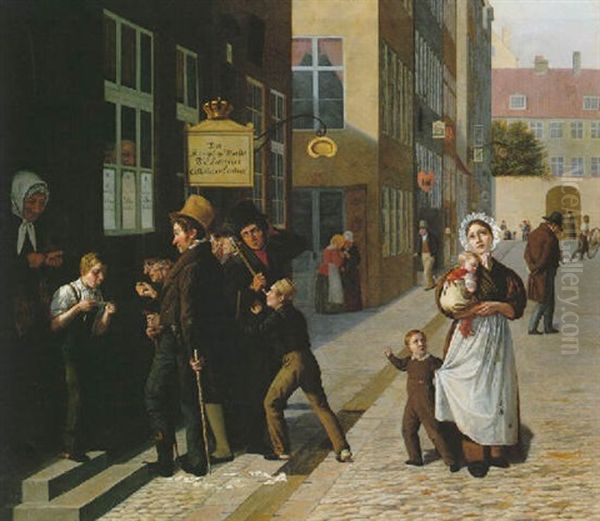
An earlier work, "Outside the Lottery, Copenhagen" (1836), now housed in the Metropolitan Museum of Art, New York, is also attributed to a Julius Friedlaender. If this is the same artist, it indicates an early start to his painting career and perhaps travels or connections to Denmark. The subject matter – a lottery – is a classic genre theme, allowing for the depiction of diverse social characters and their hopes and anxieties. The fact that this painting was acquired in 1837 through a lottery by a certain Hans Caspar (possibly Hirzel or a similar name), who retained it until at least 1848, adds a layer to its provenance.
These works, taken together, paint a picture of an artist deeply engaged with the narrative potential of painting, whether drawing from history, contemporary social life, or the enduring human dramas of military existence. His contemporaries in the German-speaking world might have included figures like Adolph Menzel, known for his historical scenes and depictions of modern life, or Carl Spitzweg, beloved for his humorous and idyllic genre paintings.
The Scholar: Contributions to Art History
Beyond the canvas, the name Julius Friedlaender is also prominently associated with significant contributions to art history, particularly in the study of Early Netherlandish painting. This scholarly figure, whose activities are often dated to a slightly later period (Max J. Friedländer, 1867-1958, is the key figure here, though the provided text attributes these achievements to "Julius Friedlaender"), carved out an influential career marked by meticulous research and a discerning eye.
This Friedlaender's academic journey included a pivotal period working at the Berlin Museum, a powerhouse of art historical research and collection in the late 19th and early 20th centuries. Here, he came under the mentorship of Wilhelm Bode (1845-1929), the formidable director-general of the Berlin State Museums. Bode was a towering figure in the museum world and a proponent of systematic art history, known for his connoisseurship and his role in building Berlin's collections into one of the world's finest. His influence on Friedlaender would have been profound, shaping his approach to art historical inquiry. Another mentor mentioned is Ludwig Schwheming (perhaps a misspelling of a known art historian like Ludwig Scheibler or August Schmarsow), indicating a broad scholarly grounding.
Friedlaender’s research focused intensely on the masters of Early Netherlandish painting – artists from the 15th and early 16th centuries in the Low Countries. This was a field that was undergoing significant scholarly re-evaluation and cataloging during his time. His magnum opus, "Die Altniederländische Malerei" (Early Netherlandish Painting), published in 14 volumes between 1924 and 1937, remains a foundational text. This exhaustive work systematically cataloged and analyzed the oeuvres of artists such as Jan van Eyck, Rogier van der Weyden, Hans Memling, Hugo van der Goes, Geertgen tot Sint Jans, Hieronymus Bosch, and Pieter Bruegel the Elder.
His methodology combined rigorous stylistic analysis – what became known as "Kennerkritik" or connoisseurship – with thorough documentary and archival research. He sought to define the individual artistic personalities of these masters, distinguishing their hands from those of their pupils and imitators. His study of the "Antwerp Mannerists," a diverse group of painters active in Antwerp in the early 16th century, exemplifies this approach, as he attempted to disentangle the various anonymous hands and workshops within this stylistic trend. He also delved into complex art historical problems, such as the relationship between the Master of Flémalle (often identified with Robert Campin) and his presumed pupil, Rogier van der Weyden.
Another significant publication, "Von Kunst und Kennerschaft" (On Art and Connoisseurship, 1946), articulated his views on the methods and importance of connoisseurship. He championed this approach, which relied on the cultivated eye and intuitive judgment of the expert, developed through years of direct engagement with artworks. While connoisseurship faced criticism for its perceived subjectivity, Friedlaender argued for its indispensable role in art history, particularly in attributing works and understanding artistic development. His views were influential, with later art historians like E.H. Gombrich recommending "On Art and Connoisseurship" as a key text on the subject.
Friedlaender's scholarly work was not confined to ivory towers. He was deeply concerned with the practicalities of the art world, including the pervasive issue of art forgery. He reportedly collaborated with figures like Emile Renders to expose how forgers operated, particularly in the realm of Flemish Primitives, highlighting the need for vigilance and expertise in the art market.
Navigating a Turbulent Era: Persecution and Emigration
The historical period during which these figures named Julius Friedlaender lived and worked was marked by profound social and political upheaval, culminating in the rise of Nazism and the Second World War. For individuals of Jewish heritage, this era brought persecution and existential threat.
The Julius Friedlaender identified as a philosopher and writer, born in Poland, experienced this tragedy directly. After studying medicine, dentistry, and then philosophy, he became known for works such as "Synthese aus Kant und Clown" and "Fasching als Logik." He emigrated to France in 1933, presumably to escape the rising tide of antisemitism in Central Europe. However, with the Nazi occupation of France, his refuge became a trap. In 1942, he was deported to the Theresienstadt concentration camp and ghetto. Tragically, he died in Paris on September 6, 1942, a victim of the Holocaust. His story is a stark reminder of the devastating human cost of this period.
The art historian Julius Friedlaender (Max J.) also faced persecution. Due to his Jewish background, he was forced to leave his position at the Wallraf-Richartz Museum (though his primary association was with Berlin) and eventually Germany itself. He found refuge in the Netherlands, where he continued his scholarly work despite the difficult circumstances. His archives and collections were eventually transferred to the Netherlands and, in 1959, were reportedly donated to the Schneider family. He passed away in 1958, having lived through some of the most tumultuous decades in European history.
The complexities of family background are also noted, with one Julius Friedlaender having a Jewish doctor father and a mother who was a singer and pianist, while his stepmother was Christian. Such mixed backgrounds were not uncommon but could present unique challenges and internal conflicts, especially during periods of heightened religious and racial persecution.
Contemporaries and Artistic Milieu
To fully appreciate the contributions of Julius Friedlaender, it's helpful to consider the broader artistic and intellectual landscape. The 19th-century painter of genre and historical scenes would have been aware of, and perhaps interacted with, a wide range of artists. In Vienna, besides Waldmüller, figures like Peter Fendi, known for his intimate genre scenes, and Carl Schindler, a military painter, were active. Internationally, the academic tradition was upheld by artists like William-Adolphe Bouguereau in France, while movements like Realism, championed by Gustave Courbet and Jean-François Millet, offered alternative approaches to depicting contemporary life. In Russia, artists like Ilya Repin and Vasily Perov were part of the Peredvizhniki (Wanderers) movement, focusing on social realism.
The art historian Julius Friedlaender (Max J.) was part of a distinguished generation of German-speaking art historians who laid the foundations for the modern discipline. Besides Wilhelm Bode, his contemporaries included scholars like Heinrich Wölfflin, who developed formal analysis; Aby Warburg, who pioneered iconology and the study of cultural memory; and Erwin Panofsky, who further developed iconographical and iconological methods, initially in Germany and later in the United States after emigrating. The intellectual debates and methodological innovations of this period profoundly shaped the field.
The provided list of "contemporaries" – Jean-Frédéric Fridel, David Fridlaender, Johann Friedrich Friderichs (a name appearing multiple times, perhaps indicating several individuals or a data anomaly), Sebastian Fridlin, and Sebastian Friedrich – suggests a network of individuals with similar names, possibly active in related artistic or scholarly fields, or simply names retrieved from historical records of the period. Their specific connections to the primary Julius Friedlaender figures discussed would require more detailed individual research.
A notable connection mentioned is with Stanley William Hayter, a highly influential printmaker. Hayter was a key figure at Atelier 17 in Paris, a printmaking workshop that attracted artists from around the world. The information suggests that a Friedlaender (likely Johnny Friedlaender, 1912-1992, a renowned German-French etcher, not Julius the 19th-century painter or Max J. the art historian) was an important student of Hayter, particularly known for contributions to color etching. This highlights the continuation of artistic innovation and mentorship across generations, though it points to yet another distinct artist named Friedlaender.
Legacy and Historical Impact
The legacy of Julius Friedlaender, in its various manifestations, is significant. As a painter, the 19th-century Julius Friedlaender contributed to the rich tradition of genre and historical painting, leaving behind a body of work that offers valuable insights into the society and artistic tastes of his time. His paintings, whether depicting grand historical narratives or quiet moments of everyday life, reflect the technical skill and narrative concerns of 19th-century academic art.
As an art historian, Julius Friedlaender (Max J.) left an indelible mark on the study of Early Netherlandish painting. His meticulous scholarship, his comprehensive catalogs, and his influential writings on connoisseurship helped to define the field for generations. His work not only advanced the understanding of specific artists and artworks but also contributed to the broader methodological debates within art history. His emphasis on the "artist's personality" and the importance of the discerning eye, while sometimes debated, underscored the human element in both the creation and the study of art. His efforts helped to elevate the status of Early Netherlandish art and to strengthen the perceived artistic and cultural links between German and Flemish traditions.
The tragic fate of the philosopher Julius Friedlaender serves as a somber reminder of the fragility of life and culture in the face of tyranny. His intellectual contributions, though perhaps overshadowed by his persecution, remain part of the broader cultural heritage.
The collections and archives associated with these figures, where they have been preserved, continue to be valuable resources for researchers. The dedication of individuals like Julius Friedlaender the numismatist to the scientific value of collecting also contributed to the preservation and understanding of historical artifacts.
In conclusion, the name Julius Friedlaender encompasses a range of significant contributions to art, scholarship, and intellectual life. Whether as a painter capturing the nuances of 19th-century existence, a pioneering art historian unraveling the complexities of Early Netherlandish masters, or a philosopher whose voice was tragically silenced, the legacies attributed to this name underscore a profound engagement with culture and history. While the source material sometimes conflates distinct individuals, the collective impact of these figures remains a testament to the enduring power of artistic creation and scholarly inquiry, even amidst the challenges of their times. Their stories, in their complexity and diversity, enrich our understanding of European art and intellectual history.