Károly Markó the Elder stands as a seminal figure in the history of Hungarian art, particularly celebrated for his mastery of landscape painting during the 19th century. Though he spent a significant portion of his career in Italy, his work remained deeply influential in his homeland and contributed to the broader European tradition of Romantic and Neoclassical landscape art. His meticulously detailed and often idealized depictions of nature, infused with mythological or biblical narratives, earned him international acclaim and a lasting legacy.
Early Life and Artistic Awakening
Born on September 25, 1791, in Lőcse, in the Szepes County of the Kingdom of Hungary (now Levoča, Slovakia), Károly Markó initially pursued a different path. His early education was geared towards engineering, which he studied in Pest (now part of Budapest) and Kolozsvár (now Cluj-Napoca, Romania). This technical background, with its emphasis on precision and observation, may have subtly informed his later artistic practice, particularly his detailed rendering of natural elements.
However, the allure of art proved stronger than the call of engineering. Around 1818, Markó made the decisive shift to painting. He moved to Pest and began to hone his skills, likely receiving some informal instruction. His formal artistic training commenced in 1822 when he enrolled at the prestigious Academy of Fine Arts in Vienna. During his time in Vienna, he would have been exposed to the prevailing artistic currents of the era, including the lingering influence of Neoclassicism and the burgeoning Romantic movement, as well as the rich collections of Old Masters. Painters like the Austrian Joseph Anton Koch, known for his heroic landscapes, were active during this period and could have provided an early influence.
The Hungarian Period and Early Works
After his studies in Vienna, Markó returned to Hungary. He initially settled in Pest and later moved to various locations in Upper Hungary. During this period, from the late 1820s into the early 1830s, he began to establish his reputation as a landscape painter. His works from this time often depicted Hungarian scenery, imbued with a sense of Arcadian idealism and a meticulous attention to detail.
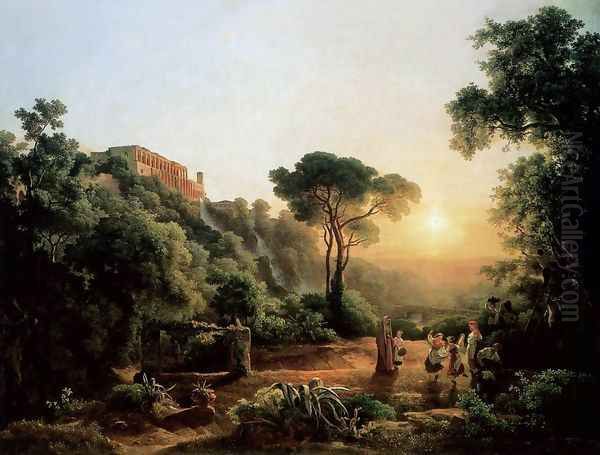
One of his most celebrated paintings from this era is Visegrád (c. 1826-1830). This piece showcases his ability to combine topographical accuracy with an idealized, almost pastoral vision of the Hungarian landscape. The composition is balanced, the light carefully managed, and the rendering of foliage and terrain precise. These early Hungarian landscapes often featured staffage – small human figures – that animated the scenes and sometimes hinted at narrative, a characteristic he would develop further. Other Hungarian artists of the time, such as the portraitist Miklós Barabás, were also active, though Markó's focus on landscape was more specialized. Károly Kisfaludy, a writer and painter, was another contemporary exploring early Romantic themes in Hungarian art.
Despite growing recognition, the opportunities for artists in Hungary at the time were somewhat limited. Financial pressures and the desire for broader artistic horizons likely motivated Markó's decision to seek his fortunes abroad.
The Italian Sojourn: Rome and Florence
In 1832, Károly Markó made the pivotal move to Italy, a country that had long been a magnet for artists from across Europe. He initially settled in Rome, the heart of the classical world and a vibrant center for international artists. The Roman Campagna, with its ancient ruins, picturesque towns, and dramatic scenery, provided endless inspiration. Here, he absorbed the influence of classical landscape traditions, particularly the work of 17th-century masters like Claude Lorrain and Nicolas Poussin, whose idealized and structured landscapes resonated with Markó's own inclinations.
The influence of Claude Lorrain is particularly evident in Markó's handling of light, his creation of atmospheric depth, and his harmonious compositions. He also became associated with the painters of the School of Posillipo, active in Naples, such as Anton Sminck Pitloo and Giacinto Gigante, who were known for their fresh, light-filled depictions of the Italian coast and countryside, often painted en plein air or with a similar immediacy.
After several years in Rome, Markó moved to Pisa in 1838, and then in 1840, he was appointed a professor at the Accademia di Belle Arti in Florence. He would spend the remainder of his most productive years in and around Florence, eventually settling in the Villa Appeggi near Antella, where he continued to paint until his death. Italy became his adopted home, and its landscapes dominated his oeuvre.
Artistic Style and Dominant Themes
Károly Markó the Elder's style is a distinctive blend of Neoclassical order and Romantic sensibility. His paintings are characterized by their meticulous detail, luminous clarity, and idealized vision of nature. While his early works showed a strong Neoclassical structure, his Italian period saw a greater infusion of Romantic elements, particularly in the emotional resonance of his landscapes and his interest in the sublime and the picturesque.
Neoclassical Elements:
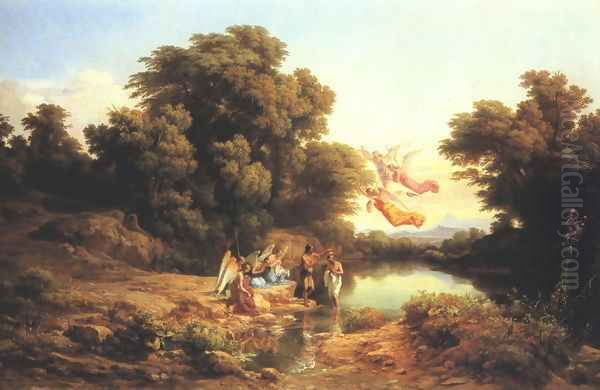
Markó's compositions are typically well-balanced and harmonious, often employing classical framing devices like trees on either side of the canvas to lead the viewer's eye into the scene. There is a sense of order and rationality in the arrangement of landscape elements. His drawing is precise, and his rendering of details, especially foliage, rocks, and water, is remarkably fine. This clarity and precision align with Neoclassical ideals.
Romantic Elements:
Despite the underlying order, Markó's landscapes are rarely cold or purely academic. They are imbued with a warm, often golden light that creates a serene or sometimes dramatic atmosphere. He was adept at capturing the play of light and shadow, enhancing the three-dimensionality of his scenes and evoking a particular mood. His choice of subjects, often featuring tranquil pastoral scenes, idyllic mythological episodes, or biblical stories set within expansive landscapes, appealed to Romantic tastes for the evocative and the transcendent. He shared this Romantic appreciation for nature with contemporaries across Europe, such as the German Caspar David Friedrich or the English J.M.W. Turner and John Constable, though Markó's style was generally more serene and less tumultuous than Turner's or Friedrich's.
Themes:
Markó's thematic range was broad but consistently rooted in landscape:
Idealized Landscapes: Many of his works are pure landscapes, celebrating the beauty of the Italian countryside – the rolling hills of Tuscany, the Roman Campagna, or coastal views. These are often populated with shepherds, peasants, or travelers, adding a touch of human interest.
Mythological Scenes: He frequently depicted scenes from classical mythology, such as Diana and Her Nymphs Bathing or The Death of Eurydice. These subjects allowed him to combine his skill in landscape with narrative figure painting, placing ancient gods and heroes within lush, Arcadian settings.
Biblical Narratives: Similar to his mythological scenes, Markó painted biblical stories set in expansive landscapes, for example, The Baptism of Christ or Christ and the Samaritan Woman at the Well. The landscape often played a crucial role in setting the spiritual or emotional tone of the narrative.
Hungarian Scenes: Even after moving to Italy, Markó occasionally returned to Hungarian themes. His painting View of the Great Hungarian Plain (The Puszta) (1853), created after a visit to his homeland, is a significant example. It captures the unique character of the Hungarian steppe with a blend of realism and romantic idealization.
His figures, though often small in relation to the overall landscape, are carefully rendered and integrated into the scene. They are not mere accessories but active participants in the idyllic world he creates.
Key Masterpieces and Their Characteristics
Throughout his long career, Károly Markó the Elder produced a significant body of work. Several paintings stand out as representative of his style and artistic achievements:
Visegrád (c. 1826-1830): An early masterpiece from his Hungarian period, this painting depicts the historic Hungarian town and castle on the Danube Bend. It combines topographical accuracy with an idealized, serene atmosphere, showcasing his early mastery of detailed rendering and balanced composition.
Landscape near Tivoli (or The Tivoli Region, various versions, e.g., 1832, 1846): Tivoli, with its waterfalls, Roman ruins, and lush vegetation, was a classic subject for landscape painters. Markó’s depictions of this area are quintessential examples of his Italian style, characterized by warm light, rich colours, and a harmonious blend of natural beauty and classical antiquity.
Fishermen (various versions): This theme allowed Markó to depict tranquil waterside scenes, often at dawn or dusk, with figures engaged in timeless, pastoral activities. These works emphasize the harmony between humanity and nature.
Southern Landscape with Dancing Nymphs (1859): A late work that encapsulates his mature style. It features a lush, idealized landscape bathed in golden light, with gracefully rendered nymphs dancing in a clearing. The painting evokes a sense of Arcadian bliss and timeless beauty, heavily influenced by Claude Lorrain.
View of the Great Hungarian Plain (The Puszta) (1853): This painting is notable for its depiction of a specifically Hungarian landscape. It captures the vastness and unique atmosphere of the Puszta, with its characteristic draw-wells, herds of cattle, and csikós (Hungarian horsemen). It demonstrates his ability to apply his idealized style to a different type of scenery, infusing it with a sense of national identity.
The Grape Harvest (or Vintage, e.g., 1841): Scenes of rural life, such as the grape harvest, were popular subjects. Markó’s versions are typically joyful and idyllic, celebrating the bounty of nature and the simple pleasures of country life, set within beautifully rendered Italian landscapes.
Death of Eurydice: This mythological subject, depicting Orpheus mourning the second loss of Eurydice, allowed Markó to explore themes of love, loss, and the power of nature. The landscape setting would have been integral to conveying the tragic mood of the scene.
View of Lake Trasimeno: Another example of his Italian landscapes, this work would have captured the serene beauty of the Umbrian lake, likely with his characteristic attention to atmospheric effects and detailed rendering of the surrounding terrain.
These works, among many others, demonstrate Markó's consistent vision, technical skill, and his ability to create landscapes that are both visually captivating and emotionally resonant. His paintings were highly sought after by collectors and patrons across Europe.
Teaching, Influence, and Artistic Circle
Károly Markó the Elder was not only a prolific painter but also an influential teacher. His appointment as a professor at the Accademia di Belle Arti in Florence in 1840 solidified his status in the Italian art world. He taught landscape painting, and his studio attracted numerous students, both Italian and foreign. His meticulous technique and idealized vision of landscape had a significant impact on his pupils.
Among his most notable students were his own sons, particularly Károly Markó the Younger (1822–1891), who became a respected landscape painter in his own right, largely following his father's style but sometimes with a slightly softer, more Romantic touch. Other sons, András Markó (1824–1895) and Ferenc Markó (1832–1874), also became painters, continuing the family's artistic tradition.
Markó's influence extended beyond his direct students. His success and international reputation helped to elevate the status of landscape painting. In Hungary, his work provided a benchmark for subsequent generations of landscape artists, even as artistic styles evolved. Painters like Antal Ligeti, who also painted Hungarian historical landscapes, and later figures in Hungarian landscape painting such as Géza Mészöly and László Paál, while developing their own distinct styles (often more realistic or aligned with the Barbizon School), operated within a tradition that Markó had helped to establish and popularize. The French Barbizon painters like Camille Corot or Théodore Rousseau were also transforming landscape painting in Europe during Markó's later career, moving towards greater naturalism.
His circle in Italy would have included many contemporary Italian and expatriate artists. The art scenes in Rome and Florence were cosmopolitan, and artists frequently interacted, exchanged ideas, and competed for commissions. While specific collaborations are not widely documented, his position as a professor and his established reputation would have placed him at the center of a vibrant artistic community.
Later Years and Enduring Legacy
Károly Markó the Elder spent his final years at the Villa Appeggi near Florence, continuing to paint with remarkable consistency and skill. He remained dedicated to his vision of idealized landscape, even as new artistic movements began to emerge in Europe. He passed away on November 19, 1860, in Appeggi, Italy, leaving behind a rich artistic legacy.
His death marked the end of an era for a particular kind of meticulously crafted, idealized landscape painting. However, his contributions to Hungarian and European art remain significant.
In Hungary, he is revered as one of the founders of modern Hungarian landscape painting. He demonstrated that Hungarian scenery could be a worthy subject for high art and set a standard of technical excellence. His works are prominently featured in the Hungarian National Gallery in Budapest and other Hungarian museums.
Internationally, Markó is recognized as a skilled practitioner of the European academic landscape tradition, a worthy successor to masters like Claude Lorrain. His paintings can be found in collections across Europe, testament to his contemporary fame and enduring appeal. While art history has often favored more revolutionary figures, Markó's dedication to beauty, his technical brilliance, and his ability to create serene and harmonious visions of nature ensure his place in the annals of 19th-century art. His influence can be seen in the work of his sons and other pupils, and he helped to foster an appreciation for landscape painting that would continue to develop in the decades following his death.
Markó in the Context of 19th-Century Art
To fully appreciate Károly Markó the Elder, it's important to see him within the broader context of 19th-century European art. His career spanned a period of significant artistic change. He began working when Neoclassicism was still a dominant force, matured during the height of Romanticism, and lived to see the stirrings of Realism and the Barbizon School.
While Markó incorporated Romantic elements, particularly in his love for nature and his evocative use of light, he largely remained within the bounds of academic tradition. He did not embrace the more radical aspects of Romanticism seen in the dramatic, often turbulent works of artists like Géricault or Delacroix in France, nor the profound spiritual introspection of Caspar David Friedrich in Germany. His Romanticism was gentler, more pastoral, and focused on the idyllic.
Compared to the Barbizon painters in France, such as Jean-Baptiste-Camille Corot (in his later, more poetic phase), Jean-François Millet, or Théodore Rousseau, who sought a more direct and unembellished depiction of nature and rural life, Markó's approach remained more idealized and meticulously finished. The Barbizon School's emphasis on plein air painting and capturing the fleeting effects of light and atmosphere pointed towards Impressionism, a direction Markó did not take.
However, his commitment to landscape as a primary subject was part of a broader 19th-century trend that saw landscape painting rise from a minor genre to a major form of artistic expression. Artists across Europe were exploring the natural world with new intensity, whether for its sublime grandeur, its picturesque charm, or its potential for scientific observation or nationalist sentiment. Markó contributed to this elevation of landscape art through the sheer quality and appeal of his work. His success demonstrated that landscape painting could achieve the same level of sophistication and intellectual depth as historical or mythological painting.
Conclusion
Károly Markó the Elder was a pivotal figure in Hungarian art and a respected landscape painter on the European stage. His journey from engineering student in Hungary to acclaimed professor of art in Florence is a testament to his talent and dedication. With a style that beautifully synthesized Neoclassical order with Romantic sensibility, he created a world of idyllic landscapes, mythological reveries, and serene biblical scenes. His meticulous technique, his masterful handling of light, and his unwavering commitment to an idealized vision of nature defined his art.
Through masterpieces like Visegrád, Landscape near Tivoli, and View of the Great Hungarian Plain, he not only captured the beauty of specific locales but also evoked a timeless sense of harmony and tranquility. His influence on his sons, his students, and the development of landscape painting in Hungary was profound. Károly Markó the Elder's legacy endures in his beautiful canvases, which continue to enchant viewers with their luminous clarity and Arcadian charm, securing his position as a distinguished master of 19th-century landscape painting.