Kurt Leyde (1881-1941) stands as an intriguing, if somewhat less universally heralded, figure within the dynamic and often tumultuous landscape of early 20th-century German art. Born in Berlin, a city on the cusp of becoming a major cultural and artistic crucible, Leyde's career unfolded during a period of profound artistic experimentation and societal change. His work, primarily in painting and drawing, reflects a journey through various influences, from academic traditions to more personal, subjective expressions. While not always at the forefront of the most radical avant-garde movements, Leyde carved out a distinct artistic identity, characterized by a nuanced approach to color, form, and emotional content.
Early Life and Artistic Formation in a Changing Germany
Kurt Leyde was born on June 12, 1881, in Berlin, the capital of the newly unified German Empire. This was a city brimming with industrial energy, intellectual ferment, and burgeoning artistic scenes. His initial artistic studies likely took place in Berlin, providing him with a foundational understanding of technique and art history. However, a significant and formative period of his education occurred at the prestigious Munich Academy of Fine Arts. Munich, at the turn of the century, was a rival to Berlin as an artistic center, particularly known for its strong academic tradition but also for the rise of influential Secession movements.
At the Munich Academy, Leyde had the distinct opportunity to study under Franz von Stuck (1863-1928). Stuck was a towering figure in German Symbolism and a co-founder of the Munich Secession in 1892. He was renowned for his mythological and allegorical paintings, characterized by their dark palettes, strong linearity, and often unsettling psychological depth. Studying with Stuck would have exposed Leyde to an artistic philosophy that valued imagination, subjective experience, and a departure from pure naturalism, even while rooted in strong draughtsmanship. Other notable artists who passed through Stuck's tutelage around this period, though their paths diverged significantly, included Wassily Kandinsky and Paul Klee, both of whom would become pioneers of abstract art.
The Development of a Personal Style
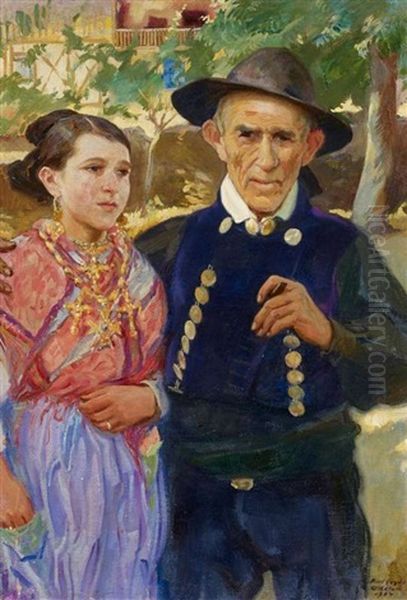
The tutelage under Franz von Stuck undoubtedly left an imprint on Leyde, but he evolved his own distinct artistic language. His oeuvre is noted for a particular emphasis on the overall structure and composition of his subjects, often prioritizing the holistic impression over meticulous, fine detail. This approach suggests an interest in conveying the essence of a scene or a figure rather than a photographic reproduction. This structural emphasis was often coupled with the use of strong, sometimes heavy, colors. Leyde was not afraid to employ a rich palette, and he masterfully utilized strong chiaroscuro – the contrast between light and dark – to unify his compositions and imbue them with a heightened sense of drama or mood.
A recurring characteristic in Leyde's work is a flowing, almost rhythmic quality in his compositions. This dynamism prevents his structured forms from becoming static, lending his paintings a sense of life and movement. Perhaps most defining, however, was his commitment to expressing a subjective, inner world. Leyde himself reportedly stated that his inspiration was drawn not from direct observation of the external world in the Impressionist vein, but rather from his internal imagination and emotional responses. This aligns him broadly with the Symbolist ethos inherited from Stuck and distinguishes him from purely realist or naturalist painters of his era. His primary subjects included portraits and landscapes, rendered predominantly in oil on canvas or wood panel, showcasing a versatility in both theme and medium.
Navigating the German Art Milieu: Berlin and Beyond
The early 20th century in Germany was a period of intense artistic innovation. In Berlin, the Berlin Secession, led by figures like Max Liebermann (1847-1935), Lovis Corinth (1858-1925), and Max Slevogt (1868-1932), had already challenged the conservative art establishment. Soon after, Expressionist groups like Die Brücke (The Bridge), founded in Dresden in 1905 with artists such as Ernst Ludwig Kirchner (1880-1938) and Karl Schmidt-Rottluff (1884-1976), and Der Blaue Reiter (The Blue Rider), formed in Munich in 1911 by Wassily Kandinsky (1866-1944) and Franz Marc (1880-1916), pushed the boundaries of color, form, and emotional expression even further.
It is within this vibrant, and at times cacophonous, artistic environment that Kurt Leyde operated. While his style, with its emphasis on structure and subjective feeling, shared some common ground with broader post-Impressionist and Symbolist trends, it did not fully align with the more radical distortions and emotional intensity of mainstream Expressionism. He appears to have charted a more independent course, absorbing influences from his academic training and Symbolist leanings while developing a personal figurative style. His work from the 1920s, for instance, might be seen in dialogue with the New Objectivity (Neue Sachlichkeit) movement, which emerged as a reaction against Expressionism, favoring a return to a more sober, realistic, yet often critically charged figuration. Artists like Otto Dix (1891-1969) and George Grosz (1893-1959) were key proponents of this latter movement, though Leyde's work generally lacked their overt social or political critique, focusing more on personal and atmospheric representation.
Representative Works and Thematic Concerns
Several works by Kurt Leyde offer insights into his artistic preoccupations and stylistic features. One notable piece is Paar auf Mallorca (Couple in Mallorca), an oil on canvas dated 1924, measuring 94 x 66.5 cm. The title itself suggests a journey to the Balearic Islands, a popular destination for artists seeking different light and landscapes. Without viewing the image, one can surmise it likely captures a moment, perhaps a portrait of a couple or a genre scene, imbued with the specific atmosphere of Mallorca. The date, 1924, places it firmly in the Weimar Republic period, a time of cultural flourishing despite underlying economic and political instability. This work, with its significant dimensions, was likely an important piece for the artist.
Another significant painting is Les Tarteres, dated 1928. This oil painting, smaller in size at 30 x 40 cm, also points to a specific locale. "Tarteres" can refer to areas with distinct geological features or scree slopes, suggesting a landscape painting focused on the raw, natural environment. The choice of a French-inflected title might indicate travels or exhibitions in French-speaking regions, or simply an artistic convention. Both Paar auf Mallorca and Les Tarteres highlight Leyde's engagement with landscape and, potentially, the human figure within it, rendered through his characteristic approach to structure and color.
An earlier mentioned piece, a depiction of a fashionable woman, is cited as being created "around 1890." If this date refers to the painting's execution, it would place it very early in Leyde's life, when he was merely nine years old, making it highly improbable as a mature work. It is more likely that the subject matter depicts the fashion of the 1890s, or that the painting was created later by Leyde as a nostalgic or historical piece, or that the date is associated with a different context. A work titled Modische, elegante Dame mit Hut (Fashionable, Elegant Lady with Hat), with an auction starting price in 2016, might be this painting. If it is indeed by Leyde and depicts an 1890s subject, it would showcase his interest in portraiture and period styles.
The mention of Leyde in the Katalog 1921 as "Saguntiner Obstbauern" (Saguntine Fruit Farmers) is also illuminating. Sagunto is a town in eastern Spain, rich in history. This reference further underscores Leyde's connection to Spain, alongside Paar auf Mallorca, suggesting that Spanish themes, landscapes, and perhaps genre scenes of rural life were part of his repertoire during the early 1920s. Such subjects were popular among Northern European artists drawn to the perceived exoticism and vibrant culture of the Mediterranean.
Leyde in the Art World: Exhibitions and Collaborations
Kurt Leyde's works have appeared in various contexts, indicating an active professional life. His inclusion in exhibitions alongside artists like Paul Ernst Max (PEM) Albrecht, Modesto Roldan, and Otto Friedrich Leu, though the initial source's dating of these contemporaries to the 17th century is clearly an error (these are more likely his actual contemporaries from the late 19th/early 20th century), shows his participation in the gallery and exhibition circuit of his time. The art world of Berlin and Munich was characterized by numerous artist associations, galleries, and juried exhibitions, which were crucial for an artist's visibility and sales.
His name also appears in Die Akten des Kaiser-Friedrich-Museums Teil II Findbuch, suggesting his work was noted by or involved with one of Berlin's most important museum institutions (now the Bode Museum). Furthermore, Leyde is documented as having engaged in collaborative projects, for instance, with Victor Singer, for whom he reportedly created engravings for Hanna Singer. This indicates a proficiency in graphic arts beyond painting, a common practice for many artists of the period who often explored printmaking for wider dissemination of their work or for illustrative purposes. Such collaborations were vital for networking and expanding an artist's reach.
The auction market provides another lens through which to view Leyde's career and posthumous recognition. His paintings, such as Les Tarteres (estimated at €500-€700) and the larger 1924 oil painting, likely Paar auf Mallorca (estimated at €3,500-€4,000), have appeared at auction houses. The painting Modische, elegante Dame mit Hut had a starting bid of €900 in a 2016 auction. These figures, while not reaching the astronomical sums of some of his more famous contemporaries like Kandinsky or members of Die Brücke such as Emil Nolde (1867-1956) or Max Pechstein (1881-1955), indicate a consistent level of appreciation and collectability for his work. His art was also featured in a 2013 European Arts and Crafts auction, further attesting to its continued presence in the market.
Artistic Context and Contemporaries
To fully appreciate Kurt Leyde's position, it's helpful to consider the broader artistic currents and some of his contemporaries. Beyond those already mentioned, the German art scene was incredibly diverse. While Leyde was developing his style, artists like Käthe Kollwitz (1867-1945) were creating powerful socially conscious works. Paula Modersohn-Becker (1876-1907) was forging a unique path with her intensely personal and pioneering depictions of women and children. Later, during the Weimar Republic, the Bauhaus school, founded by Walter Gropius (1883-1969), revolutionized art, design, and architectural education, with figures like Lyonel Feininger (1871-1956) and Oskar Schlemmer (1888-1943) contributing to its multifaceted vision.
Leyde's more figurative and subjectively emotional style, rooted in strong academic training yet open to personal interpretation, places him in a category of artists who, while not always part of the most radical avant-garde, contributed significantly to the richness and complexity of German art. He navigated a path between the established traditions of the academies and the burgeoning modernist movements. His focus on personal vision and imaginative interpretation, rather than strict adherence to external reality or radical formal deconstruction, aligns him with a persistent strand of romantic and symbolist sensibility in German art, which continued even amidst the rise of Expressionism and abstraction. Artists like Max Klinger (1857-1920), an older contemporary known for his Symbolist prints and paintings, or Lovis Corinth, who evolved from Impressionism to a powerful form of Expressionism, represent the kind of artistic environment in which Leyde matured.
Legacy and Conclusion
Kurt Leyde passed away in 1941. His life spanned a period of immense transformation in Germany: from the Wilhelmine Empire through World War I, the turbulent Weimar Republic, and into the darkest chapter of the Nazi regime. The rise of National Socialism in 1933 had a devastating impact on modern art in Germany, with many artists being persecuted, their works declared "degenerate" (entartete Kunst), and removed from museums. Artists like Emil Nolde, Ernst Barlach (1870-1938), and Max Beckmann (1884-1950) suffered greatly under this regime. While the provided information doesn't detail Leyde's specific circumstances during this period, it was an era that profoundly affected every artist in Germany.
Kurt Leyde's legacy is that of a dedicated artist who, within the vibrant and competitive German art scene of the early 20th century, developed a distinctive voice. His work, characterized by its structural integrity, evocative use of color, and commitment to subjective expression, offers a valuable perspective on a period when artists grappled with tradition, modernity, and the representation of an ever-changing world. While perhaps not as widely known as some of his revolutionary contemporaries, his paintings and drawings contribute to our understanding of the diverse artistic practices that flourished in Germany. His engagement with portraiture, landscape, and potentially genre scenes, often infused with a personal, imaginative quality, ensures his place as a noteworthy artist of his generation, whose works continue to find appreciation in collections and at auction. His journey from the academies of Berlin and Munich, under the influence of figures like Franz von Stuck, to a mature style that balanced technical skill with inner vision, reflects a path taken by many artists seeking to find their unique expression amidst the powerful currents of early modernism.