Marcello Venusti stands as a significant, if sometimes overlooked, figure in the vibrant tapestry of 16th-century Italian art. A painter of considerable skill and sensitivity, his career is inextricably linked with the colossal figure of Michelangelo Buonarroti. While often celebrated for his meticulous and faithful renditions of Michelangelo's designs, Venusti was more than a mere copyist; he was an accomplished artist in his own right, navigating the complexities of the Mannerist style and contributing to the rich artistic milieu of Rome during a period of profound cultural and religious transformation. His work, primarily focused on religious themes, served to disseminate Michelangelo's powerful imagery to a wider audience while also showcasing his own distinct artistic sensibilities.
Early Life and Artistic Formation in a Changing Italy
Marcello Venusti is believed to have been born around 1512 or 1515 in Mazzo di Valtellina, a small town in Lombardy, northern Italy. The precise details of his early life and initial artistic training remain somewhat obscure, a common challenge when studying artists of this period who were not as extensively documented as titans like Leonardo da Vinci or Raphael. However, it is known that he eventually made his way to Rome, the epicenter of the Italian Renaissance and a magnet for ambitious artists from across the peninsula and beyond.
Rome in the early to mid-16th century was a city undergoing immense artistic and architectural development, largely driven by papal patronage and the enduring legacy of High Renaissance masters. It was here that Venusti would have been exposed to a dazzling array of artistic influences. One of his early and significant connections was with Perino del Vaga (Pietro Bonaccorsi), a prominent painter who had himself been a pupil of Raphael and was a key figure in the development of the Mannerist style in Rome after Raphael's death in 1520. Working with or under Perino del Vaga would have provided Venusti with invaluable training in fresco technique, composition, and the elongated, graceful figural style characteristic of early Mannerism. This association likely helped him establish himself within the competitive Roman art scene.
The Defining Relationship: Venusti and Michelangelo
The most defining aspect of Marcello Venusti's career was undoubtedly his close association with Michelangelo Buonarroti. By the time Venusti was establishing himself, Michelangelo was already a living legend, revered for his work on the Sistine Chapel ceiling, his sculptures like the David and Moses, and his architectural projects. Venusti became one of Michelangelo's trusted assistants and, in a sense, a student, absorbing the master's powerful forms, dramatic compositions, and profound understanding of human anatomy.
Michelangelo, in his later years, often relied on other artists to translate his drawings and compositional ideas into finished paintings, particularly smaller-scale works for private patrons. Venusti proved exceptionally adept at this task. His meticulous technique and ability to capture the spirit of Michelangelo's designs made him a favored collaborator. This relationship was not merely professional; it was one of mutual respect. It is said that Michelangelo held Venusti in high enough regard to become the godfather to Venusti's son, whom he named Michelangelo Venusti, a significant honor at the time.
This collaboration allowed Michelangelo's often monumental and inaccessible designs (like those for frescoes or large sculptures) to be disseminated in more portable and intimate formats, such as panel paintings. Venusti's copies were not slavish imitations but were often imbued with his own refined sense of color and a softer, more delicate touch than the raw power, or terribilità, often associated with Michelangelo's direct hand.
Artistic Style: Mannerism, Precision, and Devotion
Marcello Venusti's artistic style is firmly rooted in Mannerism, the dominant artistic movement in Italy from roughly the 1520s until the end of the 16th century, bridging the High Renaissance and the emergence of the Baroque. Mannerism, exemplified by artists like Pontormo, Rosso Fiorentino, Bronzino, and Parmigianino, often featured elongated figures, exaggerated poses, unusual color palettes, and a departure from the classical balance and naturalism of the High Renaissance. It was a style that emphasized elegance, artifice, and often, a heightened emotional or spiritual intensity.
Venusti's Mannerism was tempered by the profound influence of Michelangelo, whose work, while foundational to Mannerism, also transcended it. Venusti adopted the sophisticated compositions and dynamic figures of his master but often rendered them with a greater degree of polish and a more delicate finish. His figures, while anatomically informed by Michelangelo, could sometimes exhibit a softer modeling.
A notable aspect of Venusti's style was his handling of color and light. While Michelangelo's palette, particularly in his frescoes, could be bold and sculptural, Venusti sometimes incorporated a richer, more nuanced approach to color, possibly influenced by his Lombard origins or exposure to Venetian painters like Giovanni Bellini and Giorgione, whose emphasis on color and atmosphere was legendary. This is suggested in the provided information, indicating an inheritance of color and light handling from these Venetian masters, perhaps indirectly or through the general artistic currents of the time.
His works are characterized by their precision and meticulous detail, especially in smaller devotional paintings. This careful execution made his paintings highly sought after for private chapels and personal contemplation. The religious fervor of the Counter-Reformation, which gained momentum during Venusti's active years, also fueled demand for such works, emphasizing clarity, piety, and emotional engagement.
Key Commissions and Patronage
Like many artists of his era, Venusti relied on patronage from the Church and wealthy individuals. One of his most significant patrons was Cardinal Alessandro Farnese, a highly influential figure in Rome and a renowned connoisseur and collector of art. The Farnese family, including Pope Paul III (Alessandro Farnese), were major patrons of Michelangelo as well. It was for Cardinal Farnese that Venusti painted one of his most famous works, the panel copy of Michelangelo's Last Judgment.
Beyond such high-profile commissions, Venusti also produced numerous altarpieces and frescoes for churches in Rome and other Italian cities. His specialization in religious subjects aligned perfectly with the needs of the Church, particularly during the Counter-Reformation, which sought to reaffirm Catholic doctrine and piety through art. His ability to translate Michelangelo's powerful theological statements into accessible painted forms was highly valued.
Representative Works: Interpreting the Master and Forging a Path
Marcello Venusti's oeuvre is rich with works that demonstrate both his fidelity to Michelangelo's designs and his own artistic merits.
_The Last Judgment_ (after Michelangelo)
Perhaps Venusti's most celebrated work is his oil on panel copy of Michelangelo's monumental fresco, The Last Judgment, in the Sistine Chapel. Commissioned by Cardinal Alessandro Farnese and completed around 1549, this painting is now housed in the Museo di Capodimonte in Naples. It is invaluable not only as a masterful copy but also as a historical document, as it depicts the fresco before Daniele da Volterra was commissioned (after the Council of Trent) to paint draperies over many of the nude figures in Michelangelo's original. Venusti's version, therefore, offers a glimpse of Michelangelo's unfiltered vision, albeit translated into a different medium and scale. He skillfully condensed the sprawling composition while retaining its dramatic power and complex figural arrangements.
_The Purification of the Temple_ (after Michelangelo)
Another significant work based on a Michelangelo design is The Purification of the Temple (also known as Christ Driving the Moneylenders from the Temple). Michelangelo provided a drawing for this composition, which Venusti then developed into a painting. One version, notable for its dynamic action and architectural setting featuring distinctive Solomonic columns, is in the National Gallery, London. This work showcases Venusti's ability to adapt a drawing into a fully realized painting, managing complex groups of figures and conveying a strong narrative.
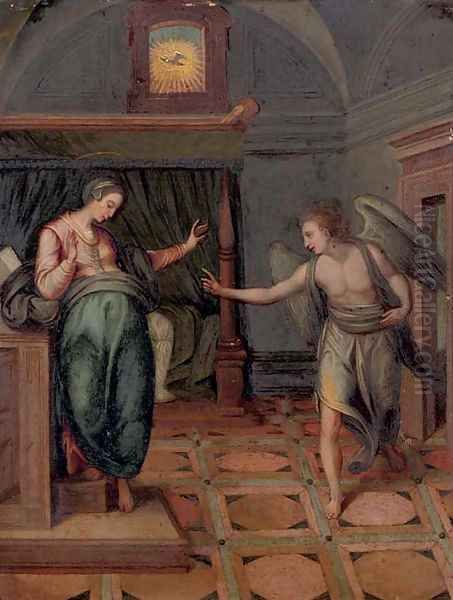
Venusti painted several versions of The Annunciation, a popular theme in Renaissance art. These works, often based on designs or sketches by Michelangelo, are characterized by their graceful figures, serene atmosphere, and delicate rendering. They exemplify Venusti's skill in creating devotional images that are both elegant and spiritually resonant. One such version, directly based on a Michelangelo cartoon, highlights the Archangel Gabriel's dynamic entry and the Virgin Mary's humble acceptance.
_Christ in the Garden of Olives_ (Agony in the Garden)
This subject, depicting Christ's prayerful anguish before his arrest, was one Venusti returned to. These paintings often convey a deep sense of pathos and spiritual intensity, with dramatic lighting and expressive figures, again frequently drawing inspiration from Michelangelo's compositional ideas for depicting human emotion and divine drama.
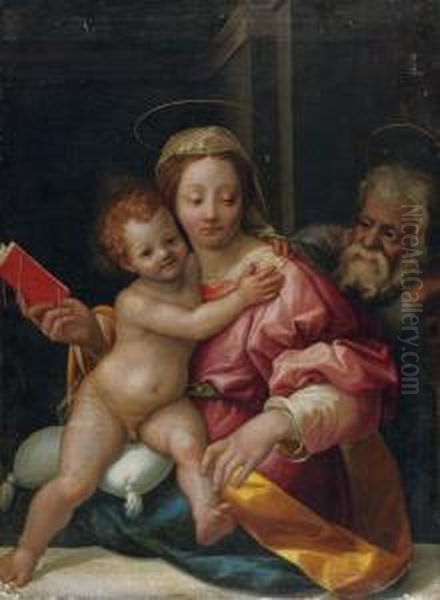
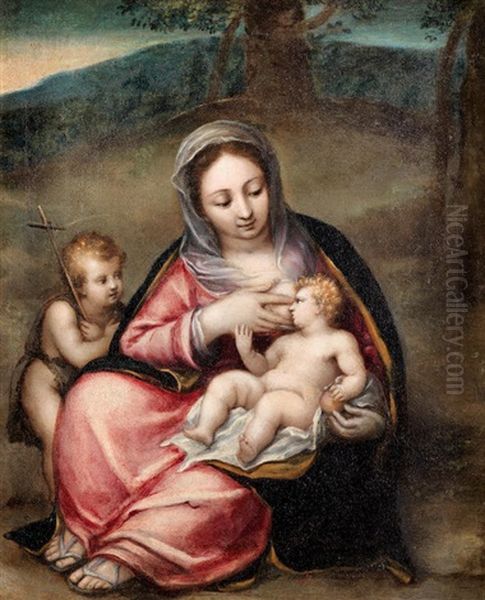
Venusti produced various compositions of the Holy Family, sometimes including the infant St. John the Baptist. These works often emphasize the tender interactions between the figures, rendered with his characteristic refinement and attention to detail. They reflect the period's focus on domestic piety and the sanctity of the family.
_Christ in Limbo_
This theological subject, depicting Christ's descent into Limbo to free the righteous souls, allowed for a dynamic composition with numerous figures. Venusti's interpretations would have drawn on Michelangelo's mastery of the human form in varied and complex poses, showcasing his ability to handle multi-figure narratives with clarity and impact.
_The Coronation of Saint Catherine_ (or _Mystic Marriage of Saint Catherine_)
This theme, representing the spiritual union of Saint Catherine of Alexandria with Christ, was another subject Venusti explored. Such paintings would have featured his refined figural style and ability to convey mystical experiences through elegant compositions and rich symbolism.
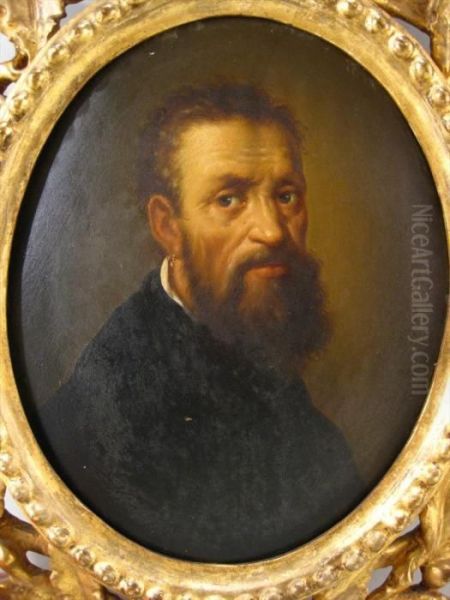
Other works include various altarpieces and frescoes, such as those for the Chapel of the Rosary in Santa Maria sopra Minerva and work in Santa Caterina dei Funari in Rome. He also painted portraits, including a notable portrait of Michelangelo himself, now in the Musei Capitolini, Rome, which offers a respectful and insightful likeness of the aged master.
Interactions with Contemporaries and the Roman Art Scene
Venusti operated within a vibrant and competitive artistic environment in Rome. His primary artistic relationship was, of course, with Michelangelo. However, he was also connected with other significant artists.
His early association with Perino del Vaga was crucial for his development. Perino, a leading figure of Roman Mannerism after the death of Raphael Sanzio da Urbino, would have instilled in Venusti the principles of this elegant and sophisticated style. Raphael's influence, though he died before Venusti's prime, still permeated Roman art, particularly through his former students like Perino and Giulio Romano.
Daniele da Volterra, another painter closely associated with Michelangelo, was a contemporary. Daniele is famously known as "Il Braghettone" (the breeches-maker) for his aforementioned work of adding drapery to Michelangelo's Last Judgment. Venusti and Daniele da Volterra sometimes collaborated or worked on similar projects stemming from Michelangelo's designs, reflecting the close-knit circle around the master.
The towering figure of Titian (Tiziano Vecellio), the leading master of the Venetian School, also had a presence in the Roman consciousness. Titian visited Rome in 1545-1546 and met Michelangelo. While there is no specific record of direct collaboration or correspondence between Venusti and Titian, Venusti would have been acutely aware of Titian's work and his mastery of color and portraiture. The artistic exchange between Rome and Venice, though distinct in their primary focuses (Florentine/Roman disegno vs. Venetian colore), was an ongoing dialogue. Venusti's own nuanced use of color might reflect a broader appreciation for Venetian achievements, possibly absorbed through intermediaries or the general artistic climate. Other Venetian masters like Giovanni Bellini (Titian's teacher) and Giorgione, though from an earlier generation, had laid the groundwork for the Venetian emphasis on color and light that continued to influence Italian art.
Giorgio Vasari, the painter, architect, and art historian, was another contemporary. Vasari's Lives of the Most Excellent Painters, Sculptors, and Architects is a foundational source for our understanding of Renaissance art. While Vasari's focus was often on Tuscan artists, he documented many figures of the period, and his writings help contextualize the artistic environment in which Venusti worked.
Other Mannerist painters active during Venusti's time, whose work contributed to the stylistic trends he navigated, include Agnolo Bronzino in Florence, known for his polished and enigmatic portraits, and Jacopo Pontormo and Rosso Fiorentino, key early Florentine Mannerists. In Rome itself, artists continued to develop the Mannerist style, leading towards the early stirrings of the Baroque with figures like Federico Barocci later in the century.
Controversies, Anecdotes, and Misattributions
The close stylistic relationship between Venusti's work and Michelangelo's designs inevitably led to instances of misattribution. One notable anecdote involves a painting of the Crucifixion discovered at Campion Hall, Oxford, in the 20th century. Initially, it was hailed by some as a lost masterpiece by Michelangelo himself. However, further scholarly scrutiny and connoisseurship led to its reattribution to Marcello Venusti, based on a known drawing by Michelangelo. This incident highlights both Venusti's skill in emulating the master and the challenges art historians face in distinguishing between the hand of a great designer and that of a highly skilled interpreter.
The creation of the Last Judgment copy for Cardinal Farnese was not controversial in itself but underscores the esteem in which Venusti was held, as such a commission required immense skill and trustworthiness to accurately represent such an iconic work. His role was often to make Michelangelo's grand, often public, statements available to a more private, elite audience through these smaller, meticulously crafted panel paintings.
Students and Legacy: The Dissemination of Michelangelism
There is little specific information available regarding a formal workshop or a list of named students or apprentices directly trained by Marcello Venusti. This is not unusual for artists who were themselves closely tied to a greater master. His primary "legacy" in terms of artistic lineage was his role in perpetuating and disseminating Michelangelo's style and compositions – a form of "Michelangelism."
Through his numerous copies and adaptations, Venusti played a crucial role in spreading Michelangelo's artistic ideas far beyond what the master could have achieved alone, especially given Michelangelo's increasing focus on architecture and poetry in his later years. Venusti's paintings allowed patrons across Italy and even Europe to own a reflection of Michelangelo's genius. His refined and accessible interpretations helped to solidify Michelangelo's profound impact on subsequent generations of artists. While he may not have had a direct school of followers in the same way as, for example, Raphael, his work served as an important model for artists seeking to understand and incorporate elements of Michelangelo's powerful style.
Later Years and Death
Marcello Venusti continued to be active as a painter in Rome throughout the mid-16th century. He remained a respected figure, known for his religious devotion and his artistic skill. He died in Rome on October 15, 1579 (some sources suggest 1580). His death marked the passing of one of the last direct links to Michelangelo's personal circle of painter-collaborators.
Venusti's Works in Collections Today
Today, Marcello Venusti's paintings are held in prestigious museums and collections around the world, a testament to their enduring quality and historical importance. Key institutions include:
Museo di Capodimonte, Naples: Home to his famous copy of The Last Judgment.
National Gallery, London: Holds The Purification of the Temple and other works.
Musei Capitolini, Rome: Features his portrait of Michelangelo.
Galleria Borghese, Rome: Possesses works attributed to him.
Galleria Nazionale d'Arte Antica (Palazzo Barberini/Palazzo Corsini), Rome: Likely holds examples of his work.
Musée du Louvre, Paris: Includes Venusti in its collection of Italian Renaissance paintings.
The Morgan Library & Museum, New York: May have drawings or smaller works.
Various Italian churches and diocesan museums: Still house altarpieces and devotional paintings in or near their original settings.
Musée Magnin, Dijon, France.
Musée des Beaux-Arts - Palais Fesch, Ajaccio, France.
Private Collections: Numerous works, such as a version of The Resurrection of Christ, remain in private hands, occasionally appearing in exhibitions or at auction.
The presence of his works in these diverse collections allows for continued study and appreciation of his contribution to 16th-century Italian art.
Conclusion: An Artist of Merit and Influence
Marcello Venusti occupies a unique and important place in the history of Italian Renaissance art. While his fame is often linked to that of Michelangelo, he was far more than a simple copyist. He was a highly skilled painter with a distinct artistic personality, characterized by meticulous execution, refined sensibility, and a deep understanding of religious narrative. His interpretations of Michelangelo's designs were not mere reproductions but thoughtful adaptations that translated the master's monumental power into a more intimate and often more delicately colored visual language.
In an era dominated by artistic giants and stylistic innovation, Venusti carved out a successful career, serving important patrons and contributing significantly to the religious art of the Counter-Reformation. His work played a vital role in disseminating the visual language of Michelangelo, ensuring its widespread influence. As an art historian, I see Marcello Venusti as a crucial figure for understanding the dynamics of artistic collaboration, the nuances of the Mannerist style, and the enduring power of Michelangelo's legacy as it was filtered through the skilled hands and sensitive eye of a devoted and talented follower. He remains a testament to the fact that even in the shadow of genius, individual artistry can flourish and leave a lasting mark.