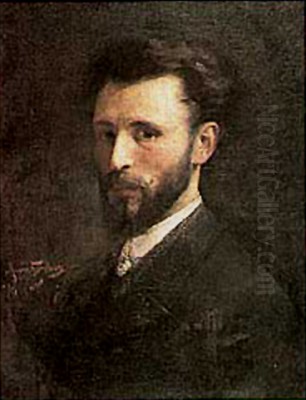
Maurycy Trebacz stands as a significant, yet poignant, figure in the landscape of Polish and Jewish art at the turn of the 19th to the 20th century. A painter of considerable talent and renown in his time, his life and career offer a window into the vibrant cultural milieu of Polish Jewry, its artistic aspirations, and the devastating impact of the Holocaust, which ultimately claimed his life. His work, predominantly in the Realist style, captured the essence of Jewish life, from intimate domestic scenes and characterful portraits to evocative landscapes, earning him accolades and a respected place among his contemporaries.
Early Life and Formative Influences in Warsaw
Born in Warsaw, Congress Poland (then part of the Russian Empire), in 1861, Maurycy Trebacz (also known by variations such as Moritz Trębacz) was the son of David Trebacz, a craftsman, specifically a painter and decorator or carpenter. This familial connection to artisanal work may have provided an early, albeit indirect, exposure to the world of visual creation. Warsaw at this time was a bustling city, a major center of Polish culture and, significantly, home to one of the largest Jewish populations in Europe. This environment, rich with its own traditions, social dynamics, and evolving identity, would profoundly shape Trebacz's artistic vision.
His formal artistic education began in his native Warsaw. He attended the Warsaw Drawing Class (Klasa Rysunkowa), a pivotal institution for aspiring artists in a Poland largely deprived of its own national higher art education establishments under foreign partitions. Here, he studied under the tutelage of notable Polish artists such as Wojciech Gerson, a leading figure of Polish Realism and an influential teacher, and Aleksander Kamiński. Gerson, in particular, emphasized meticulous observation, technical skill, and often drew upon Polish history and landscape for his subjects. This grounding in Realist principles would become a cornerstone of Trebacz's own artistic practice. The scholarship he received from Stanisław Rotwand in 1878 was instrumental in allowing him to pursue further studies.
Academic Pursuits: Krakow, Munich, and Paris
Recognizing the need for more advanced training, Trebacz, supported by the Rotwand scholarship, moved to Krakow in 1878 to enroll at the prestigious Krakow Academy of Fine Arts (Szkoła Sztuk Pięknych w Krakowie). This institution was then under the towering influence of Jan Matejko, Poland's most celebrated historical painter. Matejko's grand, dramatic canvases depicting key moments in Polish history were iconic, and his pedagogical approach, while rigorous, fostered a generation of artists. At Krakow, Trebacz studied under Matejko himself, as well as other respected professors like Leopold Löffler, known for his genre scenes and historical paintings, and Władysław Łuszczkiewicz, a painter and art historian who also emphasized historical subjects and meticulous technique. The Krakow environment, steeped in Polish national sentiment and artistic tradition, further honed his skills in academic drawing and painting.
In 1882, Trebacz's quest for artistic development led him to Germany, specifically to the Royal Academy of Fine Arts in Munich (Akademie der Bildenden Künste München). The Munich School was a dominant force in European academic art in the latter half of the 19th century, renowned for its dark palette, dramatic lighting, and a particular brand of Realism often applied to genre scenes and historical subjects. Many Polish artists, including luminaries like Józef Brandt, Maksymilian Gierymski, Aleksander Gierymski, and Alfred Wierusz-Kowalski, had studied or were active in Munich, forming a significant Polish artistic colony. In Munich, Trebacz is noted to have studied under professors such as Alexander von Wagner (Sándor Wagner), a Hungarian-born painter known for his large-scale historical compositions. This period exposed him to broader European artistic currents and further solidified his Realist inclinations.
The final significant phase of his formal education took place in Paris, the undisputed art capital of the world. From approximately 1884 to 1889, Trebacz studied at the Académie Colarossi. This was one of several private art academies in Paris that offered an alternative to the more rigid, official École des Beaux-Arts. The Académie Colarossi was known for its progressive atmosphere, allowing female students and offering life drawing classes with both male and female models. Paris in the 1880s was a crucible of artistic innovation, with Impressionism having already made its mark and Post-Impressionist movements beginning to emerge. While Trebacz remained largely committed to Realism, his time in Paris would have undoubtedly exposed him to these avant-garde developments, subtly broadening his artistic perspective.
Artistic Style, Themes, and Prominent Works
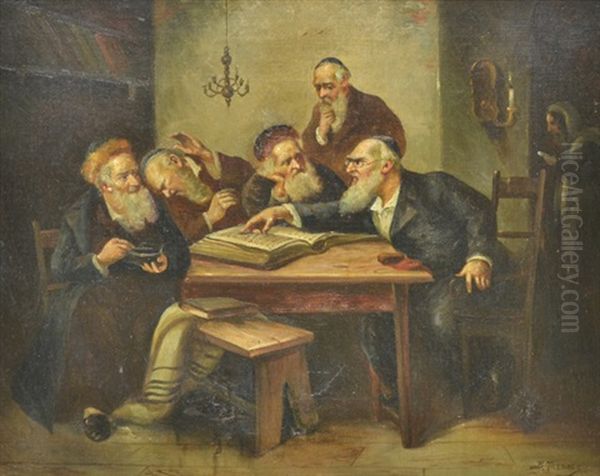
Maurycy Trebacz's artistic output is primarily characterized by Realism, a style that sought to depict subjects truthfully, without artificiality and avoiding exotic or supernatural elements. His particular strength lay in genre painting, especially scenes depicting contemporary Jewish life in Poland. These were not romanticized or overly sentimental portrayals but rather observations of daily existence, imbued with a sense of authenticity and empathy. He painted praying rabbis, elderly men and women whose faces told stories of experience, bustling street scenes from Jewish quarters, and intimate family moments. These works provide invaluable visual documentation of a world that would soon be largely annihilated.
His portraiture was also highly regarded. He possessed a keen ability to capture not only the likeness but also the character and psychological depth of his sitters. Beyond Jewish themes, Trebacz also painted landscapes, demonstrating a sensitivity to atmosphere and the natural environment. His technique was solid, built upon the academic training he had received, characterized by competent drawing, balanced composition, and often a rich, though sometimes somber, color palette reminiscent of the Munich School.
Among his most recognized works is "The Good Samaritan." This painting, a subject with biblical origins often explored by artists for its moral and humanistic message, reportedly earned him a gold medal at the World's Columbian Exposition in Chicago in 1893. This international recognition underscores the quality and appeal of his work beyond Polish borders. The painting was later noted as having been sold at a Sotheby's auction, indicating its continued market presence.
Another significant piece is "Jankiel Cembalisty" (Jankiel the Cymbalist). Jankiel is a beloved character from Adam Mickiewicz's epic Polish poem "Pan Tadeusz," a Jewish innkeeper and patriot who plays the dulcimer, his music evoking powerful national memories. Trebacz's depiction of this character would have resonated deeply within the Polish cultural context, bridging Jewish and Polish identities. This work is noted as being in a private collection.
The painting "Stara Włoszka" (Old Italian Woman), dated 1886, now housed in the National Museum in Poznań, showcases his skill in portraiture and character study, likely a fruit of his travels or studies abroad. Other thematic concerns included historical compositions and allegorical scenes, though his genre paintings of Jewish life remain his most distinctive contribution.
Career in Łódź: Teaching and Artistic Community
After completing his extensive studies abroad, Maurycy Trebacz eventually settled in Łódź. This industrial city was a major textile manufacturing hub and, like Warsaw, had a very large and dynamic Jewish population. It was a city of contrasts, with rapid industrial growth existing alongside significant poverty, but also a place of vibrant cultural activity. In Łódź, Trebacz became an active and respected member of the artistic community.
Significantly, he founded and ran a private art school in Łódź. This endeavor highlights his commitment to art education and his desire to nurture talent within his community. His school would have provided an important venue for aspiring artists, particularly Jewish students who might have faced barriers elsewhere, to receive formal training. As a teacher, he would have imparted the principles of Realism and academic technique that he himself had mastered.
Trebacz was part of a notable generation of Polish-Jewish artists who sought to engage with modern European art while also exploring their own cultural heritage. He, along with contemporaries such as Samuel Hirszenberg (known for his poignant depictions of Jewish suffering and diaspora), Leopold Pilichowski (who also focused on Jewish life and later Zionist themes), and Jakub Weinles (another painter of Jewish genre scenes), helped to define a distinct Polish-Jewish artistic voice. These artists, and others like Artur Markowicz and Wilhelm Wachtel, were among the first generations to widely break from the traditional Jewish religious prohibition against the depiction of the human form, embracing figurative art as a means of cultural expression and social commentary. They navigated the complex identities of being both Polish and Jewish, their art often reflecting this duality. Earlier figures like Maurycy Gottlieb, who died young but produced seminal works on Jewish historical and religious themes, had paved the way for this generation.
Trebacz's works were exhibited widely and successfully, not only in Poland (Warsaw, Krakow, Łódź) but also internationally in cities like Berlin, Munich, Paris, and, as mentioned, Chicago. This indicates a considerable reputation during his lifetime. He was considered one of the most popular and respected Jewish painters in Poland in the late 19th and early 20th centuries.
The Shadow of the Holocaust and Tragic End
The rise of Nazism in Germany and the subsequent invasion and occupation of Poland in 1939 brought an abrupt and horrific end to the vibrant Jewish life and culture that Trebacz had so often depicted. Łódź, renamed Litzmannstadt by the occupiers, became the site of the second-largest Jewish ghetto established by the Nazis. The Litzmannstadt Ghetto was a place of unimaginable suffering, starvation, disease, and forced labor, serving as a holding pen before eventual deportation to extermination camps.
Maurycy Trebacz, by then an elderly man, was among the hundreds of thousands of Jews imprisoned within the confines of the Łódź Ghetto. The harsh conditions took their toll. In 1941, Maurycy Trebacz died of starvation and exhaustion in the ghetto. His death was a profound loss, not only for his family and friends but also for the world of art. He was one of countless artists, writers, musicians, and intellectuals whose lives and creative potential were extinguished by the Holocaust.
Many of Trebacz's paintings were lost or destroyed during World War II and the Holocaust, a common fate for the cultural heritage of European Jewry. The systematic looting and destruction of art, libraries, and archives by the Nazis aimed to erase Jewish culture from existence. Despite these losses, a number of his works have survived in public and private collections, bearing silent witness to his talent and the world he inhabited.
Legacy and Remembrance
Maurycy Trebacz's legacy is multifaceted. Artistically, he is remembered as a skilled Realist painter who made a significant contribution to Polish art and, more specifically, to the genre of Jewish art. His depictions of Jewish life in Poland are invaluable historical and cultural documents, offering insights into the customs, traditions, and social fabric of a community that was largely decimated. He captured the humanity, dignity, and everyday realities of his subjects with sensitivity and skill.
His role as an educator through his private art school in Łódź also forms part of his legacy, having contributed to the artistic development of a younger generation. He was a bridge figure, trained in the major art centers of Europe, who brought his expertise back to his community, fostering local artistic talent.
The tragic circumstances of his death in the Łódź Ghetto serve as a stark reminder of the devastating human cost of hatred and intolerance. Remembering artists like Maurycy Trebacz is not only an act of art historical recognition but also an act of remembrance for the victims of the Holocaust. His surviving works, though fewer than what he produced in a long career, continue to speak to us, offering glimpses into a lost world and celebrating the enduring power of the human spirit to create even in the face of adversity. His art, alongside that of his contemporaries like Józef Chełmoński or Leon Wyczółkowski in the broader Polish Realist and Impressionist scenes, contributes to the rich tapestry of European art at a time of profound social and artistic change. The efforts of museums and scholars to preserve and study his work ensure that his contributions are not forgotten.