Michel Garnier (1753–1819) was a French painter whose career spanned one of the most tumultuous and transformative periods in French history. Active from the final decades of the Ancien Régime, through the French Revolution, the Napoleonic Empire, and into the early Bourbon Restoration, Garnier specialized in genre painting, capturing the intimate scenes, social customs, and everyday life of his contemporaries. Though perhaps not as widely known today as some of his peers who focused on grand history painting or official portraiture, Garnier’s work offers a valuable and charming window into the private worlds and subtle narratives of late 18th and early 19th-century Parisian society. His paintings are characterized by their lively compositions, vibrant color palettes, and meticulous attention to detail, reflecting both the lingering elegance of the Rococo and the burgeoning clarity of Neoclassicism, all while hinting at the nascent sentimentalism of Romanticism.
The Life and Artistic Milieu of Michel Garnier
Born in France in 1753, Michel Garnier entered a world where the arts were flourishing, albeit under a system dominated by the Académie Royale de Peinture et de Sculpture. This institution, founded in 1648, held sway over artistic training, official commissions, and public exhibitions, most notably the Paris Salon. For an artist to gain recognition and patronage, acceptance into the Académie and successful showings at the Salon were often crucial. While specific details about Garnier's early training remain somewhat elusive in comprehensive records, it is certain he would have been immersed in this highly structured and competitive artistic environment.
The late 18th century was a period of stylistic transition. The Rococo style, with its emphasis on lightness, asymmetry, playful eroticism, and aristocratic leisure, as exemplified by artists like Jean-Honoré Fragonard (1732-1806) and François Boucher (1703-1770), was gradually giving way to the more austere, moralizing, and classically inspired Neoclassical movement. Neoclassicism, championed by figures such as Jacques-Louis David (1748-1825), drew on the art and values of ancient Greece and Rome, emphasizing order, reason, and civic virtue. Garnier’s work seems to navigate a path between these dominant styles, often infusing Rococo charm with a more grounded, realistic depiction of his subjects.
Genre Painting: The Art of Everyday Life
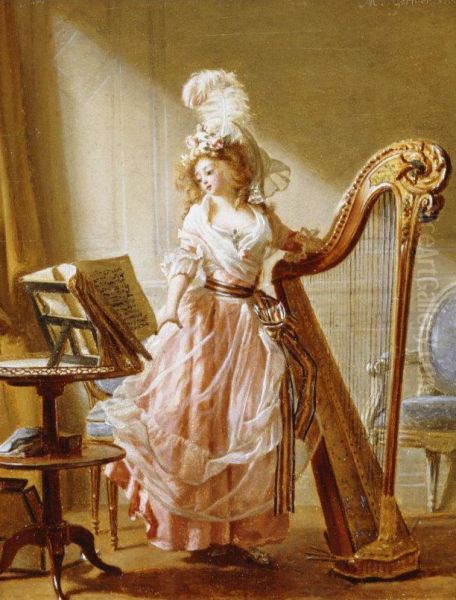
Michel Garnier dedicated himself to "scène de genre," or genre painting. This category of art focuses on scenes from everyday life, featuring ordinary people (or aristocrats in informal settings) engaged in common activities. Unlike history painting, which depicted grand mythological, religious, or historical events and was considered the highest form of art by the Académie, genre painting offered a more intimate and often relatable view of the human experience. Artists like Jean-Baptiste-Siméon Chardin (1699-1779) had earlier elevated genre painting in France with his quiet, dignified portrayals of domestic life.
Garnier’s genre scenes are noted for their narrative quality. He often depicted moments of courtship, musical interludes, domestic discussions, or social interactions that hint at a larger story. His figures are expressive, and the settings are rendered with care, filled with details of costume, furniture, and decor that provide rich contextual information about the period. This attention to the minutiae of daily existence makes his work particularly valuable for social historians as well as art lovers. The appeal of genre painting was growing during this period, particularly among the rising bourgeois class, who appreciated depictions of life that resonated with their own experiences or aspirations.
Artistic Style: Color, Detail, and Narrative
Garnier's paintings are often characterized by their bright, appealing colors and a smooth, polished finish. He demonstrated a keen observational skill, capturing the textures of fabrics, the sheen of polished wood, and the delicate play of light. His compositions are typically well-balanced, drawing the viewer's eye to the central narrative action. While his figures may not possess the heroic grandeur of David's characters, they have a lifelike quality and psychological presence that makes them engaging.
One recurring motif in Garnier's work is the depiction of musical instruments, particularly the guitar. In the art of 18th and early 19th-century France, the guitar often symbolized romantic love, courtship, and intimate social gatherings. Its inclusion in a scene could add a layer of sentimental or amorous meaning. Garnier’s paintings featuring musicians, such as young women playing the guitar or music lessons, tap into this symbolism, creating scenes that are both visually pleasing and emotionally resonant. This focus on music and its social role aligns him with other contemporary painters who explored similar themes, like Louis-Léopold Boilly (1761-1845), known for his crowded Parisian street scenes and intimate interiors.
The era in which Garnier worked was one of profound social upheaval. The French Revolution (1789-1799) dramatically altered the social fabric, and the subsequent Napoleonic period brought its own set of cultural influences. While Garnier’s work doesn't typically engage directly with the overt political turmoil of his time in the way David’s revolutionary paintings did, his scenes of domestic life and social interaction implicitly reflect the evolving manners, fashions, and preoccupations of a society in flux. The subtle dramas played out in his paintings – a lovers' quarrel, a shared confidence, a moment of quiet reflection – speak to universal human experiences set against a specific historical backdrop.
Masterpiece in Focus: "The Interrupted Marriage Contract"
Among Michel Garnier’s most recognized works is "Le contrat de mariage interrompu" (The Interrupted Marriage Contract). Painted around 1789, this oil on canvas, measuring 54.5 cm by 65.3 cm, is a prime example of his skill in narrative genre painting. The work is housed in the Musée Carnavalet in Paris, a museum dedicated to the history of the city, making it a fitting repository for a painting that so vividly captures a moment of Parisian social life from that era.
The painting depicts a dramatic interior scene. Several figures are gathered, presumably for the signing of a marriage contract, a common practice among the affluent classes to formalize the financial and property arrangements of a forthcoming union. However, as the title suggests, the proceedings have been disrupted. The exact nature of the interruption is left somewhat ambiguous, inviting the viewer to interpret the emotions and relationships of the characters. Is it a last-minute revelation, a sudden change of heart, or an unexpected objection?
The figures' expressions and postures are key to the drama: a distressed young woman, perhaps the bride-to-be, might be comforted by an older woman, while a man, possibly the groom or a legal representative, could appear consternated or authoritative. Garnier’s meticulous rendering of costumes, furniture, and the legal documents on the table grounds the scene in a specific social and historical context. The painting showcases his ability to combine detailed realism with a compelling narrative, creating a "conversation piece" that would have sparked discussion and interpretation among its contemporary viewers. The choice of subject, a pivotal moment in family and social life, resonated with the interests of the time, where matters of love, marriage, and inheritance were frequent themes in literature and art.
The Musée Carnavalet itself is a significant institution. Located in the historic Marais district, it comprises two magnificent private mansions, the Hôtel Carnavalet and the Hôtel Le Peletier de Saint-Fargeau. Its collections trace the history of Paris from its origins to the present day, encompassing paintings, sculptures, furniture, decorative arts, and historical artifacts. Garnier's painting, within this context, serves not just as a work of art but as a historical document, offering insights into the customs and social dynamics of late 18th-century Paris.
The Delicate Art of Miniatures
Beyond his larger genre paintings, Michel Garnier was also known for his work as a miniaturist, creating small, intimate portraits, particularly of aristocratic young ladies. Miniature painting was a highly valued art form in the 18th and 19th centuries, prized for its portability, personal nature, and the exquisite skill required. These small portraits were often set into jewelry, lockets, or decorative boxes, serving as keepsakes, love tokens, or symbols of familial affection.
The tradition of miniature painting had a long history, with notable practitioners like Nicholas Hilliard (c. 1547–1619) in Elizabethan England and Jean-Baptiste Isabey (1767-1855), a French contemporary of Garnier who was a celebrated miniaturist favored by Napoleon and the European aristocracy. Creating a successful miniature demanded incredible precision, a steady hand, and the ability to capture a likeness and personality within a very confined space, often painted on ivory or vellum.
Garnier’s miniatures of noblewomen would have served as cherished mementos, preserving the likenesses of daughters and sisters, and often exchanged within elite social circles. These works, sometimes preserved with their ornate original frames, stand as testaments to the personal and sentimental value placed on portraiture, offering a more private counterpoint to the public display of larger oil paintings. The skill involved in rendering delicate features, intricate hairstyles, and fashionable attire on such a small scale highlights Garnier's versatility as an artist.
Garnier's Contemporaries and the Artistic Landscape
To fully appreciate Michel Garnier's place in art history, it's helpful to consider him alongside other artists of his time. The late 18th and early 19th centuries were rich with diverse talents.
Jean-Baptiste Greuze (1725-1805) was another prominent genre painter, known for his sentimental and moralizing scenes of family life, which enjoyed immense popularity. While Garnier’s work shares Greuze’s interest in narrative and emotion, it often possesses a lighter, less overtly didactic touch.
The aforementioned Louis-Léopold Boilly (1761-1845) was a prolific painter of Parisian life, creating detailed and often humorous scenes of urban crowds, bourgeois interiors, and artists' studios. His work, like Garnier's, provides a rich visual record of the period's social tapestry.
Élisabeth Vigée Le Brun (1755-1842), one of the most successful female artists of her time, was renowned for her elegant portraits, particularly of Queen Marie Antoinette and other European aristocrats. While primarily a portraitist, her work shares Garnier's refined aesthetic and attention to the fashionable details of her sitters.
Marguerite Gérard (1761-1837), sister-in-law and student of Fragonard, also excelled in genre scenes, often depicting intimate domestic moments with a delicate touch and a focus on female subjects. Her work, like Garnier's, captures the nuances of private life.
In the realm of Neoclassicism, beyond Jacques-Louis David, artists like Jean-Auguste-Dominique Ingres (1780-1867), though his major impact came slightly later, began to emerge, pushing the boundaries of classical form and line. Ingres, a student of David, would become a dominant figure in French academic art.
The stirrings of Romanticism were also becoming evident. Théodore Géricault (1791-1824), with his dramatic and emotionally charged works like "The Raft of the Medusa" (exhibited in 1819, the year of Garnier's death), and Eugène Delacroix (1798-1863), who would become the leading figure of French Romantic painting, were beginning their careers as Garnier's was concluding. Their emphasis on passion, individualism, and the sublime offered a stark contrast to the order of Neoclassicism and the polite charm of much genre painting.
Even earlier figures cast long shadows. The influence of Antoine Watteau (1684-1721), whose "fêtes galantes" depicted idyllic scenes of aristocratic leisure and courtship, could still be felt in the refined sensibility of some later genre painters. Similarly, the quiet dignity of Jean-Baptiste-Siméon Chardin's domestic scenes provided a lasting model for artists seeking to ennoble the everyday.
Garnier’s career also overlapped with artists who specialized in other areas, such as the landscape painter Hubert Robert (1733-1808), known for his picturesque views of ruins and gardens, or the sculptor Jean-Antoine Houdon (1741-1828), celebrated for his lifelike portrait busts of leading figures of the Enlightenment. This vibrant and diverse artistic ecosystem formed the backdrop against which Michel Garnier created his charming and insightful works.
Legacy and Historical Significance
Michel Garnier may not have achieved the monumental fame of David or the enduring romantic allure of Fragonard, but his contribution to French art is nonetheless significant. As a dedicated genre painter, he meticulously documented the customs, fashions, and intimate moments of Parisian life during a period of profound change. His works serve as visual chronicles, offering glimpses into the drawing-rooms, boudoirs, and social interactions of a bygone era.
His paintings, such as "The Interrupted Marriage Contract," demonstrate a fine balance of technical skill, narrative interest, and aesthetic appeal. They capture the subtle psychological dramas of everyday existence, rendered with a clarity and charm that would have appealed to his contemporary audience and continues to engage viewers today. The inclusion of his work in the Musée Carnavalet underscores its value not only as art but also as a historical document, preserving aspects of Parisian culture that might otherwise be lost to time.
His miniatures, too, speak to a particular aspect of the period's artistic and social life – the desire for personal, portable likenesses that could be cherished as tokens of affection or remembrance. In a world before photography, such works held immense personal value.
While comprehensive scholarly monographs on Michel Garnier might be less common than those on his more famous contemporaries, his paintings appear in collections and are studied within the broader context of late 18th and early 19th-century French genre painting. His work helps to flesh out our understanding of the artistic diversity of the period, reminding us that beyond the grand statements of history painting and official portraiture, there was a rich tradition of art that focused on the more personal and relatable aspects of human experience.
Conclusion: A Painter of His Time
Michel Garnier (1753-1819) navigated a complex and evolving artistic landscape, creating a body of work that reflects both the enduring traditions of French painting and the shifting sensibilities of his era. His genre scenes and delicate miniatures offer a charming and insightful perspective on the private lives and social customs of late 18th and early 19th-century Parisians. With a keen eye for detail, a pleasing use of color, and a talent for narrative, Garnier captured moments of intimacy, romance, and everyday drama. His paintings, preserved in collections like the Musée Carnavalet, continue to provide valuable glimpses into a pivotal period in French history, securing his place as a noteworthy chronicler of his time. His art stands as a testament to the enduring appeal of scenes that, while rooted in a specific historical moment, speak to the timeless themes of human connection and daily life.