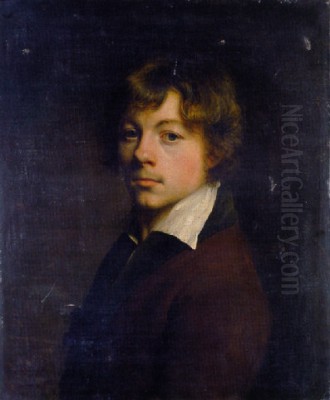
Michel-Martin Drolling (1786–1851) stands as a significant, if sometimes understated, figure in the landscape of early 19th-century French art. Born into an artistic family in Paris, his career unfolded during a period of profound political and cultural transformation in France, bridging the austere Neoclassicism of the Napoleonic era with the burgeoning Romantic sensibilities and the academic traditions that would dominate much of the century. Drolling was a painter of historical scenes, portraits, and religious subjects, respected for his technical skill, his dedication to the classical ideal, and his influential role as an educator.
Early Life and Artistic Foundations
Michel-Martin Drolling was born in Paris on March 7, 1786. His artistic journey began under the tutelage of his father, Martin Drolling (1752–1817), a painter of Alsatian origin known for his meticulous genre scenes and interiors, often reminiscent of Dutch Golden Age masters like Pieter de Hooch or Gabriël Metsu. This early exposure to a tradition valuing detailed observation and intimate settings likely provided a foundational counterpoint to the grander, more heroic style he would later embrace.
The elder Drolling, though not a member of the prestigious Royal Academy, enjoyed considerable success with a bourgeois clientele who appreciated his charming depictions of everyday life, such as his famous "Interior of a Kitchen" (1815, Louvre Museum). This domestic artistic environment undoubtedly shaped young Michel-Martin's initial understanding of painting, emphasizing craftsmanship and a keen eye for detail.
However, to truly make his mark in the highly competitive Parisian art world of the early 19th century, aspiring artists sought training in the studios of the leading masters. In 1806, Michel-Martin Drolling made a pivotal decision by entering the studio of Jacques-Louis David (1748–1825). David was the undisputed titan of French Neoclassicism, a revolutionary figure whose art and pedagogy had reshaped French painting. His studio was a crucible where a generation of artists, including luminaries like Jean-Auguste-Dominique Ingres, Antoine-Jean Gros, François Gérard, and Anne-Louis Girodet de Roussy-Trioson, were forged.
Under David's exacting eye, Drolling would have been immersed in the core tenets of Neoclassicism: the primacy of drawing, the study of classical antiquity and Renaissance masters like Raphael, the pursuit of moral and intellectual clarity, and the depiction of noble, often heroic, subjects drawn from history, mythology, and scripture. David's emphasis on anatomical precision, compositional rigor, and a smooth, polished finish became hallmarks of his students' work.
The Prix de Rome and Italian Sojourn
The ultimate ambition for many young artists in David's studio, and indeed across France, was to win the prestigious Prix de Rome. This state-sponsored prize, awarded by the Académie des Beaux-Arts, offered the victor a scholarship to study at the French Academy in Rome, providing unparalleled access to the masterpieces of classical antiquity and the Italian Renaissance.
In 1810, Michel-Martin Drolling achieved this coveted honor. His winning entry was "The Wrath of Achilles" (École Nationale Supérieure des Beaux-Arts, Paris), a quintessential Neoclassical history painting. The subject, drawn from Homer's Iliad, depicts the moment Achilles, enraged by Agamemnon's seizure of his war prize Briseis, is restrained by the goddess Athena from drawing his sword against the Greek king. Drolling’s composition demonstrated his mastery of Davidian principles: a frieze-like arrangement of figures, clear narrative gestures, idealized anatomy, and a focus on dramatic tension and moral conflict.
Winning the Prix de Rome was a significant turning point. It not only validated his talent but also provided him with the means to spend approximately six years in Italy, from roughly 1811 to 1816. This period was crucial for any artist steeped in the classical tradition. In Rome, Drolling would have diligently copied ancient sculptures, studied the works of Raphael, Michelangelo, and other Renaissance and Baroque masters, and absorbed the atmosphere of the Eternal City. This direct engagement with the sources of Neoclassicism undoubtedly deepened his artistic understanding and refined his style. His contemporaries in Rome would have included other Prix de Rome laureates, fostering an environment of shared learning and friendly rivalry.
Artistic Style and Thematic Concerns
Upon his return to Paris, Drolling established himself as a painter of historical and religious subjects, as well as portraits. His style remained firmly rooted in the Neoclassical tradition he had inherited from David, characterized by precise drawing, balanced compositions, smooth brushwork, and a somewhat cool, clear palette. His figures are often statuesque, embodying a sense of dignity and gravitas.
His historical paintings often depicted scenes from classical antiquity or French history, rendered with a concern for archaeological accuracy and narrative clarity. Works like "The Death of Abel," exhibited at the Paris Salon of 1817, showcased his ability to convey pathos and drama within a controlled, classical framework. The painting was praised for its dramatic intensity and bright coloration, indicating a subtle evolution from the more severe palette sometimes associated with David's earlier works.
Drolling also received commissions for large-scale decorative works. He was tasked with creating official murals for King Charles X, contributing to projects such as the decoration of the ceilings in the Louvre Museum. One notable example is "The Law Descends to Earth, Establishing its Dominion and Distributing its Benefits," a grand allegorical work. These public commissions underscored his standing within the official art establishment.
Beyond grand history painting, Drolling also produced portraits that were noted for their refined execution and psychological insight. While adhering to Neoclassical ideals of clarity and order, his portraiture often revealed a sensitivity to the individual character of his sitters. He also painted religious scenes, such as "Jesus Among the Doctors," which continued the tradition of depicting biblical narratives with clarity and devotional feeling.
While his primary output was in the Neoclassical vein, some art historians note a subtle undercurrent in his work, perhaps a lingering influence from his father's genre painting or a response to the changing tastes of the era. There's a certain delicacy and attention to detail in his work that, while not overtly Romantic, suggests an appreciation for finer nuances. His works, such as "The Good News" (1806), which depicts a father receiving a letter from his son, show an early inclination towards more intimate, sentimental themes, even before his full immersion in David's heroic classicism.
Academic Career and Influence as a Teacher
Michel-Martin Drolling's contributions to French art extended beyond his own canvases. In 1833, he was elected a member of the prestigious Académie des Beaux-Arts, one of the five academies of the Institut de France, succeeding his former master, Jacques-Louis David (who had died in exile), in his chair. This was a significant honor, recognizing his stature in the French art world.
Shortly thereafter, in 1837, he was appointed a professor at the École des Beaux-Arts, the leading state-sponsored art school in France. This position allowed him to directly shape the next generation of artists. As a teacher, Drolling would have perpetuated the academic tradition, emphasizing rigorous training in drawing, anatomy, and perspective, and the study of classical and Renaissance models. His studio at the École des Beaux-Arts became a respected training ground.
Among his notable pupils were several artists who went on to achieve recognition in their own right:
Paul Baudry (1828–1886): Known for his elegant portraits and large-scale decorative paintings, most famously the decorations for the foyer of the Paris Opéra.
Jean-Jacques Henner (1829–1905): Often referred to as Jean-Jacques Henrion in some older texts, Henner became celebrated for his ethereal, sfumato-laden nudes and portraits, often with a distinctive reddish-brown palette.
Charles Joshua Chaplin (1825–1891): An English-born painter who became a naturalized French citizen, Chaplin was known for his graceful and often sensuous portraits of women and genre scenes, popular during the Second Empire. An anecdote suggests that Chaplin initially aimed for history painting but, under Drolling's guidance, shifted towards subjects that better suited his talents.
William Strutt (1825–1915): An English artist who studied with Drolling and later worked in Australia, known for his historical paintings and depictions of Australian life.
Charles Bargue (c. 1826/1827–1883): Though he produced relatively few paintings, Bargue is highly regarded for his exquisite draftsmanship and his collaboration with Jean-Léon Gérôme on the influential Cours de Dessin (Drawing Course), a set of lithographs widely used for art instruction.
Drolling's role as an educator was crucial in transmitting the principles of academic art to his students, even as artistic styles began to diversify with the rise of Romanticism, led by figures like Théodore Géricault and Eugène Delacroix, and later, Realism under Gustave Courbet.
Influences, Contemporaries, and Artistic Milieu
Drolling's artistic development was shaped by several key influences. His father, Martin Drolling, provided his initial training and an appreciation for the meticulous detail of Dutch masters like Gerrit van Honthorst and Frans Hals, though the latter's looser style contrasts with the polished finish of Neoclassicism. The overwhelming influence of Jacques-Louis David defined his mature Neoclassical style.
He was a contemporary of other prominent Davidian pupils who dominated French art in the early to mid-19th century. Jean-Auguste-Dominique Ingres, perhaps David's most famous student, became a staunch defender of classical principles and a rival to the Romantic painter Eugène Delacroix. Antoine-Jean Gros and François Gérard also achieved great success, particularly with Napoleonic propaganda and portraiture.
The artistic landscape Drolling inhabited was dynamic. While Neoclassicism, championed by the Academy, remained the dominant official style for a considerable period, Romanticism offered a powerful alternative, emphasizing emotion, individualism, and often exotic or medieval subjects. Artists like Théodore Géricault, with his dramatic "Raft of the Medusa," and Delacroix, with his vibrant colors and dynamic compositions, challenged Neoclassical austerity.
Drolling also seems to have been aware of the work of artists like Louis-Léopold Boilly (1761–1845), a painter of charming genre scenes and portraits whose detailed style and focus on contemporary Parisian life found a wide audience. Later in his career, the meticulous realism and historical genre scenes of Jean-Louis Ernest Meissonier (1815–1891) would become immensely popular, suggesting a continued appreciation for detailed, narrative painting.
Drolling navigated this evolving art world by adhering to his classical training while also producing works that appealed to contemporary tastes. His participation in the Paris Salon, the official art exhibition, was crucial for showcasing his work and securing commissions. He exhibited regularly, presenting major historical and religious paintings that affirmed his academic credentials.
Navigating a Changing World: Personal Life and Challenges
Michel-Martin Drolling lived through some of France's most turbulent historical periods: the First French Empire under Napoleon, the Bourbon Restoration, the July Monarchy, and the Second Republic. Unlike his master David, who was deeply involved in the French Revolution and later became First Painter to Napoleon, Drolling appears to have maintained a more politically discreet profile. This was a common path for many artists who wished to continue their careers without being overly compromised by shifting political tides.
His personal life seems to have been relatively stable. He came from an artistic family, and his son, also named Michel-Martin Drolling (though often referred to with a distinguishing middle name or as "the younger" to avoid confusion, though this is less common in art historical records for the son), also pursued an artistic career, continuing the family tradition. His mother was from a noble family, which might have provided certain social advantages.
The primary challenges for Drolling, like for many artists of his time, would have been securing patronage, competing for commissions, and maintaining his reputation within the academic system. The Salon system was highly competitive, and critical reception could significantly impact an artist's career. Drolling's consistent success in gaining entry to the Salon, winning the Prix de Rome, and eventually becoming an Academician and professor indicates a high degree of professional achievement.
In 1837, his contributions were further recognized when he was made a Chevalier de la Légion d'Honneur (Knight of the Legion of Honour), a prestigious French order of merit.
Legacy and Art Historical Reception
Michel-Martin Drolling passed away in Paris on January 9, 1851, at the age of 64. At the time of his death, he was a respected figure within the French art establishment, known for his adherence to classical principles and his role as an influential teacher.
In the decades following his death, as new artistic movements like Realism, Impressionism, and Post-Impressionism gained prominence, the academic art of figures like Drolling was often overshadowed or viewed critically by proponents of the avant-garde. Neoclassicism, once the pinnacle of artistic achievement, came to be seen by some as rigid and overly formulaic.
However, art historical evaluations are rarely static. In the 20th and 21st centuries, there has been a renewed scholarly interest in 19th-century academic art. Historians now recognize the technical skill, intellectual depth, and cultural significance of artists who worked within this tradition. Drolling's work is seen as representative of a key phase in French art, demonstrating the enduring power of the classical ideal and its adaptation to the changing cultural landscape of the 19th century.
His paintings are held in major French museums, including the Louvre, the École Nationale Supérieure des Beaux-Arts in Paris, and various regional museums. While he may not have achieved the same level of fame as Ingres or Delacroix, his contributions as a painter and educator were substantial. He played a vital role in maintaining and transmitting the academic tradition, which, despite its later critiques, provided a rigorous foundation for countless artists.
His historical paintings, such as "The Wrath of Achilles" and "The Death of Abel," are valued for their compositional clarity and dramatic force. His portraits are appreciated for their refined execution. His large-scale decorative works for the Louvre attest to his ability to handle complex allegorical subjects on a grand scale.
The evolution of his style, from the Davidian Neoclassicism of his early career to a style that, while still classical, perhaps incorporated a greater softness or attention to intimate detail, reflects the broader shifts in artistic sensibility during his lifetime. He successfully bridged the gap between the heroic Neoclassicism of the Napoleonic era and the more eclectic academicism of the mid-19th century.
Conclusion
Michel-Martin Drolling was a dedicated and accomplished artist who made significant contributions to French Neoclassical painting. From his early training with his father and his formative years in the studio of Jacques-Louis David, to his success in winning the Prix de Rome and his long career as a painter and influential professor at the École des Beaux-Arts, Drolling exemplified the ideals of the academic tradition.
His work, characterized by technical proficiency, compositional harmony, and a commitment to classical themes and aesthetics, earned him respect and recognition during his lifetime. As an educator, he played a crucial role in shaping a new generation of artists, ensuring the continuity of academic principles even as the art world around him was undergoing profound changes. While perhaps not a radical innovator, Michel-Martin Drolling remains an important figure for understanding the richness and complexity of French art in the first half of the 19th century, a testament to the enduring appeal of the classical tradition and the dedication of its practitioners. His legacy is preserved not only in his own paintings but also in the work of the many students he inspired.