Octavius Oakley (1800-1867) stands as a notable figure in the rich tapestry of 19th-century British art. Primarily celebrated for his exquisite watercolour portraits, often on a miniature scale, and his evocative depictions of rustic life, particularly scenes involving the Romani people or "travellers," Oakley carved a distinct niche for himself during a vibrant period of artistic development in Britain. His career spanned a time of significant change in artistic tastes and the burgeoning status of watercolour as a serious and respected medium.
Early Life and Artistic Emergence
Born in London in 1800, the precise details of Octavius Oakley's early artistic training remain somewhat elusive, a commonality for many artists of his era who did not emerge from established artistic dynasties or the most prestigious academies from a young age. However, it is clear that he developed a considerable talent, particularly in the demanding medium of watercolour. He initially resided and worked outside the bustling art capital, spending time in both Leamington Spa and Derby. These provincial settings likely provided him with ample subjects for his interest in everyday life and portraiture beyond the confines of high society, though he certainly catered to a genteel clientele as well.
His professional career gained significant traction in the 1820s. Oakley began exhibiting his works, a crucial step for any artist seeking recognition and patronage. Between 1826 and 1860, he was a consistent presence at the prestigious Royal Academy of Arts in London, where he exhibited a total of thirty portraits. This long association with the Academy underscores his acceptance within the mainstream art establishment and the consistent quality of his output. He also showcased his art at the galleries on Suffolk Street, another important venue for artists in London.
Mastery of Watercolour and Professional Affiliations
The 19th century witnessed a golden age for British watercolour painting. Artists like J.M.W. Turner and Thomas Girtin had, in the preceding decades, elevated the medium from its traditional role in topographical records and preparatory sketches to a vehicle for profound artistic expression. Oakley emerged within this flourishing tradition, contributing to its continued vitality. His technical proficiency in watercolour allowed him to capture subtle nuances of light, texture, and character, which were particularly vital for portraiture.
A significant milestone in Oakley's career was his move to London in 1842. This relocation to the heart of the British art world coincided with his election as a member of the Society of Painters in Water Colours (often referred to as the O.W.C.S. or the "Old Watercolour Society"). Membership in such a society was a mark of distinction, signifying peer recognition of an artist's skill and contribution to the medium. The O.W.C.S. held annual exhibitions that were important events in the London art calendar, providing a dedicated platform for watercolourists to display and sell their work, distinct from the oil-dominated Royal Academy. Oakley was an active participant, exhibiting not only portraits but also landscapes and genre scenes with the society. His involvement extended to exhibiting at other notable institutions, including the Birmingham Art Gallery (B.I.) and the South Kensington Museum (S.B.I.A.) between 1847 and 1848, further broadening his exposure.
The Art of Portraiture
Octavius Oakley's reputation was significantly built upon his skill as a portraitist. In an era before the widespread availability of photography, painted and drawn portraits were the primary means of capturing an individual's likeness for posterity. Oakley specialized in smaller-scale watercolour portraits, which offered an intimacy and delicacy that differed from the grander, often more formal, oil portraits by contemporaries like Sir Thomas Lawrence (who died in 1830 but whose influence lingered) or Sir George Hayter.
One of his notable commissions was the portrait of the young Francis Galton, executed in 1840. Galton, later a renowned scientist and polymath, was depicted by Oakley with features described as a "thin build, light hair, high forehead, and large eyes." While some critiques noted minor imperfections, such as the rendering of the mouth, the portrait is valued as a likeness of a significant historical figure in his youth. This work, like many of Oakley's portraits, aimed to capture not just a physical resemblance but also a sense of the sitter's character and presence. The survival of this portrait allows us to directly engage with Oakley's style in this genre.
Another significant portrait attributed to Oakley is that of Sarah Forbes Bonetta. Bonetta, an Egbado princess of Yoruba descent, was orphaned during a slave-hunt war, later liberated and became a goddaughter to Queen Victoria. Her life story was extraordinary, and portraits of her, including the one by Oakley, provide important visual records. Oakley's depiction would have captured her in the attire and context of her unique position within Victorian society, showcasing his ability to handle diverse subjects with sensitivity.
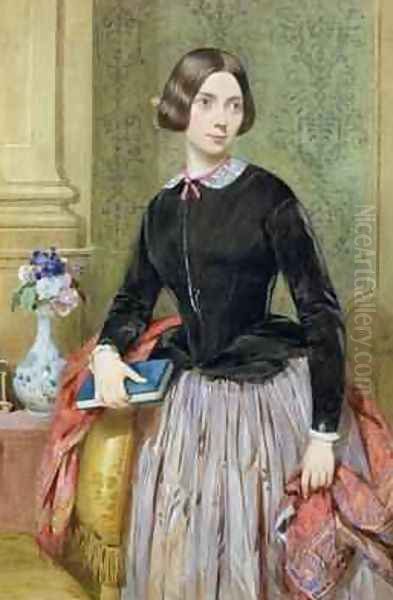
His work Portrait of a Lady, dated circa 1830, exemplifies his approach to female portraiture. This watercolour, measuring 29 x 23 cm, shows a woman in a white dress and a light blue scarf. Such works demonstrate Oakley's delicate brushwork, his ability to render fabrics and textures, and his creation of an elegant, composed image that conveys the sitter's grace. These intimate portraits were popular among the burgeoning middle and upper-middle classes who desired likenesses that were both accurate and aesthetically pleasing.
Depictions of Rustic Life and "Travellers"
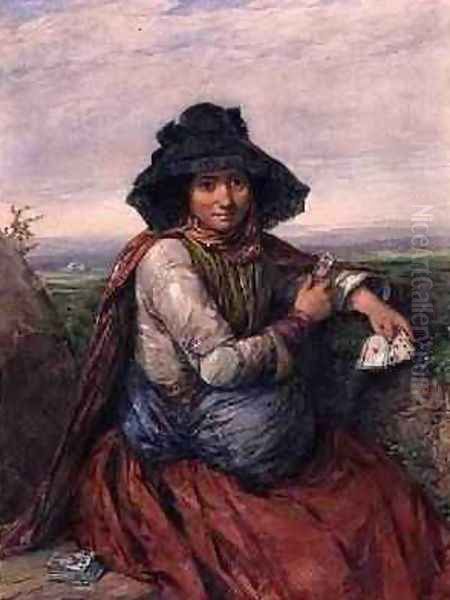
Beyond formal portraiture, Octavius Oakley was highly regarded for his depictions of rustic scenes and, notably, his portrayals of "travellers" or Romani people (often referred to as Gypsies in the parlance of the time). This interest aligned with a broader Romantic and Victorian fascination with the picturesque, the rural, and those perceived as living outside conventional societal norms. Artists like George Morland in an earlier generation, and later Augustus John, explored similar themes, though with different stylistic approaches.
Oakley's paintings of Romani figures were not merely ethnographic studies but were imbued with a sense of character and often a romanticised dignity. These works were praised and contributed significantly to his reputation. His ability to capture the distinctive attire, expressions, and perceived lifestyle of these communities resonated with contemporary audiences. These subjects allowed for a departure from the constraints of formal portraiture, offering opportunities for more dynamic compositions and narrative elements.
His painting Standing female harvester (47.5cm x 30cm) is a fine example of his work in rustic genre. This watercolour, likely heightened with white bodycolour to achieve opacity and highlights, would have depicted a figure central to the agricultural life of the period. Such works celebrated rural labour and the connection to the land, themes popular in Victorian art, as seen in the works of painters like Myles Birket Foster, who also specialized in idyllic rural scenes in watercolour. Oakley's treatment would have focused on the individual character of the harvester, blending portrait-like specificity with the broader genre subject.
Artistic Style and Technique
Octavius Oakley's artistic style is characterized by its refinement, meticulous detail, and sensitive handling of the watercolour medium. He demonstrated a keen understanding of light and shadow (chiaroscuro), using it to model forms and create a sense of depth and atmosphere in his compositions. His brushwork was typically precise, allowing for the delicate rendering of facial features, hair, and the textures of clothing and drapery.
In his portraits, he aimed for a balance between accurate representation and a pleasing aesthetic. The compositions were often straightforward but elegant, focusing attention on the sitter. The use of watercolour allowed for a luminosity and freshness, particularly in the rendering of skin tones and delicate fabrics. As seen in Standing female harvester, he was adept at combining transparent washes with opaque bodycolour (gouache) to achieve varied effects, from subtle gradations of tone to strong highlights.
His engagement with landscape elements, even in his portraits or genre scenes, suggests an awareness of the strong British landscape tradition, dominated by figures like John Constable and J.M.W. Turner. While Oakley was not primarily a landscape painter in the epic mould of Turner or the naturalistic vein of Constable, his rustic scenes and the backgrounds of his portraits often displayed a sensitive rendering of natural settings, contributing to the overall mood and context of the work. His style was perhaps more aligned with the picturesque sensibilities of artists like David Cox or Peter De Wint, who also excelled in watercolour landscapes and rustic scenes.
Influence and Contemporaries
While perhaps not as widely influential as some of his more famous contemporaries, Octavius Oakley's work did have an impact. Notably, he is credited with influencing the artist Louise Rayner (1832-1924). Rayner, known for her detailed watercolour paintings of British streets and buildings, became a prominent artist in her own right, and Oakley's guidance or example played a role in her development, helping her become recognized as a distinguished artist. This connection highlights Oakley's position within the artistic community, not just as a practitioner but also as a potential mentor or source of inspiration.
Oakley worked during a period of immense artistic diversity in Britain. The early part of his career overlapped with the towering figures of Romanticism, Turner and Constable. As his career progressed, the Victorian art scene saw the rise of various movements and trends. The Pre-Raphaelite Brotherhood, founded in 1848 by artists like Dante Gabriel Rossetti, John Everett Millais, and William Holman Hunt, challenged academic conventions with their emphasis on detail, vibrant colour, and literary or moral themes. While Oakley's style remained rooted in an earlier tradition, the broader artistic environment was dynamic and multifaceted. Other notable contemporaries included genre painters like William Powell Frith, known for his sprawling canvases of Victorian life, and narrative painters like Daniel Maclise.
The Oregon Journey: A Biographical Note
An interesting, though somewhat tangential, aspect of Octavius Oakley's life is a documented journey he undertook in 1839. He reportedly travelled from Independence, Missouri, to Oregon as part of a group of seventeen people with seven packhorses. Following his return to Peoria, Illinois, he authored a report on his experiences with this "Peoria Party." This account, which mentioned interactions with the Kaws (Kaw) tribe and observations about trade, was published in the National Intelligencer.
While this American adventure seems distinct from his artistic career in Britain, it speaks to a spirit of inquiry or perhaps a period of exploration in his life. It's unclear how or if these experiences directly informed his artistic output, which remained focused on British subjects. However, it adds a layer to his biography, suggesting a man with experiences beyond the confines of the artist's studio. Such journeys were not uncommon for Britons in the 19th century, driven by exploration, emigration, or adventure.
Legacy and Historical Evaluation
Octavius Oakley's artistic achievements lie primarily in his skilled and sensitive watercolour portraiture and his engaging depictions of rustic and Romani life. He was a respected member of the Society of Painters in Water Colours and a regular exhibitor at the Royal Academy, indicating his standing within the professional art world of his time. His works are valued for their technical accomplishment, their charm, and the insight they offer into Victorian society and its artistic tastes.
Historically, Oakley is considered an important contributor to the British watercolour tradition of the 19th century. His portraits, like that of Francis Galton or Sarah Forbes Bonetta, serve as valuable historical documents as well as works of art. His genre scenes, particularly those featuring Romani figures, tap into a specific strand of Victorian cultural interest and demonstrate his ability to capture character and narrative.
While he may not have achieved the towering fame of a Turner or a Constable, nor the revolutionary impact of the Pre-Raphaelites, Octavius Oakley holds a secure place among the accomplished "minor masters" of the Victorian era. His work is represented in various collections, and his name is recorded in histories of British watercolour painting. The assessment that his influence might have been somewhat limited by the local nature of some exhibitions or the prevalence of his work in private collections is plausible; many skilled artists of the period catered to a specific clientele rather than seeking broad national or international acclaim.
His dedication to the watercolour medium, his consistent output over several decades, and the aesthetic appeal of his surviving works ensure his continued recognition. He successfully navigated the art world of his time, producing work that was admired by his contemporaries and continues to be appreciated for its skill and historical value.
Conclusion
Octavius Oakley was an artist who excelled in his chosen specialisms. His watercolour portraits offered an intimate and refined alternative to grander oil paintings, capturing the likenesses of a diverse range of sitters. His scenes of rustic life and Romani figures contributed to a popular genre, imbued with a sense of character and picturesque charm. As a member of the esteemed Society of Painters in Water Colours and a regular exhibitor at the Royal Academy, he was a recognized and respected figure in the Victorian art world. His legacy is that of a skilled and dedicated artist whose work provides a valuable window into the artistic and social fabric of 19th-century Britain, a craftsman who mastered his medium and left behind a body of work that continues to engage and delight.