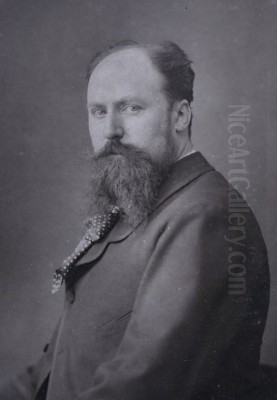
Paul Louis Narcisse Grolleron stands as a notable figure in late 19th-century French art. Born in 1848 and passing away in 1901, he carved a niche for himself primarily as a painter of military subjects, particularly those drawn from the Franco-Prussian War, alongside creating compelling genre scenes. Though initially set on a different artistic path, his training under a renowned master and his keen eye for historical detail led him to produce works that captured the public imagination and earned him recognition within the competitive Parisian art world.
Early Life and Artistic Formation
Paul Grolleron was born in Seignelay, located in the Charny canton within the Burgundy region of France. His initial aspirations leaned towards the decorative arts, a field demanding skill in ornamentation and design. However, his trajectory shifted significantly upon moving to Paris, the epicenter of the European art world. There, he sought guidance from one of the era's most respected academic painters, Léon Bonnat.
Bonnat, known for his portraiture and historical paintings, ran a prominent teaching studio. Grolleron entered this atelier around 1875, immersing himself in the rigorous training typical of the academic tradition, which emphasized draftsmanship, anatomical accuracy, and a polished finish. Under Bonnat's tutelage, Grolleron honed his technical skills, moving away from decorative arts towards figure painting, encompassing both genre subjects and historical narratives. His official debut at the prestigious Paris Salon occurred in 1873, marking his entry into the professional art scene.
A Shift Towards Military and Historical Themes
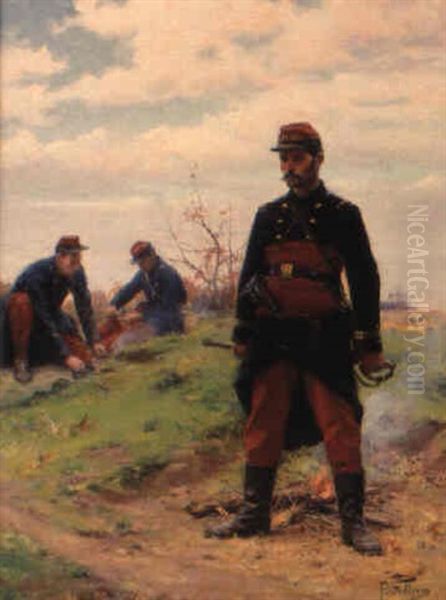
While his early Salon entries included genre scenes, Grolleron soon found his primary calling in the depiction of military life and historical events. He became particularly known for his vivid portrayals of the Franco-Prussian War (1870-1871), a conflict that had deeply scarred the French national psyche. His paintings sought to capture the varied experiences of soldiers during this period.
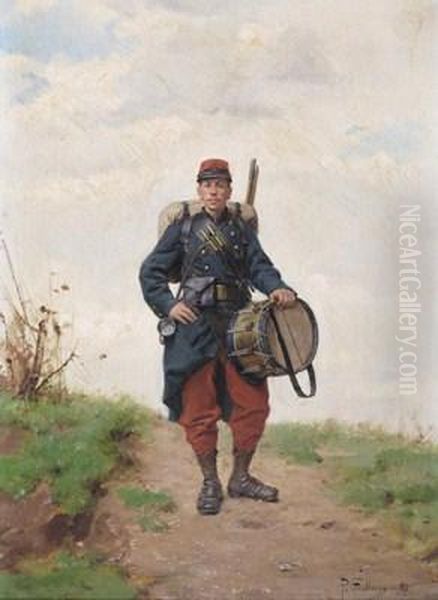
His approach was not monolithic; his works ranged from depicting the mundane, everyday moments of camp life to capturing scenes of high drama and tension on the battlefield. He also explored more sentimental themes, focusing on the human cost of war, such as injury, loss, or camaraderie under duress. This ability to convey a spectrum of emotions—from the ordinary to the dramatic and the poignant—became a hallmark of his military art. An early work reportedly titled Combat in a Factory under the Paris Métro from 1870 (though the Metro's construction timeline makes the title intriguing) apparently garnered him an honorable mention, signaling his potential in this demanding genre.
Exploration of Genre Painting
Alongside his focus on military subjects, Grolleron continued to produce genre paintings throughout his career. These works often depicted scenes of everyday life, leisure, or anecdotal moments, showcasing a different facet of his artistic interests. Examples cited include When the Master is Away (1874), likely a charming scene involving servants or perhaps pets engaged in mischief.
Other notable genre works include The Game of Chess (or Chessboard Game, 1875) and Cat Chasing Mice (1878), titles suggesting intimate interior scenes or playful observations. He also exhibited La Partie de Pique at the 1875 Salon and Valet qui Prend in 1877, further indicating his activity in genre painting during his formative years. His repertoire also included subjects drawn from rural life and nature, such as hunting scenes like Wounded Boar (dated 1865, perhaps an early work before his formal training shift), A Double Blow (1869), From Return of Boar Hunt in the Vosges (1879), Bosnian Bear Exhibitor (1880), and Capture of a Wild Boar (1886).
Key Military Works
Grolleron's reputation largely rests on his military paintings. Among his representative works in this vein is The Drummer (also cited as Military Drummer), painted in 1883. This piece likely focuses on the figure of a young military musician, perhaps capturing a moment of quiet duty or anticipation before battle, a common motif allowing for character study within a military context.
Another significant work is Soldier at Tanviray (or Soldiers of Tanviray), dated 1894. The title suggests a specific location, possibly linked to a historical skirmish or a garrison, allowing Grolleron to depict soldiers within a defined setting, perhaps emphasizing their environment or a particular moment in their service.
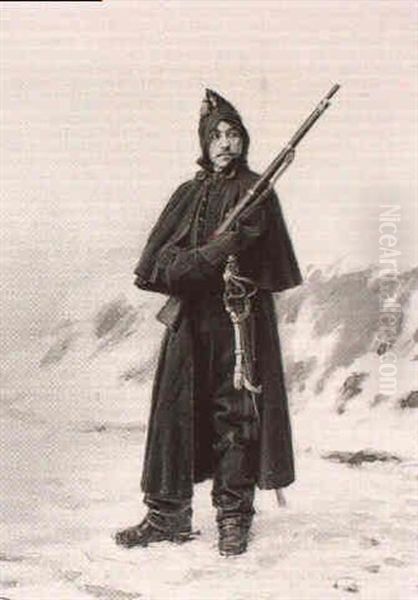
A more enigmatic title is The Last Sailor at the Battle of Poitiers, dated 1898. The Battle of Poitiers historically refers to conflicts in 732 or 1356, making its connection to a late 19th-century painter focused on contemporary warfare unusual. It might represent a foray into earlier French history, a symbolic title, or perhaps a misunderstanding or mistranslation in historical records. Regardless, it points to his continued engagement with historical and potentially heroic themes late in his career. His works often focused on the individual soldier, highlighting personal experiences within the larger canvas of war.
Artistic Style and Influences
Grolleron's style was fundamentally shaped by his academic training under Léon Bonnat. This is evident in the detailed realism, careful composition, and polished finish often found in his works. Bonnat emphasized strong drawing and accurate representation, qualities Grolleron applied diligently, particularly in rendering uniforms, equipment, and the human figure. His military scenes are noted for their meticulous detail and clarity.
While firmly rooted in the academic tradition, some sources suggest connections or affinities with Impressionism and Post-Impressionism. This claim is somewhat surprising given his primary focus and training but might reflect certain aspects of his brushwork, color palette in specific works, or perhaps his residence in an artistically vibrant neighborhood. However, his main artistic lineage connects him more directly to the tradition of French military painting popular in the Third Republic.
His approach to military subjects can be compared to contemporaries who specialized in the genre, such as the highly successful Jean-Louis-Ernest Meissonier, known for his incredibly detailed Napoleonic scenes, and Édouard Detaille and Alphonse de Neuville, who also gained fame depicting the Franco-Prussian War with dramatic realism and patriotic sentiment. Like them, Grolleron aimed to create believable, engaging narratives, though perhaps often on a more intimate scale. His teacher, Bonnat, and Bonnat's own contemporary, Jean-Léon Gérôme, represent the broader academic context emphasizing historical accuracy and technical proficiency.
Life in Paris and Contemporaries
Between 1885 and 1893, Grolleron resided in the Batignolles district of Paris. This area was a well-known hub for artists and writers during the latter half of the 19th century, famously associated with the Impressionist movement. The Café Guerbois, a key meeting place for the avant-garde, was located there.
Sources claim that during his time in Batignolles, Grolleron may have had contact with prominent figures associated with the area's artistic circles. These include the writer Émile Zola, a champion of realism and friend to many painters, and leading Impressionist and Post-Impressionist artists such as Pierre-Auguste Renoir, Claude Monet, Édouard Manet (who lived nearby and was a central figure), Alfred Sisley, Camille Pissarro, and Edgar Degas.
It is important to note, however, that while his presence in Batignolles placed him geographically close to these influential figures, the available source material explicitly states that specific records or details of his interactions with these particular artists are lacking. His connection remains more circumstantial, based on shared locale, rather than documented collaboration or close friendship. His primary artistic network likely remained closer to the academic circles associated with Bonnat and the Salon system.
Recognition and Exhibitions
Grolleron was a regular participant in the official Paris Salon, the most important art exhibition in France at the time. Presenting works there was crucial for an artist's reputation and commercial success. Following his debut in 1873, he continued to exhibit, showcasing both genre and military paintings.
His efforts gained official recognition through several awards. He received a third-class medal at the Salon of 1886, acknowledging the quality of his work within the established art hierarchy. This was followed by a silver medal at the Salon of 1889, indicating a growing stature. Furthermore, his work was selected for the Exposition Universelle (World's Fair) held in Paris in 1900, a major international event where he was awarded a bronze medal. These accolades confirm his standing as a respected painter within the mainstream art world of his time.
Thematic Considerations in Military Art
Painting military subjects, especially recent conflicts like the Franco-Prussian War, presented artists like Grolleron with specific challenges. The genre often navigated a complex space between patriotic commemoration, realistic depiction of hardship, and the potential for romanticizing or glorifying conflict. Artists had to decide whether to focus on heroism and duty or on the suffering and brutality of war.
The source material contextualizes this by mentioning the general controversies surrounding military art, citing Pablo Picasso's later masterpiece Guernica (1937) as an example of a powerful anti-war statement that broke radically from traditional depictions. While Grolleron worked within a more conventional framework, he, like Detaille and de Neuville, likely faced the balancing act of creating images that resonated with national sentiment while also acknowledging the human realities of warfare. His varied emotional range—from everyday moments to dramatic encounters—suggests an attempt to portray different facets of the soldier's experience. The potential criticism of romanticizing war, a charge sometimes leveled at 19th-century military painters, remains a relevant consideration when viewing his work.
Personal Life
Beyond his artistic career, some details of Grolleron's personal life are recorded. He was married to Marthe Dufrêne, who was known as an actress. This connection links him to the theatrical world of Paris. Marthe Dufrêne passed away in 1904, three years after Grolleron himself. The source material mentions their marriage but provides no further details about their life together or any specific events or controversies related to their union.
Later Life and Legacy
Paul Grolleron continued to paint until his death in Paris in 1901, at the relatively young age of 53. He left behind a substantial body of work, primarily focused on French military history and genre scenes. His paintings captured a specific moment in French art and history, reflecting the tastes and concerns of the late 19th century.
Today, his works are held in various public and private collections. Notably, the Metropolitan Museum of Art in New York includes works by Grolleron, ensuring his art remains accessible to international audiences. He is remembered as a skilled academic painter who specialized in bringing the life of the French soldier, particularly during the Franco-Prussian War, to the canvas with detail and emotional resonance.
Conclusion
Paul Louis Narcisse Grolleron navigated the Parisian art world of the late 19th century, transitioning from decorative arts to become a respected painter under the guidance of Léon Bonnat. While also adept at genre scenes, his most significant contribution lies in his depictions of military life, offering detailed and varied perspectives on the Franco-Prussian War. Through regular Salon participation and official awards, he achieved recognition in his lifetime. Though perhaps overshadowed by the revolutionary movements of Impressionism and Post-Impressionism developing around him, Grolleron remains an important figure for understanding the academic tradition and the popular themes, particularly military history, that captivated French audiences during the Third Republic. His work provides a valuable visual record of his time, rendered with technical skill and a sensitive eye for human detail amidst historical events.