Pieter Neeffs the Elder (c. 1578 – between 1656 and 1661) stands as a pivotal figure in the rich tapestry of 17th-century Flemish Baroque art. An eminent member of the Antwerp School, he carved a distinct niche for himself as a specialist painter of architectural interiors, particularly the awe-inspiring interiors of Gothic churches. His canvases are celebrated for their meticulous rendering of architectural detail, profound understanding of perspective, and an almost magical ability to capture the play of light and shadow, transforming stone and glass into scenes of serene grandeur and spiritual contemplation. Active in Antwerp, a bustling artistic hub, Neeffs was part of an artistic dynasty, working alongside his sons, and frequently collaborating with other renowned painters who would populate his architectural vistas with figures.
Early Life and Artistic Formation in Antwerp
Born in Antwerp around 1578, though some sources suggest a later birth year closer to 1590, Pieter Neeffs the Elder emerged from a city that was a crucible of artistic innovation. His father, Aart Neeffs, was a merchant dealing in silks and also an innkeeper, a background that may have provided a degree of financial stability for the young artist to pursue his calling. The precise details of his earliest training are somewhat debated, but it is widely accepted that he was a pupil of, or at least profoundly influenced by, Hendrick van Steenwyck the Elder (c. 1550–1603), a pioneering figure in the genre of architectural painting.
Van Steenwyck the Elder had already established a reputation for his detailed church interiors, often based on the Cathedral of Our Lady in Antwerp. This mentorship, or strong influence, instilled in Neeffs a rigorous approach to perspective and an appreciation for the intricate beauty of Gothic architecture. By 1609, Pieter Neeffs the Elder had achieved the status of a master in the prestigious Antwerp Guild of St. Luke, a clear indication of his recognized skill and professional standing. The following year, in 1610, he is recorded as becoming a citizen of Antwerp. His personal life also took root in the city; in 1612, he married Maria Lauterbeens, with whom he would have five children, some of whom would follow in his artistic footsteps.
The Signature Style: Capturing Ecclesiastical Grandeur
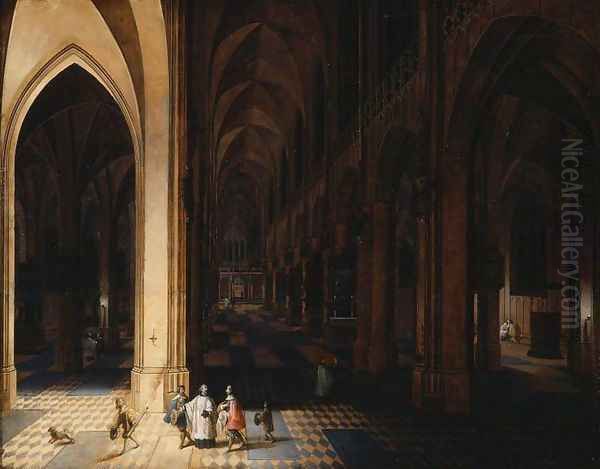
The core of Pieter Neeffs the Elder's artistic output revolves around the depiction of church interiors. He possessed an extraordinary ability to translate the soaring vaults, slender columns, and intricate tracery of Gothic cathedrals onto canvas with remarkable accuracy. His preferred subject was often the Cathedral of Our Lady in Antwerp, a magnificent edifice whose complex structure provided endless inspiration. However, his works were not mere topographical records; they were carefully composed scenes designed to evoke a sense of space, light, and spiritual atmosphere.
Neeffs demonstrated an exceptional command of linear perspective, creating a convincing illusion of depth that draws the viewer into the sacred space. His compositions often feature a central vanishing point, leading the eye down the nave towards a distant altar or choir screen, emphasizing the length and height of the structure. The architectural elements – pillars, arches, ribbed vaults, stained-glass windows, and ornate tombs – are rendered with painstaking detail, showcasing his keen observational skills and dedication to verisimilitude. This precision extended to the textures of stone, wood, and metal, lending a tangible reality to his painted worlds.
Mastery of Light, Shadow, and Atmosphere
Beyond architectural accuracy, Pieter Neeffs the Elder was a virtuoso in the manipulation of light and shadow. His church interiors are rarely evenly lit; instead, they are animated by a dynamic interplay of light, often streaming from unseen sources or through prominent stained-glass windows, casting complex patterns across the floors and pillars. He masterfully depicted both natural daylight and the warmer, more focused glow of artificial light from candles or lamps, particularly in his evocative nocturnal scenes. This use of chiaroscuro was not merely for dramatic effect but served to define form, enhance the sense of depth, and create a specific mood, often one of quiet contemplation or solemn reverence.
His palette, while often subdued to reflect the cool stone of church interiors, was capable of great subtlety. He skillfully managed tonal gradations to suggest the way light diffuses through vast spaces or reflects off different surfaces. The ethereal glow filtering through stained glass, casting colored light onto the flagstones, or the soft illumination of a distant chapel, are hallmarks of his sensitive approach to light. This ability to capture varied lighting conditions—from the bright clarity of midday to the mysterious ambiance of a candlelit evening service—imbued his paintings with a distinct character and emotional resonance.
The Collaborative Spirit: Staffage and Artistic Partnerships
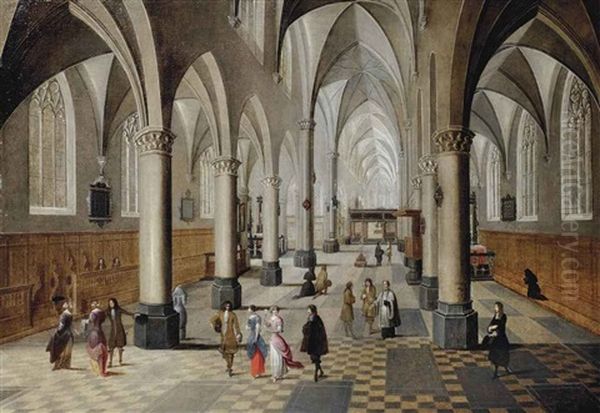
In keeping with a common practice among specialist painters in 17th-century Flanders, Pieter Neeffs the Elder frequently collaborated with other artists who would paint the "staffage" – the human figures – in his architectural settings. While Neeffs was the undisputed master of the architectural framework, these figure painters added narrative interest, scale, and liveliness to his compositions. These figures could range from elegantly dressed gentlefolk strolling through the church, to priests conducting services, or humble worshippers at prayer.
Among the notable artists with whom Neeffs collaborated are Frans Francken the Younger (1581–1642), a prolific painter known for his small-scale historical, allegorical, and genre scenes. His son, Frans Francken III (1607–1667), also contributed figures to Neeffs' works. The celebrated Jan Brueghel the Elder (1568–1625), famous for his detailed landscapes and flower paintings, is also documented as a collaborator, as is his son Jan Brueghel the Younger (1601-1678). David Teniers the Elder (1582–1649) and his more famous son, David Teniers the Younger (1610–1690), both versatile artists, are also known to have provided staffage. Other collaborators included Gonzales Coques (1614/18–1684), sometimes referred to as the "little Van Dyck" for his elegant small-scale portraits and genre scenes, and Adriaen van Stalbemt (1580–1662), known for his landscapes and religious scenes. Jacob Peeters is another name associated with providing figures. This practice of collaboration was mutually beneficial, allowing each artist to focus on their area of expertise and produce works of high quality more efficiently.
The Neeffs Dynasty: A Family of Architectural Painters
Pieter Neeffs the Elder was the patriarch of a veritable dynasty of architectural painters. His artistic legacy was carried on by at least two of his sons: Ludovicus Neeffs (baptized 1617, died after 1649) and Pieter Neeffs the Younger (baptized 1620, died 1675 or later). Both sons followed closely in their father's footsteps, specializing in the same genre of church interiors and often emulating his style and subject matter.
Ludovicus Neeffs became a master in the Antwerp Guild of St. Luke in 1646/47. While his output is less extensive or as consistently distinguished as his father's or brother's, his works clearly show the family's characteristic attention to architectural detail and perspective.
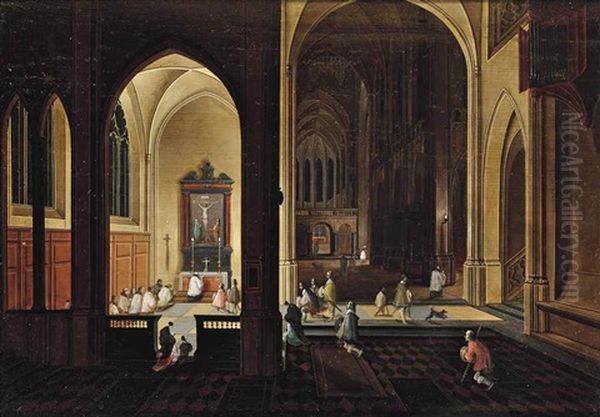
Pieter Neeffs the Younger, however, became a highly accomplished painter in his own right. He trained under his father and his style can be so similar that attributions are sometimes challenging, especially for works produced in the family workshop. Generally, the son's works are sometimes considered to be somewhat harder in their execution or smaller in scale, often painted on copper, which allows for a very fine finish. He, too, frequently depicted the interiors of Antwerp's churches and collaborated with figure painters. The continuation of the Neeffs workshop by his sons ensured that this specialized genre of painting remained prominent in Antwerp for several decades. The shared subject matter and stylistic similarities can sometimes lead to confusion in attributing works definitively to the Elder, the Younger, or Ludovicus, particularly if unsigned.
Key Works and Their Defining Characteristics
Several paintings exemplify Pieter Neeffs the Elder's skill and artistic vision. While many are titled generically, such as Interior of a Gothic Church, specific locations and dates help to trace his development and highlight his consistent quality.
_Interior of a Gothic Church_ (c. 1651): This work, representative of many with similar titles, showcases his mastery of perspective, with the receding lines of the architecture drawing the viewer deep into the sacred space. The play of light, perhaps filtering through unseen windows, illuminates certain areas while leaving others in shadow, creating a sense of volume and atmosphere. Figures, likely by a collaborator, populate the scene, adding a human element and sense of scale.
_Interior of St. Paul's Church, Antwerp_ (1636): Now housed in the Rijksmuseum, Amsterdam (though the provided text mentions the National Gallery, London, for this specific work, the Rijksmuseum is a more commonly cited location for a prominent Neeffs painting of St. Paul's), this painting is a testament to his ability to capture the specific character of a known building. The detailed rendering of the church's distinctive features, combined with his typical light effects, makes it a significant example of his work.
_Interior of Antwerp Cathedral_ (various versions, e.g., one dated 1647 in the Louvre, Paris): The Antwerp Cathedral was a recurring subject for Neeffs. These paintings are remarkable for their depiction of the cathedral's soaring Gothic architecture, its vastness, and its intricate details, from the stained-glass windows to the ornate choir screen and side chapels. Each version might offer a slightly different viewpoint or lighting condition, demonstrating his sustained engagement with this monumental structure.
_Interior of a Gothic Church by Candlelight_ (numerous examples): Neeffs was particularly adept at nocturnal scenes. In these paintings, the primary light sources are candles or torches, creating dramatic contrasts between brightly lit areas and deep shadows. These works have a more intimate and mysterious atmosphere compared to his daylight scenes, showcasing his versatility in handling different lighting conditions.
_Interior of St. George's Church, Antwerp_ (1650, private collection): Another example of his focus on specific Antwerp churches, this work would have displayed his characteristic precision and atmospheric lighting applied to a different architectural subject, highlighting the unique features of St. George's.
These works, and many others like them, are characterized by their calm, ordered compositions, their meticulous detail, and their evocative use of light. They offer a window into the religious life and architectural splendors of 17th-century Antwerp.
Influences, Contemporaries, and Artistic Milieu
Pieter Neeffs the Elder operated within a vibrant artistic environment in Antwerp, which, despite political and economic shifts, remained a major European art center. His primary influence, as mentioned, was Hendrick van Steenwyck the Elder, and he also worked in a similar vein to Hendrick van Steenwyck the Younger (c. 1580–1649), who further developed the genre of architectural interiors, often with more complex lighting and elaborate staffage.
The broader context of architectural painting in the Low Countries included artists like Hans Vredeman de Vries (1527–c. 1607), whose influential publications on perspective and architectural ornament provided a theoretical foundation for many painters. Other notable architectural painters active during or slightly after Neeffs's main period include Bartholomeus van Bassen (c. 1590–1652) and Dirck van Delen (c. 1605–1671), who worked primarily in the Dutch Republic but whose paintings of real and imaginary palaces and church interiors share thematic concerns with Neeffs's oeuvre.
While Neeffs specialized, Antwerp was dominated by towering figures like Peter Paul Rubens (1577–1640), whose dynamic and dramatic Baroque style influenced almost every artist in the city. Anthony van Dyck (1599–1641), Rubens's most gifted pupil, achieved international fame as a portraitist. Jacob Jordaens (1593–1678) was another leading figure, known for his robust and lively genre scenes, historical paintings, and portraits. Although Neeffs's quiet and meticulous style differed greatly from the flamboyant energy of these masters, he was part of the same artistic ecosystem, contributing to the diversity and richness of Antwerp's artistic production. His collaborations with figure painters like the Franckens and Teniers families directly connected him to the mainstream of Antwerp painting.
Anecdotes and Unresolved Details
Like many artists from this period, some aspects of Pieter Neeffs the Elder's life remain shrouded in a degree of uncertainty. The exact year of his birth is one such point, with scholarly estimates varying between c. 1578 and c. 1590. His father's profession as a silk merchant and innkeeper is an interesting detail, suggesting a comfortable bourgeois background rather than an established artistic lineage for his father.
A curious aspect noted in some records is that his documented activity seems to become less clear after 1661, which is one of the later dates proposed for his death (the other being 1656). There's also a mention of his works continuing until 1675, but this likely refers to the continued production of the Neeffs workshop, possibly under the direction of his son, Pieter Neeffs the Younger, or the dating of works completed earlier but signed or sold later. Such ambiguities are not uncommon in the study of Old Masters.
His innovative use of artificial lighting in nocturnal church scenes was a distinctive feature that set him apart and contributed to the unique atmosphere of these particular works. The family enterprise, with father and sons working in a similar style and often on similar subjects, while a testament to a successful artistic formula, also presents ongoing challenges for art historians in terms of precise attribution for every piece emerging from the Neeffs workshop.
Legacy and Dispersal of Works
Pieter Neeffs the Elder's contribution to art history lies in his elevation of the architectural interior to a refined and respected genre. He, along with the Steenwyck family, established a tradition of church interior painting in Flanders that was both meticulous in its execution and evocative in its atmosphere. His influence extended to his sons and to other painters who specialized in or dabbled in architectural scenes.
Today, the works of Pieter Neeffs the Elder are held in high esteem and can be found in the collections of major museums across the world. These include:
The National Gallery, London
The National Gallery of Art, Washington D.C.
The Metropolitan Museum of Art, New York
The Louvre Museum, Paris (e.g., Interior of Antwerp Cathedral, 1647)
The Hermitage Museum, St. Petersburg
The Rijksmuseum, Amsterdam (e.g., Interior of St. Paul's Church, Antwerp, 1636)
The Kunsthistorisches Museum, Vienna
The Thyssen-Bornemisza Museum, Madrid
The Nationalmuseum, Stockholm (e.g., Interior of a Gothic Church)
The Royal Museums of Fine Arts of Belgium, Brussels
The Worcester Art Museum, Massachusetts
The Museu Nacional de Arte Antiga, Lisbon (e.g., Interior of a Gothic Church, 1647)
His paintings also appear periodically on the art market, at prominent auction houses like Sotheby's and Christie's, attesting to their continued appreciation by collectors. The Koetser Gallery in Zurich is also noted as having handled his works. This wide dispersal is a testament to his productivity and the desirability of his paintings, both during his lifetime and in subsequent centuries.
Conclusion: An Enduring Vision of Sacred Space
Pieter Neeffs the Elder was more than just a skilled painter of architecture; he was a poet of sacred space. His canvases invite viewers to step into the serene and ordered world of Gothic cathedrals, to marvel at their structural ingenuity, and to experience the subtle interplay of light and shadow that defines their spiritual ambiance. Through his meticulous attention to detail, his mastery of perspective, and his sensitive rendering of light, Neeffs created enduring images that capture not only the physical reality of these magnificent buildings but also their transcendent atmosphere.
His collaborations with prominent figure painters enriched his compositions, while his role as the head of an artistic family ensured the continuation of his specialized genre. As a key member of the Antwerp School, Pieter Neeffs the Elder made a significant and lasting contribution to Flemish Baroque art, leaving behind a legacy of luminous sanctuaries that continue to fascinate and inspire. His work remains a vital touchstone for understanding the development of architectural painting and the rich artistic culture of 17th-century Antwerp.