Philip Eustace Stretton (1865-1919) was a British artist who carved a distinct niche for himself within the vibrant and diverse art scene of the late Victorian and Edwardian eras. While perhaps not possessing the monumental fame of some of his contemporaries, Stretton's contribution, particularly in the realm of animal painting, remains significant. He was especially renowned for his depictions of dogs, capturing not just their physical likeness but also a profound sense of their inner emotional world, often tinged with a characteristic melancholy that resonated deeply with the sensibilities of his time.
The Artistic Climate of Victorian and Edwardian Britain
To fully appreciate Stretton's work, one must understand the cultural milieu in which he operated. The Victorian era (1837-1901) and the subsequent Edwardian period (1901-1910) were times of immense social, industrial, and cultural change in Britain. Artistically, it was an age of eclecticism. The Royal Academy still held considerable sway, championing narrative paintings, historical scenes, and portraits executed with academic precision. Artists like Lord Frederic Leighton and Sir Lawrence Alma-Tadema produced grand canvases that appealed to a wealthy bourgeoisie.
Simultaneously, movements like the Pre-Raphaelite Brotherhood, with figures such as Dante Gabriel Rossetti, John Everett Millais, and William Holman Hunt, had earlier challenged academic conventions, advocating for truth to nature and complex symbolism. The influence of Impressionism was also beginning to be felt, though its acceptance in Britain was slower than in France, with artists like Walter Sickert and Philip Wilson Steer championing its principles.
Within this landscape, animal painting held a particularly cherished position. The British have long been known for their love of animals, and the Victorian era saw an explosion in pet ownership and a heightened sentimental attachment to domestic creatures. This affection was mirrored in the art world, creating a strong market for paintings that celebrated the beauty, loyalty, and character of animals, especially dogs and horses.
Stretton's Specialisation: The Soulful Animal Portrait
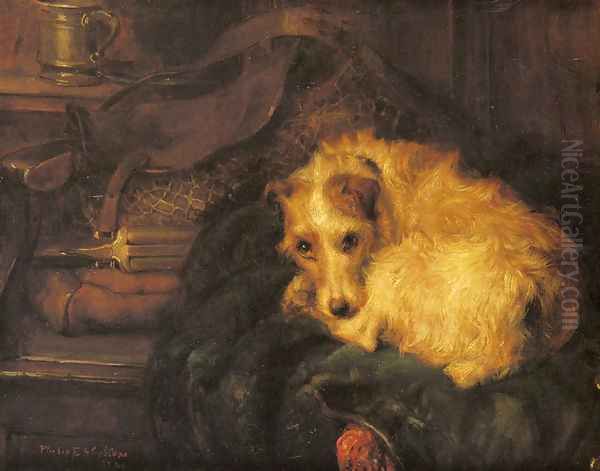
Philip Eustace Stretton emerged as a significant talent within this specialized genre. His primary focus was on animals, and he excelled in portraying dogs with a remarkable sensitivity. What set Stretton apart was his ability to imbue his subjects with an almost human-like pathos. His dogs often gaze out of the canvas with expressions that viewers interpreted as mournful, loyal, or pensive. This anthropomorphic tendency was highly popular, tapping into the Victorian fondness for sentimentality and moral narrative.
His technique was typically traditional, employing oil on canvas with a skilled hand that captured the texture of fur, the gleam in an eye, and the subtle nuances of canine anatomy. His compositions were often intimate, focusing closely on the animal, sometimes in a domestic setting or as part of a sporting scene, though the emotional connection with the animal subject always remained paramount.
The popularity of such works was not accidental. The Victorian era was a period where emotions were often expressed indirectly, and animal companions became vessels for affection and unspoken feelings. Stretton's paintings provided a visual language for this bond, allowing viewers to project their own emotions onto the depicted animals.
Notable Works and Their Characteristics
Several works by Philip Eustace Stretton exemplify his style and thematic concerns. Among his most recognized pieces is "Boris," a portrait of a black Labrador Retriever, painted in 1914. This work, measuring 51 x 40 cm, is signed and dated. An interesting anecdote accompanies its creation: Stretton was reportedly invited to a family's home near Falmouth while on holiday and stayed for a week to complete the portrait of their beloved pet. This suggests a commissioned practice, common for animal painters, and highlights the personal connection owners had with such portraits. "Boris" likely showcases Stretton's skill in capturing the sleek coat and intelligent, perhaps slightly wistful, expression characteristic of the breed and his style.
Another notable painting is "The Best of Friends." This oil painting, sized at 10.25 x 12 inches (approximately 26 x 30.5 cm), likely depicts a tender moment between two or more animals, or perhaps an animal and a human, emphasizing companionship and loyalty – recurrent themes in his oeuvre. The title itself evokes the sentimental appeal that was a hallmark of his success.
A larger work, "Cattle watergoil" (possibly a slight misspelling or variation of "Cattle Watering" or "Cattle by a Water Gully"), an oil on canvas measuring 100 x 151 cm, indicates Stretton also tackled broader pastoral scenes, though still centered on animal subjects. While the provided information notes some wear, its existence points to his versatility within the animal genre, moving beyond singular pet portraits to more complex compositions involving livestock in a landscape. Such scenes were also popular, evoking an idealized rural life that was increasingly receding with industrialization.
One description of a typical Stretton piece involves a poignant scene: a hound lying on a hunter's discarded red coat, with another hound resting its head nearby. This type of narrative, hinting at loyalty, waiting, or perhaps loss, perfectly encapsulates the "mournful" quality often attributed to his work and catered directly to the era's taste for emotionally charged, anecdotal art. These works often featured in ornate frames, sometimes with gilt slips, enhancing their status as treasured domestic objects.
Stretton in the Company of His Peers
Philip Eustace Stretton was not working in a vacuum. The field of animal painting in Britain was rich and competitive. The towering figure of Sir Edwin Landseer (1802-1873) had, by the mid-19th century, set an incredibly high bar. Landseer's dramatic and often highly sentimental depictions of animals, such as "The Monarch of the Glen" or "Dignity and Impudence," had made him a favorite of Queen Victoria and the public alike. His influence was pervasive, and many subsequent animal painters, Stretton included, operated in a market largely shaped by Landseer's success.
Among Stretton's closer contemporaries in animal art, several names stand out. Briton Rivière (1840-1920) was highly acclaimed for his paintings of wild and domestic animals, often imbued with narrative and emotional depth, such as "Sympathy" or "Daniel's Answer to the King." Rivière, like Stretton, often focused on the psychological aspect of his animal subjects.
John Emms (1843-1912) was another prominent dog painter, particularly known for his vigorous and characterful depictions of foxhounds, terriers, and other sporting breeds. Emms's style was often more dynamic and less overtly sentimental than Stretton's, but he shared a profound understanding of canine anatomy and behavior. His works, like "New Forest Buckhounds," are prized for their energy.
Maud Earl (1864-1943) was a leading female animal painter, contemporary with Stretton. She gained international recognition for her masterful portraits of purebred dogs, often commissioned by royalty and wealthy patrons. Her work was characterized by its elegance and accuracy, capturing the distinct personality of each breed. Her father, George Earl, was also a notable sporting and canine artist.
Arthur Wardle (1860-1949) was another prolific and versatile animal painter, producing works featuring domestic pets, wild animals (especially big cats), and sporting scenes. Wardle's style was realistic and detailed, and he exhibited regularly at the Royal Academy. His range was perhaps broader than Stretton's, but they shared a common ground in their dedication to animal subjects.
Other artists contributing to this genre included John Sargent Noble (1848-1896), known for his depictions of dogs, particularly bloodhounds and deerhounds, often in Highland settings, and Richard Ansdell (1815-1885), who, though slightly earlier, was a prolific painter of animals and sporting scenes, sometimes collaborating with figure painters like Thomas Creswick. Even the great French animal painter Rosa Bonheur (1822-1899) had a significant impact on British tastes with her realistic and powerful depictions of animals, particularly horses and cattle.
While Stretton may have focused more intensely on the "mournful" or sentimental aspect, he was part of a robust tradition. These artists collectively catered to a public fascinated by the animal kingdom, whether in the context of sport, companionship, or as symbols of virtue and emotion. The demand for such art was fueled by publications like "The Illustrated London News," which often featured engravings of popular animal paintings.
Artistic Training and Influences
Specific details about Philip Eustace Stretton's formal artistic training or direct mentorship are not readily available in the provided summary. However, it is highly probable that he would have undergone some form of academic training, perhaps at one of the many art schools flourishing in Britain at the time, or through private tutelage. The technical proficiency evident in his work suggests a solid grounding in drawing and oil painting techniques.
His influences would undoubtedly have included the aforementioned Sir Edwin Landseer, whose shadow loomed large over animal painting in Britain. The general trends in Victorian narrative painting, with its emphasis on clear storytelling and emotional engagement, would also have shaped his approach. Furthermore, the burgeoning interest in specific dog breeds, fueled by the rise of dog shows (Crufts was established in 1891), created a demand for accurate and characterful canine portraiture, which Stretton adeptly supplied.
The Market and Legacy of Philip Eustace Stretton
The commercial success of artists like Stretton was tied to the tastes of the burgeoning middle and upper-middle classes. These patrons sought art that was relatable, emotionally resonant, and often decorative. Stretton's paintings, with their focus on beloved pets and sentimental themes, fit these criteria perfectly. The mention of his work "Boris" selling for close to its £180 estimate at auction indicates a healthy market for his pieces during his lifetime and continued interest among collectors. This price point, while not astronomical, was respectable for a specialist painter of his kind.
His legacy lies in his contribution to the specific subgenre of sentimental animal portraiture. He masterfully captured a particular emotional tone that was highly valued in his era. While art history often prioritizes a_vant-garde_ movements and groundbreaking innovators, artists like Stretton played a crucial role in reflecting and shaping the cultural values and aesthetic preferences of their society. His work offers a window into the Victorian and Edwardian psyche, particularly its complex relationship with the animal world.
His paintings continue to appear at auction, appreciated by collectors of canine art and those interested in the social history of the period. They serve as charming and poignant reminders of a time when the depiction of an animal's perceived inner life could be a subject of serious artistic endeavor and widespread popular appeal.
Conclusion: An Artist of His Time
Philip Eustace Stretton was an accomplished British artist who specialized in capturing the essence of animals, particularly dogs, with a distinctive emotional depth. Working within the popular Victorian and Edwardian tradition of animal painting, he distinguished himself through his ability to convey a sense of melancholy and soulful introspection in his subjects. His works, such as "Boris" and "The Best of Friends," resonated with the sentimental tastes of his audience and found a ready market.
While operating in a field populated by notable talents like Landseer, Rivière, Emms, and Maud Earl, Stretton carved out his own space by focusing on a particular emotional register. His paintings are more than mere animal portraits; they are reflections of the human capacity for empathy and the profound bonds shared with animal companions. As an art historian, one recognizes Stretton not just for his technical skill, but for his insightful contribution to a genre that reveals much about the cultural heart of his era. His art remains a testament to the enduring appeal of animal companionship and the Victorian fascination with the expressive potential of the animal gaze.