Pietro Montanini: A Perugian Master of the Lyrical Landscape
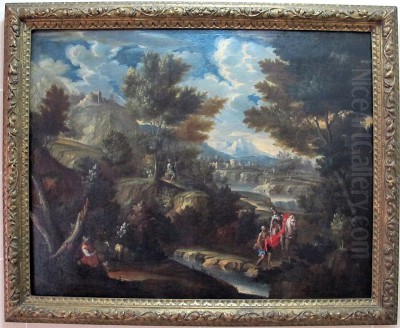
Pietro Montanini, an Italian painter born in Perugia in 1626 and passing away in 1689, carved a distinct niche for himself within the vibrant artistic milieu of 17th-century Italy. Often known by the moniker Puccio Penugia, Montanini is celebrated primarily for his evocative landscape paintings, which skillfully blended a romantic sensibility with keen observations of the natural world. His artistic journey saw him absorb influences from prominent masters, yet he ultimately forged a style that was uniquely his own, characterized by imaginative compositions and a profound emotional resonance.
Early Life and Artistic Genesis in Umbria
Born into the artistically rich region of Umbria, Pietro Montanini's early environment would have been steeped in a legacy of artistic excellence. Perugia, his birthplace, had been a significant center during the Renaissance, home to masters like Pietro Perugino, whose serene and harmonious compositions left an indelible mark on Central Italian art. While the High Renaissance fervor had passed by the 17th century, the echoes of its achievements and the local traditions of craftsmanship would have undoubtedly shaped a young, aspiring artist's worldview.
Details of Montanini's earliest training remain somewhat obscure, a common fate for many artists of the period whose initial apprenticeships were not always meticulously documented. However, it is known that he eventually made his way to Rome, the undisputed artistic capital of Europe at the time. This move was a critical step for any ambitious painter seeking to learn from the best, gain prestigious commissions, and immerse himself in both classical antiquity and the cutting-edge developments of Baroque art.
Roman Apprenticeships and Formative Influences
In Rome, Montanini's formal artistic education took a significant turn. He is recorded as having been a student of Ciro Ferri (1634-1689), a prominent painter and architect who was himself a principal pupil and collaborator of the great Baroque master Pietro da Cortona (1596-1669). Training under Ferri would have exposed Montanini to the grand, dynamic, and often theatrical style of High Baroque painting that Cortona had championed. This tradition emphasized flowing compositions, rich color palettes, and an integration of figures and settings to create powerful narrative and decorative effects, often seen in large-scale frescoes and altarpieces.
Pietro da Cortona's influence was pervasive in Rome, and his studio was a crucible for many talented artists. Cortona's work, such as the immense ceiling fresco in the Palazzo Barberini, the "Allegory of Divine Providence and Barberini Power," exemplified the energy and decorative splendor of the era. Through Ferri, Montanini would have absorbed principles of composition, figure drawing, and the use of color that were hallmarks of this dominant Roman school. He also reportedly had contact with or was influenced by the works of Domenichino (Domenico Zampieri, 1581-1641), a Bolognese artist active in Rome known for his more classical and emotionally restrained compositions, and Francesco Francia, though the latter refers to an earlier Bolognese master (c. 1447 – 1517), suggesting perhaps an appreciation for earlier traditions or a misattribution in some sources to a contemporary. More likely, this refers to an influence of the broader Bolognese classicism that artists like Domenichino represented.
The Pivotal Encounter with Salvator Rosa
A defining moment in Montanini's artistic development was his encounter with Salvator Rosa (1615-1673). Rosa, a Neapolitan painter, poet, and printmaker, was one of the most original and unconventional artistic personalities of the 17th century. He was renowned for his wild, untamed landscapes, often populated by bandits, witches, philosophers, or soldiers. His paintings evoked a sense of the sublime, emphasizing nature's ruggedness and power, a stark contrast to the idealized, pastoral landscapes of artists like Claude Lorrain.
The impact of Rosa on Montanini was profound and transformative. It is said that after meeting Rosa, Montanini's style underwent a sudden and decisive shift. He moved away from the more conventional classicism or High Baroque grandeur he might have been cultivating and embraced a more romantic, imaginative, and often dramatic approach to landscape painting, directly inspired by Rosa's pioneering vision. This adoption of Rosa's manner was not mere imitation; Montanini assimilated Rosa's spirit, developing his own interpretations of untamed nature, atmospheric effects, and the integration of small, often enigmatic figures within expansive settings. This stylistic allegiance earned him recognition and placed him firmly within the lineage of painters who sought to capture the more poetic and untamed aspects of the natural world.
Montanini's Distinctive Artistic Style
Pietro Montanini's mature style is characterized by its romanticism and imaginative flair. His landscapes are rarely simple topographical records; instead, they are imbued with a palpable mood and atmosphere. He excelled at depicting the interplay of light and shadow, creating depth and drama within his scenes. His brushwork, while capable of rendering detail, often possessed a spirited quality that contributed to the overall dynamism of his compositions.
His works often feature dramatic natural formations – rocky outcrops, cascading waterfalls, dense forests, and expansive skies. These elements are not merely picturesque backdrops but active participants in the narrative or emotional tenor of the painting. The influence of Salvator Rosa is evident in this preference for wilder, less cultivated scenery, and in the often-dramatic lighting that bathes his compositions. Montanini's landscapes frequently convey a sense of solitude or contemplation, inviting the viewer to immerse themselves in the scene.
While primarily a landscape painter, Montanini also incorporated figures into his works. These figures, though often small in scale relative to the grandeur of the landscape, play crucial roles. They might be peasants, travelers, mythological characters, or religious figures, adding a human element or a narrative focus to the scene. Some critics have noted that his figure painting, while competent, was perhaps not as strong as his mastery of landscape, a common observation for artists specializing in a particular genre. Nevertheless, his figures are integral to the overall composition, guiding the viewer's eye and enhancing the story or mood. His style in this regard can be seen as part of a broader trend in 17th-century landscape painting where the landscape itself became the primary subject, with figures serving to animate or contextualize the scene, a path also explored by artists like Claude Lorrain (1600-1682) and Nicolas Poussin (1594-1665) in their different ways.
Key Themes and Subjects in Montanini's Oeuvre
Montanini's subject matter was predominantly focused on landscapes, but within this genre, he explored a variety of themes. River landscapes with waterfalls were a recurring motif, allowing him to showcase his skill in depicting the movement of water and the play of light on its surface. Forest scenes, with their intricate patterns of trees and foliage, also feature prominently, often imbued with a sense of mystery or seclusion.
His works sometimes incorporated architectural elements, such as rustic bridges, ancient ruins, or distant towns, which added points of interest and a sense of human history within the natural setting. These elements often contribute to the romantic atmosphere, evoking a sense of the past or the picturesque decay of man-made structures reclaimed by nature. This interest in ruins and the picturesque was a growing sensibility in European art, finding particular favor in the 17th and 18th centuries.
Beyond pure landscapes, Montanini also tackled religious subjects, though often these were set within expansive landscape settings where nature played a significant role in conveying the spiritual atmosphere. Works like "Santa Rosalia" and "Natività" demonstrate his ability to adapt his landscape skills to devotional themes, using light and environment to enhance the sanctity and emotion of the scene. He also painted more dramatic, almost genre-like scenes, such as "Dopo la battaglia" (After the Battle), which would have allowed for a more overt display of narrative and human drama, again likely echoing Salvator Rosa's penchant for battle scenes and historical subjects.
Notable Works and Their Characteristics
Several works by Pietro Montanini stand out and help to define his artistic contribution. Among his most celebrated is "The Little Waterfalls of Tivoli," also known as "Paesaggio con figure e Tempio di Vesta a Tivoli." Tivoli, with its dramatic waterfalls and ancient Roman ruins, was a magnet for landscape artists from the 17th century onwards. Montanini's depiction captures the picturesque charm and natural grandeur of the site, likely featuring the famous Temple of Vesta (or Temple of the Sibyl). Such paintings would have appealed to the growing number of Grand Tour travelers and collectors who sought evocative souvenirs of Italy's famed landscapes.
His religious paintings, such as "Santa Rosalia" and "Natività," showcase his ability to integrate sacred figures into carefully constructed natural environments. In these works, the landscape is not merely a backdrop but an essential component of the painting's spiritual message, with light and atmosphere contributing to the devotional mood. For instance, a "Natività" would allow for dramatic chiaroscuro effects, highlighting the sacred figures amidst a nocturnal or crepuscular landscape.
The painting described as a forest scene featuring an old man crowned with ivy hints at Montanini's engagement with mythological or allegorical themes, common in the Baroque period. Such a figure could represent a river god, a sylvan deity, or a philosopher in communion with nature, subjects that resonated with the era's classical learning and poetic sensibilities. Similarly, "Dopo la battaglia" suggests a foray into historical or genre painting with a dramatic narrative, a theme also explored by contemporaries like Jacques Courtois (1621-1676), known as "Il Borgognone," who specialized in battle scenes.
Two large canvases depicting mountain landscapes with peasants, housed in the Museo dell'Oratorio di Comunale di Calvi di Umbria, further attest to his skill in capturing the ruggedness of terrain and the daily lives of rural people, integrating them into the broader sweep of nature. These works reflect a "romanticism and primitivism" that was considered typical of late 17th-century Northern Italian landscape painting, though Montanini was Umbrian, his style resonated with broader Italian trends.
Technical Innovations and Artistic Quirks
Beyond his conventional paintings, Montanini was reportedly involved in some unusual technical experiments. There are mentions of him creating "magic walls" using light-sensitive materials on canvas. These works would supposedly reveal or alter their appearance under specific lighting conditions, suggesting an innovative and curious mind exploring the boundaries of pictorial representation. While details on these experiments are scarce, they point to an artist interested in the more novel and perhaps theatrical aspects of visual effects, a trait that aligns with the Baroque era's fascination with illusion and spectacle.
His sudden stylistic shift after encountering Salvator Rosa is itself a notable "quirk" or, more accurately, a testament to the powerful impact one artist could have on another. This decisive change indicates Montanini's openness to new artistic directions and his conviction in pursuing a path that resonated more deeply with his own sensibilities, even if it meant diverging from his earlier training.
Contemporaries and the Artistic Milieu of 17th-Century Italy
Pietro Montanini worked during a period of immense artistic activity in Italy. Rome, in particular, was a melting pot of Italian and international talent. Besides his teachers Pietro da Cortona and Ciro Ferri, and his primary influence Salvator Rosa, Montanini would have been aware of, and likely interacted with, a wide circle of artists.
The landscape genre was flourishing. Claude Lorrain, a Frenchman based in Rome, was creating idealized, luminous landscapes that became the benchmark for classical landscape painting. Nicolas Poussin, another Frenchman in Rome, also produced highly influential classical landscapes, often with mythological or biblical narratives. Gaspard Dughet (1615-1675), Poussin's brother-in-law and also known as Gaspard Poussin, specialized in stormy, romantic landscapes of the Roman Campagna, sharing some common ground with Rosa and, by extension, Montanini.
Dutch Italianates like Herman van Swanevelt (c. 1603-1655) and Jan Both (c. 1618-1652) were also active in Rome, bringing their Northern European sensibility for light and detail to Italian scenery, influencing the development of landscape painting. Francisque Millet (Jean-François Millet I, 1642-1679), a Flemish-born French painter active in Paris but whose style was Poussinesque, also contributed to the landscape tradition. Montanini's work, with its romantic leanings, offered a distinct alternative to the more serene classicism of Claude or the intellectual rigor of Poussin, aligning more closely with the wilder visions of Rosa and Dughet.
In the realm of figure painting and grand decoration, artists like Andrea Sacchi (1599-1661), a rival of Pietro da Cortona, championed a more classical and restrained Baroque style. The towering figure of Gian Lorenzo Bernini (1598-1680), though primarily a sculptor and architect, dominated the Roman art scene with his dynamic and emotionally charged Baroque vision, setting a standard for artistic ambition and innovation. Montanini's decision to specialize in landscapes, particularly those with a romantic and untamed character, allowed him to carve out a distinctive identity within this competitive and multifaceted artistic environment.
Reception, Legacy, and Collections
Pietro Montanini achieved considerable recognition during his lifetime. His works were appreciated not only in Italy but also in France, a testament to the appeal of his romantic landscapes. His ability to capture the poetic essence of nature, combined with imaginative compositions, found favor with collectors and connoisseurs.
Today, Montanini's paintings are held in various public and private collections, primarily in Italy. The Galleria Nazionale dell'Umbria in his native Perugia and the Cassa di Risparmio di Perugia are significant repositories of his work. Exhibitions, such as the "Incursioni" show organized by these institutions, have highlighted his contribution, often placing his landscapes in dialogue with other works to emphasize the narrative power of his natural settings. The Museo dell'Oratorio di Comunale di Calvi di Umbria also holds important examples of his large-scale landscapes.
Art historians regard Montanini as an important representative of 17th-century Italian landscape painting, particularly within the romantic tradition fostered by Salvator Rosa. His works are valued for their atmospheric qualities, their imaginative depiction of nature, and their emotional depth. While perhaps not as widely known internationally as some of his contemporaries like Claude Lorrain or Salvator Rosa himself, Montanini remains a significant figure for his distinctive interpretation of the Italian landscape and his contribution to the diversification of the genre.
Challenges and Critical Perspectives
Like many artists, Montanini faced challenges and varying critical assessments. As mentioned, some contemporary and later critics found his figure painting to be less accomplished than his landscapes. This is not an uncommon critique for specialized landscape artists, where the figures, often referred to as "staffage," primarily serve to animate the scene rather than being the main focus of anatomical or psychological study.
The art market of the 17th century was competitive, and while Montanini achieved success, the level of fame and financial reward could vary greatly. The enduring popularity of certain masters often overshadowed talented contemporaries. Even in modern times, the art market can be fickle; for instance, the provided information notes that his works did not particularly stand out in a 2024 auction, which can be due to various factors including market trends, provenance, or the specific quality of the pieces offered, rather than a definitive statement on his overall artistic merit.
His stylistic shift towards Rosa's manner, while defining his mature work, might also have invited comparisons that could be both favorable and challenging. To follow such a distinctive and powerful artist as Rosa meant working in a recognizable idiom, where originality would be measured by how well one could adapt and personalize that influence.
Conclusion: An Enduring Vision of Nature's Poetry
Pietro Montanini stands as a compelling figure in the rich tapestry of Italian Baroque art. From his Umbrian origins and Roman training under the likes of Ciro Ferri, he absorbed the foundational techniques of his time. However, it was his transformative encounter with Salvator Rosa that truly ignited his artistic direction, leading him to become a notable exponent of the romantic landscape. His paintings, characterized by their imaginative portrayal of wild and evocative natural scenes, often imbued with a sense of drama or poetic melancholy, offer a distinctive vision that resonated with his contemporaries and continues to be appreciated today.
Through works like "The Little Waterfalls of Tivoli" and his numerous other landscapes, Montanini demonstrated a profound sensitivity to the moods and forms of nature. He skillfully balanced observation with imagination, creating worlds that invite contemplation and stir the emotions. While navigating the competitive artistic currents of 17th-century Italy, he carved out a unique voice, contributing significantly to the tradition of landscape painting that sought to express not just the appearance of the world, but its inherent poetry and power. His legacy endures in the collections that preserve his work, allowing future generations to experience the lyrical and often untamed beauty of Pietro Montanini's vision.