Stephan Kessler (1622-1700) stands as a significant, if sometimes overlooked, figure in the vibrant tapestry of 17th-century European art. Active primarily in the South Tyrol region, then under the cultural and political sphere of the Austrian Habsburgs, Kessler carved a distinct niche for himself as a master of Baroque narrative painting. His prolific output, characterized by meticulous detail, dynamic compositions, and a profound understanding of dramatic storytelling, left an indelible mark on the sacred and secular art of his time. Born into an era of artistic ferment and religious zeal, Kessler's life and work reflect the broader currents of the Baroque, while also showcasing a unique regional flavour.
The Artistic Milieu of 17th-Century Tyrol
To understand Stephan Kessler, one must first appreciate the world he inhabited. The 17th century in Tyrol, as in much of Europe, was shaped by the aftermath of the Reformation and the vigorous artistic and religious response of the Counter-Reformation. The Council of Trent (1545-1563) had laid down guidelines for religious art, emphasizing clarity, emotional impact, and doctrinal accuracy. This spurred a demand for art that could instruct, inspire, and move the faithful. Churches and monasteries became major patrons, seeking grand altarpieces, devotional images, and extensive fresco cycles that could visually articulate the tenets of Catholicism.
Tyrol, strategically located at the crossroads of Germanic and Italian cultures, was a fertile ground for artistic exchange. Influences from Italy, particularly Venice and the Bolognese school, mingled with traditions from Northern Europe. Artists like Peter Paul Rubens (1577-1640) in Flanders, whose dynamic compositions and rich colours were transforming Baroque art, cast a long shadow across the continent. Similarly, the dramatic realism and tenebrism pioneered by Caravaggio (1571-1610) in Italy, and further developed by his followers, the Caravaggisti, resonated widely. The classical ideals championed by artists like Annibale Carracci (1560-1609) and the Bolognese Academy also provided a powerful counterpoint and source of inspiration. Within the Habsburg lands themselves, a distinct Austrian Baroque was beginning to flourish, with artists absorbing and reinterpreting these international trends.
Early Life and Artistic Formation
Stephan Kessler was born in Donauwörth, Swabia, in 1622, but his family soon moved to Brixen (Bressanone) in South Tyrol, a prominent episcopal city and artistic centre. While specific details of his early training are not extensively documented, it is highly probable that he apprenticed in a local workshop, absorbing the prevailing artistic techniques and styles. The artistic environment of Brixen would have exposed him to a range of influences. It is known that he undertook travels, a common practice for aspiring artists of the period, which likely included journeys to artistic centres in Italy and possibly Germany, further broadening his visual vocabulary.
His formative years would have been steeped in the visual language of the late Renaissance and early Baroque. The emphasis on naturalism, dynamic movement, and emotional intensity, hallmarks of the Baroque, would have been central to his education. The influence of earlier Tyrolean masters, as well as the pervasive impact of Italian and Flemish art, would have shaped his developing style. It is during this period that he likely first encountered the works or widely circulated prints of major figures like Rubens, whose impact on Kessler's work is undeniable.
Kessler's Distinctive Artistic Style: Narrative, Detail, and Drama
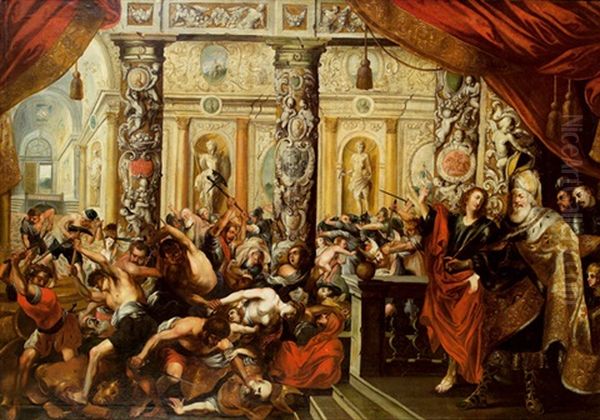
Stephan Kessler's mature style is characterized by several key elements. He was, above all, a storyteller. His canvases, whether depicting biblical scenes, historical events, or allegorical subjects, are rich in narrative detail. He possessed a remarkable ability to marshal numerous figures into complex, yet coherent, compositions. This is particularly evident in his "Wimmelbilder" or "teeming pictures," a genre in which he excelled. These works are densely populated, inviting the viewer to explore a multitude of mini-narratives within the larger scene.
His use of colour was vibrant and expressive, contributing to the overall dynamism of his paintings. While influenced by the rich palette of Rubens, Kessler developed his own distinct colour harmonies. He paid meticulous attention to the rendering of textures – fabrics, armour, flesh – lending a tangible reality to his figures and their surroundings. Dramatic lighting, often employing strong contrasts of light and shadow (chiaroscuro), served to heighten the emotional intensity of his scenes and direct the viewer's eye to key focal points. This dramatic sensibility is a hallmark of Baroque art, and Kessler employed it with considerable skill.
The influence of Peter Paul Rubens is perhaps the most significant external factor in Kessler's art. Rubens's mastery of dynamic composition, his depiction of robust, energetic figures, and his ability to convey powerful emotions clearly resonated with Kessler. This is not to say Kessler was a mere imitator; rather, he absorbed Rubenesque principles and adapted them to his own artistic temperament and the specific demands of his patrons. The theatricality and emotional depth found in many of Kessler's works owe a debt to the Flemish master.
Major Themes and Iconography
Stephan Kessler's oeuvre was diverse, though religious subjects formed the core of his production, reflecting the predominant patronage of the Church. He created numerous large-scale altarpieces for churches and monasteries throughout Tyrol and beyond. These works often depicted key moments from the Old and New Testaments, the lives of saints, and allegories of faith. His ability to translate complex theological concepts into compelling visual narratives made him a sought-after artist for such commissions.
Biblical stories, such as scenes from the life of Christ, the parables, and episodes from the Old Testament, were recurrent themes. He also painted numerous depictions of the Virgin Mary and various saints, catering to the devotional needs of his patrons. Beyond purely religious subjects, Kessler also engaged with historical themes. His paintings often commemorated significant contemporary or past events, imbued with a sense of grandeur and historical importance. He also produced works depicting allegorical figures and scenes, conveying moral or philosophical messages through symbolic imagery. A notable aspect of his work includes depictions of everyday life or specific commissions like the pilgrimage scene of Jakob Trapp VII and his family, showcasing his versatility.
Key Masterpieces: A Closer Look
Several key works exemplify Stephan Kessler's artistic prowess and stylistic characteristics.
"Gastmahl im Haus des Simon" (The Feast in the House of Simon), created in 1660, is a monumental work (235.5 x 1020 cm) housed in the Chorherrenstift gallery at Neustift Monastery. This expansive canvas depicts the biblical scene where Mary Magdalene anoints the feet of Jesus. Kessler masterfully handles the large number of figures, creating a lively and engaging composition. The rich colours, detailed rendering of costumes and setting, and the expressive gestures of the figures all contribute to the painting's impact. It showcases his ability to manage complex narratives on a grand scale, a hallmark of his "Wimmelbild" approach.
"Daniel und König Cyrus im Tempel Bels" (Daniel and King Cyrus in the Temple of Bel), now in a private collection, is another significant example of his biblical narratives. This painting likely illustrates the apocryphal story where the prophet Daniel exposes the deception of the priests of Bel to King Cyrus. Such subjects allowed Kessler to explore themes of wisdom, divine intervention, and the triumph of truth, all while creating a visually rich and dramatic scene. The interaction between the figures, the architectural setting, and the use of light and shadow would have been key elements in conveying the story's tension and resolution.
"Weltgeschichte im Wimmelbild" (World History in a Teeming Picture), which includes a depiction of the Liberation of Vienna in 1683, demonstrates Kessler's skill in historical painting and the "Wimmelbild" genre. The Siege of Vienna was a pivotal event in European history, and its depiction would have resonated strongly with contemporary audiences. Kessler's version would have been filled with countless figures, battle scenes, and specific details related to the event, creating a panoramic and immersive viewing experience. This type of painting served not only as a historical record but also as a celebration of Christian victory and Habsburg power.
These works, among many others, highlight Kessler's capacity for detailed observation, his flair for dramatic composition, and his commitment to narrative clarity, even within the most crowded of scenes.
The Workshop, Patronage, and Artistic Reach
Like most successful artists of his time, Stephan Kessler would have maintained an active workshop. This workshop would have included apprentices and assistants who helped with the preparation of canvases, the grinding of pigments, the painting of less critical areas, and the production of copies or variants of successful compositions. The scale of many of Kessler's works, particularly the large altarpieces and "Wimmelbilder," would have necessitated such collaborative effort.
His primary patrons were ecclesiastical institutions – churches, monasteries, and cathedral chapters – throughout South Tyrol. The demand for religious art during the Counter-Reformation ensured a steady stream of commissions. However, he also received commissions from noble families and wealthy burghers, for whom he painted portraits, historical scenes, and allegorical works. The Trapp family pilgrimage painting is a case in point.
Kessler's reputation extended beyond the immediate confines of South Tyrol. His works were found in collections and churches in other parts of the Austrian Habsburg lands and neighboring German territories. Records indicate his paintings were exhibited or held in places like Vienna, Graz, and parts of Bavaria and Swabia. This wider reach suggests a recognized talent and an ability to connect with a broader network of patrons and art connoisseurs. This dissemination of his work also contributed to the spread of Tyrolean Baroque characteristics.
Kessler in the Context of His Contemporaries
Stephan Kessler was working during a golden age of Baroque art across Europe. While directly influenced by Peter Paul Rubens, he was also a contemporary of many other significant artists whose work formed the broader artistic landscape. In Italy, the High Baroque was in full swing, with artists like Gian Lorenzo Bernini (1598-1680) dominating sculpture and architecture in Rome, and painters like Pietro da Cortona (1596-1669) creating vast, illusionistic ceiling frescoes. The legacy of Caravaggio continued through artists like Artemisia Gentileschi (1593-1656) and Jusepe de Ribera (1591-1652), who was active in Naples.
In the Spanish Netherlands, alongside Rubens, artists like Anthony van Dyck (1599-1641), Rubens's most famous pupil, achieved international fame as a portraitist, and Jacob Jordaens (1593-1678) continued the robust Flemish Baroque tradition. In the Dutch Republic, a different, more bourgeois art market flourished, producing masters like Rembrandt van Rijn (1606-1669), whose psychological depth and mastery of light were unparalleled, and Johannes Vermeer (1632-1675), known for his serene interior scenes. Frans Hals (c. 1582-1666) captured the vitality of his sitters with a remarkably free brushwork.
Closer to Kessler's sphere of activity, in the Austrian and German lands, artists like Joachim von Sandrart (1606-1688), a painter and influential art historian, were active. The generation following Kessler, or overlapping with his later career, included prominent Austrian Baroque painters such as Johann Michael Rottmayr (1654-1730) and Martino Altomonte (1657-1745), who would further develop a distinctive Austrian Baroque style, often characterized by lighter palettes and Rococo tendencies in its later phases. Kessler's work, therefore, can be seen as part of this broader Germanic and Central European artistic development, absorbing Italian and Flemish influences while contributing to a regional Tyrolean school. His narrative focus and detailed execution provided a solid foundation upon which later artists could build.
The Enduring Appeal of the "Wimmelbild"
Kessler's mastery of the "Wimmelbild" or "teeming picture" deserves special mention. This genre, popular in Northern European art since the Renaissance (think of Pieter Bruegel the Elder), found a new lease of life in the Baroque period. These paintings are characterized by their panoramic views and dense population of figures, each often engaged in a specific activity that contributes to the overall theme. Kessler's "Wimmelbilder" were not merely exercises in technical virtuosity, cramming as many figures as possible onto the canvas. Instead, they were carefully orchestrated narratives, where the multitude of details served to enrich the central story or theme.
These works invited prolonged contemplation. Viewers could spend hours exploring the canvas, discovering new vignettes and appreciating the artist's skill in depicting a vast array of human activities, emotions, and interactions. In a religious context, such as a depiction of a biblical parable or a scene from the life of a saint, the "Wimmelbild" could offer multiple layers of meaning and moral instruction. In a historical context, like the Liberation of Vienna, it could provide a comprehensive and engaging visual record of a complex event. Kessler's contribution to this genre in the Tyrolean context was significant, showcasing his unique ability to blend intricate detail with grand narrative sweep.
Later Career, Legacy, and Art Historical Assessment
Stephan Kessler remained active as a painter throughout his long life, dying in Brixen in 1700. His prolific output and the presence of his works in numerous churches and collections ensured his continued visibility in the decades following his death. He played a crucial role in establishing and popularizing Baroque idioms in South Tyrol, bridging local traditions with international artistic currents. His influence can be seen in the work of subsequent generations of Tyrolean painters who continued to work in the Baroque style.
While perhaps not achieving the same level of international fame as some of his more celebrated contemporaries from major artistic centres like Rome, Antwerp, or Amsterdam, Stephan Kessler holds an important place in the history of Central European Baroque art. His work is a testament to the artistic vitality of regional centres and their capacity to produce artists of considerable skill and originality. Art historical scholarship has increasingly recognized his contribution, particularly his mastery of narrative and his distinctive "Wimmelbilder." Exhibitions and publications have helped to bring his work to a wider audience, allowing for a more nuanced understanding of the complexities and diversity of the Baroque era.
His paintings continue to be valued not only for their artistic merit but also as important historical documents, offering insights into the religious beliefs, cultural practices, and historical consciousness of 17th-century Tyrol. They reflect the era's fascination with drama, its didactic religious imperatives, and its appreciation for detailed, engaging storytelling.
Conclusion: The Enduring Narrative of Stephan Kessler
Stephan Kessler was more than just a provincial painter; he was a skilled narrator in paint, a master of complex compositions, and a significant conduit for Baroque artistic ideas in the South Tyrolean region. His life's work, spanning much of the 17th century, provides a rich visual chronicle of his time. Influenced by giants like Rubens, yet developing his own distinct voice, Kessler created a body of work that is both representative of broader Baroque trends and uniquely Tyrolean.
His large-scale altarpieces, his intricate "Wimmelbilder" teeming with life, and his dramatic historical and biblical scenes continue to engage and impress viewers today. They stand as a powerful reminder of the artistic richness that flourished beyond the major metropolitan centres, contributing to the vast and varied landscape of European Baroque art. Stephan Kessler's legacy is preserved in the churches and museums that house his works, inviting us to delve into the detailed worlds he so masterfully created, and to appreciate the enduring power of visual storytelling. His contribution to the artistic heritage of Tyrol and the broader Baroque movement ensures his place in the annals of art history.