
Thomas Baker (1809-1869), often affectionately and descriptively known as "Baker of Leamington," stands as a significant figure in the rich tapestry of 19th-century British landscape painting. His life and work are a testament to a deep-seated love for the English countryside, particularly the bucolic scenery of the Midlands. Baker's canvases, predominantly oil paintings though he was also adept in watercolour, capture an idyllic, often sun-drenched vision of rural life, resonating with a charm and technical proficiency that earned him considerable acclaim during his lifetime and a lasting appreciation among collectors and art enthusiasts. His meticulous attention to detail, combined with a gentle, poetic sensibility, allowed him to create works that are both faithful representations of nature and evocative portrayals of a serene, pastoral England.
Born in Bishop's Tawton, Devonshire, in 1809, Thomas Baker's artistic journey would lead him away from the coastal landscapes of his birth to the heart of England. While details of his earliest years and initial artistic inclinations are not extensively documented, it is known that he moved to Birmingham, a burgeoning industrial city that, perhaps surprisingly to some, also fostered a vibrant artistic community. It was here that Baker's formal artistic training truly began and where his lifelong dedication to landscape painting was solidified. The environment of Birmingham, with its proximity to the varied and picturesque countryside of Warwickshire and the surrounding counties, provided ample inspiration for the young artist.
Early Influences and Artistic Formation in Birmingham
The most pivotal influence on Thomas Baker's early career was undoubtedly Joseph Vincent Barber (1788-1838). Barber was a respected landscape painter and a prominent member of the Barber family of artists in Birmingham, who ran an influential art academy. Under Barber's tutelage, Baker honed his skills in drawing and painting, absorbing the principles of landscape composition and the techniques for capturing the nuances of light and atmosphere. Barber's own work, which often depicted the local scenery with a sensitive and observant eye, clearly left a lasting impression on his student. It was Barber who is credited with guiding Baker to explore the landscapes of Warwickshire, a region that would become central to Baker's artistic identity.
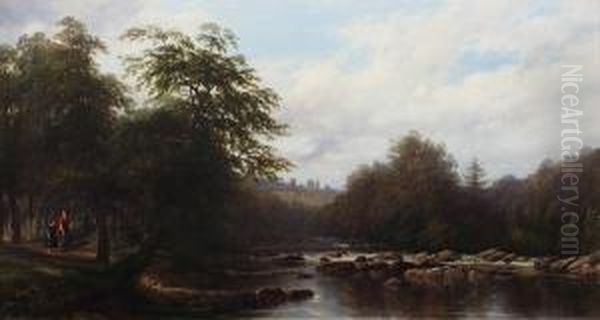
The artistic environment in Birmingham during the early to mid-19th century was dynamic. The Birmingham School of landscape painters, of which Barber was a key figure, emphasized direct observation of nature. This local school, while perhaps not as nationally renowned as the Norwich School with figures like John Crome and John Sell Cotman, nonetheless played an important role in fostering regional artistic talent. Artists like David Cox (1783-1859), though he spent much of his career elsewhere, also had strong ties to Birmingham and shared a similar dedication to capturing the atmospheric effects and rustic charm of the British landscape. Baker would have been aware of, and likely interacted with, other artists within this sphere, contributing to a shared ethos of landscape depiction.
Another contemporary landscape painter whose style and general approach are noted as having an influence on Baker was Thomas Creswick (1811-1869). Creswick, a Royal Academician, was known for his pleasing and meticulously detailed depictions of English and Welsh scenery, often featuring rivers, woodlands, and rustic figures. His success and popularity would have provided a model for aspiring landscape artists like Baker, and similarities in their careful rendering of foliage and their preference for serene, well-composed scenes can be observed. The prevailing taste of the Victorian era leaned towards naturalism and detailed representation, and both Creswick and Baker catered to this sensibility, albeit with their own individual inflections.
The Development of a Distinctive Style: The Midlands Pastoral
Thomas Baker's mature style is characterized by a profound affection for the specific landscapes he chose to depict. He became particularly associated with the scenery of Warwickshire, Worcestershire, and the wider Midlands. His paintings frequently feature gently rolling hills, meandering rivers, ancient trees, and picturesque farmsteads. A recurring motif in his work is the presence of cattle and sheep, often shown grazing peacefully or drinking at a water's edge. These animals are not mere accessories but integral components of his pastoral vision, imbuing his scenes with a sense of tranquil rural life. Works such as Deer Park Landscape with Cattle, On the Usk (though Usk is in Wales, it reflects his broader landscape interests), and Cattle Watering are prime examples of these thematic preoccupations.
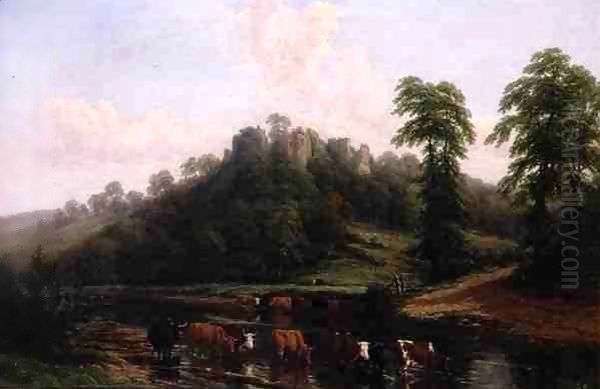
Baker's palette is typically warm and inviting, often favoring the bright, clear light of spring or summer days. He had a particular skill in rendering the textures of the natural world – the rough bark of trees, the soft fleece of sheep, the shimmering surface of water, and the varied foliage of the English countryside. His skies are often expansive, filled with soft clouds that contribute to the overall sense of peace and harmony. While his work aligns with the broader trends of 19th-century Realism and Naturalism, there is also a distinct romantic and idyllic quality to his paintings. He seemed less interested in the dramatic or sublime aspects of nature, which captivated artists like J.M.W. Turner (1775-1851), and more focused on its gentle, nurturing, and picturesque qualities, echoing perhaps some of the earlier sensibilities of artists like Thomas Gainsborough (1727-1788) in his landscape work, though with a distinctly Victorian precision.
The influence of John Constable (1776-1837), the titan of English landscape painting, is also worth considering, even if indirect. Constable's revolutionary approach to capturing the fleeting effects of light and weather, and his deep emotional connection to his native Suffolk landscapes, had a profound impact on the course of British art. While Baker's style is generally more polished and less overtly painterly than Constable's, the older master's emphasis on direct observation from nature and his elevation of humble rural scenes to high art undoubtedly created a more receptive environment for artists like Baker. It is noted that Frederick White, a student of Baker, drew inspiration from Constable, suggesting that Constable's principles were part of the artistic discourse within Baker's circle.
Representative Works and Thematic Concerns
Thomas Baker was a prolific artist, and his body of work consistently reflects his dedication to the pastoral genre. His titles often provide a straightforward indication of the subject matter, such as A View in Warwickshire, Harvest Time, Worcestershire, or Sheep Grazing by a River. These titles underscore his commitment to specific locales and the characteristic activities and features of the English countryside.
Deer Park Landscape with Cattle exemplifies many of Baker's strengths. Such a scene would typically feature majestic, mature trees, a hallmark of English parkland, with a herd of cattle peacefully occupying the foreground or middle distance. The play of light through the leaves, the careful delineation of the animals, and the overall sense of serene order would be characteristic. These parkland scenes also spoke to a particular aspect of English heritage and land ownership, appealing to patrons who valued such established, cultivated landscapes.
On the Usk indicates his willingness to travel slightly further afield for picturesque subjects, with the River Usk in Wales being a popular destination for artists seeking romantic scenery. His treatment would likely focus on the tranquil beauty of the river, perhaps with anglers or cattle, rather than its wilder, more mountainous stretches. This demonstrates a common practice among landscape painters of the era, who often undertook sketching tours to gather material.
Cattle Watering is a theme he returned to frequently, allowing him to showcase his skill in animal painting and in depicting the reflective qualities of water. Such scenes are inherently peaceful and evoke a timeless rhythm of rural life. The cattle are rendered with anatomical accuracy and a sense of individual character, reflecting close observation. The setting would typically be a gentle riverbank or a shallow pond, under a calm sky, reinforcing the overall mood of tranquility. His ability to integrate figures and animals seamlessly into the landscape was a key component of his success.
Beyond these specific titles, Baker's oeuvre is filled with variations on these themes: country lanes winding through sun-dappled woods, harvesters at work in golden fields, quiet village scenes, and expansive views across cultivated farmland. His work consistently celebrates the beauty and productivity of the English agricultural landscape, offering an reassuring vision of stability and continuity in an era of rapid industrial and social change.
Exhibitions, Recognition, and "Baker-Mania"
Thomas Baker achieved considerable recognition during his lifetime. He was a regular exhibitor at prestigious London venues, most notably the Royal Academy of Arts, where he showed works between 1831 and 1858. He also exhibited at the British Institution and the Royal Birmingham Society of Artists (RBSA), the latter being a key institution in his home region. Consistent exposure at these exhibitions was crucial for an artist's reputation and commercial success in the 19th century.
His paintings proved highly popular with the Victorian public and collectors. His appealing subject matter, combined with his evident skill and the pleasing aesthetic of his work, led to a strong demand. Indeed, by the late 19th century, his reputation was such that a phenomenon described as "Baker-mania" emerged, with his paintings commanding high prices in the art market. This posthumous surge in popularity speaks to the enduring appeal of his pastoral vision and the quality of his execution.
The esteem in which Baker was held is further evidenced by the inclusion of his works in numerous public collections. Today, his paintings can be found in the Herbert Art Gallery and Museum in Coventry, Birmingham Museums Trust, Leicester Museum & Art Gallery, and the Victoria and Albert Museum in London, among others. This institutional recognition solidifies his place as an important regional artist with a national reputation. His connection to Leamington Spa, where he lived for many years, was so strong that he became widely known as "Baker of Leamington," a moniker that distinguished him and tied him closely to the landscapes he so lovingly depicted.
The Artistic Milieu: Contemporaries and Comparisons
To fully appreciate Thomas Baker's contribution, it's helpful to consider him within the broader context of 19th-century British landscape painting. He was working in a period that had already seen the towering achievements of Turner and Constable, who had fundamentally reshaped the genre. The generation of artists that followed, including Baker, built upon these foundations while also responding to the specific tastes and sensibilities of the Victorian era.
Artists like Thomas Creswick, as mentioned, shared a similar aesthetic of detailed, pleasing landscapes. Others, such as David Cox, particularly in his later, more expressive watercolours, explored the atmospheric effects of the British weather with great vigour. Peter De Wint (1784-1849) was another highly regarded contemporary known for his broad, assured watercolours of English agricultural scenes, often capturing the expansive landscapes of Lincolnshire. John Linnell (1792-1882) produced rich, often dramatic, pastoral scenes, sometimes with a more overtly religious or moral undertone, and was a friend of William Blake and Samuel Palmer.
Samuel Palmer (1805-1881), a contemporary of Baker, represents a different strand of landscape painting with his intensely personal, visionary depictions of the Shoreham countryside, filled with a mystical quality. While Baker's work is more grounded in straightforward naturalism, Palmer's deep spiritual connection to the landscape offers an interesting contrast.
The Pre-Raphaelite Brotherhood, founded in 1848, also had a significant impact on the depiction of nature in British art. Artists like John Everett Millais (1829-1896) and William Holman Hunt (1827-1910), in their landscape backgrounds and dedicated nature studies, pursued a meticulous, almost photographic, truth to nature. While Baker was not a Pre-Raphaelite, the movement's emphasis on detailed observation and fidelity to the natural world was part of the broader artistic climate and may have reinforced his own tendencies towards careful rendering.
Baker's focus on specific English regions, particularly the Midlands, aligns him with a tradition of artists who found deep inspiration in their local environments. This regional focus was a strong characteristic of British landscape painting, seen in Constable's Suffolk, Turner's Thames and Yorkshire, and the work of the Norwich School painters like John Crome (1768-1821) and John Sell Cotman (1782-1842) in East Anglia. Baker carved out his own niche, becoming the pre-eminent painter of Warwickshire's gentle charms.
The "Baker of Leamington" Persona and Local Identity
The moniker "Baker of Leamington" is more than just a convenient label; it speaks to Thomas Baker's deep integration into the life and landscape of Leamington Spa and its surroundings. During the 19th century, Leamington Spa developed from a small village into a fashionable spa town, attracting visitors for its saline springs. Baker's presence in Leamington from around 1840 onwards coincided with this period of growth and prosperity. His paintings, often depicting the tranquil countryside that lay just beyond the burgeoning town, would have appealed to both residents and visitors who appreciated the picturesque qualities of the area.
His dedication to the local scenery was unwavering. He meticulously recorded the changing seasons, the specific character of local woodlands, fields, and waterways, and the agricultural life that defined the region. This intimate knowledge of his chosen terrain allowed him to imbue his paintings with a sense of authenticity and affection that resonated with his audience. He was, in essence, chronicling and celebrating the beauty of his adopted home. This strong sense of place is a defining characteristic of his work and a key reason for his enduring regional popularity.
The fact that he became so closely identified with Leamington suggests that he was a well-known and respected figure in the local community. His success as an artist would have brought a degree of cultural prestige to the town. For collectors and admirers of his work, the "Baker of Leamington" name guaranteed a certain type of subject matter and a consistent level of quality, rooted in the landscapes of the English Midlands.
Artistic Legacy and Enduring Appeal
Thomas Baker's legacy lies in his contribution to the tradition of English pastoral landscape painting. He successfully captured a particular vision of rural England – one of peace, harmony, and gentle beauty – that held great appeal for his Victorian contemporaries and continues to resonate today. In an age of increasing industrialization and urbanization, Baker's paintings offered an escape into an idealized countryside, a reminder of the enduring rhythms of nature and agricultural life.
His technical skill was considerable. His careful drawing, his nuanced understanding of light and colour, and his ability to render detail without sacrificing overall compositional harmony are all hallmarks of a proficient and dedicated artist. While he may not have been an innovator on the scale of Constable or Turner, he excelled within his chosen idiom, creating works of consistent quality and undeniable charm. His paintings are often described as "calm," "peaceful," and "idyllic," and it is this very quality that forms a significant part of their lasting appeal. They evoke a sense of nostalgia for a seemingly simpler, more harmonious past, a sentiment that transcends his own era.
The "Baker-mania" of the late 19th century, though perhaps a peak in his market value, indicates the deep chord his work struck. Even today, his paintings are sought after by collectors of Victorian art and those who appreciate traditional landscape painting. His work serves as a valuable visual record of the Midlands countryside in the 19th century, capturing a landscape that has, in many places, been irrevocably altered by modern development.
Conclusion: A Master of the Gentle Landscape
Thomas Baker of Leamington carved out a distinguished career as a painter of the English pastoral landscape. Influenced by his teacher Joseph Vincent Barber and working within a tradition shaped by figures like Constable and alongside contemporaries such as Thomas Creswick and David Cox, he developed a distinctive style characterized by meticulous detail, warm light, and a profound affection for the scenery of Warwickshire and the Midlands. His depictions of tranquil rural scenes, often featuring cattle and sheep, resonated deeply with the Victorian public, leading to considerable success and a lasting reputation.
His numerous exhibitions at the Royal Academy and other institutions, and the presence of his work in major public collections, attest to his standing in the art world of his time. More than just a skilled technician, Baker was an artist who conveyed a genuine love for his subject matter, creating paintings that are both accurate representations of nature and evocative expressions of a peaceful, idyllic England. His legacy is that of a master of the gentle landscape, an artist whose work continues to offer a comforting and aesthetically pleasing vision of the enduring beauty of the English countryside. Thomas Baker remains a cherished figure, particularly in the Midlands, a testament to his ability to capture the unique spirit and charm of that region.