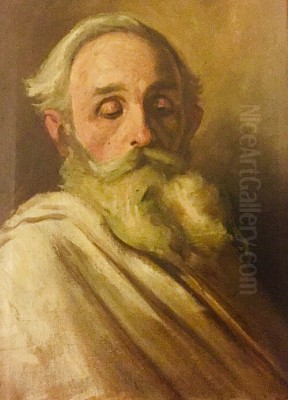
Wilhelm Schreuer (1866-1933) stands as a noteworthy figure in German art of the late 19th and early 20th centuries. An artist deeply rooted in the academic traditions of his time, Schreuer dedicated his career to capturing historical narratives and the nuanced social scenes of his era. His work, characterized by a distinctive approach to tonality and a commitment to realistic depiction, offers valuable insights into the cultural and historical milieu of Germany before and after the turn of the century. While perhaps not as globally renowned as some of his avant-garde contemporaries, Schreuer's contributions to genre and historical painting, particularly within the context of the Düsseldorf School, merit careful consideration.
Early Life and Artistic Formation in Düsseldorf
Born in Wesel, Germany, in 1866, Wilhelm Schreuer's artistic journey began in earnest when he enrolled at the prestigious Kunstakademie Düsseldorf (Düsseldorf Art Academy) in 1884. He remained a student there until 1890, a period that profoundly shaped his artistic sensibilities and technical skills. During his formative years at the academy, Schreuer studied under the tutelage of several influential artists. Among his instructors were Heinrich Lauenstein (often cited as Heinrich Laustensteiner), a respected painter known for his religious and historical subjects, and later Hugo Crola, who served as a professor and director at the academy and was noted for his portraiture and genre scenes. Some accounts also suggest he received guidance from Peter Janssen the Elder (often referred to as Peter Jensen-Petersen in some translations), a prominent historical painter and then director of the academy, known for his large-scale historical compositions.
The Düsseldorf Art Academy, during the 19th century, was one of Europe's most significant art institutions. It was renowned for the Düsseldorf School of painting, which emphasized detailed realism, meticulous technique, and often narrative or anecdotal subject matter. This school produced a generation of artists who excelled in landscape, genre, and historical painting. Figures like Andreas Achenbach and Oswald Achenbach became celebrated for their dramatic landscapes, while Johann Wilhelm Schirmer was a key figure in establishing the landscape tradition there. The academy's influence extended internationally, attracting students from across Europe and America. Schreuer's education within this environment instilled in him a strong foundation in academic draftsmanship, composition, and the traditional methods of oil painting.
Artistic Style, Thematic Concerns, and Techniques
Wilhelm Schreuer's artistic output primarily revolved around historical subjects and genre scenes, reflecting the prevailing tastes and academic training of his time. He developed a reputation for his adeptness in oil painting, often employing what was described as a "special tonal quality." This suggests a careful modulation of light and shadow, and perhaps a tendency towards a more limited or harmonious palette to achieve specific atmospheric effects. Some sources even hint at a monochromatic approach in certain works, which, if true, would have been a distinctive choice, setting his work apart by its focused exploration of value and form over a wide chromatic range.
His thematic concerns were diverse. Historical scenes, particularly those involving military figures or significant past events, featured prominently. This aligned with a broader 19th-century European interest in national history and identity, often expressed through grand visual narratives. Artists like Adolph Menzel in Germany, with his detailed depictions of the life of Frederick the Great and Prussian military history, or Anton von Werner, known for his portrayals of key moments in German unification, exemplify this trend. Schreuer's engagement with such themes placed him within this tradition of historical chroniclers.
Beyond grand history, Schreuer was also a keen observer of contemporary social life. His genre paintings captured everyday moments, interior scenes, and social gatherings, offering glimpses into the customs and environments of his time. These works often displayed a commitment to Realism, aiming for a truthful representation of their subjects, akin to the broader Realist movement championed by artists like Gustave Courbet in France or Wilhelm Leibl in Germany. However, Schreuer's Realism was likely tempered by the narrative and anecdotal tendencies of the Düsseldorf School, resulting in compositions that were both descriptive and engaging. He was known to depict concert halls, theatrical stages, and even maritime subjects like ships and cityscapes, showcasing a versatile interest in the world around him.
Schreuer also engaged in illustration, with a collection of his illustrative work reportedly published in 1897. This aspect of his career underscores his skill in narrative composition and his ability to adapt his artistic talents to different mediums and purposes. The creation of a mural depicting Spanish mercenaries in the Essen Minster (Cathedral) further highlights his capacity for large-scale historical work and public commissions.
Notable Works: A Glimpse into Schreuer's Oeuvre
While a comprehensive catalogue raisonné might be elusive, several specific works by Wilhelm Schreuer are documented, providing concrete examples of his artistic preoccupations and style. These paintings, mostly held in private collections or known through auction records, illustrate the range of his subject matter.
One of his significant historical pieces is "Friedrich der Große" (Frederick the Great), an oil painting dated 1893, measuring 85 x 120 cm. This work undoubtedly depicts the iconic Prussian king, a recurring figure in German historical art, likely portrayed in a characteristic setting, perhaps on military maneuvers or in a courtly scene, rendered with Schreuer's attention to historical detail and his particular tonal approach. The choice of Frederick the Great as a subject aligns Schreuer with artists like Menzel who extensively documented the monarch's life.
"Dorfscene" (Village Scene) is a smaller work, 33 x 24 cm, executed in mixed media, combining watercolor and oil. This piece would have showcased Schreuer's ability to capture the rustic charm and daily life of rural Germany. The use of mixed media suggests a versatility in technique and an interest in the varied textures and transparencies achievable with different materials. Such scenes were popular, reflecting a romanticized or ethnographic interest in peasant life, a theme also explored by artists like Jean-François Millet in France or Fritz von Uhde in Germany, albeit often with different social or religious undertones.
Dated 1911, "H Holländische Girl" (Dutch Girl), an oil painting of 31 x 29 cm, indicates an interest in regional character studies or perhaps travels to the Netherlands. Dutch genre scenes, famously pioneered by 17th-century masters like Johannes Vermeer and Pieter de Hooch, had a lasting influence, and many 19th-century artists revisited Dutch themes or were inspired by the distinctive culture and costumes.
Also from 1911 is "Husaren am Fluss" (Hussars by the River), a 30 x 24 cm oil painting. This work returns to military themes, focusing on cavalry soldiers, a popular subject in historical and genre painting. The depiction of hussars, with their distinctive uniforms, by a river would have allowed for a picturesque composition combining figures, animals (horses), and landscape elements.
A larger mixed-media piece, "Rast vor dem Gasthof" (Rest in Front of the Inn), measuring 100 x 120 cm, would have presented a more complex genre scene. Inns were common settings for depicting social interaction, travel, and everyday life, offering opportunities to portray a variety of characters and activities. The scale of this work suggests it was an important composition for the artist.
The title "Kampf" (Battle/War Scene) points to Schreuer's direct engagement with the depiction of conflict. Such scenes, whether historical or contemporary (given the period leading up to World War I), were a staple of academic art, allowing for dramatic compositions and the portrayal of heroism, tragedy, or the sheer chaos of war. Artists like Vasily Vereshchagin in Russia or Édouard Detaille in France were renowned for their powerful war paintings.
"Die Kontract" (The Contract) suggests a narrative genre scene, perhaps depicting a legal or business transaction, or a marriage contract. Such subjects allowed for the exploration of human psychology and social customs, often with a moralizing or anecdotal undertone, a characteristic of much 19th-century genre painting.
The general reference to "Zwei Gemälde" (Two Paintings) in some records, while not specific, implies a consistent output. His work also included depictions of war scenes in trenches or open fields, reflecting the realities or anticipations of modern warfare.
Exhibitions, Recognition, and Contemporaneous Context
Wilhelm Schreuer was an active participant in the art world of his time. His works were exhibited in various significant venues, including museums in Düsseldorf and Cologne, as well as in private galleries. His participation in international art exhibitions further broadened his exposure. The fact that he studied under prominent figures at the Düsseldorf Academy and later exhibited alongside established artists like Arthur Kampf—a notable historical and allegorical painter, and later a director of the Berlin Academy of Arts—indicates his integration into the mainstream art scene.
The artistic environment in Germany during Schreuer's career was dynamic and multifaceted. While he operated within the academic tradition, this period also saw the rise of Impressionism (with German proponents like Max Liebermann, Lovis Corinth, and Max Slevogt), Symbolism, and the beginnings of Expressionism. Schreuer's commitment to Realism and historical subjects placed him in a more conservative, though still respected, stream of art production. His focus on narrative clarity and technical finish would have appealed to a broad segment of the art-buying public and official institutions.
A posthumous retrospective exhibition was organized in 1934 by various art associations, including those in Silesia, South Germany, and the North Rhine region. Such an event, occurring shortly after his death in 1933, signifies a recognition of his contributions and a desire to honor his artistic legacy. His works continue to appear in the art market, indicating an ongoing, if modest, interest among collectors of German academic painting.
While the provided information does not detail specific collaborative projects with his teachers Heinrich Lauenstein or Hugo Carola beyond the student-mentor relationship, the academic environment itself fostered a degree of shared artistic discourse. Similarly, while auction catalogues might list his works alongside those of other artists, such as Lothar Schreyer (a Bauhaus artist and quite different stylistically), this primarily reflects the nature of auction sales rather than direct artistic collaboration or deep stylistic affinity. It is important to distinguish Wilhelm Schreuer from artists with similar names, such as the highly successful Orientalist painter Adolf Schreyer, whose dramatic equestrian and Eastern European scenes commanded significantly higher prices and a different market segment.
Legacy and Art Historical Significance
Wilhelm Schreuer's significance in art history lies in his role as a diligent and skilled practitioner of academic historical and genre painting in Germany. He represents a generation of artists who upheld the traditions of meticulous realism and narrative clarity even as modernist movements began to challenge these conventions. His work serves as a valuable visual record of the subjects, styles, and artistic values prevalent in late 19th and early 20th-century Germany.
His paintings, with their "special tonal quality" and focus on historical and social themes, contribute to our understanding of how the past was interpreted and how contemporary life was depicted during this period. While he may not have been an innovator in the mold of the avant-garde, his dedication to his craft and his consistent output earned him a place within the artistic fabric of his time. His connection to the Düsseldorf Art Academy, a powerhouse of 19th-century art education, further anchors his work within a significant historical and institutional context.
The continued presence of his works in collections and their appearance at auction demonstrate a sustained, albeit specialized, appreciation for his artistic contributions. He was a chronicler of his times, capturing both grand historical narratives and the more intimate moments of social existence, leaving behind a body of work that reflects the artistic currents and cultural preoccupations of a Germany on the cusp of profound transformation. His art provides a window into a world where academic skill, narrative content, and realistic representation were highly valued, offering a counterpoint to the more radical artistic experiments that would come to define much of the 20th century.
Conclusion
Wilhelm Schreuer, through his dedicated career spanning from the late Imperial German period into the early years of the Weimar Republic and the cusp of the Nazi era, remained a steadfast exponent of academic painting. His education at the Düsseldorf Art Academy under figures like Heinrich Lauenstein and Hugo Crola equipped him with the skills to tackle complex historical compositions and nuanced genre scenes. Works such as Friedrich der Große, Dorfscene, and Husaren am Fluss exemplify his thematic interests and his characteristic tonal approach to painting.
Exhibiting alongside contemporaries like Arthur Kampf and contributing to the rich tapestry of German art, Schreuer carved out a niche for himself as a painter of historical and social realities. While the artistic landscape around him was rapidly changing with the advent of modernism, Schreuer's commitment to the principles of realism and narrative art provided a consistent and valued contribution. His legacy, preserved in museums, private collections, and through the records of his exhibitions, allows us to appreciate an artist who diligently documented and interpreted his world through the lens of late 19th-century academic tradition. He remains a significant, if understated, figure in the broader narrative of German art history.