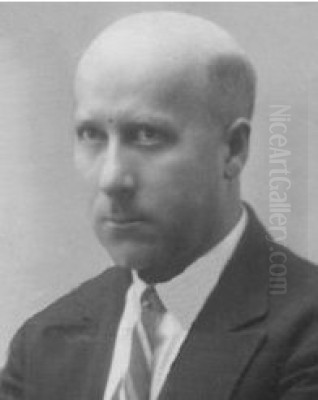
Janos Schadl stands as an intriguing, if somewhat enigmatic, figure within the vibrant landscape of early twentieth-century Hungarian art. Active during a period of intense artistic experimentation and socio-political upheaval, Schadl's work reflects the dynamic currents that swept through Central Europe. While detailed biographical information remains relatively scarce, his surviving artworks and their connection to broader artistic movements like Expressionism and Constructivism offer valuable insights into his creative vision and the cultural milieu he inhabited. This exploration seeks to illuminate Schadl's artistic contributions, placing his known works within the rich tapestry of Hungarian modernism and its dialogue with international avant-garde trends.
The Hungarian Artistic Climate at the Turn of the Century
To understand Janos Schadl, one must first appreciate the artistic environment of Hungary in the late nineteenth and early twentieth centuries. Budapest, a rapidly modernizing metropolis, was becoming a significant cultural hub. Artists were increasingly looking beyond the academic traditions of Vienna and Munich, seeking new forms of expression. The Nagybánya artists' colony, founded in 1896 by Simon Hollósy, Károly Ferenczy, and others, was pivotal in introducing plein-air painting and Impressionist and Post-Impressionist ideas to Hungary. This set the stage for a generation eager to break new ground.
Figures like József Rippl-Rónai, who had direct contact with the Nabis in Paris, and the visionary symbolist Tivadar Csontváry Kosztka, demonstrated the diverse paths Hungarian artists were forging. By the first decade of the 20th century, a more radical avant-garde began to emerge, influenced by Fauvism, Cubism, and German Expressionism. This was the fertile ground from which artists like Schadl would grow, absorbing and reinterpreting these international currents through a distinctly Hungarian lens.
Schadl's Emergence and Stylistic Inclinations
Janos Schadl's nationality is confirmed as Hungarian, and his primary artistic domain was painting. His active period, particularly the 1910s, places him squarely within the ferment of Hungarian modernism. The available information suggests his artistic style was not monolithic but rather embraced elements of both Expressionism and Realism, with a notable connection to the Constructivist tendencies that were gaining traction in Hungary, especially in the post-World War I era.
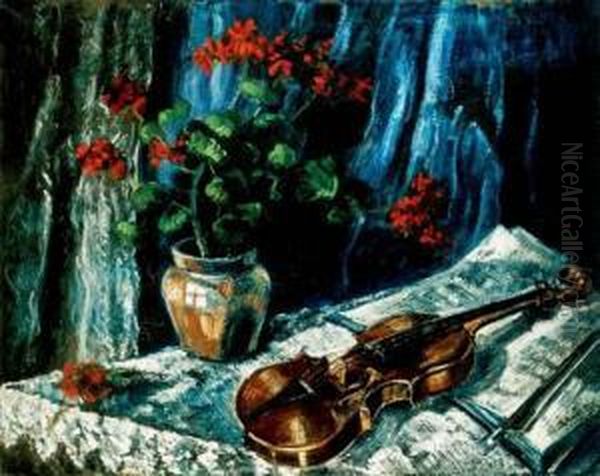
His engagement with Expressionism would have aligned him with a broader European movement that prioritized subjective feeling and emotional experience over objective reality. This often translated into distorted forms, bold colors, and a sense of inner turmoil or intensity. Simultaneously, an undercurrent of Realism might suggest a commitment to depicting tangible subjects, perhaps imbued with a modern sensibility. The mention of his involvement in exhibitions of Hungarian Constructivist painters indicates an affinity for geometric abstraction, functional design, and art with a social purpose, a hallmark of the Constructivist ethos championed by figures like Lajos Kassák.
Representative Works: A Glimpse into Schadl's Vision
Two works, in particular, offer concrete examples of Janos Schadl's artistic output: "Boy with the Violin" (1917) and "Aktivista landscape" (also referred to as "Aktivista tárgy" or "Activist Landscape") (1919). These pieces, created during a tumultuous period in Hungarian history, provide valuable clues to his thematic concerns and stylistic approaches.
Boy with the Violin (1917)
Dated 1917, "Boy with the Violin" is described as a charcoal drawing on paper. The medium itself, charcoal, lends itself to strong contrasts and expressive mark-making, often favored by artists seeking to convey emotion directly. The subject, a boy with a violin, is a classic theme, but in the context of 1917 – a year deep into the devastation of World War I – it could carry multiple layers of meaning. It might evoke innocence amidst chaos, the solace of art in troubled times, or a more personal, introspective mood.
The description of this work as a "unique work incorporating light and shadow" suggests a sophisticated handling of chiaroscuro, perhaps used to heighten the emotional atmosphere or to sculpt the form with a dramatic intensity characteristic of Expressionist portraiture. The auction estimates provided for this piece indicate a significant contemporary valuation, underscoring its perceived artistic merit. Without viewing the image, one might imagine a work that, while representational, uses the interplay of light and dark to create a powerful psychological presence, perhaps akin to the early portraits of Oskar Kokoschka or Egon Schiele, albeit filtered through Schadl's individual sensibility.
Aktivista landscape / Aktivista tárgy (1919)
Created in 1919, "Aktivista landscape" (or "Activist Object/Composition") is a mixed-media work, employing oil, watercolor, pencil, sketch, and paperboard. The dimensions are given as 46.5 x 64.5 cm, and it is signed "Schadl 919" in the lower right. The very title, "Aktivista," directly links this piece to the Hungarian Activist movement, a radical avant-garde group centered around Lajos Kassák and his influential journal MA (Today).
The year 1919 was exceptionally turbulent in Hungary, witnessing the short-lived Hungarian Soviet Republic, followed by its collapse and the beginning of the Horthy era. The Activists, including Kassák, Sándor Bortnyik, and Béla Uitz, sought to create a new art for a new society, often blending Expressionist fervor with Constructivist principles of order and social utility. An "Aktivista landscape" by Schadl from this year would likely reflect these ideals. It might feature a stylized, perhaps fragmented depiction of a landscape, infused with dynamic energy or geometric underpinnings. The use of mixed media itself suggests an experimental approach, breaking down traditional boundaries between materials and techniques, which was common among avant-garde artists of the period. The term "tárgy" (object or composition) could imply a move towards abstraction or a focus on the formal elements of the artwork.
The Context of Hungarian Activism and Constructivism
Janos Schadl's connection to Activism and Constructivism places him within a crucial chapter of the Hungarian avant-garde. Lajos Kassák was the ideological and organizational force behind this movement. His journal MA, published from 1916 to 1925 (initially in Budapest, then in exile in Vienna), was a platform for radical art, literature, and theory, connecting Hungarian artists with international figures like Tristan Tzara, El Lissitzky, and Kurt Schwitters.
The Hungarian Activists, initially influenced by Expressionism and Futurism, increasingly gravitated towards Constructivism, particularly after Kassák's encounter with Russian Constructivist ideas. They advocated for an art that was non-representational, based on geometric forms, and integrated with life and social progress. Artists like Sándor Bortnyik became known for their "Bildarchitektur" (picture architecture), abstract compositions with a strong sense of structure and order. Béla Uitz, another prominent Activist, created powerful graphic works and later monumental frescoes reflecting revolutionary ideals. János Mattis-Teutsch, with his unique blend of Expressionism and abstract organic forms, also moved within these circles.
Schadl's "Aktivista landscape" and his participation in exhibitions of Hungarian Constructivist painters suggest he was an active participant or at least a close fellow traveler in this dynamic movement. His work would have been part of a broader effort to redefine art's role in society and to forge a visual language appropriate for the modern age. This context also included artists who, while perhaps not strictly "Activist," shared the avant-garde spirit, such as László Moholy-Nagy, who would later become a key figure at the Bauhaus and a pioneer of international Constructivism. Moholy-Nagy's early work in Hungary was certainly shaped by the same intellectual currents as Schadl's.
The Broader Hungarian Avant-Garde: The Eight and Beyond
The ground for movements like Activism was partly prepared by earlier avant-garde formations, most notably "The Eight" (Nyolcak), who held their first exhibition in 1909. This group, including Károly Kernstok, Róbert Berény, Dezső Czigány, Béla Czóbel, Ödön Márffy, Dezső Orbán, Bertalan Pór, and Lajos Tihanyi, broke decisively with the Impressionistic tendencies of Nagybánya. They embraced bold colors, strong outlines, and expressive forms, drawing inspiration from Paul Cézanne, the Fauves, and early Cubism.
While Schadl's documented works appear slightly later, the intellectual and artistic legacy of The Eight would have been part of the atmosphere. Their emphasis on structural composition and expressive intensity paved the way for the more radical experiments of the 1910s. Artists like Róbert Berény, for instance, explored psychological portraiture and dynamic compositions that resonated with Expressionist ideas. Lajos Tihanyi, known for his powerful portraits and later Cubist-influenced works, was another significant figure whose development paralleled the broader shifts in European art.
The Hungarian avant-garde was not monolithic. It encompassed a range of styles and personalities. Figures like József Nemes Lampérth, with his intensely expressive, almost Fauvist landscapes and nudes, or Vilmos Perlrott-Csaba, who absorbed Parisian influences and developed a distinctive decorative style, contributed to the richness of the period. The political climate, especially after 1919, led many avant-garde artists, including Kassák, Bortnyik, Moholy-Nagy, and Marcel Breuer (who would become a famed architect and designer), to emigrate, primarily to Vienna, Berlin, and later, some to the Soviet Union or the West. This diaspora played a crucial role in disseminating Hungarian avant-garde ideas internationally.
Schadl in the Artistic Milieu: Connections and Exhibitions
The provided information indicates that Janos Schadl participated in exhibitions featuring Hungarian Constructivist painters. This is a significant detail, as group exhibitions were vital for avant-garde artists to showcase their work, exchange ideas, and build a collective identity. Such exhibitions, often organized by groups like MA, would have placed Schadl's work alongside that of his contemporaries who were exploring similar artistic territory.
While specific collaborations or direct mentorships are not detailed, the very nature of the avant-garde involved a degree of shared purpose and intellectual exchange. The cafes of Budapest, the editorial offices of journals like MA or Nyugat (West), and the studios of artists were hubs of discussion and debate. It is highly probable that Schadl was part of these networks, engaging with the ideas and personalities that shaped Hungarian modernism. The mention of the Hungarian Ministry of Culture's support for certain exhibitions also points to a level of official (or at least semi-official) recognition for these new artistic directions at various points.
The art scene would have also included critics and writers who championed the avant-garde, such as Ernő Kállai, who later became an important theorist associated with Constructivism and the Bauhaus. The interplay between artists, writers, and publications was crucial for the development and dissemination of modernist ideas.
Challenges in Reconstructing a Full Picture
Despite these contextual anchors, reconstructing a comprehensive biography and oeuvre for Janos Schadl presents challenges. The historical record for many artists of this period, particularly those who may not have achieved the international fame of a Moholy-Nagy or a Kassák, can be fragmented. Political upheavals, wars, and emigration often led to the loss or dispersal of artworks and archival materials.
The art market, through auction records, sometimes brings lesser-known works or artists back into focus. The significant estimates for Schadl's "Boy with the Violin" and "Aktivista landscape" suggest that these pieces are now considered valuable examples of Hungarian avant-garde art. However, a fuller understanding would require more extensive art historical research, potentially uncovering further works, exhibition records, or contemporary critical reviews.
It's also important to note the commonality of names, which can sometimes lead to confusion in historical records. For instance, the provided text initially contained a misattribution to a "Johannes Schadl," a lighting designer, highlighting the care needed in art historical research. The focus here remains firmly on Janos Schadl, the Hungarian painter active in the early 20th century.
Legacy and Significance
Janos Schadl's legacy, based on the available evidence, is that of an artist who actively engaged with the transformative artistic ideas of his time. His work, as exemplified by "Boy with the Violin" and "Aktivista landscape," demonstrates a stylistic range that encompassed the emotional depth of Expressionism and the forward-looking dynamism of Activism and Constructivism. He was part of a generation of Hungarian artists who sought to break from academic constraints and forge a new visual language relevant to the modern experience.
His participation in the Hungarian Constructivist movement, even if his exact role or output within it requires further elucidation, places him within an important current of European modernism. Hungarian Constructivism, with its unique blend of international influences and local characteristics, made a significant contribution to the broader Constructivist International. Artists like Schadl, working within this framework, contributed to a collective effort to reimagine the role of art and the artist in society.
The survival and recent market recognition of his works ensure that Janos Schadl is not entirely lost to art history. They serve as tangible evidence of his artistic journey and offer a window into the vibrant and often turbulent world of the Hungarian avant-garde. Further research may yet uncover more about his life and work, adding greater detail to our understanding of this Hungarian painter and his place in the rich narrative of early twentieth-century European art. His story is a reminder of the many individual talents that contributed to the collective force of modernism, each adding their unique voice to a period of profound artistic change.