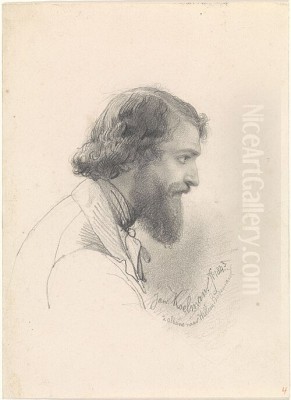
Willem Bodemann emerges from the annals of 19th-century art history primarily as a dedicated student and follower of the renowned Dutch Romantic landscape painter, Barend Cornelis Koekkoek. While not as widely celebrated as his illustrious master, Bodemann's work contributes to our understanding of the dissemination and evolution of Romantic landscape painting in the Netherlands and surrounding regions during a period of significant artistic transformation. His career, intrinsically linked to Koekkoek, reflects the prevailing artistic tastes and pedagogical methods of the era, emphasizing meticulous detail, idealized natural scenery, and an emotive response to the landscape.
Early Artistic Inclinations and the Dutch Context
The early 19th century in the Netherlands witnessed a resurgence of interest in landscape painting, hearkening back to the Golden Age masters of the 17th century but infused with the new sensibilities of Romanticism. Artists sought to capture not just the topographical accuracy of a scene, but also its mood, atmosphere, and the sublime power of nature. It was within this fertile artistic environment that Willem Bodemann would have developed his initial interest in art. Specific details about his early life and formative years before his tutelage under Koekkoek are scarce, a common fate for artists who did not achieve widespread, independent fame.
However, it is reasonable to assume that Bodemann, like many aspiring painters of his time, would have been exposed to the works of established Dutch landscape artists. The legacy of painters such as Jacob van Ruisdael and Meindert Hobbema was still potent, providing a foundation upon which new artistic movements could build. The desire for formal training would have been paramount for any young artist wishing to make a mark, and seeking out a respected master was the conventional path to acquiring the necessary skills and artistic vision.
The Pivotal Apprenticeship with B.C. Koekkoek
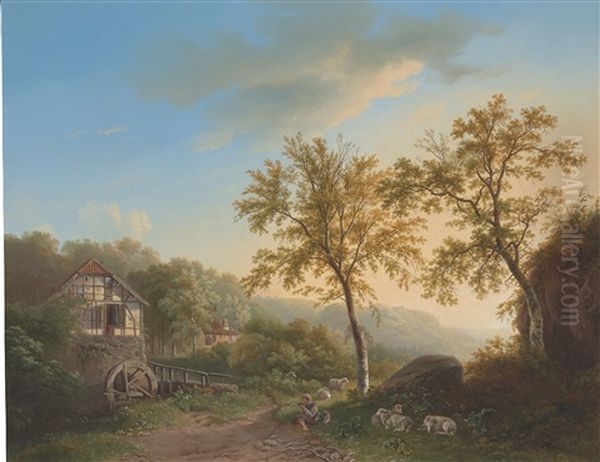
Willem Bodemann's most defining professional association began in 1826 when he became one of the first pupils of Barend Cornelis Koekkoek (1803-1862). Koekkoek, who would later be hailed as the "Prince of Landscape Painters," was himself a rising star at this time, though his exceptional talent was already evident. Bodemann's apprenticeship under Koekkoek spanned approximately four years, until 1830. This period was crucial for Bodemann's artistic development, as he absorbed the techniques, stylistic preferences, and artistic philosophy of his master.
Their association was not confined to a single studio. Bodemann studied with Koekkoek in various locations, reflecting Koekkoek's own movements and search for inspiring landscapes. These included Amsterdam, a major artistic hub; Hilversum, known for its picturesque natural surroundings; and importantly, Cleves (Kleve) in Germany, near the Dutch border. Koekkoek would eventually settle in Cleves and establish an academy there, drawn by its rolling hills and wooded scenery, which differed from the flatter landscapes typical of much of Holland. Bodemann's presence with Koekkoek in these diverse settings exposed him to a variety of natural environments, enriching his visual vocabulary.
The master-apprentice relationship in the 19th century was intensive. It involved not only direct instruction in drawing and painting techniques – such as composition, color mixing, and brushwork – but also joint sketching trips and the study of nature firsthand. Bodemann reportedly accompanied Koekkoek on study trips, possibly through parts of Germany and Belgium, further immersing himself in the practice of capturing landscapes en plein air, or at least making detailed studies that would later be worked up into finished paintings in the studio.
Bodemann's Artistic Style: Echoes of Romanticism
Willem Bodemann's artistic style was, by all accounts, deeply influenced by B.C. Koekkoek. He worked firmly within the Romantic tradition, which in landscape painting emphasized the beauty, grandeur, and sometimes the untamed wildness of nature. His paintings typically featured meticulously rendered details, a hallmark of Koekkoek's own work, and a careful attention to the play of light and shadow to create mood and atmosphere.
The compositions in Bodemann's works, like those of his master, often aimed for an idealized version of nature. This involved selecting and arranging natural elements – majestic trees, rolling hills, distant mountains, serene water bodies – into harmonious and aesthetically pleasing scenes. The goal was not necessarily a literal transcription of a specific place, but rather the creation of a landscape that evoked a particular emotional or poetic response in the viewer. This approach, where the artist "composed" nature to enhance its beauty, was central to Koekkoek's teachings and is evident in the works of his followers.
Color palettes in Dutch Romantic landscapes, and likely in Bodemann's work, tended towards rich, earthy tones for foregrounds and mid-grounds, with luminous skies often featuring dramatic cloud formations or the soft glow of dawn or dusk. The human element, if present, was usually small in scale, serving to emphasize the grandeur of the natural surroundings rather than being the primary subject.
Themes and Subjects: The Romantic Landscape
The primary themes in Willem Bodemann's oeuvre revolved around the depiction of romanticized landscapes. Given his training with Koekkoek, who was renowned for his forest scenes and, later, his more expansive mountain views, Bodemann's subject matter would have aligned closely with these interests.
Forest interiors were a popular subject for Koekkoek and his school. These paintings often featured towering, ancient trees, dappled sunlight filtering through the canopy, and perhaps a winding path or a rustic cottage nestled within the woods. Such scenes allowed for intricate studies of foliage, bark texture, and the complex interplay of light and shadow. Bodemann would have honed his skills in depicting these elements under Koekkoek's guidance.
While the Netherlands itself lacks mountainous terrain, Koekkoek's move to Cleves and his travels to regions like the Harz Mountains and the Ardennes introduced more dramatic, hilly, and even mountainous scenery into his repertoire. Bodemann, having traveled with Koekkoek, would also have been exposed to these "grandiose" landscapes. His works likely included majestic mountain views, possibly with dramatic skies and atmospheric perspective, conveying a sense of awe and the sublime. These were often populated with small figures of travelers or herdsmen, adding a narrative touch and enhancing the scale of the landscape.
Representative Works: A Reflection of a School
Pinpointing specific, widely recognized "masterpieces" by Willem Bodemann is challenging, as is often the case with artists who worked closely in the shadow of a more famous master. His paintings are not as extensively cataloged or as frequently reproduced as those of B.C. Koekkoek. However, based on his training and stylistic affinities, his representative works would undoubtedly be romantic landscapes that echo Koekkoek's thematic concerns and technical polish.
One could expect to find paintings by Bodemann titled in a manner typical of the period and school, such as "Forested Landscape with Stream and Figures," "Summer Landscape near Cleves," "Mountain Valley with Cattle," or "Winter Scene with Skaters on a Frozen River." These titles reflect the common subjects: detailed woodland scenes, idyllic summer pastorals, expansive valley views, and atmospheric seasonal depictions. The quality would lie in the careful rendering of natural details, the balanced composition, and the evocative use of light.
His works would likely be characterized by a high degree of finish, a smooth application of paint, and a clear distinction between foreground, middle ground, and background elements to create a convincing sense of depth. The influence of 17th-century Dutch masters like Jacob van Ruisdael or Meindert Hobbema, filtered through Koekkoek's Romantic lens, would also be discernible, particularly in the treatment of trees and skies. While perhaps not breaking new ground in terms of innovation, Bodemann's paintings would have capably represented the prevailing tastes for romantic and picturesque landscapes.
The Enduring Influence of Koekkoek and the Dutch Romantic Tradition
The impact of Barend Cornelis Koekkoek on Willem Bodemann cannot be overstated. Koekkoek was not just a teacher of technique; he imparted an entire artistic vision. His emphasis on combining direct observation of nature with an idealized, poetic interpretation became the guiding principle for his students. Bodemann, as one of the earliest, would have been thoroughly steeped in this philosophy. Koekkoek's own artistic lineage, tracing back to masters like Andreas Schelfhout (1787-1870), who was one of Koekkoek's teachers, meant that Bodemann was also connected to a broader tradition of Dutch landscape painting.
Schelfhout himself was a pivotal figure in 19th-century Dutch art, renowned for his winter landscapes and panoramic views. His influence on Koekkoek, particularly in terms of meticulous detail and atmospheric effects, would have indirectly shaped Bodemann's approach. Other contemporaries of Koekkoek, who formed the core of Dutch Romanticism, included Wijnand Nuijen (1813-1839), whose promising career was cut short but who produced vibrant, romantic scenes, and Johannes Warnardus Bilders (1811-1890), known for his forest landscapes that shared some affinities with the Oosterbeek School.
The artistic environment in which Bodemann worked was rich with talent. Painters like Cornelis Springer (1817-1891) and Bartholomeus Johannes van Hove (1790-1880) excelled in townscapes, but the overall Romantic sensibility pervaded various genres. Marine painters from the Koekkoek family, such as B.C.'s father Johannes Hermanus Koekkoek (1778-1851) and his brother Hermanus Koekkoek Sr. (1815-1882), also contributed to the diversity of Dutch Romantic art. Bodemann's specialization in landscapes placed him firmly within the most popular and critically acclaimed genre of the period in the Netherlands.
Context: The Wider European Romantic Landscape
While Bodemann's primary sphere was Dutch and German Romanticism, it's useful to see this movement within the broader European context. Across the continent, artists were exploring similar themes of nature's power and beauty. In Germany, Caspar David Friedrich (1774-1840) was creating iconic images of sublime and spiritual landscapes, often imbued with symbolism. Johan Christian Dahl (1788-1857), a Norwegian painter who worked in Dresden, also captured the wildness of nature with dramatic flair. Carl Blechen (1798-1840) represented a transition towards Realism but with strong Romantic underpinnings in his Italian landscapes.
In Britain, Joseph Mallord William Turner (1775-1851) pushed the boundaries of landscape painting with his expressive and often abstract depictions of light and atmosphere, while John Constable (1776-1837) focused on the tranquil beauty of the English countryside with a more naturalistic, yet still deeply felt, approach. Though Bodemann's style was more aligned with the detailed and composed manner of Koekkoek, the overarching Romantic spirit – the emphasis on emotion, individualism, and the awe-inspiring aspects of the natural world – was a pan-European phenomenon. This international movement provided a backdrop against which the specific characteristics of Dutch Romanticism, as practiced by Koekkoek and his students like Bodemann, can be better appreciated.
Contemporaries and the Artistic Milieu of Cleves
After B.C. Koekkoek established his drawing academy (Zeichen Collegium) in Cleves in 1841, the town became a magnet for aspiring landscape painters. While Bodemann's primary training period (1826-1830) predates the formal academy, Koekkoek was already active in Cleves during part of this time, and Bodemann was known to visit him there. The artistic circle around Koekkoek in Cleves included many artists who either studied with him or were influenced by his style.
Painters like Johann Bernhard Klombeck (1815-1893) became one of Koekkoek's most accomplished pupils and collaborators, often painting figures into Koekkoek's landscapes. Klombeck developed his own distinct style but remained true to the Romantic ideals. Louwrens Hanedoes (1822-1905) was another Dutch painter who studied with Koekkoek and specialized in similar wooded and panoramic landscapes. The presence of such a community of artists, all focused on landscape painting and sharing a common aesthetic foundation, created a vibrant artistic environment.
Other Dutch artists who might be considered part of this broader school or who shared similar stylistic tendencies include Marinus Adrianus Koekkoek I (1807-1868), B.C.'s younger brother, who also painted landscapes and forest scenes. The collective output of these artists solidified the reputation of the "Cleves School" of painting, characterized by its romantic, detailed, and often idealized depictions of nature, primarily forests and river valleys along the Rhine. Willem Bodemann, through his early and close association with Koekkoek, can be seen as a precursor or an early member of this influential group.
Challenges in Documenting Bodemann's Oeuvre
One of the inherent challenges in art historical research is the varying degrees of documentation available for different artists. Major figures like B.C. Koekkoek have been the subject of extensive study, with catalogues raisonnés detailing their works. For students and followers like Willem Bodemann, the historical record is often less complete. His paintings may be less frequently signed or dated, or they might be misattributed, sometimes even to Koekkoek himself if the style is particularly close.
The art market also plays a role. Works by highly sought-after artists are more likely to be researched and authenticated. Paintings by lesser-known artists, even if of good quality, may circulate more quietly in private collections or appear sporadically at auction without extensive provenance. This makes it difficult to assemble a comprehensive overview of Bodemann's total output or to trace the evolution of his style with the same precision as one can for his master.
However, the existing evidence clearly indicates his role as a skilled painter within the Koekkoek school. Each identified work by Bodemann helps to build a clearer picture of his contribution and demonstrates the effective transmission of Koekkoek's artistic principles. Art historians and connoisseurs continue to refine attributions and uncover works by artists like Bodemann, gradually enhancing our understanding of the breadth and depth of 19th-century landscape painting.
Legacy and Historical Placement
Willem Bodemann's legacy is primarily that of a talented disciple who capably absorbed and perpetuated the style of one of the 19th century's leading landscape painters. He may not have been an innovator who forged a radically new path, but his work is representative of a significant and popular artistic movement. Artists like Bodemann played an important role in disseminating a particular aesthetic, satisfying the public's appetite for romantic and picturesque views of nature.
His paintings, characterized by their technical competence and adherence to the Romantic ideals taught by Koekkoek, would have found appreciation among collectors of his time. Today, his works are valued by those who admire the Dutch Romantic tradition and the specific qualities of the Koekkoek school. They offer insights into the master-student dynamic of the period and illustrate how an influential artist's style could be adopted and adapted by his followers.
In the broader narrative of art history, Willem Bodemann is a figure who contributes to the richness and complexity of his era. While the spotlight often falls on the great masters, the students and associates who formed their "schools" are essential for a complete understanding of artistic trends and influences. Bodemann's connection to B.C. Koekkoek ensures his place within the story of Dutch Romantic landscape painting, a testament to his dedication and skill in capturing the serene and majestic beauty of the natural world as envisioned by his celebrated mentor.
Conclusion: An Artist in the Romantic Current
Willem Bodemann stands as a noteworthy figure within the Dutch Romantic landscape tradition, a painter whose artistic identity was profoundly shaped by his tutelage under the eminent Barend Cornelis Koekkoek. From 1826 to 1830, through study in Amsterdam, Hilversum, Cleves, and travels across Germany and Belgium, Bodemann immersed himself in Koekkoek's methods and vision. His work, characterized by romanticized forest scenes and majestic mountain vistas, reflects the meticulous detail, idealized compositions, and emotive power that were hallmarks of his master and the broader Romantic movement.
While specific titles of his major works may not be as widely known, the nature of his oeuvre—comprising finely rendered landscapes that celebrate the beauty and poetry of nature—is clear. He was part of an artistic milieu that included not only his teacher Koekkoek but also figures like Andreas Schelfhout, Wijnand Nuijen, and later, members of the Cleves School such as Johann Bernhard Klombeck. His art contributes to our understanding of a period when landscape painting reached new heights of popularity and expressive depth, moving beyond mere topography to engage the viewer's emotions. Willem Bodemann's paintings remain a valuable part of the legacy of 19th-century Dutch art, illustrating the enduring appeal of the Romantic engagement with the natural world.