William Frederick Ritschel, a name synonymous with the turbulent beauty and profound power of the sea, stands as a towering figure in American art history. Born in Nuremberg, Germany, in 1864, his life was an odyssey that spanned continents and artistic movements, culminating in a legacy of marine paintings that continue to captivate audiences with their dynamism, emotional depth, and masterful execution. His journey from a young German mariner to a celebrated American artist, particularly associated with the rugged Californian coastline, is a testament to his unwavering passion for the ocean and his exceptional ability to translate its myriad moods onto canvas.
Early Life and European Foundations
Ritschel's formative years were intrinsically linked to the sea. Before formally dedicating himself to art, he served as a mariner, an experience that profoundly shaped his artistic vision. These voyages instilled in him an intimate understanding of the ocean's rhythms, its capricious nature, and the interplay of light on water – knowledge that would later infuse his paintings with an unparalleled authenticity. This practical, firsthand experience distinguished him from many of his contemporaries, lending his seascapes a visceral quality that resonated with viewers.
His formal artistic education began at the Royal Academy of Fine Arts in Munich. At the time, Munich was a vibrant artistic center in Europe, a hub where traditional academicism coexisted with emerging modern art movements. Under the tutelage of esteemed professors such as Friedrich August von Kaulbach and Wilhelm von Diez, Ritschel would have been exposed to a rigorous curriculum emphasizing drawing, composition, and the study of the Old Masters. The Munich School was particularly known for its rich, dark palette and painterly realism, influences that can be discerned in Ritschel's early works before he fully embraced the brighter palette of Impressionism. It was during his time in Munich that he encountered a painting titled "Der Abwurf" (The Castaway or The Derelict), depicting a shipwreck, which reportedly made a lasting impression on him and may have solidified his resolve to specialize in marine subjects.
Arrival in America and the New York Scene
In 1895, at the age of 31, William Ritschel made the pivotal decision to immigrate to the United States, initially settling in New York City. This was a period of significant artistic ferment in America. The Gilded Age was giving way to new sensibilities, and American artists were forging a distinct national identity, absorbing European influences while adapting them to American landscapes and themes. Ritschel quickly immersed himself in this dynamic environment.
His talent was soon recognized, and he became an active member of several prestigious art organizations, including the New York Watercolor Club and the American Watercolor Society. Watercolor, with its fluidity and transparency, was a medium well-suited to capturing the ephemeral qualities of water and light, and Ritschel excelled in it alongside his oil painting. His works began to appear in prominent exhibitions, earning him critical acclaim and a growing circle of admirers. He was known for his robust personality and his dedication to his craft, often spending long hours observing the sea from various vantage points along the Atlantic coast.
During his New York years, Ritschel associated with prominent American Impressionists. He developed friendships with artists like Childe Hassam, J. Alden Weir, Edward Redfield, and Willard Metcalf. These figures were at the forefront of American Impressionism, adapting French techniques to depict American life and landscapes. Their influence, particularly their emphasis on capturing fleeting moments of light and atmosphere en plein air, undoubtedly resonated with Ritschel’s own inclinations. While his style retained a strong element of realism and a dramatic power often distinct from the more lyrical tendencies of some Impressionists, the brighter palette and broken brushwork characteristic of the movement became increasingly evident in his work. In 1914, his standing in the American art world was solidified when he was elected an Associate of the National Academy of Design, followed by full Academician status in 1918, a significant honor.
The Call of California: Carmel and "Castel a Mare"
While New York provided a fertile ground for his burgeoning career, the dramatic landscapes of the American West, particularly the California coast, eventually beckoned. In 1911, Ritschel made his first visit to California, drawn by tales of its stunning natural beauty and burgeoning art scene. He was immediately captivated by the rugged coastline of the Monterey Peninsula, a region that would become his muse for the remainder of his life. He initially spent time in the area, and by 1918, he had decided to make Carmel Highlands his permanent home.
In Carmel, Ritschel became one of the pioneering artists of the Carmel-by-the-Sea art colony, a community that attracted numerous painters, writers, and poets. This colony included notable figures such as Armin Hansen, another powerful marine painter; Guy Rose, a leading California Impressionist; E. Charlton Fortune, known for her vibrant landscapes and harbor scenes; and Charles Rollo Peters, famed for his romantic nocturnes. Ritschel's presence further enhanced the reputation of Carmel as a significant center for American art. He was an active member of the Carmel Art Association, contributing to its exhibitions and fostering a sense of community among artists.
It was in the Carmel Highlands, overlooking the majestic Pacific Ocean, that Ritschel built his iconic home and studio, "Castel a Mare" (Castle by the Sea). This stone fortress, perched dramatically on a cliff, was more than just a residence; it was a statement of his artistic identity and his profound connection to the sea. From its windows and terraces, he had an unparalleled, ever-changing view of the ocean, allowing him to study its moods at all times of day and in all weather conditions. The castle itself became a local landmark, embodying the romantic and rugged spirit of its owner. He often hosted fellow artists and patrons there, and the dramatic setting undoubtedly inspired many of his most powerful works.
Artistic Style and Thematic Focus
William Ritschel's artistic style is a compelling fusion of Realism and Impressionism, uniquely tailored to his primary subject: the sea. His early training in Munich provided a strong foundation in academic draftsmanship and composition, ensuring a structural integrity to his works. However, his direct experience as a sailor and his later engagement with Impressionistic principles led him to develop a style that was both accurate in its depiction of maritime details and evocative in its capture of atmosphere and emotion.
Ritschel was a master of portraying the sheer power and dynamism of the ocean. His canvases often depict crashing waves, turbulent storms, and the rugged interface between sea and shore. He employed vigorous, expressive brushwork, sometimes using a palette knife to build up thick impasto, conveying the texture of rocks and the churning energy of water. His understanding of wave mechanics, gleaned from years at sea, allowed him to render the complex forms of breakers and swells with remarkable accuracy and force. Artists like Winslow Homer had earlier set a high bar for American marine painting with their dramatic portrayals of the sea, and Ritschel continued this tradition, albeit with his own distinct voice.
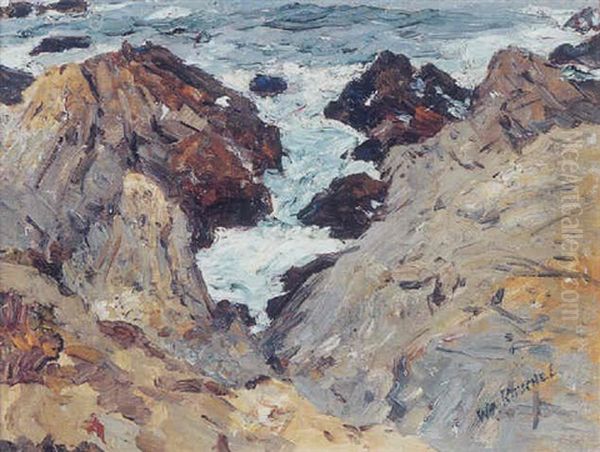
Light was a crucial element in Ritschel's work. He was adept at capturing the myriad effects of light on water – the glint of sunlight on a calm surface, the diffused glow of a misty morning, the dramatic illumination of a storm-tossed sea by a break in the clouds, or the ethereal shimmer of moonlight. His palette could range from the deep blues and greens of the open ocean to the vibrant ochres, siennas, and purples of coastal rocks, often heightened by the brilliant whites of breaking surf. While some of his works exhibit the brighter colors and broken brushwork associated with Impressionism, others retain a more tonal quality, emphasizing the dramatic interplay of light and shadow.
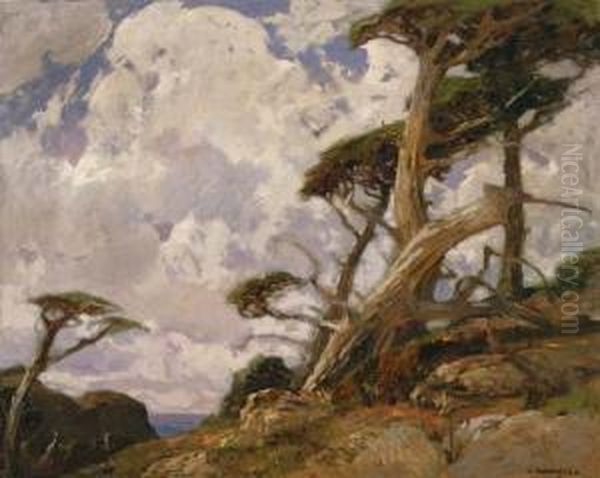
His thematic focus was almost exclusively on the sea, but within this, he explored a wide range of subjects. He painted the open ocean, coastal scenes, shipwrecks, fishing boats, and tranquil harbors. The California coast, with its dramatic cliffs, cypress trees, and powerful Pacific swells, provided endless inspiration. He was particularly drawn to locations like Point Lobos, Monterey Bay, and the Big Sur coastline. Unlike some Impressionists who focused on the more placid or picturesque aspects of nature, Ritschel often embraced the sublime and untamed character of the ocean, conveying a sense of awe and respect for its formidable power. His work can be compared in spirit to that of European marine masters like J.M.W. Turner, who also sought to capture the elemental forces of nature.
Masterpieces of the Sea
Throughout his long and prolific career, William Ritschel produced numerous paintings that are now considered masterpieces of American marine art. These works exemplify his technical skill, his profound understanding of his subject, and his ability to evoke a powerful emotional response.
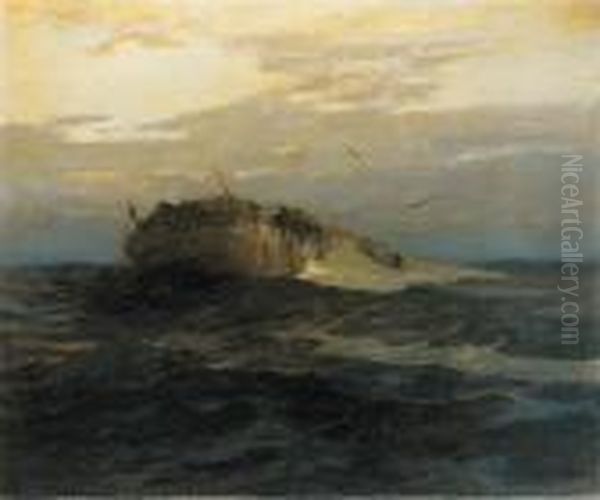
One of his early significant themes, influenced by the painting "Der Abwurf" he saw in Munich, was that of the derelict ship, a poignant symbol of the sea's unforgiving nature. Paintings like The Derelict capture the lonely grandeur of abandoned vessels, battered by the elements, serving as a memento mori of human endeavors against the vastness of nature.
His California period yielded a wealth of iconic images. Glorious Pacific (1926) is a quintessential Ritschel work, showcasing a panoramic view of the sunlit ocean with waves crashing against a rocky shore. The play of light on the water, the dynamic composition, and the vibrant color palette all contribute to a sense of exhilaration and the immense scale of the Pacific.
Waiting for the Tide is another notable piece, likely depicting a more tranquil scene, perhaps fishing boats in a harbor or a quiet cove, showcasing his versatility in capturing different moods of the sea. Such works highlight his ability to find beauty not only in the ocean's fury but also in its moments of calm.
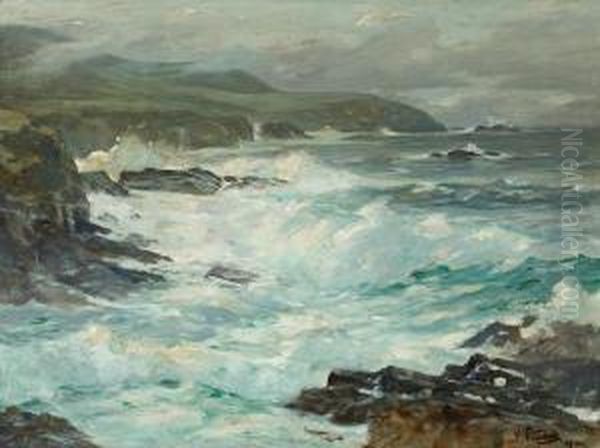
Paintings specifically titled Point Lobos or Monterey Coast are numerous and highly sought after. These works often feature the characteristic wind-swept cypress trees, dramatic rock formations, and the relentless surge of the Pacific. In these, Ritschel masterfully balances the geological solidity of the land with the fluid energy of the water, creating compositions that are both powerful and harmonious. Surf Crashing on Rocks is a title that could apply to many of his works, as this was a recurring and favorite theme, allowing him to explore the dynamic interplay of force and resistance, movement and stasis.
His works were widely exhibited and won numerous awards throughout his career, including gold medals at the Panama-Pacific International Exposition in San Francisco (1915) and other prestigious venues. His paintings were acquired by major museums, including the Art Institute of Chicago, the Pennsylvania Academy of the Fine Arts, and, fittingly, the Monterey Museum of Art, which holds a significant collection of his work.
Legacy and Influence
William Frederick Ritschel passed away in 1949 in his beloved "Castel a Mare" in Carmel Highlands, leaving behind an extraordinary body of work and an enduring legacy. He is widely regarded as one of America's foremost marine painters, often referred to as the "Dean of American Marine Painters." His influence extended to other artists who were drawn to the California coast, and he played a significant role in establishing the Monterey Peninsula as a major center for American art.
His ability to convey the raw power and sublime beauty of the ocean remains unparalleled. He did not merely paint the sea; he interpreted its soul, drawing on his deep personal connection and his exceptional artistic gifts. His works continue to be highly prized by collectors and admired by the public for their technical brilliance, their emotional resonance, and their timeless depiction of the eternal dialogue between land and sea.
Ritschel's art serves as a powerful reminder of the majesty of the natural world. He stands in a lineage of great marine painters that includes artists like Frederick Judd Waugh, who also specialized in dramatic seascapes, and Paul Dougherty, another contemporary known for his powerful coastal scenes. However, Ritschel's unique blend of German academic training, American Impressionist influences, and his profound, sailor's understanding of the sea gives his work a distinctive character. His paintings are not just visual records; they are immersive experiences, inviting the viewer to feel the spray of the surf, hear the roar of the waves, and sense the immense, untamed spirit of the ocean that he so masterfully captured. His contribution to American art, and particularly to the genre of marine painting, is indelible.