William Widgery stands as a significant figure in the annals of British landscape painting, particularly celebrated for his evocative depictions of Devon and its rugged, atmospheric terrains. A largely self-taught artist, his life and work offer a fascinating glimpse into the artistic spirit of Victorian England, a period rich with a public appetite for landscape art that captured the nation's diverse natural beauty. His journey from humble beginnings to a respected painter, whose works continue to be admired, is a testament to his innate talent and profound connection to the West Country environment.
Early Life and the Call of Art
Born in North Molton, Devon, in 1826, William Widgery's early life was not one steeped in artistic academia. His initial trade was that of a stonemason, a physically demanding profession that nonetheless may have instilled in him an appreciation for form, texture, and the raw materials of the earth. It is not definitively recorded when the shift from stone to canvas occurred, but it is clear that the dramatic landscapes surrounding him exerted a powerful pull. The moors, tors, rivers, and coastlines of Devon became his open-air studio and his most enduring muse.
Unlike many of his contemporaries who benefited from formal training at institutions like the Royal Academy Schools, perhaps under the tutelage of established masters such as Sir Edwin Landseer or following the landscape traditions refined by John Constable and J.M.W. Turner, Widgery forged his own path. This autodidactic approach allowed him to develop a style that was uniquely his own, less constrained by academic conventions and more directly responsive to the visceral experience of nature.
The Self-Taught Master of Devon
Widgery's decision to become a full-time artist was a bold one, but his dedication soon bore fruit. He established himself in Exeter, and his reputation as a painter of Devon's distinctive scenery grew steadily. His works were characterized by a remarkable ability to capture the fleeting atmospheric conditions of the region – the mists rolling over Dartmoor, the play of light on water, the rich colours of autumn foliage, and the dramatic skies above the coastline.
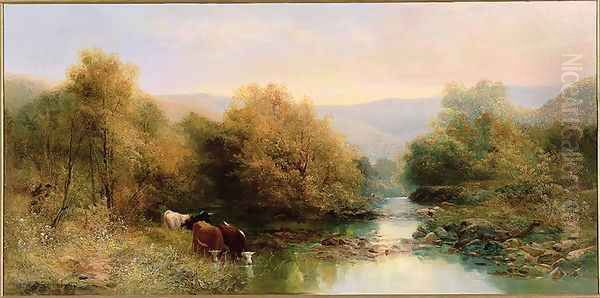
His technique, developed through keen observation and relentless practice, was praised for its vigorous handling of paint and its excellent command of colour. He often worked on a large scale, producing canvases that enveloped the viewer in the landscapes he portrayed. This preference for larger formats allowed him to convey the grandeur and wildness of areas like Dartmoor, a subject he returned to throughout his career. His deep understanding of the local flora, the granite tors, and the ever-changing weather patterns lent an authenticity to his paintings that resonated with both critics and the public.
Depicting Dartmoor and Beyond
Dartmoor, with its ancient granite tors, sweeping moorlands, and often brooding skies, was a particular source of inspiration for William Widgery. He captured its many moods, from the sun-drenched heather in summer to the stark, snow-covered expanses of winter. His paintings often feature the hardy Dartmoor ponies or cattle grazing, adding a touch of pastoral life to the wildness of the landscape. These depictions were not merely topographical records; they were imbued with a romantic sensibility, reflecting a deep emotional connection to the land.
While Dartmoor was a central theme, Widgery also painted other parts of Devon and Cornwall. Coastal scenes, with crashing waves and rugged cliffs, were another forte. He skillfully rendered the translucency of water and the textures of rock, demonstrating his versatility as a landscape artist. His work can be seen in the context of a broader Victorian fascination with specific regional landscapes, a trend also evident in the work of artists like Benjamin Williams Leader, known for his Worcestershire scenes, or Myles Birket Foster, whose idyllic depictions of the Surrey countryside were immensely popular.
Representative Works and Artistic Style
Among William Widgery's notable works, "Torre Abbey" and "Cattle on the Dart in Autumn" are often cited. These paintings exemplify his ability to combine accurate observation with an atmospheric and often dramatic presentation. "Torre Abbey" would have captured a significant historical site within a landscape setting, a common practice for artists wishing to appeal to local pride and interest in heritage. "Cattle on the Dart in Autumn" showcases his skill in rendering animal forms within a richly coloured seasonal landscape, highlighting his mastery of light and texture to evoke a specific time of year.
His style was characterized by a certain robustness and directness. While not possessing the meticulous detail of the Pre-Raphaelite landscapes, such as those by John Everett Millais or the early works of William Holman Hunt, Widgery's paintings had an immediacy and an emotional impact. He was less concerned with botanical precision than with conveying the overall spirit and atmosphere of a place. His brushwork could be bold and expressive, particularly in his larger canvases, suggesting an artist working with confidence and a clear vision.
Contributions to Tourism and Local Identity
Beyond his easel paintings, William Widgery played a role in the burgeoning tourism industry of the 19th century. He provided illustrations for travel books and railway advertisements, his images helping to popularize Devon as a picturesque destination. In this, he shared a common ground with other artists who contributed to the visual culture of travel, making distant landscapes accessible and appealing to a wider audience. This commercial aspect of his work did not diminish its artistic merit but rather extended its reach, embedding his vision of Devon in the public consciousness.
His work helped to shape and reinforce a sense of local identity, celebrating the unique beauty of the West Country. This regional focus was a characteristic of many Victorian artists, who found rich subject matter in their immediate surroundings, much like John Linnell who painted the Surrey hills or Samuel Palmer whose visionary works were rooted in the Kent countryside around Shoreham.
The Artistic Milieu and Contemporaries
William Widgery operated within a vibrant British art scene. While he was self-taught, he would have been aware of the dominant artistic trends. The legacy of Romanticism, with its emphasis on nature and emotion, as championed by Turner and Constable, still held sway. The Pre-Raphaelite Brotherhood, with their call for "truth to nature," offered a different, highly detailed approach to landscape. Later in his career, the influence of Impressionism began to be felt in Britain, though Widgery's style remained more rooted in the British landscape tradition.
He was a contemporary of artists like George Vicat Cole, who also specialized in landscape, and Alfred de Breanski Sr., known for his dramatic depictions of Scottish and Welsh scenery. While Widgery's focus was primarily regional, his success indicates that his work appealed to a broader appreciation for skillfully rendered and emotionally resonant landscapes. The public's appetite for such art was significant, with exhibitions at the Royal Academy and other institutions drawing large crowds.
The Widgery Artistic Dynasty: Frederick John Widgery
William Widgery's artistic legacy was continued by his son, Frederick John Widgery (1861–1942), who also became a notable landscape painter. Unlike his father, F.J. Widgery received formal art training, studying at the Exeter School of Art, then in Antwerp, and later at Hubert von Herkomer's renowned art school in Bushey, Hertfordshire. Hubert von Herkomer himself was a versatile and influential artist, and his school attracted many talented students.
F.J. Widgery, while also deeply inspired by the Devon landscape, particularly Dartmoor, developed a style that differed in some respects from his father's. He was known for his fine draughtsmanship and often worked on a smaller scale, producing many accomplished watercolours and illustrations. His formal training perhaps lent a greater degree of refinement and detail to his work, though he shared his father's love for the atmospheric qualities of the West Country. The father-and-son duo became synonymous with Devon landscape painting, each contributing significantly to the artistic representation of the region. F.J. Widgery also became a prominent public figure in Exeter, serving as mayor.
Critical Reception and Enduring Appeal
During his lifetime, William Widgery was a popular and respected artist. Critics praised his ability to capture the essence of Devon's landscapes, his skillful use of colour, and the atmospheric quality of his work. His paintings were sought after by collectors, and his contributions to local culture were recognized. The fact that he was self-taught often added to the admiration for his achievements, highlighting his natural talent and determination.
His work continues to be appreciated today. His paintings are held in public collections, including the Royal Albert Memorial Museum (RAMM) in Exeter, and frequently appear at auction, demonstrating an enduring market interest. For art historians and enthusiasts of British landscape painting, Widgery represents an important regional artist who, while perhaps not achieving the national fame of a Turner or Constable, made a distinctive and valuable contribution to the genre. His dedication to his native Devon, and his ability to translate its unique character onto canvas, ensures his place in art history. He can be seen as part of a lineage of artists deeply connected to place, a tradition that includes figures like Thomas Gainsborough with his Suffolk landscapes, or later, artists of the Newlyn School like Stanhope Forbes and Walter Langley who were drawn to the light and life of Cornwall.
Later Years and Legacy
William Widgery passed away in 1893, leaving behind a substantial body of work that continues to celebrate the beauty and wildness of the Devon landscape. His life story, from stonemason to acclaimed painter, is an inspiring one. He demonstrated that profound artistic expression could emerge from a deep personal connection to one's environment, independent of formal academic structures.
His legacy is twofold: the artworks themselves, which provide a vivid and atmospheric record of Victorian Devon, and the continuation of an artistic tradition through his son, F.J. Widgery. Together, the Widgerys created an unparalleled visual chronicle of their beloved county. William Widgery's paintings serve as a reminder of the power of landscape to inspire, and of the enduring appeal of art that captures the spirit of a place with honesty and passion. His work stands alongside that of other dedicated landscape painters of his era, such as Sidney Richard Percy of the Williams family of painters, who also found their inspiration in the British countryside.
Conclusion: An Enduring Vision of Devon
William Widgery's contribution to British art lies in his authentic and spirited portrayal of the Devon landscape. As a self-taught artist, he developed a distinctive style characterized by atmospheric depth, strong colour, and a romantic sensibility. His depictions of Dartmoor, the Devon coasts, and river valleys not only captured the visual appearance of these locations but also their inherent mood and character. He successfully translated his profound personal connection to his native county into works of art that resonated with his contemporaries and continue to be admired. His life and work underscore the rich artistic traditions that flourished outside the major metropolitan centers, celebrating the unique beauty of Britain's diverse regions. William Widgery remains a key figure in the story of West Country art, a master whose canvases still evoke the timeless allure of the Devon landscape.