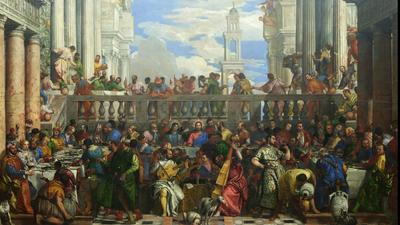
In 1573, Paolo Veronese completed a monumental masterpiece titled The Feast in the House of Levi. Measuring over thirteen meters wide, this canvas was originally intended to depict the Last Supper, yet it transformed into one of the most vibrant scenes in Renaissance art. Look closely at the center, where Jesus sits beneath a soaring white arch. Surrounding him is a chaotic, living tapestry of humanity. Turbaned figures, curious children, jesters, and even dogs roam freely through the grand loggia. Notice the dynamic energy: guests lean in to whisper, servants hurry with silver platters, and figures in exotic silks gesture toward the bustling crowd below. The composition is framed by three magnificent Corinthian arches that open into a luminous, pale blue sky. Veronese fills the space with a soft, silvery glow, making the rich crimsons and deep emeralds of the garments shimmer with life. The light feels airy and atmospheric, washing over the marble balustrades and creating a sense of immense depth. Every brushstroke breathes luxury and celebration into the architectural space.
This work is celebrated for its daring fusion of the sacred and the worldly. Rather than a somber ritual, Veronese invites us into a theatrical spectacle, celebrating the diversity and grandeur of Venetian life. It remains a breathtaking testament to the power of imagination and the beauty of a world captured in a single, magnificent moment.