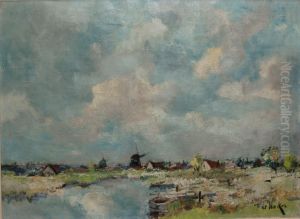
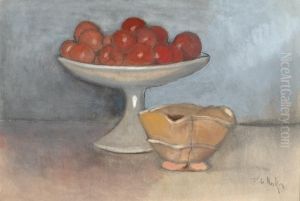
Francois Pierre Emile, commonly known as Frans De Nocker, was a Belgian artist born on April 24, 1934, in Sint-Jans-Molenbeek, Belgium. His artistic journey began at a young age, and he was particularly known for his vibrant use of color and dynamic compositions that often reflected the post-expressionist movement.
De Nocker studied at the Royal Academy of Fine Arts in Brussels, where he honed his craft and was significantly influenced by his professors and the rich artistic heritage of Belgium. His early work demonstrated a keen interest in the human form and urban landscapes, themes that he would continue to explore throughout his career.
Throughout the 1960s and 1970s, De Nocker's style evolved, and he became known for his abstract works that played with geometric forms and color planes. Despite the abstract nature of his work, there was often a suggestion of narrative or a reflection of his personal experiences and observations of the world around him. He participated in numerous exhibitions, both solo and group, gaining recognition within the Belgian art scene and internationally.
In addition to painting, De Nocker also explored other mediums such as printmaking and drawing. His versatility and dedication to his craft earned him a respected place among his contemporaries. De Nocker's works are part of several public and private collections, and his contribution to art continues to be celebrated posthumously.
Frans De Nocker's life was cut short when he passed away on August 6, 1992. Despite his relatively brief career, his artistic legacy endures, and he is remembered as an important figure in the Belgian post-expressionist movement. His unique approach to color and form, as well as his ability to capture the essence of his time, continues to inspire new generations of artists.