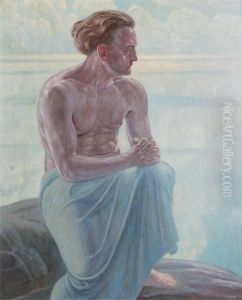
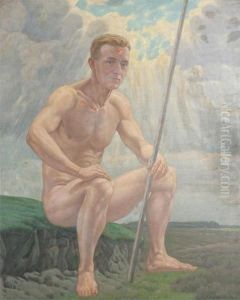
Karl Holleck-Weithmann was a German artist known for his watercolor paintings, graphics, and illustrations. Born on January 1, 1900, in Vienna, Austria, Holleck-Weithmann initially trained as an architect before fully dedicating himself to the visual arts. His early career was shaped by the tumultuous times of the early 20th century, with World War I and its aftermath having profound effects on the cultural landscape of Europe.
After his architectural studies, Holleck-Weithmann focused on watercolor painting and graphic works, developing a distinctive style that often depicted landscapes, city scenes, and everyday life with a vibrant and expressive use of color. He was particularly influenced by the Austrian art scene, which at the time was characterized by the succession and the development of modernist movements.
During the interwar period, Holleck-Weithmann's work gained recognition, and he became a member of various art associations. His art was exhibited in numerous shows, and he became an integral part of the German and Austrian art communities. With the rise of National Socialism, many artists faced restrictions and persecution, but Holleck-Weithmann managed to continue his work throughout this period.
After World War II, Karl Holleck-Weithmann's style evolved, reflecting the changes in post-war society. His later works continued to showcase his mastery of watercolors, but with a more subdued palette and often poignant reflections on the human condition. He remained active as an artist until his later years, contributing to the art world through his unique perspective and capturing the essence of the mid-20th century European environment.
Karl Holleck-Weithmann passed away on November 10, 1981, leaving behind a rich body of work that continues to be appreciated for its historical significance and artistic value. His contributions to the German and Austrian art scenes have made him a respected figure among art historians and collectors, and his works are featured in various galleries and museums across Europe.