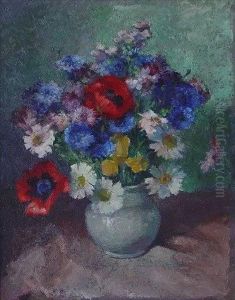
Willem Bogtman was a prominent Dutch artist, best known for his contributions to the field of stained glass design and execution in the early to mid-20th century. Born on May 14, 1882, in Haarlem, Netherlands, Bogtman's artistic journey began in an era that saw a resurgence of interest in traditional crafts, spurred by the Arts and Crafts movement. This period emphasized the value of handcraftsmanship and the aesthetic qualities of materials, which deeply influenced Bogtman’s work throughout his career.
After completing his education, Bogtman quickly immersed himself in the world of stained glass, a medium that had seen a revival in artistic and architectural circles in Europe. His talent and dedication to the craft led him to establish his own studio, Atelier Bogtman, in Haarlem, which would become one of the most respected stained glass workshops in the Netherlands. His works were characterized by their vibrant colors, intricate designs, and the ability to integrate both traditional and contemporary motifs. This versatility made Bogtman a sought-after collaborator for a variety of projects, ranging from religious buildings to secular institutions.
Throughout his career, Bogtman was deeply involved in the artistic community, participating in numerous exhibitions and contributing to the development of Dutch art. His influence extended beyond his own practice, as he mentored a generation of artists and craftsmen in the techniques and philosophies of stained glass artistry. Despite the challenges posed by two World Wars and the changing tastes in art and architecture, Bogtman continued to innovate, exploring new materials and techniques.
Willem Bogtman's legacy is not only preserved in the windows that adorn buildings across the Netherlands and beyond but also in the enduring impact he had on the Dutch art scene. His commitment to craftsmanship and beauty in everyday spaces underscored a belief in the power of art to inspire and uplift. Bogtman passed away on July 25, 1955, leaving behind a body of work that continues to be studied and admired for its contribution to the revitalization of stained glass art in the 20th century.