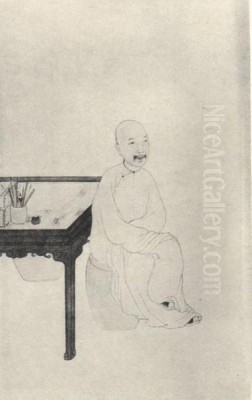
Dai Xi , a name that resonates with the refined elegance and profound depth of traditional Chinese literati painting, stands as a pivotal figure in the art history of the late Qing Dynasty. Born in 1801 in Qiantang, now part of Hangzhou in Zhejiang Province, Dai Xi, also known by his courtesy name Chunshi and his art names (hao) Yu'an , Songping , Luchuang Jushi , and Jingdong Jushi , was not only a celebrated painter but also a respected poet and a dedicated official. His life, tragically cut short in 1860, was a testament to the scholar-official ideal, balancing artistic pursuits with civic duty, and ultimately demonstrating unwavering loyalty.
Dai Xi's artistic legacy is primarily anchored in his masterful landscape paintings (shanshui), though he also excelled in depicting flowers, bamboo, and rocks. He is often lauded as a significant successor to the "Four Wangs" of the early Qing Orthodox school, and his work is considered a vital link in the continuity and evolution of Chinese landscape art. His ability to synthesize various traditional influences while infusing his work with personal observation and poetic sentiment secured him a distinguished place among his contemporaries and a lasting influence on subsequent generations.
Early Life and Artistic Awakening
Dai Xi's upbringing in the culturally rich environment of Hangzhou, a city renowned for its scenic beauty and long artistic heritage, undoubtedly played a crucial role in shaping his aesthetic sensibilities. From a young age, he was immersed in the scholarly traditions that valued poetry, calligraphy, and painting as integral components of a cultivated mind. His familial connections also provided early exposure to art; his uncle, Dai Daoheng, was a friend of the established painter Xi Gang .
Through this connection, the young Dai Xi was influenced by Xi Gang, a prominent artist associated with the late phase of the Orthodox school who also showed an appreciation for the more individualistic styles. This early tutelage likely instilled in Dai Xi a respect for traditional brushwork and composition, particularly the tenets of the Southern School of landscape painting, which emphasized lyrical expression and calligraphic brushwork, as championed by the influential Ming dynasty artist and theorist Dong Qichang . This foundation would become the bedrock upon which Dai Xi would build his distinctive artistic voice.
A Scholar-Official's Path
Embracing the conventional path for aspiring scholars of his time, Dai Xi dedicated himself to rigorous classical studies. His efforts culminated in 1832 when he successfully passed the prestigious Jinshi imperial examination, the highest level of academic achievement. This accomplishment opened the doors to an official career, and he was subsequently appointed to the esteemed Hanlin Academy, a body of outstanding scholars responsible for literary tasks, historical compilation, and advising the emperor.
Over the years, Dai Xi served in various capacities, including as a compiler at the Hanlin Academy, an educational commissioner, and eventually rising to significant positions such as Vice Minister of Rites . His official duties required him to reside in Beijing, the imperial capital, for extended periods. This urban environment, with its vibrant intellectual and artistic circles, provided him with opportunities to view renowned collections and interact with fellow scholar-officials and artists, further enriching his artistic perspective.
However, Dai Xi's official career was not without its challenges. A notable anecdote recounts an incident where he was tasked with writing a plaque for the Nan Shufang , an important imperial chamber. For reasons that remain somewhat obscure, his calligraphy or perhaps his handling of the commission was deemed unsatisfactory, leading to a demotion. This event, perceived as a slight, reportedly contributed to his decision to resign from his official post, citing illness, and return to his native Hangzhou. This withdrawal allowed him to dedicate more of his time and energy to his true passions: painting and poetry.
Artistic Philosophy and Influences
Dai Xi's artistic philosophy was deeply rooted in the literati tradition, which viewed painting not merely as a craft for representation but as a means of self-expression and a reflection of the artist's inner world. He famously advocated for "learning from nature to paint one's heart" , a principle that underscored the importance of direct observation of the natural world while simultaneously emphasizing the infusion of personal feeling and poetic sensibility into the artwork.
He was a keen student of past masters, believing in the importance of "learning from the ancients but not being constrained by them" . His early development showed the influence of the "Four Wangs" – Wang Shimin , Wang Jian , Wang Hui , and Wang Yuanqi . Among these, he particularly admired the meticulous brushwork and compositional skills of Wang Hui and the structural depth of Wang Yuanqi.
Dai Xi also urged artists to "take lessons from Song masters" , looking further back to the monumental landscapes and nuanced ink play of the Song dynasty (960-1279). He is known to have studied and emulated the styles of Northern Song masters like Ju Ran , known for his "hemp-fiber" texture strokes and rounded mountain forms. From the Yuan dynasty (1271-1368), he drew inspiration from figures like Wu Zhen , one of the Four Masters of the Yuan, celebrated for his powerful ink washes and expressive depictions of bamboo and landscapes. His engagement with these earlier traditions demonstrates a desire to move beyond the sometimes-formulaic approaches of later Orthodox school followers and to reinvigorate landscape painting with a sense of historical depth and directness.
Distinctive Artistic Style and Techniques
Dai Xi's paintings are characterized by their refined brushwork, rich and moist ink tones, and a harmonious balance between meticulous detail and evocative atmosphere. He was a master of creating landscapes that were both structurally sound and poetically resonant. While firmly grounded in the Southern School tradition, his work often integrated elements that could be associated with the more robust qualities of the Northern School, resulting in a style that was both elegant and substantial.
One of his notable technical innovations, or at least a technique he perfected and became known for, was the "Chan Yi Cun" , or "cicada wing texture stroke." This technique involved using light, layered, and somewhat dry brushstrokes to build up the texture of rocks and mountains, creating a delicate, almost translucent effect reminiscent of a cicada's wing. This method allowed for subtle gradations of tone and a sense of airy lightness, even in complex mountain forms.
His compositions were often carefully constructed, leading the viewer's eye through layers of receding space, from detailed foreground elements like trees and pavilions to distant, mist-shrouded peaks. Water, whether in the form of rivers, lakes, or waterfalls, frequently played a significant role, adding dynamism and a sense of flow to his scenes. The human presence, when included, was typically small, emphasizing the grandeur and vastness of nature, a common theme in Chinese landscape painting. His palette was generally subtle, often relying on the expressive power of ink alone, though he also created works in light colors .
Representative Masterpieces
Dai Xi's prolific output includes numerous works that are now treasured in museum collections worldwide. Among his most celebrated pieces are:
_Remembering Pines Diagram_ : This work, often created for friends or to commemorate specific sentiments, showcases his skill in depicting pine trees, symbols of longevity and resilience. The painting likely evokes a sense of nostalgia or longing, imbued with personal meaning. It was notably painted for his friend and fellow official Qi Junzao, reflecting their shared appreciation for art and nature.
_Pine and Bamboo Diagram_ : Pine and bamboo are classic subjects in Chinese art, symbolizing integrity, endurance, and the spirit of the scholar. Dai Xi's renditions of these motifs are marked by their vigorous brushwork and an understanding of the plants' essential characteristics, capturing both their physical form and their symbolic resonance.
_Album of Twelve Landscapes_ : Album leaves were a popular format for literati painters, allowing for a series of intimate and varied explorations of landscape themes. Such an album by Dai Xi would demonstrate his versatility in composition and mood, with each leaf offering a distinct, jewel-like vision of nature, often executed with a focus on ink play and refined brushwork, characteristic of his later style.
_Cloud, Orchid, Swallowtail Diagram_ : While primarily a landscape painter, this title suggests a work that might focus on more specific natural elements, perhaps with a delicate rendering of orchids (symbolizing a noble character) amidst atmospheric clouds, possibly with calligraphic flourishes resembling swallowtails.
_One Mountain Diagram_ : This title implies a focus on a singular, prominent mountain form, allowing for an intensive study of its structure, texture, and spiritual presence. Such works often carry philosophical or personal connotations, with the mountain representing stability, aspiration, or a place of retreat.
_Clouds, Mist, and Verdant Smoke Diagram_ : This title evokes a quintessential Chinese landscape scene, emphasizing atmospheric effects. Dai Xi excelled at rendering mist and clouds, which served not only to create a sense of depth and mystery but also to unify compositional elements and evoke a poetic mood.
These works, and many others, exemplify Dai Xi's ability to convey the lyrical beauty of the Chinese landscape, filtered through his scholarly sensibility and masterful command of brush and ink.
Interactions with Contemporaries and Artistic Circles
During his time in Beijing and later in Hangzhou, Dai Xi was an active participant in the artistic and literary circles of his era. His relationships with other painters and scholars were crucial for the exchange of ideas, the viewing of artworks, and mutual encouragement.
One of his most significant artistic peers was Tang Yifen . Dai Xi and Tang Yifen were so highly regarded and often stylistically compared that they were frequently referred to together as "Tang-Dai." Both were leading figures in landscape painting during the Daoguang (1821-1850) and Xianfeng (1851-1861) reigns, and both ultimately met tragic ends related to the Taiping Rebellion (Tang Yifen also committed suicide when Nanjing fell). While Dai Xi was particularly known for his landscapes influenced by the Orthodox school, Tang Yifen was also celebrated for his depictions of plum blossoms. Their parallel careers and shared prominence underscore the vitality of traditional painting in this period.
Dai Xi maintained a close friendship with Qi Junzao , a high-ranking official and fellow art enthusiast. Their correspondence and the exchange of artworks, such as Dai Xi's _Remembering Pines Diagram_ for Qi, attest to a deep bond built on shared cultural values. Qi Junzao was also a collector, and through such friendships, Dai Xi would have had access to important historical paintings, including authentic works by masters like Wang Yuanqi, which further honed his connoisseurship and informed his own practice.
Later in his life, around 1858, Dai Xi became acquainted with Shen Shuyong , a younger scholar and collector who commissioned an album from Dai. This interaction, though brief due to Dai Xi's subsequent death, indicates his continued engagement with the artistic community.
His early artistic development, as mentioned, was influenced by Xi Gang , whose style bridged the Orthodox school with more individualistic tendencies. This early exposure provided a solid grounding in traditional techniques while perhaps also planting the seeds for Dai Xi's own subtle innovations.
The broader artistic context of Dai Xi's work includes the towering figures of the Orthodox School, the "Four Wangs" (Wang Shimin, Wang Jian, Wang Hui, Wang Yuanqi), whose art and theories, largely derived from Dong Qichang , formed the mainstream of Qing painting. Dai Xi's engagement with their legacy was one of respectful emulation and thoughtful reinterpretation. He also studied earlier masters like Ju Ran and Wu Zhen , seeking to connect with the foundational sources of the literati landscape tradition. His work can be seen as part of the lineage of the Yushan School , founded by Wang Hui, and the Loudong School , associated with Wang Yuanqi, as he synthesized elements from both.
Literary Contributions: The Xikuzhai Huapu
Beyond his painted oeuvre, Dai Xi made significant contributions to art theory through his writings. His most important work in this regard is the Xikuzhai Huapu , also referred to as Xikuzhai Huaxu . This collection of essays and notes encapsulates his thoughts on painting theory, practice, and connoisseurship.
In this text, Dai Xi elaborates on the aesthetic principles of the Southern School, offering insightful interpretations of the art of Dong Qichang, the Four Masters of the Yuan dynasty (Huang Gongwang, Wu Zhen, Ni Zan, Wang Meng), and the Ming dynasty Wu School masters (such as Shen Zhou and Wen Zhengming). He discusses techniques, the importance of capturing the "spirit resonance" of a subject, and the moral and intellectual qualities required of a true literati painter. The Xikuzhai Huapu is a valuable resource for understanding not only Dai Xi's own artistic philosophy but also the prevailing art critical views of his time. It underscores his belief in the importance of rigorous practice ("practicing hardship") and deep engagement with tradition as prerequisites for genuine artistic expression.
The Final Years: Turmoil and Tragic End
The later years of Dai Xi's life were overshadowed by the immense social and political upheaval of the Taiping Rebellion (1850-1864), a devastating civil war that ravaged much of southern China. As a former Qing official and a man deeply imbued with Confucian values of loyalty and duty, Dai Xi was profoundly affected by the conflict.
In 1860, the Taiping forces advanced on Hangzhou. Faced with the imminent fall of his beloved native city, Dai Xi made the ultimate gesture of loyalty to the Qing dynasty and the traditional order it represented. Rather than submit to the rebels or flee, he chose to end his own life by drowning in a pond. This act of martyrdom, while tragic, was seen by many of his contemporaries as a noble and principled stand, consistent with the highest ideals of a scholar-official. In recognition of his loyalty, he was posthumously granted the honorific title "Wenjie" , meaning "Cultured and Chaste" or "Cultured and Principled."
Legacy and Influence
Despite his premature death, Dai Xi left an indelible mark on Chinese art history. He is regarded as one of the most accomplished landscape painters of the 19th century, a period often seen as a decline in traditional Chinese painting but which, through figures like Dai Xi, demonstrated continued vitality and refinement. His ability to work within the Orthodox tradition while avoiding sterile imitation, and his emphasis on personal expression and observation of nature, provided a model for later artists.
His style, sometimes referred to as the "Dai family style" , was carried on by members of his family, including his son Dai Heng and nephew Dai Zhaochun, who became noted painters in their own right, particularly active in the Shanghai art scene. This familial continuation of his artistic lineage helped to disseminate his influence.
Dai Xi's paintings were also admired beyond China's borders. His works were collected in Japan, where they were appreciated for their technical skill and embodiment of literati ideals, contributing to the Japanese understanding and reception of Chinese painting.
In the broader narrative of Chinese art, Dai Xi is often seen as a key figure who upheld the standards of the literati tradition in a challenging era. He successfully navigated the legacy of the "Four Wangs," infusing their orthodox approach with fresh perspectives drawn from earlier masters and his own keen observation. His advocacy for "taking lessons from Song masters" and his nuanced brushwork represented a subtle but significant shift, encouraging a move towards greater textural richness and atmospheric depth. His life and work serve as a poignant reminder of the enduring connection between art, scholarship, and personal integrity in Chinese culture.
Conclusion: An Enduring Figure in Chinese Art
Dai Xi's contributions to Chinese art are multifaceted. As a painter, he mastered the complexities of landscape representation, creating works of enduring beauty and profound poetic resonance. His distinctive "Chan Yi Cun" and his overall command of ink and brush placed him among the leading artists of his generation. As a scholar and theorist, his Xikuzhai Huapu offers valuable insights into the aesthetics and practices of literati painting. As an official and a man of principle, his life, culminating in a tragic act of loyalty, embodied the Confucian ideals he cherished.
In the grand tapestry of Chinese art history, Dai Xi stands as a figure who skillfully wove together the threads of tradition and personal innovation. He demonstrated that even within established conventions, there was ample room for individual expression and artistic evolution. His legacy continues to inspire appreciation for the subtle beauty and intellectual depth of Chinese landscape painting, securing his place as a luminary of the late Qing Dynasty.