Amandus Faure: A German Artist of Vibrant Life and Shifting Styles
Amandus Faure (1874-1931) stands as an intriguing figure in German art at the turn of the 20th century. Born in Hamburg, Germany, Faure spent a significant portion of his life and career in Stuttgart, a city that, while perhaps not as central to the avant-garde as Paris or Berlin, possessed a lively cultural scene. His artistic journey is characterized by a distinct evolution in style, a fascination with specific themes, and a body of work that captures the dynamism of performance, the bohemian spirit, and the stark realities of conflict. Though perhaps not as globally renowned as some of his contemporaries, Faure's contributions offer a valuable lens through which to view the artistic currents of his time, particularly within the German context.
His work, often marked by strong, expressive colors and a keen eye for dramatic light and shadow, found its place in various exhibitions and museum collections, indicating a recognized talent during his lifetime. He navigated a period of immense artistic change, with Impressionism having reshaped the landscape and new movements like Expressionism beginning to emerge. Faure's art reflects an engagement with these shifts, moving from darker, more traditional approaches towards a brighter, more modern sensibility.
Early Artistic Inclinations and Development
While specific details about Amandus Faure's earliest artistic training and formal education are not extensively documented in readily available broad historical summaries, his emergence as a painter suggests a dedicated period of learning and practice. Artists of his generation typically underwent academic training, often starting with drawing from casts and life models, before progressing to painting. It's plausible he attended a local art academy or studied under established painters, a common path for aspiring artists in Germany at the time.
His initial works were described as having a "dark, coppery etching style." This suggests an early interest in tonality and perhaps a more graphic quality, possibly influenced by Old Masters or the printmaking traditions that were strong in Germany. Artists like Albrecht Dürer, centuries earlier, had established a powerful legacy in German graphic arts, and the tonal richness of painters like Rembrandt van Rijn, though Dutch, was widely admired and studied across Europe. This darker palette would serve as a foundation from which his style would later evolve, providing a contrast to the brighter works he would become known for.
The city of Stuttgart, where he predominantly worked, had its own artistic institutions and community. The Württembergischer Kunstverein Stuttgart, an art association, would have been a key venue for exhibitions and a meeting point for artists. Faure's participation in such associations indicates his integration into the local art world and his desire to present his developing vision to the public.
The Allure of Performance: Circus and Bohemian Life
A significant portion of Amandus Faure's oeuvre is dedicated to capturing the vibrant and often ephemeral world of performance. He was particularly drawn to the circus, a popular form of entertainment in the late 19th and early 20th centuries, offering a spectacle of skill, daring, and exoticism. His paintings of circus interiors and bohemian life are characterized by their dynamic compositions and, increasingly, by a vivid use of color. These themes allowed him to explore movement, human interaction, and the interplay of light and shadow in enclosed, often dramatically lit spaces.
His interest in such subjects aligns him with other artists of the period who were fascinated by urban entertainment and the lives of performers. In France, Edgar Degas famously depicted ballet dancers, café-concerts, and circus scenes, focusing on the behind-the-scenes moments as much as the performance itself. Henri de Toulouse-Lautrec immortalized the nightlife of Montmartre, including its cabarets and circuses, with a distinctive graphic style. While Faure's approach would have its own German inflection, the thematic concerns were shared across Europe, reflecting a modern interest in popular culture and the spectacle of city life.
Faure's depictions of these scenes were noted for their "strong colors" and "dramatic light and shadow." This suggests an attempt to convey the energy and atmosphere of these environments. The use of鮮明的色彩 (鲜明色彩 - vivid colors) and 戏剧性的光影效果 (戏剧性光影效果 - dramatic light and shadow effects) would have heightened the emotional impact of his work, drawing the viewer into the lively, sometimes chaotic, world he portrayed.
A Shift Towards Light: Embracing Impressionistic Influences
A crucial development in Amandus Faure's artistic journey was his gradual shift from his earlier, more somber palette towards a brighter and more colorful style. This evolution is described as moving him closer to French Impressionism. The Impressionist movement, which had revolutionized painting in the 1870s and 1880s with artists like Claude Monet, Camille Pissarro, and Pierre-Auguste Renoir, emphasized capturing fleeting moments, the effects of light and atmosphere, and often employed a brighter palette with broken brushwork.
While Faure may not have become a purely Impressionist painter in the French mold, the influence is evident in his increased use of vibrant color and a more luminous quality in his later works. This transition was not uncommon for artists outside of France; German Impressionism, for instance, saw painters like Max Liebermann, Lovis Corinth, and Max Slevogt adapt Impressionist techniques to their own sensibilities and subjects. Faure's engagement with these ideas suggests an awareness of contemporary artistic developments and a willingness to experiment and evolve.
His later works, characterized by this brighter approach, would have allowed for a different kind of expressiveness, particularly in his favored themes of dance and performance. The interplay of artificial light in a theatre or circus tent, or the vibrant costumes of performers, would have provided ample opportunity for exploring a more luminous and colorful palette, moving away from the "dark, coppery etching style" of his earlier period. This stylistic change also indicates a move towards a more modern aesthetic, one that valued direct observation and the subjective experience of color and light.
The Artist as Witness: Depicting War
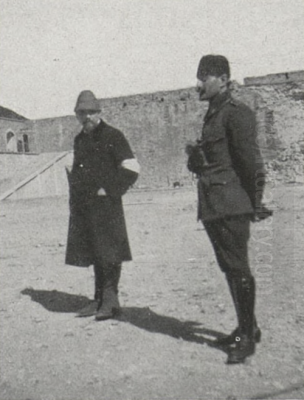
Beyond the world of entertainment, Amandus Faure also turned his artistic attention to the stark realities of war. He is noted for his work as a war artist, particularly for his depictions of Turkish army fortresses on the Gallipoli peninsula during the Dardanelles Campaign of World War I. These works, which included detailed illustrations of interior structures, were published in German newspapers, bringing images of the conflict to the home front.
This role as a war artist places Faure in a long tradition of artists documenting conflict, from the battle paintings of the Renaissance to the more immediate and often critical depictions of war in the 19th and 20th centuries. Artists like Francisco Goya had powerfully conveyed the horrors of war in his "Disasters of War" series. During World War I itself, many artists were officially commissioned or independently chose to record their experiences and observations. Max Slevogt, mentioned earlier, also served as an official war artist for Germany.
Faure's war sketches from the Dardanelles would have served both an informational and potentially a propagandistic purpose, depending on their content and how they were framed by the newspapers. His focus on the "internal structure" of Turkish fortresses suggests a detailed, almost technical approach in some instances, providing insights into the defensive preparations of Germany's Ottoman allies. These works highlight a different facet of his artistic skill, demonstrating his ability to adapt his observational powers and draftsmanship to the demands of reportage and historical documentation in a time of global conflict.
Notable Works and Exhibitions
Several specific works and exhibitions help to illuminate Amandus Faure's career. His painting "Reisend circus" (Traveling Circus) is a prime example of his engagement with performance themes. This oil painting, measuring 90.5 x 130 cm, was notably exhibited from July 17 to August 11, 2021, at the Museum de Wieger in Deurne. The relatively recent exhibition of this piece underscores a continuing interest in his work. The title itself, "Traveling Circus," evokes the itinerant nature of these entertainment troupes and the unique subculture they represented.
Another work mentioned is "Ausfahrer Zug," which can be translated as "Departure Train" or perhaps "Ring Carriages" in a circus context. This piece was highlighted for its "strong color contrast," further emphasizing Faure's skill in using color for dramatic effect. Such a work likely captured the bustling activity and visual richness associated with the circus, perhaps the loading or unloading of equipment and performers, or a parade-like procession.
Faure regularly exhibited new works at art associations (Kunstvereine). These associations were vital for artists in Germany, providing platforms for showcasing their art, engaging with peers, and reaching potential patrons. His continued participation in such exhibitions indicates an active career and a desire to remain part of the contemporary art dialogue. Furthermore, the mention of his works being held in museum collections in Stuttgart and Venice speaks to a level of recognition that extended beyond local appreciation, with Venice being a historically significant international art center.
Influences and Artistic Milieu
Amandus Faure's artistic development was undoubtedly shaped by the broader artistic environment and specific influences. The provided information notes a connection to the French historical landscape painter Jean-Victor Bertin. Bertin was a significant figure in the neoclassical landscape tradition and, importantly, was the teacher of Jean-Baptiste-Camille Corot and Charles-François Daubigny. Corot and Daubigny were key figures in the Barbizon School and precursors to Impressionism, known for their sensitive depictions of nature and light.
If Faure was influenced by Bertin, or by the lineage that flowed through him to Corot and Daubigny, it would suggest an early grounding in landscape painting and a sensitivity to light and atmosphere that could have informed his later work, even when his subjects were interiors or urban scenes. The Barbizon painters' emphasis on direct observation of nature and their nuanced portrayal of light certainly paved the way for Impressionism. Faure's later move towards a brighter, Impressionist-influenced style might be seen as a natural progression from such foundational influences.
His artistic network would have also included his German contemporaries. The art scene in Stuttgart and other German cities was active, with artists exploring various styles from late Romanticism and Realism to the emerging modern movements. The dialogue between German artistic traditions and international trends, particularly from Paris, was a defining feature of the era. Artists like Adolph Menzel, though of an earlier generation, had set a high bar for realism and historical depiction in Germany, while the aforementioned German Impressionists were forging a distinct national variant of the French style. Faure's work, with its blend of thematic interests and stylistic evolution, fits within this dynamic and multifaceted artistic landscape.
Thematic Consistency and Stylistic Evolution
Throughout his career, Amandus Faure demonstrated a consistent interest in certain themes while allowing his style to evolve. The worlds of dance, theatre, and the circus remained central to his artistic vision. These subjects offered rich opportunities for exploring human figures in motion, complex lighting conditions, and the vibrant colors of costumes and stage design. His fascination with "bohemian life" suggests an interest in subcultures and lifestyles that existed outside the mainstream, a common preoccupation for artists seeking authenticity and unconventional beauty.
The shift from a "dark, coppery etching style" to a brighter, more Impressionistic palette represents a significant artistic development. This was not merely a technical change but likely reflected a new way of seeing and interpreting the world. The adoption of stronger, more luminous colors allowed for a greater sense of immediacy and vibrancy, particularly suited to his dynamic subjects. This evolution suggests an artist who was responsive to the changing artistic climate of his time, willing to incorporate new ideas and techniques into his practice.
His use of "dramatic light and shadow" remained a consistent feature, even as his palette brightened. This suggests a continued interest in creating mood and atmosphere, and in using light to model form and create focal points within his compositions. Whether depicting a dimly lit circus tent or a brightly illuminated stage, the interplay of light and dark was a key element of his artistic language. This mastery of chiaroscuro, adapted to different coloristic approaches, demonstrates a sophisticated understanding of pictorial construction.
Faure and the German Art Scene
To fully appreciate Amandus Faure, it's important to consider him within the context of the German art scene of the late 19th and early 20th centuries. This was a period of significant cultural and artistic activity in Germany. While Paris was often seen as the epicenter of the avant-garde, German cities like Munich, Berlin, Dresden, and Stuttgart had thriving artistic communities and academies. Artists were grappling with the legacy of German Romanticism, the rise of industrialization, and the influence of international movements like Realism and Impressionism.
The Kunstvereine (art associations) played a crucial role in this ecosystem, as did major exhibitions like the Munich Secession (founded 1892) and the Berlin Secession (founded 1898). These Secession movements represented a break from conservative academic art and promoted more modern approaches. While Faure's direct involvement with these specific Secession groups isn't detailed, his stylistic evolution towards a brighter, Impressionist-influenced style aligns with the broader trends they championed.
His work as a war artist during World War I also places him within a specific German historical context. The war had a profound impact on German society and culture, and artists responded in various ways, from patriotic depictions to critiques of the conflict's brutality. Faure's Dardanelles sketches contributed to the visual record of the war from a German perspective. Later, the Weimar Republic would see the rise of German Expressionism, with artists like Ernst Ludwig Kirchner, Emil Nolde, and Otto Dix (who also extensively depicted war, though often with a more critical and harrowing vision), pushing artistic boundaries further. Faure's career predates the full flowering of Expressionism's post-war intensity, but his use of strong color and expressive qualities can be seen as part of the broader shift towards more subjective and emotionally charged art.
A Note on Religious Activities
The provided information also mentions Amandus Faure's participation in religious activities, including serving in a significant role, possibly as a bishop or senior priest, during a mass and preaching alongside other clergy. This aspect of his life, if accurately attributed and pertaining to the same Amandus Faure the artist, adds a fascinating and somewhat unusual dimension to his biography. It's not common for an artist known for depicting bohemian and circus life to also be deeply involved in ecclesiastical duties at such a level.
This information suggests a multifaceted personality, potentially with deeply held spiritual convictions that coexisted with his artistic pursuits. It could imply that his engagement with life's spectacles, from the circus ring to the battlefield, was perhaps underpinned or complemented by a spiritual framework. Without further specific details or contextualization of this religious involvement, it remains a distinct thread in his life story, hinting at a depth and complexity beyond his artistic output alone. It's possible this activity was a community role or a lay involvement, or it could indeed point to a more formal clerical position. This aspect certainly warrants further investigation for a complete biographical picture.
Legacy and Conclusion
Amandus Faure's legacy is that of a skilled and evolving German artist who captured the vibrancy of performance, the intimacy of bohemian life, and the starkness of war. His journey from a darker, more traditional style to a brighter, Impressionist-influenced palette reflects his engagement with the artistic currents of his time. His works, characterized by strong colors, dramatic lighting, and a keen observational eye, offer a valuable window into the cultural life of Germany in the late 19th and early 20th centuries.
While he may not have achieved the same level of international fame as some of his French Impressionist counterparts or the leading figures of German Expressionism who followed, his contributions to the German art scene were significant. His dedication to themes of performance aligns him with a broader European artistic interest in popular entertainment and modern life. His war art provides a specific historical record from a German perspective.
The continued exhibition of his work, such as "Reisend circus" at the Museum de Wieger, indicates that his art still resonates and holds interest for contemporary audiences and art historians. Artists like Amandus Faure, who may operate slightly outside the main narratives of art history, often provide crucial insights into the richness and diversity of artistic production in a given period. His ability to move between different themes and to adapt his style demonstrates a versatile and committed artistic practice. He remains a noteworthy figure, whose paintings of circus wagons, theatrical stages, and distant battlefields contribute to our understanding of a pivotal era in European art and history. His work invites us to explore the color, light, and drama of the worlds he chose to depict.