Ambrosius Bosschaert the Younger: A Jewel of the Dutch Golden Age Still Life Tradition
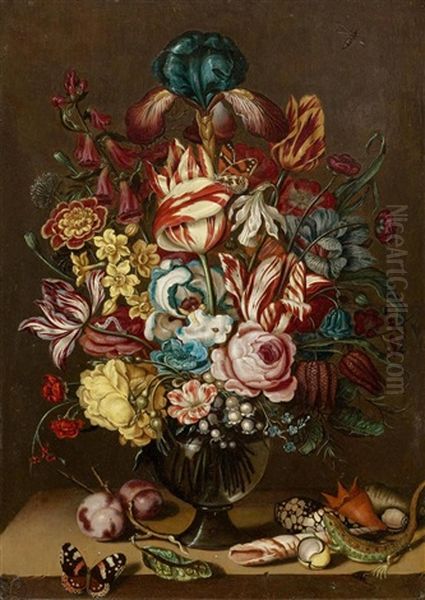
Ambrosius Bosschaert the Younger (1609-1645) stands as a significant, albeit sometimes overshadowed, figure in the rich tapestry of Dutch Golden Age painting. Born into a veritable dynasty of still life artists, he inherited a legacy of meticulous observation and exquisite execution, contributing his own nuanced vision to the burgeoning genre of flower and fruit painting. Though his career was tragically short, his works continue to captivate audiences with their vibrant colours, intricate details, and the subtle symbolism that characterized the art of his era.
Early Life and Artistic Lineage
Ambrosius Bosschaert the Younger was born in Middelburg, a prosperous trading city in the province of Zeeland, in 1609. Artistry was in his blood. His father was the renowned Ambrosius Bosschaert the Elder (1573-1621), one of the pioneers of Dutch flower painting. The Elder had established a distinct style characterized by symmetrically arranged bouquets, often featuring rare and exotic blooms, rendered with almost scientific precision. This environment undoubtedly provided the young Ambrosius with his earliest exposure to the painter's craft.
Following his father's death in 1621, the family, including Ambrosius the Younger and his two brothers, Johannes and Abraham, who also became painters, moved to Utrecht. There, his training was likely continued under the tutelage of his maternal uncle, Balthasar van der Ast (1593/94-1657). Van der Ast had himself been a pupil of Ambrosius the Elder and was a master of still life painting, known for his more relaxed compositions, inclusion of shells and insects, and a softer, more atmospheric touch compared to his brother-in-law. This familial and artistic connection was crucial in shaping the younger Bosschaert's development. The influence of both his father and uncle is readily discernible in his work, blending the former's precision with the latter's evolving compositional freedom.
The artistic milieu of Utrecht was also significant. The city was a vibrant centre for painters, including the Utrecht Caravaggisti like Hendrick ter Brugghen and Gerard van Honthorst, who brought a dramatic use of light and shadow from Italy. While Bosschaert the Younger's genre differed, the city's artistic dynamism would have provided a stimulating atmosphere. Other still life painters, such as Roelant Savery, who also worked in Utrecht for a period, contributed to the city's reputation in this specialized field.
Artistic Style and Thematic Focus
Ambrosius Bosschaert the Younger specialized, like his father and uncle, in flower pieces and, later, fruit still lifes. His paintings are celebrated for their delicate brushwork, luminous colours, and an almost tangible rendering of textures, from the velvety softness of a rose petal to the cool gleam of a glass vase or the intricate patterns on a seashell.
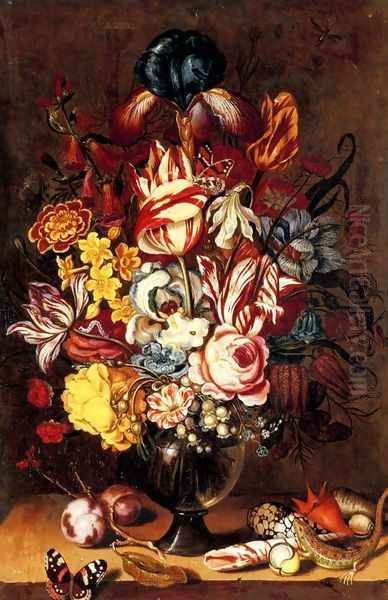
His early works, created from around 1625, often show a high viewpoint and a low vanishing point, a compositional trait inherited from his father. The bouquets are typically presented in ornate glass roemers or simple earthenware vessels, set against a dark, neutral background that makes the vibrant colours of the flowers pop. These bouquets are not casual arrangements but carefully constructed compositions, often featuring flowers that would not bloom simultaneously in nature, underscoring the artificial and idealized aspect of these "impossible bouquets." Tulips, roses, irises, lilies, columbines, and carnations are frequent subjects, each rendered with botanical accuracy.
A hallmark of Bosschaert the Younger's style, and indeed of the Bosschaert dynasty, is the inclusion of minute details such as dewdrops, insects (butterflies, caterpillars, dragonflies, beetles), and sometimes snails or lizards. These elements were not merely decorative; they often carried symbolic weight. Dewdrops and insects could allude to the transience of life and beauty (vanitas), a common theme in Dutch still life painting. Butterflies were often symbols of resurrection or the soul, while caterpillars could represent earthly existence. The meticulous depiction of these tiny creatures also served to showcase the artist's incredible skill and patience.
His paintings often feature a sense of balanced formality, though as his career progressed, particularly in his fruit still lifes, he explored more complex and sometimes asymmetrical compositions. The interplay of light and shadow is handled with subtlety, creating a sense of depth and volume. He frequently painted on copper, a support favoured by his father and other artists like Jan Brueghel the Elder for its smooth surface, which allowed for an exceptionally fine finish and enhanced the jewel-like quality of the colours.
Signature and Artistic Development
The evolution of Ambrosius Bosschaert the Younger's signature provides a clue to his artistic development. His earlier works, up until around 1633, are often signed with the Gothic monogram "AB." Later, he adopted a more calligraphic, cursive monogram, and occasionally signed with his full name. This shift in signature style can help art historians in dating his works and distinguishing them from those of his father and his brother Abraham, whose styles could be remarkably similar.
His artistic career can be broadly divided into two periods. The first, from roughly 1625 to 1633, is dominated by flower paintings that closely follow the tradition established by his father and Balthasar van der Ast. These works emphasize clarity, bright colours, and often symmetrical arrangements.
The second period saw an increased focus on fruit compositions. These works tend to be more elaborate, with a greater variety of objects, including fruits like grapes, peaches, and plums, often accompanied by flowers, shells, and the ubiquitous insects. The compositions become more dynamic and sometimes asymmetrical, reflecting a broader trend in Dutch still life painting towards more opulent and less rigidly structured arrangements, as seen in the works of artists like Jan Davidsz. de Heem. These later works often display a richer, more atmospheric lighting.
Representative Works
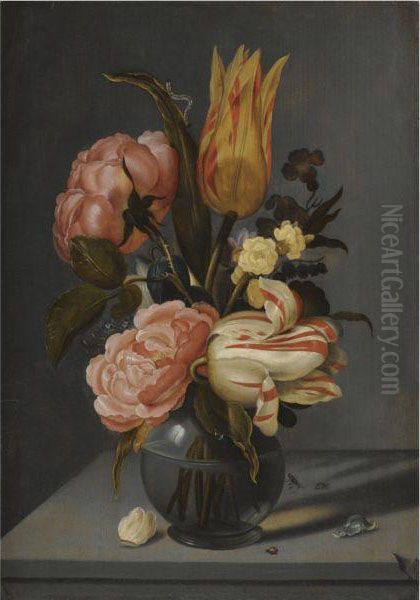
While many of his works are in private collections or their specific whereabouts are not widely published, several key pieces illustrate his talent. One of his most recognized paintings is Bouquet of Flowers in a Glass Vase, dated by some sources to as early as 1621 (though this date would make him exceptionally young, and other sources suggest later dates for similar works, aligning with his active period from the mid-1620s). This painting, or similar versions, showcases a vibrant assembly of tulips, roses, irises, and other flowers meticulously arranged in a glass roemer. A dragonfly and a red admiral butterfly might be depicted among the blooms, adding to the painting's lifelike quality and symbolic depth. The reflection of light on the glass vase is rendered with particular skill.
Another notable work is Still Life with Fruit, Flowers and Two Cockatoos, dated 1635, which is housed in the Centraal Museum in Utrecht. This painting exemplifies his later style, with a more complex arrangement featuring not only flowers and fruit but also exotic birds, showcasing a move towards more elaborate and decorative compositions. The inclusion of cockatoos points to the Dutch global trade and the fascination with exotic flora and fauna.
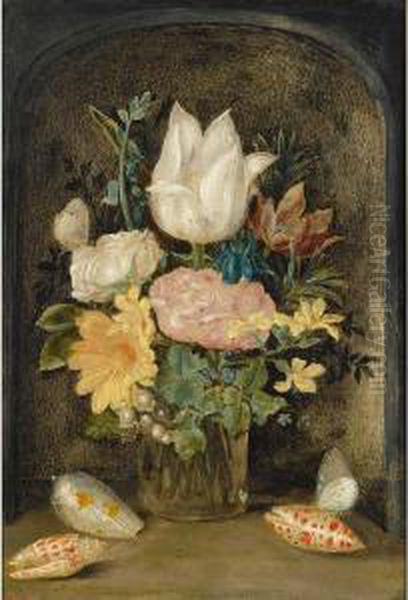
His works on copper, such as a Still Life of Flowers in a Glass Beaker or versions painted on silver, highlight his technical finesse. The smooth, non-absorbent surface of the metal allowed for incredibly fine detail and luminous colours that seem to glow from within. These small-scale, precious works were highly prized by collectors.
The Bosschaert Dynasty and Its Influence
Ambrosius Bosschaert the Younger was a key member of what can be termed the "Bosschaert dynasty" of still life painters. His father, Ambrosius the Elder, was the patriarch and a foundational figure in the genre. His uncle, Balthasar van der Ast, was a prolific and influential artist who further developed the style. Ambrosius the Younger and his brothers, Johannes Bosschaert (c. 1606/08–c. 1628/29) and Abraham Bosschaert (1612/13–1643), all contributed to this family tradition.
Johannes Bosschaert, though his career was even shorter than Ambrosius the Younger's, produced exquisite flower pieces clearly influenced by both his father and Van der Ast. Abraham Bosschaert's style is often so close to that of Ambrosius the Younger that attributions can be challenging, particularly for unsigned works or those with the simple "AB" monogram. This similarity underscores the close working relationship and shared artistic vocabulary within the family workshop.
The Bosschaert family, along with contemporaries like Osias Beert the Elder in Antwerp and Roelant Savery, helped establish flower painting as an independent and highly respected genre. Their emphasis on botanical accuracy, combined with symbolic meaning and aesthetic beauty, laid the groundwork for later generations of still life painters, including luminaries such as Jan van Huysum, Rachel Ruysch, and Willem van Aelst, who pushed the genre towards even greater illusionism and decorative exuberance in the later 17th and early 18th centuries.
Position in the Dutch Golden Age
The Dutch Golden Age (roughly the 17th century) was a period of unprecedented artistic production in the Netherlands. Economic prosperity, fueled by trade and maritime power, created a wealthy merchant class eager to adorn their homes with art. Unlike in Catholic countries where the church and aristocracy were the primary patrons, in the Protestant Netherlands, private citizens drove the art market. This led to a specialization among artists, with genres like portraiture (Frans Hals, Rembrandt van Rijn), landscape (Jacob van Ruisdael, Meindert Hobbema), genre scenes (Johannes Vermeer, Jan Steen), and still life flourishing.
Within this context, Ambrosius Bosschaert the Younger occupied a respected niche. Still life paintings, particularly flower pieces, were highly sought after. They appealed to the Dutch interest in the natural world, their pride in horticulture (tulip mania being an extreme example), and their appreciation for meticulous craftsmanship. These paintings were not just beautiful objects; they were also status symbols and objects of contemplation, often carrying moral or religious undertones related to the brevity of life and the virtues of moderation.
Bosschaert the Younger's works, with their bright palettes and detailed execution, fit well within the "fine painter" (fijnschilder) tradition, which valued polished surfaces and an almost invisible brushstroke. While perhaps not as innovative as some of his contemporaries who dramatically broke with earlier compositional conventions, his contribution lies in the consistent quality and refinement he brought to the established Bosschaert style. He was a contemporary of Jan Brueghel the Elder (though Brueghel was Flemish and of an older generation, his flower pieces were influential in the Netherlands) and his work prefigures the more opulent still lifes of artists like Jan Davidsz. de Heem or Willem Kalf.
Anecdotes and Interesting Details
Specific anecdotes about Ambrosius Bosschaert the Younger's personal life are scarce, a common situation for many artists of this period unless they achieved superstar status or were involved in notable public events. However, details about his artistic practice and the context of his work offer insights.
The very act of painting such detailed still lifes was a laborious process. Artists often worked from individual studies of flowers, as the blooms themselves would wilt before a complex composition could be completed. This practice also explains the "impossible bouquets" featuring flowers from different seasons.
The confusion between his works and those of his brother Abraham highlights the collaborative nature of family workshops and the shared stylistic traits that could develop. Art historians continue to refine attributions based on subtle differences in handling, composition, and signature.
The symbolic content of his paintings remains a subject of study. While general vanitas themes are accepted, the specific meaning of each element could vary. For instance, a "broken" or drooping tulip, as sometimes depicted, could directly allude to the fleeting nature of beauty or even the speculative folly of tulip mania. A documented restoration of a Bosschaert painting titled Broken Tulip reportedly revealed a hidden, perfectly intact tulip beneath the damaged one, suggesting complex artistic decisions and perhaps layers of meaning or later alterations.
The market value of such paintings during the Golden Age could be considerable. His father, Ambrosius the Elder, was known to command high prices. For example, a flower painting by the Elder was reportedly sold for 1,000 guilders in 1621, a substantial sum at the time. While specific figures for Ambrosius the Younger are less commonly cited, the demand for high-quality still lifes suggests his works would have been well-remunerated.
Later Life, Legacy, and Collections
Ambrosius Bosschaert the Younger married in Utrecht in 1634. His life, however, was cut short when he died in Utrecht in 1645, at the young age of 36. This relatively brief career means his oeuvre is not as extensive as that of artists who lived longer, but the quality of his surviving works ensures his place in art history.
His legacy is intertwined with that of his family. The Bosschaerts collectively represent a crucial phase in the development of Dutch still life painting, bridging the early, more rigid forms with the increasingly naturalistic and elaborate styles that followed. Ambrosius the Younger played a vital role in continuing and subtly evolving this tradition.
Works by Ambrosius Bosschaert the Younger are found in various museums and private collections worldwide. The National Gallery of Art in Washington D.C. holds a Flowers in a Vase attributed to him, dated to 1621 (again, this early date is subject to art historical debate regarding whether it might be a very early work, a collaboration, or a misattribution to his father, though the museum attributes it to the Younger). As mentioned, the Centraal Museum in Utrecht holds his Still Life with Fruit, Flowers and Two Cockatoos.
His paintings continue to appear at auction, attesting to their enduring appeal. For instance, in 2023, a painting titled Tulips, Roses, Lily of the Valley and Other Flowers in a Glass Vase on a Stone Ledge was offered with an estimate of $20,000 to $38,000. Records also indicate that a work by Ambrosius Bosschaert the Younger, acquired by the noted collector Frits Lugt in 1918 (described as part of a larger collection of seventy-one works on paper), and another work acquired in 1918 has been linked in auction records from 2024 to the contemporary artists Rob and Nick Carter, perhaps indicating a reinterpretation or a work from a collection associated with them, showcasing the continued relevance and re-engagement with Old Master paintings.
Conclusion
Ambrosius Bosschaert the Younger was a gifted artist who masterfully continued the tradition of flower and fruit still life painting established by his father and uncle. Working within the vibrant artistic environment of the Dutch Golden Age, he produced works of exquisite detail, luminous colour, and subtle symbolism. Though his career was brief, his paintings are a testament to his skill and his family's significant contribution to art history. His art offers a window into the Dutch appreciation for nature, craftsmanship, and the contemplative beauty found in the transient world of flowers and fruits, forever preserved through his delicate brush. He remains a cherished figure for connoisseurs of Dutch still life, a true jewel in a golden era of painting.