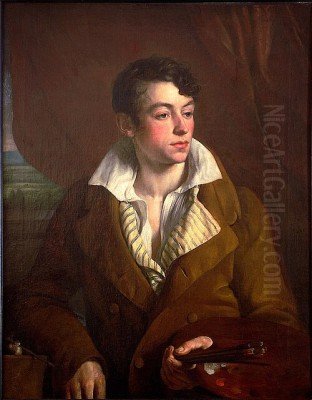
Anton Sminck Pitloo, a name perhaps not instantly recognized by all, stands as a pivotal figure in the evolution of 19th-century landscape painting, particularly within the vibrant artistic milieu of Naples. A Dutchman by birth, his journey led him to the sun-drenched shores of Southern Italy, where he not only forged a remarkable career but also became the progenitor of an influential artistic movement, the School of Posillipo. His life and work offer a fascinating study of artistic migration, the cross-pollination of cultural influences, and the enduring quest to capture the essence of nature on canvas.
Early Life and Artistic Awakening
Born in Arnhem, the Netherlands, on April 21 or August 8, 1790 (sources vary slightly on the exact day, but the year is consistently 1790), Anton Sminck Pitloo, sometimes referred to as Antonio Sminck van Pitloo in Italian contexts, displayed an early aptitude for the arts. His formative years in the Netherlands would have exposed him to the rich legacy of Dutch Golden Age landscape painting, a tradition renowned for its meticulous observation of light, atmosphere, and everyday scenery. This grounding likely instilled in him a profound appreciation for the subtleties of the natural world, a characteristic that would define his later work.
The Napoleonic era brought significant political and cultural shifts across Europe. In 1808, a significant opportunity arose for the young Pitloo. Through the patronage of Louis Bonaparte, then King of Holland (a puppet state of the French Empire), he was awarded a scholarship. This bursary enabled him to travel first to Paris, the undisputed artistic capital of Europe at the time, and subsequently to Rome, a city that had for centuries drawn artists eager to study classical antiquity and the Italian masters.
Parisian and Roman Sojourns: Broadening Horizons
In Paris, Pitloo immersed himself in the academic environment. He studied under notable figures, including the architect and designer Charles Percier. Percier, along with Pierre Fontaine, was a leading exponent of the Empire style, known for its neoclassical grandeur. While architecture was Percier's primary domain, the principles of composition, perspective, and classical form were integral to academic art training. During this period, Pitloo also encountered the work of landscape painters like Jean-Victor Bertin, a prominent neoclassical landscape artist whose pupils included Camille Corot. Bertin's emphasis on structured, idealized landscapes, often imbued with historical or mythological themes, represented one dominant strand of landscape painting.
However, Pitloo's artistic inclinations began to steer him more decisively towards landscape painting itself, perhaps finding the direct engagement with nature more compelling than historical or architectural subjects. His time in Rome, from around 1811, further solidified this direction. Rome and its surrounding Campagna had long been a magnet for landscape artists. The city offered a unique blend of ancient ruins, picturesque countryside, and a vibrant community of international artists. Here, Pitloo would have encountered fellow Dutch artists, such as Abraham Teerlink, Hendrik Voogd (known as the "Dutch Claude Lorrain" for his classical landscapes), and Martin Verstappen, who were part of a thriving expatriate community. He also likely absorbed the influences of earlier masters like Claude Lorrain and Nicolas Poussin, whose idealized Italian landscapes had set a standard for centuries. Furthermore, the burgeoning trend of en plein air (open-air) sketching, championed by figures like Pierre-Henri de Valenciennes, was gaining traction, encouraging artists to capture the immediate impressions of light and atmosphere directly from nature.
Naples: A New Home and a New School
After completing his studies, around 1811 or shortly thereafter, Pitloo made a life-altering decision: he chose to settle in Naples. This city, with its stunning bay, dramatic coastline, and the looming presence of Mount Vesuvius, offered an inexhaustible source of inspiration for a landscape painter. Naples was also a major stop on the Grand Tour, fostering a cosmopolitan atmosphere and a market for views of its famous scenery. Unlike the more classical and often historically charged landscapes of Rome, the Neapolitan environment seemed to encourage a more direct, vibrant, and perhaps more romantic engagement with nature.
It was in Naples that Pitloo truly came into his own. He quickly established himself as a significant figure in the local art scene. His Dutch heritage, combined with his French and Roman training, gave him a unique perspective. He opened a private studio, which soon became a hub for aspiring young artists. This informal gathering evolved into what became known as the School of Posillipo (Scuola di Posillipo). The name derives from the scenic coastal area of Posillipo in Naples, a favorite sketching ground for these artists.
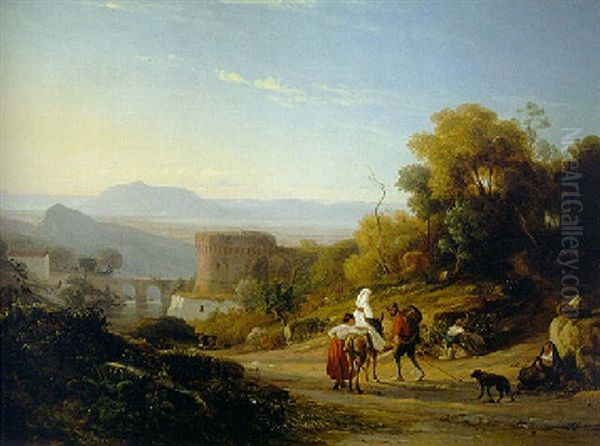
The School of Posillipo, under Pitloo’s guidance, marked a departure from the more formal, often grandiose, and meticulously detailed veduta painting tradition previously exemplified by artists like Jacob Philipp Hackert, who had been a court painter in Naples. Pitloo and his followers favored a more intimate, lyrical, and atmospheric approach. They were particularly interested in capturing the specific light conditions of the Neapolitan region – the hazy mornings, the brilliant midday sun, the soft glow of twilight – and the everyday life unfolding within these landscapes. Their work was characterized by fresh observation, often executed en plein air, and a sensitivity to the picturesque qualities of the local scenery, from grand coastal vistas to humble fishing villages and rustic interiors.
Professorship and Academic Recognition
Pitloo's influence extended beyond his private studio. In 1820 (some sources suggest 1822 or 1824), his talent and innovative approach were formally recognized when he was appointed Professor of Landscape Painting at the prestigious Royal Academy of Fine Arts in Naples (Reale Accademia di Belle Arti di Napoli). This position allowed him to institutionalize his teaching methods and influence a new generation of Neapolitan painters. His emphasis on direct study from nature, a hallmark of the School of Posillipo, began to permeate the academic curriculum, challenging older, more studio-bound conventions.
As a professor, he nurtured a remarkable cohort of artists who would go on to become leading figures in Neapolitan painting. Among his most notable students were Giacinto Gigante, who became one of the most celebrated exponents of the Posillipo style, known for his luminous watercolors and oil paintings. Others included Achille Vianelli, Gabriele Smargiassi (also referred to as Gabriele Signani in some texts), Teodoro Duclère, and Consalvo Carelli. These artists, while developing their own individual styles, all bore the imprint of Pitloo’s teaching, particularly his dedication to capturing the authentic character of the Neapolitan landscape.
Pitloo also participated in public exhibitions, showcasing his work to a wider audience. He exhibited at the Real Museo Borbonico (Royal Bourbon Museum) in Naples in 1826, 1828, and 1830, further cementing his reputation. These exhibitions provided a platform for the evolving style of landscape painting he championed, contrasting with more traditional approaches.
Artistic Style and Technical Innovations
Anton Sminck Pitloo’s artistic style is characterized by a delicate balance between careful observation and a romantic sensibility. He possessed a remarkable ability to render the specific qualities of light and atmosphere. His paintings often convey a sense of immediacy and freshness, as if captured in a fleeting moment. While his compositions are well-structured, they avoid the rigid formality of neoclassical landscapes. Instead, they evoke a more personal and emotional response to the scenery.
His palette was often subtle, capable of capturing the soft, diffused light of a misty morning or the warm glow of an Italian sunset. He paid close attention to detail, but not in a way that felt labored or overly meticulous. Rather, his details contribute to the overall atmospheric effect and the verisimilitude of the scene. Figures in his landscapes are typically small, serving to animate the scene and provide a sense of scale, but the primary focus always remains the landscape itself.
One of Pitloo’s notable technical innovations, or at least a practice he popularized within the Neapolitan context, was the use of oil paint on paper or card. This technique, often used for preparatory sketches or studies, allowed for a greater spontaneity and fluidity than painting directly on canvas. The paper support could absorb the oil in a particular way, lending a unique texture and luminosity to the work. Many of these oil-on-paper studies were later mounted on canvas for preservation or presentation. This practice was embraced by many artists of the School of Posillipo and contributed to the fresh, sketch-like quality often found in their finished works. His brushwork could be both fine and descriptive, and at other times, quick and suggestive, particularly in his studies, demonstrating a versatility that served his expressive aims.
Representative Works: Capturing the Italian Soul
Several works stand out as representative of Pitloo’s oeuvre and his contribution to landscape painting.
_Lago di Nemi, Italy_ (Lake Nemi, 1811-37): This painting, depicting the volcanic crater lake in the Alban Hills near Rome, is a quintessential example of his style. It showcases his ability to capture a specific mood and atmosphere. The work is noted for its refined composition, the delicate rendering of the winter light, the coppery tones of the foliage, and the misty quality of the air over the lake. The quick brushstrokes and cool palette contribute to a sense of naturalism that feels almost directly observed, even if composed or finished in the studio. Unfortunately, some versions of this painting have reportedly suffered damage over time, leading to discussions about their condition and conservation.
_The Grotto of Posillipo, Naples_ (1826): This subject, a famous ancient Roman tunnel in Naples, was popular with artists. Pitloo’s rendition captures the dramatic contrast between the dark, narrow interior of the grotto and the bright light filtering in from its entrance. It highlights his skill in handling chiaroscuro and creating a sense of mystery and awe, elements often associated with Romanticism.
_Study of a Pergola, Capri_ (circa 1820): This oil on paper, now in the Fondation Custodia, Collection Frits Lugt, Paris, exemplifies his more intimate studies. Measuring approximately 26.1 x 37.5 cm, it depicts a sun-dappled pergola on the island of Capri. The work demonstrates his mastery of capturing the interplay of light and shadow, and the lushness of the Mediterranean vegetation, with a freshness and immediacy characteristic of plein air work.
Other works explore various aspects of the Neapolitan and Roman countryside, from coastal scenes with fishing boats to tranquil rural landscapes and views of ancient ruins integrated into the living environment. Each piece reflects his deep connection to the Italian landscape and his ability to translate its unique character into paint.
Contemporaries and Artistic Interactions
Pitloo’s career unfolded within a rich tapestry of artistic exchange. In Naples, he was not an isolated figure. Besides his students, he interacted with other Italian and foreign artists. The city attracted painters from across Europe, including British artists like J.M.W. Turner, who visited Naples and whose own experiments with light and atmosphere, though often more dramatic, shared some common ground with the concerns of the Posillipo school. German Romantic painters such as Carl Gustav Carus also visited Naples and recorded their impressions, contributing to the broader European fascination with Italian scenery. Earlier, Joseph Wright of Derby had famously painted Vesuvius.
The Austrian painter Joseph Rebell was another contemporary active in Naples, known for his precise and luminous Italian landscapes. The German Franz Ludwig Catel also spent considerable time in Italy, including Naples, producing picturesque views. The Russian painter Sylvester Shchedrin was a significant contemporary who also worked extensively in Naples and Southern Italy, similarly dedicated to plein air painting and capturing the local light and color, often with a remarkable clarity and vibrancy. Their collective presence created a dynamic environment where different national traditions and artistic approaches intersected.
Pitloo’s relationship with his students was particularly significant. Giacinto Gigante, for instance, initially studied with the German artist Wolfgang Huber (also known as Guglielmo Huber), who himself had learned watercolor techniques and panoramic views from Pitloo. Gigante later became a direct pupil of Pitloo at the Academy, and his work, while highly individual, clearly shows Pitloo's influence in its atmospheric sensitivity and topographical accuracy. Francesco Vervolo, another Neapolitan landscape painter, was a friend of Pitloo and a prominent member of the School of Posillipo.
Anecdotes, Challenges, and the Human Element
While detailed personal anecdotes about Pitloo are somewhat scarce, his life was not without its challenges and points of interest. His decision as a Dutchman to make Naples his permanent home and to become so deeply integrated into its artistic fabric is remarkable in itself. He effectively bridged Dutch observational traditions with Italianate subject matter and a burgeoning Romantic sensibility.
The very innovation he brought to Neapolitan landscape painting, moving away from the highly finished, almost photographic vedute of artists like Hackert towards a more personal, atmospheric, and often sketch-like aesthetic, could have been met with resistance from more conservative elements within the Neapolitan art establishment. However, his appointment as a professor at the Academy suggests that his approach gained significant acceptance and respect.
His teaching methods, emphasizing direct observation from nature, were progressive for the time. This contrasted with traditional academic training that often prioritized copying Old Masters and composing idealized scenes in the studio based on classical principles. This shift, which Pitloo helped pioneer in Naples, was part of a broader European movement towards greater naturalism in landscape art.
His premature death in 1837, at the age of 47, was a significant loss to the Neapolitan art world. He succumbed to a cholera epidemic that swept through Naples that year, a tragic end to a vibrant career. Cholera was a recurrent scourge in 19th-century Europe, and its impact on communities was devastating.
Later Years, Death, and Enduring Legacy
Despite his relatively short life, Anton Sminck Pitloo’s impact on Neapolitan painting was profound and lasting. He is widely regarded as the true founder and leading spirit of the School of Posillipo, a movement that revitalized landscape painting in Southern Italy and produced a generation of talented artists. His emphasis on plein air painting, his sensitivity to light and atmosphere, and his ability to capture the unique character of the Neapolitan landscape set a new direction for the genre.
The School of Posillipo continued to flourish after his death, with his students and their followers carrying forward his legacy. Artists like Giacinto Gigante, in particular, further developed the style, infusing it with their own personalities while retaining the core principles learned from Pitloo. The school’s influence extended well into the latter half of the 19th century, paving the way for later movements like the Scuola di Resina and influencing the broader current of Italian Realism (Verismo).
Pitloo's work effectively bridged the gap between the earlier, more formal landscape traditions and the more subjective, naturalistic approaches that would come to dominate the 19th century. He introduced a Northern European sensibility for light and detail into the sun-drenched Mediterranean environment, creating a unique fusion that resonated deeply with the spirit of the place.
Collections and Continued Appreciation
Today, works by Anton Sminck Pitloo can be found in various public and private collections, primarily in Italy, but also internationally. The Museo di San Martino and the Capodimonte Museum in Naples hold significant examples of his work and that of the School of Posillipo. The aforementioned Study of a Pergola, Capri is in the Fondation Custodia, Collection Frits Lugt, in Paris, a testament to his recognition beyond Italy. Some works are also held in the Intesa Sanpaolo bank's art collection, which includes a group of his small oil paintings. His paintings occasionally appear at auctions, such as the Lago di Nemi which was noted at a Munich art market sale in 2011, indicating continued interest among collectors.
The scholarly attention given to Pitloo and the School of Posillipo has grown over the years, with exhibitions and publications dedicated to reassessing their contribution to 19th-century European art. He is recognized not just as a skilled painter, but as an important catalyst for change, an influential teacher, and a key figure in defining the visual identity of Naples for generations of artists and art lovers.
Conclusion: The Dutch Painter of the Neapolitan Sun
Anton Sminck Pitloo’s story is one of successful artistic assimilation and innovation. From his Dutch roots and academic training in Paris and Rome, he emerged in Naples as a transformative figure. He captured the unique beauty and atmosphere of Southern Italy with a freshness and sensitivity that broke new ground. As the guiding spirit of the School of Posillipo, he fostered a new approach to landscape painting that emphasized direct observation, personal interpretation, and the evocative power of light. His legacy lived on through his numerous talented students and the enduring appeal of the Neapolitan landscapes he so masterfully depicted. Though his life was cut short, Anton Sminck Pitloo left an indelible mark on the history of art, forever associated with the luminous skies and picturesque shores of Naples.