Arnold Houbraken: Artist, Biographer, and Chronicler of the Dutch Golden Age
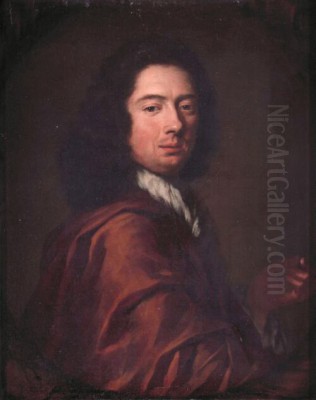
Arnold Houbraken stands as a pivotal figure in the study of Dutch Golden Age art, a period of extraordinary artistic production in the 17th-century Netherlands. While a competent painter and etcher in his own right, his most enduring legacy lies in his monumental three-volume work, De Groote Schouburgh der Nederlantsche Konstschilders en Schilderessen (The Great Theatre of Dutch Painters and Paintresses). This extensive collection of artist biographies, published between 1718 and 1721, remains an indispensable, albeit sometimes flawed, primary source for understanding the lives, works, and artistic milieu of countless Dutch masters. Houbraken was not merely a compiler of facts; he was an interpreter, a critic, and a moralist, whose writings shaped the perception of Dutch art for generations.
Early Life and Artistic Formation
Arnold Houbraken was born on March 28, 1660, in Dordrecht, a city with a rich artistic heritage, having been home to painters like Aelbert Cuyp and Nicolaes Maes. His early life saw him apprenticed in the textile trade, a common path for many young men at the time. However, his artistic inclinations soon led him to pursue painting. His initial instruction in art is recorded as being with Johannes de Haan, a local Dordrecht painter. He subsequently studied under Willem van Drielenburch, another Dordrecht artist, and later with Jacob Leveck, who had himself been a pupil of the great Rembrandt van Rijn.
The most significant influence on Houbraken's artistic and intellectual development, however, was Samuel van Hoogstraten. Hoogstraten, also a Dordrecht native, was a multifaceted artist—painter, etcher, poet, and art theorist—and another former pupil of Rembrandt. Houbraken spent approximately two years in Hoogstraten's studio, likely between 1676 and 1678. He held his master in high esteem, frequently referencing Hoogstraten's wisdom and pedagogical methods in his own writings. Hoogstraten's theoretical treatise, Inleyding tot de hooge school der schilderkonst: anders de zichtbaere werelt (Introduction to the Academy of Painting; or the Visible World, 1678), profoundly shaped Houbraken's own views on art theory, the hierarchy of genres, and the moral purpose of art.
Around 1685, Houbraken married Sara Sasbout. For a period, he continued to work in Dordrecht, establishing himself as a painter. His artistic output included portraits, historical and biblical scenes, and genre paintings. Like many artists of his time, he also practiced etching, producing a number of prints. Around 1709 or 1710, seeking greater opportunities and a more vibrant artistic center, Houbraken moved his family to Amsterdam, the bustling metropolis that was the heart of the Dutch art market. He remained in Amsterdam until his death on October 14, 1719, just as the final volume of his Schouburgh was being prepared for publication.
Houbraken the Painter and Etcher
As a practicing artist, Arnold Houbraken worked across several genres then popular in the Dutch Republic. His training under various masters, particularly Samuel van Hoogstraten, equipped him with a solid technical foundation. While his fame as a writer has largely overshadowed his artistic output, his paintings and etchings provide insight into his aesthetic sensibilities and the prevailing tastes of his time.
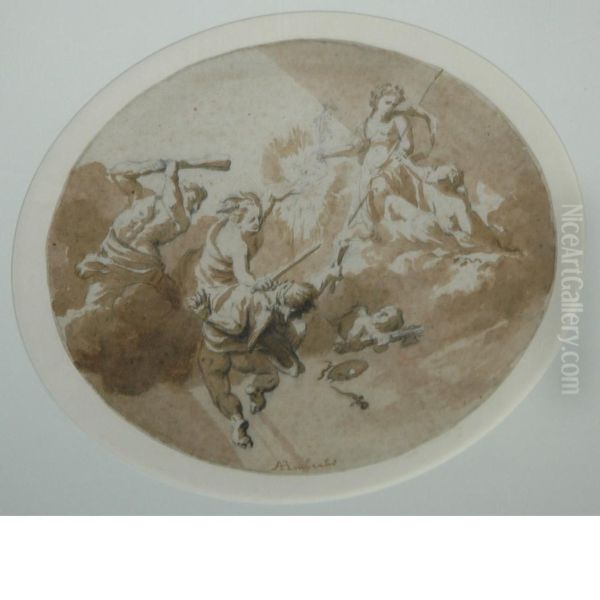
Houbraken's painted oeuvre includes portraits, which were a staple for many Dutch artists seeking commissions. He also produced history paintings, a genre highly esteemed in academic circles and by theorists like his mentor Hoogstraten. These works often depicted biblical, mythological, or allegorical subjects, allowing for grand compositions and the expression of moral or intellectual themes. For instance, works like "Scipio Africanus and the Captured Bride" or allegorical representations of concepts like "Painting" or "Virtue" would fall into this category. His style in these history pieces often aimed for clarity in narrative, a balanced composition, and an emotional resonance in the figures, reflecting the classical ideals tempered with a Dutch sense of realism.
Genre scenes, or "comic pictures" as sometimes translated from contemporary descriptions, also formed part of his output. These would have depicted scenes of everyday life, perhaps with a moralizing undertone or a humorous observation of human behavior, a tradition well-established by artists like Jan Steen or Adriaen van Ostade. Houbraken's approach to these would likely have emphasized detailed observation and character portrayal.
His work as an etcher is also noteworthy. He produced a number of prints, some of which were emblems or illustrations with symbolic meanings. Titles such as "Seeing an Overly Blossoming Tree" or "The Sun and its Projected Shadow" suggest an engagement with emblematic traditions, where visual motifs convey deeper moral or philosophical ideas. These etchings would have showcased his skill in draughtsmanship and his ability to use line and tone to create expressive images. His son, Jacob Houbraken, would later become one of the most celebrated portrait engravers of the 18th century, undoubtedly benefiting from his father's artistic environment.
While few of Arnold Houbraken's paintings are widely known today compared to the giants of the Golden Age like Rembrandt, Vermeer, or Frans Hals, his artistic practice was crucial. It provided him with an insider's understanding of artistic techniques, workshop practices, and the challenges faced by artists—knowledge that deeply informed his biographical writings in De Groote Schouburgh. His direct experience as a painter lent authenticity and a practical perspective to his assessments of other artists' works and careers.
De Groote Schouburgh: A Monumental Undertaking
Arnold Houbraken's most significant contribution to art history is undoubtedly De Groote Schouburgh der Nederlantsche Konstschilders en Schilderessen (The Great Theatre of Dutch Painters and Paintresses). This ambitious three-volume work, published posthumously in its entirety (Volume I in 1718, Volume II in 1719, and Volume III, completed by his wife and son Jacob, in 1721), aimed to provide a comprehensive account of Netherlandish artists, primarily from the 17th century.
The Schouburgh was conceived as a continuation and expansion of Karel van Mander's Schilder-Boeck (Book of Painters) of 1604, which had been the primary source for the lives of earlier Netherlandish artists. Houbraken saw the need for a similar work to cover the flourishing of talent during the Dutch Golden Age. His model was also influenced by Giorgio Vasari's Lives of the Most Excellent Painters, Sculptors, and Architects (1550/1568), adopting a biographical approach that combined factual information with anecdotes, critical assessments, and moral lessons.
The work is organized roughly chronologically by the artists' birth years, though Houbraken often groups artists by school, master-pupil relationships, or thematic connections. Each volume contains numerous biographies, varying in length and detail depending on the information available to Houbraken and his assessment of the artist's importance. He drew upon a variety of sources: existing printed materials, oral traditions passed down through artist families and communities, personal recollections, and direct observation of artworks. He often recounts stories of artists' travels, their eccentricities, their successes and failures, and their interactions with patrons and fellow artists.
The Schouburgh is invaluable for the sheer number of artists it documents, many of whom might otherwise have been forgotten. He provides information on major figures like Rembrandt van Rijn, Frans Hals, and Johannes Vermeer (though his entry on Vermeer is notably brief and somewhat dismissive, reflecting the artist's relative obscurity at the time). He also covers a vast array of lesser-known masters, specialists in various genres such as landscape (e.g., Jacob van Ruisdael, Meindert Hobbema), portraiture (e.g., Bartholomeus van der Helst), still life (e.g., Willem Kalf, Rachel Ruysch), marine painting (e.g., Willem van de Velde the Younger), and genre scenes (e.g., Jan Steen, Gerard Dou).
The title, "Great Theatre," is itself indicative of Houbraken's approach. He presents the lives of artists as a series of dramatic narratives, often with a moralizing intent. He praises diligence, piety, and artistic excellence, while sometimes condemning profligacy, laziness, or perceived artistic shortcomings. This moralistic tone is characteristic of much biographical writing of the period.
A significant feature of the Schouburgh is the inclusion of engraved portraits of many of the artists, primarily executed by Houbraken's talented son, Jacob Houbraken. These portraits, often based on existing paintings or drawings, added a visual dimension to the biographies and contributed greatly to the work's popularity and enduring appeal. They helped to create a visual canon of Dutch masters.
The Schouburgh's Strengths and Weaknesses
As a historical source, De Groote Schouburgh has both immense strengths and notable weaknesses. Its primary strength lies in its scope and the wealth of information it preserves. For many artists, Houbraken's account is the earliest, and sometimes the only, significant biographical record. He provides details about their training, travels, artistic specialties, and sometimes even their personalities, offering a vivid, if subjective, picture of the Dutch art world. His anecdotes, while not always verifiable, often capture the spirit of the times and the perceived characters of the artists.
However, the Schouburgh must be used with caution. Houbraken was not a modern, objective historian. His accounts can be prone to inaccuracies, embellishments, and biases. He sometimes relied on hearsay or uncorroborated stories. His critical judgments were shaped by his own artistic preferences and theoretical leanings, particularly his adherence to classicist ideals inherited from Hoogstraten. This led him, for example, to be critical of certain aspects of Rembrandt's later style, which he perceived as rough and unfinished, even while acknowledging Rembrandt's genius. He famously recounted anecdotes about Rembrandt's supposed avarice and unconventional behavior, which, while colorful, have been challenged by later scholarship.
His treatment of artists like Frans Hals also reflects his classicist bias, sometimes downplaying Hals's innovative brushwork in favor of more polished styles. Similarly, his brief mention of Johannes Vermeer, calling him a follower of Carel Fabritius but offering little more, indicates that Vermeer's profound genius was not widely recognized in Houbraken's time, or at least did not fit neatly into Houbraken's narrative structure or aesthetic criteria.
Furthermore, Houbraken's moralizing tendency means that his narratives are often constructed to serve an ethical point, which can sometimes distort the historical reality. He might emphasize an artist's piety or downfall due to vice to provide a lesson for his readers. Despite these limitations, the Schouburgh remains an essential starting point for research on Dutch Golden Age painters. Modern scholars have learned to cross-reference Houbraken's claims with archival evidence and other contemporary sources, allowing for a more nuanced understanding of the artists he discusses.
Houbraken's Artistic Theories and Philosophy
Arnold Houbraken's writings, particularly the introductory sections and critical asides within De Groote Schouburgh, reveal a distinct artistic philosophy, heavily influenced by his master, Samuel van Hoogstraten, and the broader classicist currents of the late 17th and early 18th centuries. This theoretical framework shaped his judgments of other artists and his understanding of art's purpose.
Central to Houbraken's thought was a concept one might term "theological classicism" or "divine classicism." He believed that art should not merely imitate nature but should strive to represent an idealized, ordered vision of reality that reflected divine creation and moral truth. This aligned with Hoogstraten's emphasis on the intellectual and moral aspects of painting. For Houbraken, history painting—depicting biblical, mythological, or significant historical events—stood at the apex of the hierarchy of genres because it offered the greatest scope for conveying profound ideas, moral lessons, and noble human actions. He valued clarity of narrative, decorum (appropriateness of figures and actions to the subject), and emotional expressiveness that served the story's meaning.
His admiration for artists like Gerard de Lairesse, a contemporary classicist painter and theorist, reflects this preference. De Lairesse advocated for a rational, rule-based approach to art, drawing inspiration from classical antiquity and the High Renaissance. Houbraken, while perhaps less rigidly doctrinaire than De Lairesse, shared this inclination towards order, clarity, and edification in art.
This perspective informed his critiques. When discussing Peter Paul Rubens, for example, Houbraken admired the Flemish master's dynamism, emotional power, and compositional skill. However, he sometimes tempered his praise with criticism of what he perceived as occasional excesses or a lack of classical restraint, a common Dutch critique of the more exuberant Flemish Baroque.
His views on landscape painting were generally positive, as he saw in the depiction of nature an opportunity to reflect on God's creation. However, he was more ambivalent about still life painting. While acknowledging the technical skill involved in rendering textures and objects realistically—a hallmark of Dutch still life masters like Willem Claesz. Heda or Pieter Claesz—he sometimes expressed reservations about the genre's perceived lack of intellectual content or moral elevation compared to history painting.
Houbraken also engaged with the concept of naer het leven (from life) versus uyt den geest (from the mind/spirit). While valuing observation from life as fundamental to an artist's training, he believed that true artistry involved transcending mere imitation through intellectual selection, idealization, and invention, especially in history painting. This was a key tenet of classicist theory.
His writings also reveal an interest in the practical aspects of art-making and the artist's life, discussing studio practices, the use of models, and the importance of diligence and continuous study. He often used the lives of artists as exemplars, either of virtuous conduct leading to success or of flaws leading to decline, reinforcing the didactic purpose he ascribed to art and biography.
Relationships with Contemporaries and the Art World
Arnold Houbraken was deeply embedded in the art world of his time, both in Dordrecht and later in Amsterdam. His relationships with other artists, writers, and thinkers were crucial to his development and to the creation of De Groote Schouburgh.
His most formative relationship was with Samuel van Hoogstraten. Houbraken's reverence for his master is evident throughout his writings. He absorbed Hoogstraten's theoretical ideas, his emphasis on the intellectual dignity of the painter, and his broad interests that spanned painting, poetry, and philosophy. Hoogstraten's Inleyding served as a direct model and source of inspiration for Houbraken's own theoretical musings.
In Amsterdam, Houbraken would have been part of a vibrant artistic and intellectual community. His decision to move there suggests a desire to be at the center of artistic discourse and patronage. His work on the Schouburgh necessitated extensive networking, as he gathered information from artists, their families, collectors, and art dealers. He mentions interactions with, or information received from, various individuals, indicating a wide circle of contacts.
His relationship with his son, Jacob Houbraken, was clearly one of close collaboration, especially in the later stages of the Schouburgh's production. Jacob's skill as an engraver was essential to the visual appeal and success of the volumes. This father-son partnership ensured the continuation of Arnold's monumental project after his death.
Houbraken also engaged with the ideas of other contemporary writers and thinkers. He was aware of the broader European tradition of art biography, from Vasari to Van Mander and others like Joachim von Sandrart, whose Teutsche Academie (1675-1679) provided biographies of German and Netherlandish artists. He also had connections with figures in the literary and philosophical world, such as the writer and philosopher Willem Goeree, whose ideas contributed to the intellectual climate of the early Dutch Enlightenment and touched upon art theory. Houbraken's work reflects some of these early Enlightenment concerns with reason, empirical observation, and the dissemination of knowledge.
His critical assessments of other painters, even when negative or based on partial information, reveal the ongoing debates and shifting reputations within the art world. His views on Rembrandt, for instance, reflect a broader late 17th/early 18th-century trend that, while acknowledging Rembrandt's early brilliance, often found his later, more expressive and less polished style problematic when judged by classicist standards. He praised artists like Adriaen van der Werff, whose highly finished, elegant, and classicizing style was immensely popular in Houbraken's later years.
Through the Schouburgh, Houbraken effectively acted as a mediator, transmitting stories, opinions, and information about artists to a wider public. He was not just a passive recorder but an active shaper of artistic reputations, influencing how these artists were perceived for many years to come.
Representative Works and Artistic Style
While Arnold Houbraken is primarily celebrated for his biographical encyclopedia, his own artistic creations offer insights into his skills and the prevailing tastes of his era. His style generally aligned with the Dutch artistic traditions of the later 17th century, which saw a move towards greater refinement and classicizing tendencies, particularly in history painting and portraiture, even as genre and landscape painting continued to flourish.
In his history paintings, such as "The Sacrifice of Manoah" or "Scipio Africanus and the Captured Bride," Houbraken aimed for clear storytelling, balanced compositions, and expressive figures that conveyed the emotional and moral core of the narrative. These works would have demonstrated his understanding of anatomy, perspective, and the classical principles of decorum and idealization, as espoused by his teacher Samuel van Hoogstraten and other classicist theorists like Gerard de Lairesse. The figures are often rendered with a degree of solidity, and the compositions are typically well-ordered, avoiding the more dramatic turbulence of High Baroque art in favor of a more considered, theatrical presentation.
His portraits, though less documented than his history pieces, would have followed the Dutch tradition of capturing a likeness while also conveying the sitter's status and character. Given his theoretical leanings, he likely aimed for a dignified and somewhat idealized representation, rather than the raw psychological intensity found in some of Rembrandt's portraits or the informal vivacity of Frans Hals.
As an etcher, Houbraken demonstrated proficiency in a medium popular among Dutch artists. His prints, such as the emblematic "Seeing an Overly Blossoming Tree" or "The Sun and its Projected Shadow," reveal a capacity for detailed work and symbolic expression. These etchings often carried moral or philosophical messages, aligning with the didactic function he attributed to art. The quality of his line work and his ability to create tonal variations would have been evident in these prints. His experience as an etcher undoubtedly informed his appreciation for the graphic works of other artists he chronicled.
One of Houbraken's most visually impactful, albeit indirect, contributions to the visual record of art history was through the portrait engravings of artists featured in De Groote Schouburgh, predominantly executed by his son, Jacob Houbraken. While Arnold himself may have provided preliminary sketches or sourced the original portraits, Jacob's refined engraving technique brought these likenesses to life, creating a lasting visual archive of the Dutch masters. These engravings, such as the iconic portrait of Rembrandt or that of Jan Steen, became the standard images of these artists for centuries.
Overall, Arnold Houbraken's artistic style can be characterized as competent, informed by his academic training, and reflective of the later Dutch Golden Age's classicizing trends. His works emphasized clarity, order, and moral purpose, values that he also championed in his art historical writings. While he may not have achieved the revolutionary innovations of some of the artists he wrote about, his own practice as a painter and etcher gave him a profound and practical understanding of the artistic process, enriching his biographical endeavors.
Influence and Lasting Legacy
Arnold Houbraken's influence on the study and perception of Dutch Golden Age art has been profound and long-lasting, primarily through De Groote Schouburgh. Despite its acknowledged flaws, the work became a foundational text for subsequent art historians and biographers.
For much of the 18th and 19th centuries, Houbraken's Schouburgh was the principal source of information on many Dutch painters. It shaped the canon of Dutch art, elevating some artists while, inadvertently or by omission, contributing to the temporary obscurity of others like Vermeer. The anecdotes he recounted, whether accurate or not, often became defining stories associated with particular artists, influencing public perception and scholarly narratives. His moralizing interpretations also resonated with the didactic tendencies of later periods.
Later art biographers, such as Johan van Gool with his De nieuwe Schouburg der Nederlantsche kunstschilders en schilderessen (1750-1751) and Jacob Campo Weyerman with De levens-beschryvingen der Nederlandsche konst-schilders en konst-schilderessen (1729-1769), explicitly positioned their works as continuations or corrections of Houbraken, demonstrating his central importance as a point of reference. Even as more rigorous, archive-based art historical methods developed in the late 19th and 20th centuries, Houbraken's text remained a crucial, if critically examined, resource.
The portrait engravings by Jacob Houbraken, integral to the Schouburgh, also had a lasting impact. They standardized the visual representation of many Dutch masters, and these images were widely reproduced, further cementing the artists' identities in the cultural consciousness.
In modern scholarship, Houbraken is appreciated not just for the factual data his work contains (when verified) but also as a reflection of art historical thought and taste in the early 18th century. His biases, his theoretical framework, and his narrative choices are themselves subjects of study, offering insights into how art was understood and valued in his time. The Schouburgh provides a window into the artistic networks, the critical debates, and the cultural preoccupations of the period immediately following the Golden Age.
Furthermore, Houbraken's efforts helped to preserve the memory of numerous artists who might otherwise have faded into complete obscurity. By recording their names, basic biographical details, and descriptions of their works, he provided essential clues for later researchers to build upon. His work underscores the importance of biographical traditions in constructing art history, even as it highlights the need for critical engagement with such sources.
In conclusion, Arnold Houbraken was more than just an artist or a compiler of data. He was a shaper of art historical narrative, a critic, and a moralist whose De Groote Schouburgh remains a towering, if complex, monument in the historiography of Dutch art. His dedication to chronicling the lives and achievements of Netherlandish painters ensured that the "Great Theatre" of the Dutch Golden Age would continue to captivate and inform audiences for centuries to come, securing his own enduring place within that artistic legacy.