Beneš Knüpfer stands as a fascinating figure in late 19th-century European art, a Bohemian painter who found his truest voice not in his homeland but under the sun-drenched skies of Italy. His canvases, teeming with mythological creatures of the sea, dramatic coastal vistas, and an almost palpable sense of the ocean's power, offer a unique blend of academic precision, Romantic sensibility, and Symbolist undertones. Though perhaps not as universally recognized as some of his contemporaries, Knüpfer's dedication to his distinct vision and his evocative portrayals of marine mythology secure him a notable place in the annals of art history. His life, marked by a profound connection to the sea, ultimately ended in tragedy, mirroring the often turbulent and mysterious depths he so passionately depicted.
Early Life and Artistic Awakening in Bohemia and Munich
Born on April 12, 1844, in Frýdštejn, a small town in the picturesque region of Northern Bohemia (then part of the Austrian Empire, now the Czech Republic), Beneš Knüpfer's early artistic inclinations soon led him to seek formal training. He initially enrolled at the Academy of Fine Arts in Prague, the historic capital of Bohemia, where he would have been exposed to the prevailing artistic currents of Central Europe. Prague's academy, while perhaps not as avant-garde as Paris, provided a solid foundation in traditional drawing and painting techniques, essential for any aspiring artist of the period.
However, like many ambitious young artists from across Europe, Knüpfer was drawn to Munich, which by the mid-19th century had become a major artistic center, rivaling Paris and Vienna in importance. In 1870, he entered the prestigious Munich Academy of Fine Arts. This move was pivotal. In Munich, he had the distinct opportunity to study under the celebrated history painter Karl von Piloty. Piloty was a leading figure of the Munich School, renowned for his large-scale historical and allegorical canvases, characterized by dramatic compositions, rich color, and meticulous detail. Studying with Piloty would have instilled in Knüpfer a strong sense of narrative, a command of complex figure arrangements, and an appreciation for the grand manner of painting. Other notable artists associated with Piloty or the Munich School around this time included Franz von Lenbach, known for his powerful portraits, Franz Defregger, who specialized in genre and historical scenes from Tyrolean life, and the Austrian Hans Makart, whose opulent, theatrical style had a significant impact, though he was primarily active in Vienna.
The Lure of Italy: A New Home in Rome
After completing his studies in Munich, around 1879 or 1880, Knüpfer made a decision that would define the rest of his artistic career and personal life: he moved to Rome. Italy, with its classical ruins, Renaissance masterpieces, and vibrant Mediterranean light, had long been a magnet for artists from northern Europe. For Knüpfer, the allure was irresistible. He established a studio in Rome and, significantly, never returned to live in his native Bohemia. The Eternal City and the Italian coastline became his adopted home and the primary source of his inspiration.
This immersion in the Italian environment, particularly the proximity to the sea, profoundly shaped his thematic concerns. While his Munich training under Piloty provided him with the technical skills for large-scale, dramatic compositions, it was the Mediterranean that ignited his imagination towards marine subjects. He became captivated by the sea's beauty, its power, and its ancient mythological associations. This was a departure from the typical historical or genre scenes favored by many of his Munich contemporaries, allowing him to carve out a unique niche. He joined a long tradition of foreign artists in Rome, including figures like Anselm Feuerbach and Hans von Marées, German painters who also found inspiration in Italy's classical heritage and landscape, though their stylistic approaches differed.
The Realm of Marine Mythology: Sirens, Tritons, and Nereids
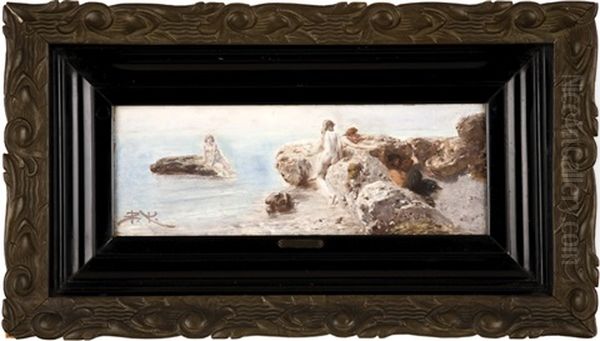
Knüpfer's artistic identity became inextricably linked with the sea and its mythical inhabitants. His canvases are populated by an array of fantastical beings: alluring sirens luring sailors to their doom, powerful tritons blowing their conch shells, graceful Nereids riding seahorses, and formidable sea monsters emerging from turbulent waves. These were not mere decorative elements but central actors in dramatic narratives set against expansive seascapes and rugged coastlines.
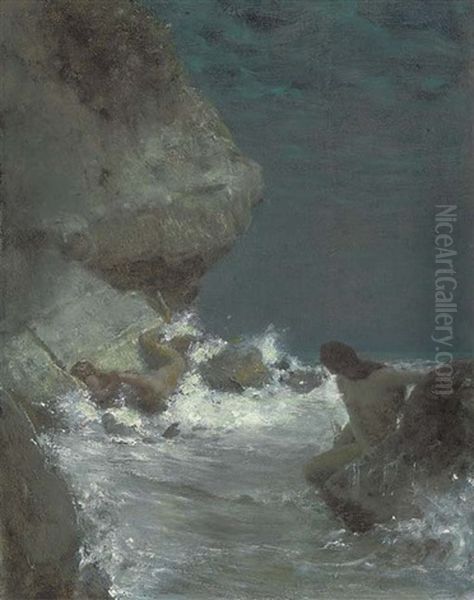
His fascination with these themes places him within a broader late 19th-century interest in mythology and symbolism. Artists across Europe were exploring ancient legends and folklore as a means to convey deeper emotional or psychological states, often as a reaction against the perceived materialism of the industrial age. Knüpfer's mermaids and sirens, for instance, embody the archetypal femme fatale – beautiful and enchanting, yet dangerous and untamable, reflecting a common trope in Symbolist art. His depictions of tritons and other male sea deities often emphasize their raw, primal power, engaged in epic struggles or commanding the waves.
In this thematic preoccupation, Knüpfer shares affinities with artists like the Swiss-German painter Arnold Böcklin, whose "Isle of the Dead" became an icon of Symbolism and who frequently painted mythological scenes, including tritons and nereids, often imbued with a sense of mystery and melancholy. While Böcklin's style was perhaps more idiosyncratic, both artists shared a deep connection to Italian landscapes and a penchant for reinterpreting classical myths through a personal, often dramatic, lens. Other artists exploring mythological themes during this period, albeit with different stylistic inflections, included Gustave Moreau in France and Edward Burne-Jones in England, highlighting a widespread fin-de-siècle fascination with the otherworldly.
Artistic Style: Academic Foundations and Romantic Visions
Beneš Knüpfer's style is a compelling synthesis of his academic training and a deeply Romantic, sometimes Symbolist, sensibility. His grounding in the Munich School under Piloty is evident in his skilled draftsmanship, his ability to handle complex multi-figure compositions, and his attention to anatomical accuracy, even when depicting fantastical creatures. His figures, whether human or mythological, possess a tangible solidity and often a heroic or idealized quality.
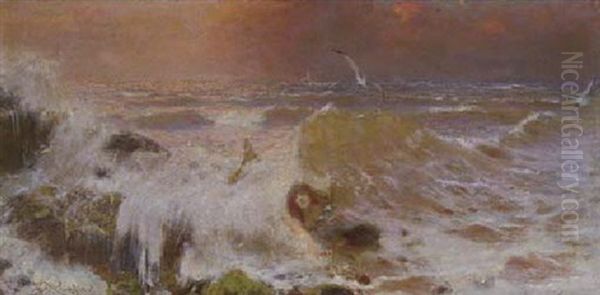
However, Knüpfer infused these academic skills with a dramatic intensity and emotional depth that aligns with Romanticism. His seas are rarely calm; they are often depicted as turbulent, powerful forces of nature, with crashing waves, stormy skies, and dramatic lighting. This use of the sublime – nature's overwhelming power and beauty – was a hallmark of Romantic art. His color palettes could range from luminous, sun-drenched Mediterranean hues to darker, more somber tones, depending on the mood of the scene.
There are also Symbolist undertones in his work. The mythological figures often seem to represent more than just characters from ancient stories; they evoke deeper psychological states or universal themes such as temptation, struggle, or the untamable forces of nature and passion. The enigmatic expressions of his sirens or the fierce determination of his tritons suggest an inner life beyond the purely narrative. This aligns him with other Symbolist-inclined artists like Max Klinger or Franz Stuck in Germany, who also explored mythological and allegorical themes with a strong psychological charge.
Masterpieces of the Marine Realm
Several of Beneš Knüpfer's works stand out as particularly representative of his artistic vision and skill. Perhaps his most famous painting is "Kampf der Tritonen" (Fight of the Tritons). This dynamic and powerful composition depicts a tumultuous battle between muscular tritons, some riding seahorses, amidst crashing waves. The energy and raw physicality of the scene are palpable, showcasing Knüpfer's ability to combine mythological narrative with a dramatic portrayal of the sea itself. The work exemplifies his mastery of anatomy and movement, creating a scene of epic struggle that is both classical in its subject and Romantic in its execution.
Another significant work is "Poslední pozdrav" (The Last Salute), also known as "The Siren's Victim." This painting, depicting a siren mourning or perhaps claiming a drowned sailor, is imbued with a poignant, melancholic atmosphere. It captured the imagination of the great German-language poet Rainer Maria Rilke, who was born in Prague and wrote a poem inspired by it. This connection highlights the evocative power of Knüpfer's imagery and its ability to resonate with contemporary literary figures.
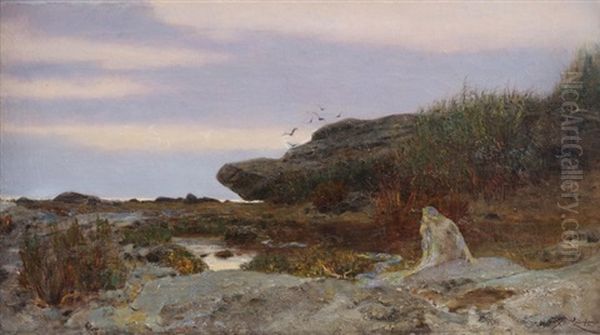
Other notable paintings include various depictions of "Sirens," "Mermaids," and "Nereids," where he explored the alluring and often treacherous nature of these mythical sea women. Works like "Sirens' Song" often show them on rocky outcrops, their beautiful forms contrasting with the wildness of the sea, their gazes enigmatic. He also painted more straightforward marine landscapes, but it was his mythological scenes that truly defined his oeuvre. A piece titled "Duel of the Centaurs" (Kampf der Zentauren) shows his capacity to handle other mythological subjects with similar dynamism, though marine themes remained his primary focus. These works were exhibited in various European cities, including Rome, Munich, Berlin, and Vienna, gaining him a degree of international recognition.
Recognition, Contemporaries, and Tragic End
During his lifetime, Beneš Knüpfer achieved a measure of success, particularly outside his native Bohemia. His works were admired for their technical skill and imaginative power. Notably, Emperor Franz Joseph I of Austria-Hungary purchased one of his paintings, a significant mark of official recognition. He was an active participant in the international art scene, particularly within the German-speaking artistic communities in Rome.
While he was geographically distant from the burgeoning Czech National Revival art scene, which included figures like Mikoláš Aleš, known for his historical and folk-themed works, or the landscape painter Julius Mařák, Knüpfer's path was more aligned with international currents. His contemporaries in the broader European context included artists who, like him, were navigating the transitions from academicism to Symbolism and other modern movements. For instance, the Belgian Symbolist Jean Delville also explored esoteric and mythological themes with a highly polished technique. In Germany, Lovis Corinth, though later associated with Expressionism, produced early works with mythological content that shared some of the dramatic flair seen in Knüpfer's art.
Despite his artistic achievements, Knüpfer's life was shadowed by personal struggles. He reportedly suffered from depression, a condition perhaps exacerbated by the solitary nature of an expatriate artist's life or the intense emotional engagement with his often dramatic and turbulent subject matter. His profound connection to the sea, which had been the wellspring of his artistic inspiration, also became the setting for his tragic end. In 1910, at the age of 66, Beneš Knüpfer died by suicide, drowning himself in the sea near Anzio, south of Rome. This poignant end seems to echo the dramatic and often perilous marine world he so vividly brought to life on his canvases.
Legacy and Enduring Appeal
Beneš Knüpfer's legacy is that of a dedicated and imaginative painter who carved a distinct path by focusing on the mythology of the sea. While his name might not be as widely known as some of the leading figures of major art movements, his work holds a significant place, particularly within the context of late 19th-century mythological painting and the art of the German and Austro-Hungarian cultural spheres. His paintings offer a captivating window into a world where classical myths were re-envisioned with Romantic drama and Symbolist depth.
His decision to live and work in Italy, immersing himself in the Mediterranean environment, was crucial to the development of his unique artistic voice. He stands as an example of an artist who found his true subject matter far from his homeland, embracing the universal language of myth and the timeless allure of the sea. The technical skill honed in the academies of Prague and Munich, combined with a passionate imagination, allowed him to create works that continue to fascinate viewers with their dynamic compositions, evocative atmospheres, and powerful storytelling.
Today, his works can be found in various collections, particularly in Central Europe. They serve as a testament to an artist who, though perhaps overshadowed by more radical innovators, remained true to his vision, leaving behind a compelling body of work that explores the enduring power of myth and the captivating mysteries of the marine world. His art reminds us of the rich diversity of artistic expression in the late 19th century, a period of transition and immense creativity, where artists like Beneš Knüpfer wove together tradition and personal vision to create worlds of enduring imaginative appeal. His dramatic portrayals of sirens, tritons, and tumultuous seas continue to speak to our fascination with the unknown depths, both of the ocean and of the human psyche.