Charles de La Fosse: A Bridge Between Baroque Grandeur and Rococo Grace
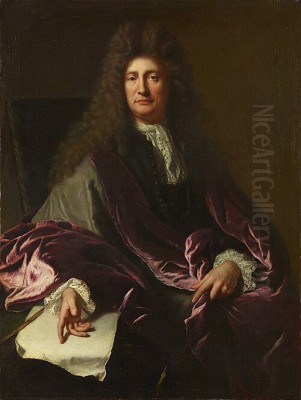
Charles de La Fosse (1636-1716) stands as a pivotal figure in the history of French art, an artist whose career gracefully spanned the opulent late Baroque era of Louis XIV and heralded the lighter, more intimate sensibilities of the nascent Rococo style. A master colorist and a prolific decorator, La Fosse left an indelible mark on the grand interiors of palaces and churches, skillfully blending the rich traditions of Venetian painting with the academic discipline of the French school. His work not only adorned the most prestigious sites of his time but also influenced a generation of artists who would further shape the course of eighteenth-century European art.
Early Life and Artistic Formation
Born in Paris on June 15, 1636, Charles de La Fosse was the son of a goldsmith. His familial environment, steeped in craftsmanship, may have provided an early exposure to the world of art and design. His formal artistic training began under the tutelage of François Chauveau, an engraver and painter, but it was his subsequent apprenticeship with Charles Le Brun that proved most formative. Le Brun, the dominant figure in French art during the reign of Louis XIV and the first painter to the King, was the chief architect of the artistic program at the Palace of Versailles. Under Le Brun, La Fosse would have absorbed the principles of grand-scale historical and allegorical painting, characterized by dramatic compositions and a clear, didactic narrative style, often serving the glorification of the monarch.
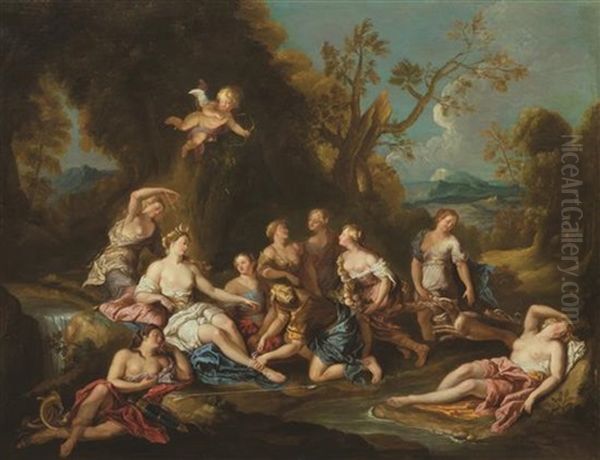
Recognizing his pupil's talent, Le Brun encouraged La Fosse to further his studies in Italy. Around 1658-1660 (sources vary slightly, with the provided text suggesting 1662), La Fosse embarked on this crucial journey, spending approximately two years in Rome and three years in Venice. In Rome, he would have immersed himself in the study of classical antiquity and the works of High Renaissance masters like Raphael and Michelangelo, as well as contemporary Baroque artists such as Pietro da Cortona and Annibale Carracci. However, it was Venice that truly captured his artistic imagination. The Venetian school, with its emphasis on rich color, sensuous textures, and dynamic light, profoundly influenced his developing style. He was particularly drawn to the works of masters like Titian, Paolo Veronese, and Giorgione, whose mastery of color and atmospheric effects would become hallmarks of La Fosse's own mature work. He also studied the works of Correggio in Parma, whose soft modeling and graceful figures left a lasting impression.
Return to France and Academic Ascent
Upon his return to Paris around 1663, La Fosse rejoined Le Brun's extensive workshop, which was then heavily engaged in the monumental decorative projects commissioned by Louis XIV. He contributed to the decorations of the Tuileries Palace and, most significantly, the Palace of Versailles. His skill and the Venetian warmth he brought to his palette quickly distinguished him. In 1673, La Fosse was received into the prestigious Académie Royale de Peinture et de Sculpture (Royal Academy of Painting and Sculpture) upon presentation of his dazzling reception piece, The Rape of Proserpine (École des Beaux-Arts, Paris). This marked his official entry into the highest echelons of the French art world.
His career within the Academy flourished. He was appointed as an assistant professor in 1674, and steadily rose through the ranks, becoming a full professor. His reputation as a gifted painter and a knowledgeable artist grew, and he became a respected figure among his peers. His ability to synthesize the grandeur of the French academic tradition, as championed by Le Brun, with the coloristic vibrancy of the Venetian school made his work highly sought after for both royal and private commissions.
Major Decorative Schemes and Royal Patronage
The reign of Louis XIV was characterized by an unprecedented level of artistic patronage, with the King using art as a tool of statecraft to project power and magnificence. Charles de La Fosse was a key contributor to these ambitious projects, particularly at Versailles. He worked on several of the Grand Apartments, including the Salon de Diane, where he painted scenes from mythology, and notably the ceiling of the Salon d'Apollon (Apollo Salon). His work in the Apollo Salon, depicting Apollo in his chariot, is a prime example of his ability to create dynamic, illusionistic compositions suitable for vast ceiling spaces.
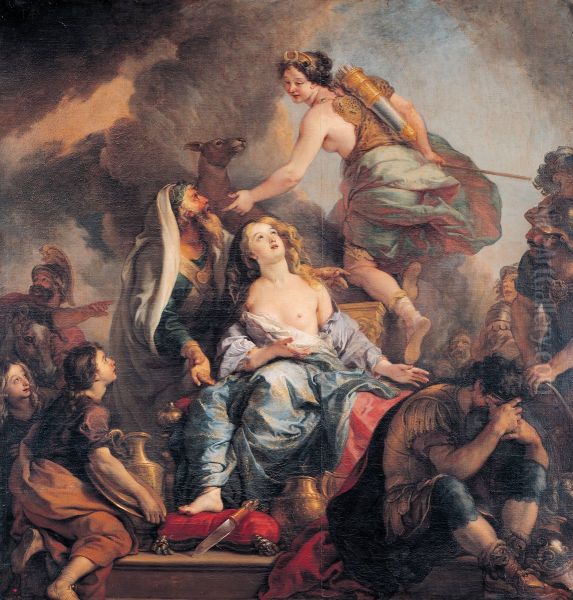
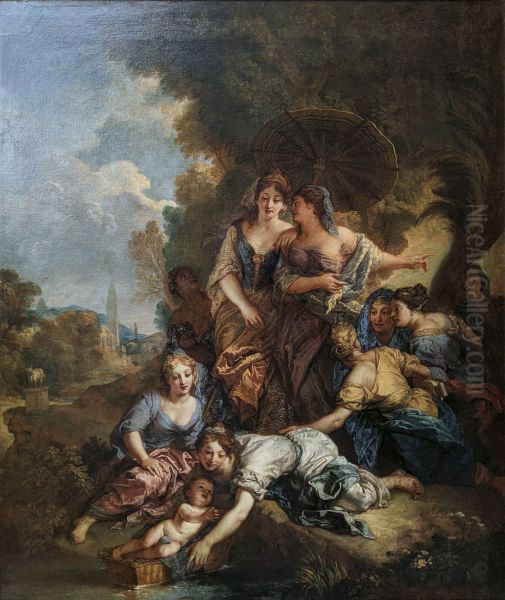
Two of his most celebrated works at Versailles are the large canvases The Sacrifice of Iphigenia (c. 1680) and Moses Saved from the Waters (c. 1680s), originally intended for the State Apartments. The Sacrifice of Iphigenia showcases his dramatic flair and rich color palette, capturing the emotional intensity of the mythological scene. Moses Saved from the Waters demonstrates his skill in composing complex figural groups and his sensitivity to landscape, imbued with a soft, atmospheric light reminiscent of Venetian painting. These works exemplify his mature style, combining narrative clarity with a painterly richness.
Beyond Versailles, La Fosse undertook other significant commissions. He contributed to the decoration of the Church of the Assumption in Paris and the dome of the Church of Les Invalides, working alongside other prominent artists like Jean Jouvenet. His religious paintings, while adhering to the decorum required for such subjects, often displayed a warmth and humanity that set them apart.
The London Interlude: Montagu House
La Fosse's fame extended beyond the borders of France. In 1689, he was invited to England by Ralph Montagu, 1st Duke of Montagu, who was the English ambassador to France and a great admirer of French art and culture. Montagu commissioned La Fosse to decorate his lavish London residence, Montagu House (on the site of the present-day British Museum). La Fosse spent about two years in London, from 1689 to 1691, creating magnificent allegorical and mythological scenes for the ceilings and walls of the state rooms.
His work at Montagu House, which included subjects like the Assembly of the Gods and scenes from Ovid's Metamorphoses, was highly acclaimed and introduced a more vibrant, continental Baroque style to England, which at the time was still heavily influenced by the more restrained portraiture tradition of artists like Sir Peter Lely and Sir Godfrey Kneller. La Fosse collaborated with other French artists on this project, including the decorative painter Jacques Rousseau for architectural perspectives and Jean-Baptiste Monnoyer for flower paintings. Unfortunately, the original Montagu House was destroyed by fire in 1686, but it was rebuilt, and La Fosse was again employed for its decoration. His work there further solidified his international reputation.
Artistic Style: The Fusion of Traditions and the "Querelle du Coloris"
Charles de La Fosse's artistic style is characterized by its brilliant synthesis of diverse influences. From his French training under Le Brun, he inherited a strong sense of composition, a clarity of narrative, and an understanding of the grand manner suitable for large-scale decorations. However, his Italian sojourn, particularly his immersion in Venetian art, infused his work with a sensuousness of color, a mastery of light and shadow (chiaroscuro), and a painterly handling of brushwork that distinguished him from many of his more rigidly academic contemporaries.
He was a key figure in the "Querelle du Coloris" (Quarrel of Color), a significant aesthetic debate that animated the French Royal Academy in the late 17th and early 18th centuries. This debate pitted the "Poussinistes" against the "Rubénistes." The Poussinistes, followers of Nicolas Poussin, championed the primacy of drawing (disegno) and intellectual rigor in painting, emphasizing clear outlines, balanced compositions, and noble subjects drawn from history and classical mythology. Charles Le Brun, in his earlier phase, was a leading proponent of this view.
The Rubénistes, on the other hand, advocated for the supremacy of color (colorito) and a more painterly, expressive approach, inspired by the works of Peter Paul Rubens and the Venetian masters. They valued visual appeal, emotional impact, and the sensuous qualities of paint. Roger de Piles, a highly influential art critic and theorist, was the leading voice of the Rubénistes. La Fosse, with his Venetian-inspired palette and fluid brushwork, naturally aligned himself with the Rubénistes. His work provided a powerful visual argument for the importance of color and light in achieving artistic effect. This debate was not merely academic; it reflected a broader shift in taste towards a more visually pleasurable and less overtly didactic form of art. La Fosse's success and growing influence helped to tip the balance in favor of the colorists, paving the way for the Rococo.
His palette was typically warm and luminous, featuring rich reds, golden yellows, and deep blues, often set off by subtle gradations of tone that created a sense of depth and atmosphere. His figures, while often heroic in scale, possessed a grace and softness, particularly in his female nudes, which recalled the sensuality of Correggio and Titian.
Transition to Rococo
While firmly rooted in the Baroque, La Fosse's later work exhibits a discernible shift towards the emerging Rococo style. This transition is evident in a lightening of his palette, a preference for more fluid and asymmetrical compositions, and an increased emphasis on charm and elegance over heroic grandeur. The subjects, while still often mythological or allegorical, could take on a more intimate or playful character.
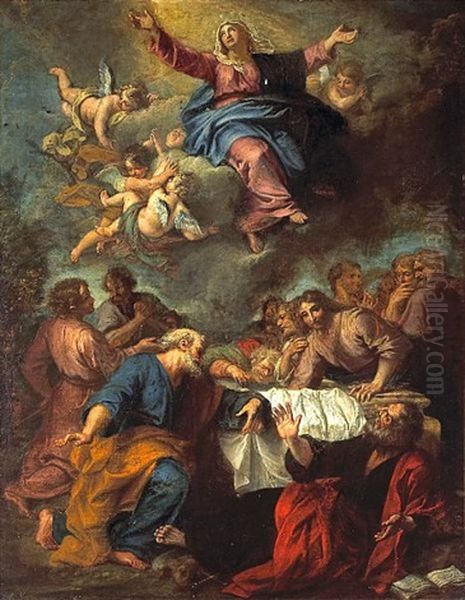
His influence on the next generation of artists was profound. Younger painters like Antoine Watteau, François Lemoyne, Jean-François de Troy, and Nicolas Lancret were deeply indebted to his example. Watteau, in particular, who arrived in Paris around 1702, found in La Fosse's work a model for the painterly freedom and chromatic richness that would define his own fêtes galantes. La Fosse, in his capacity as a professor and later Director of the Academy, was in a position to support and encourage these younger talents who were moving away from the stricter classicism of Le Brun's era. He was known to be a generous mentor and a supporter of artists who shared his passion for color. His friendship with the great collector Pierre Crozat, whose house La Fosse decorated, also placed him at the center of a circle of connoisseurs and artists who were championing a more modern, color-oriented aesthetic.
Academic Career and Influence
La Fosse's contributions were not limited to his artistic output; he was also a significant figure within the academic establishment. He was appointed Professor at the Royal Academy in 1673, and his influence grew steadily. He served as Rector of the Academy from 1699, and then as Director from 1702 to 1705, and again as Chancellor from 1715 until his death. In these roles, he played a part in shaping the curriculum and guiding the artistic development of students.
His advocacy for the importance of color, supported by the theoretical writings of Roger de Piles, helped to liberalize the Academy's doctrines. This shift was crucial for the development of the Rococo style, which prioritized visual delight, sensuous appeal, and painterly execution. Artists like François Boucher and Jean-Honoré Fragonard, who would become leading masters of the High Rococo, built upon the foundations laid by La Fosse and the Rubénistes. Even portraitists of the era, such as Hyacinthe Rigaud and Nicolas de Largillière, while distinct in their genre, were part of this broader artistic milieu that increasingly valued vibrant color and dynamic compositions.
Key Works Revisited
A closer look at some of his key works reveals the nuances of his style:
The Rape of Proserpine (1673, École des Beaux-Arts, Paris): His reception piece for the Academy, this painting demonstrates his mastery of dynamic composition and dramatic narrative, inherited from the Baroque tradition, but already infused with a Venetian richness of color and a sense of movement that is less rigid than typical French academic works of the period.
The Sacrifice of Iphigenia (c. 1680, Palace of Versailles): This large canvas is a tour-de-force of dramatic storytelling. The figures are arranged in a complex, swirling composition, with strong contrasts of light and shadow heightening the emotional tension. The rich reds of the draperies and the warm flesh tones are characteristic of his Venetian-inspired palette.
Moses Saved from the Waters (c. 1680s, Palace of Versailles): Here, La Fosse combines a biblical narrative with a lush, atmospheric landscape. The figures are gracefully rendered, and the overall mood is one of serenity and tenderness, showcasing a softer aspect of his art.
Ceiling of the Salon d'Apollon (Palace of Versailles): This work required immense skill in perspective and foreshortening to create a convincing illusion of the sun god Apollo traversing the heavens. The vibrant colors and dynamic energy are typical of his grand decorative style.
Acis and Galatea (c. 1700, Musée du Louvre, Paris): This mythological scene, depicting the lovers surprised by the jealous cyclops Polyphemus, shows a move towards a more Rococo sensibility. The figures are elegant and graceful, the colors are softer and more luminous, and there is a greater emphasis on charm and sensuality.
Decorations for Pierre Crozat's Hôtel (c. 1704-1707, Paris, largely destroyed): La Fosse painted several mythological scenes for the dining room and gallery of the influential collector Pierre Crozat. These works, known through descriptions and preparatory drawings, were celebrated for their light, airy quality and their harmonious integration with the architecture, further signaling the shift towards Rococo aesthetics. Watteau is known to have admired these decorations immensely.
Later Years and Legacy
Charles de La Fosse remained active and highly respected throughout his long career. He continued to receive important commissions and to play a leading role in the Academy. His ability to adapt and evolve his style, while remaining true to his core artistic principles, ensured his enduring relevance. He successfully navigated the changing tastes of the art world, from the formal grandeur of the Sun King's court to the more intimate and refined atmosphere of the Régence period that followed Louis XIV's death in 1715.
He passed away in Paris on December 13, 1716, at the age of eighty, and was buried in the Church of Saint-Eustache. His death marked the end of an era, but his legacy lived on through his numerous students and followers, and through the profound impact his art had on the development of French painting.
Charles de La Fosse is remembered as one of the most important French painters of his generation. He was a master of large-scale decorative painting, a brilliant colorist, and a crucial transitional figure who helped to bridge the gap between the Baroque and Rococo styles. His successful fusion of French academic discipline with Venetian painterly richness created a style that was both grand and appealing, and his advocacy for color within the Academy helped to liberate French art from overly rigid doctrines, paving the way for the innovations of the 18th century. His influence can be seen in the work of many artists who followed, including Jean Restout, Charles-Joseph Natoire, and Carle Van Loo, ensuring his place as a significant force in the history of European art.