Christiaen van Couwenbergh: A Distinctive Voice in the Dutch Golden Age
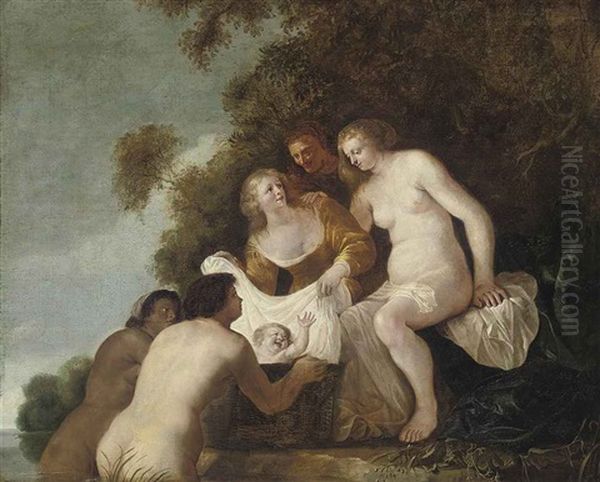
Christiaen van Couwenbergh stands as a notable, if sometimes overlooked, figure in the dazzling constellation of artists who defined the Dutch Golden Age. Active during a period of unprecedented artistic flourishing, economic prosperity, and cultural dynamism in the Netherlands, Couwenbergh carved out a specific niche for himself, primarily as a painter of historical and allegorical subjects, often featuring striking, life-sized nudes. His work offers a fascinating glimpse into the tastes, preoccupations, and sometimes the uncomfortable realities of 17th-century Dutch society.
Early Life and Artistic Formation in Delft
Christiaen van Couwenbergh was born in Delft on July 8, 1604. His father, Gillis van Couwenbergh, was a multifaceted craftsman – a silversmith, engraver, and art dealer – suggesting that young Christiaen was immersed in an artistic milieu from his earliest years. Delft, at this time, was a thriving center for the arts, home to masters like Michiel van Mierevelt, who dominated portraiture, and later, the luminous Johannes Vermeer. While specific details of Couwenbergh's earliest training remain somewhat elusive, it is known that he was a pupil of Johan van Nes, a portrait painter who himself had studied under Mierevelt. This initial grounding likely provided him with a solid technical foundation.
The artistic currents of the early 17th century were rich and varied. The influence of Italian art, particularly the dramatic realism and chiaroscuro of Caravaggio, had permeated the Netherlands, most notably through the "Utrecht Caravaggisti" such as Gerard van Honthorst, Hendrick ter Brugghen, and Dirck van Baburen. These artists, having spent time in Rome, brought back a style characterized by strong contrasts of light and shadow, earthy realism, and often, a focus on genre scenes or religious narratives imbued with a palpable human presence. It is highly probable that Couwenbergh absorbed these influences, either directly or indirectly.
Stylistic Development and Thematic Preferences
Couwenbergh's artistic output is primarily characterized by history paintings, mythological scenes, and allegories, genres that allowed for narrative complexity and the depiction of the human form. He demonstrated a particular proclivity for rendering life-sized figures, especially nudes, which, while not uncommon in mythological or allegorical contexts, were handled by him with a certain directness. His early works show a clear affinity with the robust forms and dramatic lighting associated with the Caravaggist movement.
Over time, however, his style appears to have evolved, incorporating elements of a more classical, perhaps even academic, approach. This shift might suggest a period of study or travel in Italy, a common rite of passage for ambitious Northern European artists, although definitive proof of such a journey for Couwenbergh is lacking. Nevertheless, a refinement in his figures and a somewhat more idealized treatment of form can be observed in his later works. Beyond easel painting, Couwenbergh also reportedly designed cartoons for tapestries, showcasing a versatility in applying his artistic skills.
Masterpieces and Key Works
Several key works illuminate Couwenbergh's artistic concerns and stylistic capabilities. Among his most recognized paintings is The Finding of Moses, dated 1640. This large canvas, measuring 124 x 118 cm and now housed in the Royal Museums of Fine Arts of Belgium in Brussels, depicts the biblical scene where Pharaoh's daughter discovers the infant Moses among the reeds. Couwenbergh presents the princess and her attendants in various states of undress, bathing by the riverbank. The composition is dynamic, and the figures are rendered with a fleshy realism that is characteristic of his approach to the nude. The scene’s boldness, particularly in its depiction of female nudity in a biblical context, was quite distinctive for its time.
Another significant, and far more controversial, work is his 1632 painting often referred to as The Rape of a Black Woman or Sexual Harassment. This disturbing image portrays three white men violently assaulting a Black woman. The painting is a stark and unsettling depiction of racial and sexual violence. In recent years, art historians have re-examined this work, interpreting it not merely as a sensationalist image but as a reflection of the brutal realities of colonialism, the transatlantic slave trade, and the complex, often exploitative, attitudes towards race and gender prevalent in 17th-century Europe. It serves as a powerful, albeit deeply uncomfortable, historical document, prompting discussions about power dynamics and representation in art.
Mythological subjects also provided fertile ground for Couwenbergh. Works such as Venus and Adonis (variously dated, with one version noted as purchased by the Prince of Orange in 1638 for a considerable sum of 800 guilders) and a separate Venus (1643, formerly in a Rijswijk collection) demonstrate his engagement with classical themes of love, beauty, and tragedy. These paintings allowed him to explore the idealized nude, often set within lush landscapes or opulent interiors, catering to the sophisticated tastes of his patrons who appreciated such classical allusions.
His oeuvre also includes portraits, such as The Hunter, with a Portrait of an Artist from 1653, which is now in a private collection (Maja Markovic). While history painting was his forte, such portraits indicate his capacity to work within other established genres, likely fulfilling commissions from the affluent citizenry.
The Socio-Historical Context of Couwenbergh's Art
Couwenbergh's art cannot be divorced from the societal and historical currents of the Dutch Golden Age. The Dutch Republic in the 17th century was a hub of global trade, intellectual inquiry, and artistic innovation. This prosperity fostered a burgeoning art market, with a new class of wealthy merchants and burghers eager to commission and collect art. While religious art declined in public spaces due to the dominance of Calvinism, which eschewed elaborate church decoration, there was still a demand for biblical scenes in private homes, as well as mythological and allegorical paintings that often carried moralizing or intellectual messages.
Couwenbergh's focus on historical and allegorical themes, often with an emphasis on the human figure, placed him somewhat apart from painters like Jan Steen, known for his lively genre scenes, or Adriaen van der Velde, celebrated for his idyllic landscapes. His work aligns more closely with a tradition of history painting that, while perhaps less dominant in Holland than in Flanders (where Peter Paul Rubens and Jacob Jordaens reigned supreme), still held considerable prestige. Artists like Caesar van Everdingen also explored a more classicizing style in their historical and allegorical works.
The Calvinist influence in the Northern Netherlands emphasized virtues such as diligence, piety, and modesty. However, the presence of classical nudes and sometimes morally ambiguous themes in art suggests a complex cultural landscape where humanist learning and an appreciation for classical antiquity coexisted with religious austerity. Couwenbergh's works, particularly those dealing with sensuality or violence, navigated this complex terrain, appealing to a sophisticated clientele that could appreciate the artistic skill and intellectual underpinnings of such subjects.
Professional Life, Associations, and Later Years
Christiaen van Couwenbergh was an active participant in the artistic infrastructure of his time. He became a member of the Guild of Saint Luke in Delft in 1627, a crucial step for any artist wishing to practice professionally. Later, after a period in The Hague, he is recorded as joining the Confrerie Pictura, the city's new painters' confraternity, in 1647, and he even served as its deacon in 1649. These affiliations underscore his standing within the artistic community.
He maintained connections with other artists. His close association with Leonard Bramer, another prominent Delft painter known for his dramatic history scenes and nocturnal subjects, is well-documented. Both artists shared an interest in narrative painting, though Bramer's style was often more idiosyncratic and darker in tone. The influence of Michiel van Mierevelt, Delft's leading portraitist, was also likely significant in Couwenbergh's formative years, at least in terms of professional standards and the artistic environment of the city.
Despite his artistic activities and a reported inheritance, Couwenbergh seems to have faced financial difficulties later in his life. In 1653 or 1654, he relocated from Delft to Cologne, a significant move. Records indicate that even after this move and despite receiving an inheritance, he was burdened by debts. Interestingly, a document from 1656 shows the city council of The Hague providing a positive testimonial for him, describing him as a good father and a respectable individual, perhaps in an attempt to aid his situation in Cologne.
Anecdotes and Unresolved Aspects
The financial struggles of Couwenbergh in his later years, despite his artistic output and an inheritance, present something of an enigma. The reasons for his debts are not clearly recorded, leaving room for speculation about his financial management or perhaps the fluctuating fortunes of an artist reliant on commissions and sales in a competitive market.
His artistic choice to frequently depict bold, life-sized nudes, as seen in The Finding of Moses, was also somewhat audacious within the broader context of Dutch art, which often favored more restrained or domestic scenes. This suggests a confident, perhaps even provocative, artistic personality, willing to push conventional boundaries. The starkness of his painting The Rape of a Black Woman also points to an artist unafraid to tackle challenging and disturbing subject matter, a decision that continues to provoke discussion and re-evaluation centuries later.
Legacy and Conclusion
Christiaen van Couwenbergh died in Cologne on July 4, 1667. While he may not have achieved the towering fame of contemporaries like Rembrandt van Rijn or Johannes Vermeer, his contribution to the Dutch Golden Age is undeniable. He was a skilled practitioner of history painting, a genre that, while perhaps less voluminous in the Dutch Republic than in other parts of Europe, was still highly esteemed. His work is characterized by a robust handling of the human form, a flair for narrative, and an engagement with significant themes, from biblical stories and classical myths to the darker aspects of human behavior and societal injustice.
His paintings offer valuable insights into the artistic tastes and cultural complexities of the 17th century. The blend of Caravaggist influence with a developing classicism, his bold depiction of nudes, and his willingness to confront difficult subjects mark him as an artist of considerable interest. In an era that produced an astonishing array of artistic talent, including masters of landscape like Jacob van Ruisdael, portraiture like Frans Hals, and still life like Willem Kalf, Christiaen van Couwenbergh carved out his own distinctive path, leaving behind a body of work that continues to engage and, at times, challenge viewers today. His art serves as a reminder of the diverse expressions and thematic concerns that flourished under the umbrella of the Dutch Golden Age.