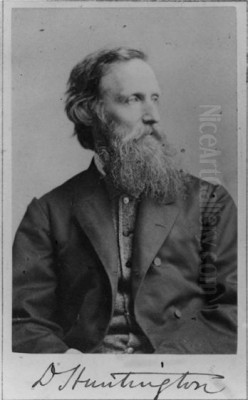
Daniel Huntington, a name that resonates with the artistic fervor of nineteenth-century America, stands as a significant, if sometimes overlooked, figure in the nation's art history. Born in New York City on October 4, 1816, and passing away there on April 19, 1906, Huntington's long life spanned a period of immense transformation in American society and its artistic landscape. He was a prolific painter, an influential educator, and a central figure in New York's art institutions, navigating the currents of Romanticism, Realism, and the enduring appeal of academic tradition. His legacy is complex, marked by early popular acclaim and later overshadowed by emerging modernist trends, yet his contribution to the fabric of American art remains undeniable.
Early Life and Artistic Awakening
Daniel Huntington hailed from a distinguished lineage. His father was Benjamin Huntington, and his grandfather, also named Benjamin Huntington, was a respected United States Representative from Connecticut and a delegate to the Second Continental Congress. This background likely instilled in young Daniel a sense of history and public service, themes that would later subtly permeate his artistic endeavors.
His academic journey began at Yale University, where he spent a year before transferring to Hamilton College in Clinton, New York. It was at Hamilton that the seeds of his artistic passion were sown, largely through the encouragement and inspiration of the portrait painter Charles Loring Elliott. Elliott, a notable artist in his own right, recognized Huntington's nascent talent and likely guided his early explorations into the world of visual arts. This encounter proved pivotal, steering Huntington away from more conventional career paths and towards the demanding yet rewarding life of an artist.
Formal Training and Emergence in New York
By 1835, Daniel Huntington had made the decisive move to New York City, then rapidly becoming the epicenter of American artistic life. He sought out the tutelage of two of the most prominent artists of the day: Samuel F. B. Morse and Henry Inman. Morse, already renowned as a painter before his groundbreaking work on the telegraph, was a key figure in the National Academy of Design and a proponent of historical and portrait painting. Inman, equally celebrated, was known for his versatile talents in portraiture, genre scenes, and miniatures.
Under their guidance, Huntington honed his skills and began to establish his professional direction. He absorbed the academic principles of drawing and composition, the nuances of color, and the prevailing tastes of the era. His dedication bore fruit quickly; in 1836, he exhibited his first works at the prestigious National Academy of Design, marking his formal entry into the American art world. He became an associate member of the Academy in 1839 and a full academician in 1840, a testament to his rapidly growing reputation.
The European Sojourns: Broadening Horizons
Like many ambitious American artists of his generation, Huntington recognized the necessity of European travel and study to fully develop his artistic vision. In 1839, he embarked on his first significant journey abroad, visiting England, France, and, most importantly, Italy. Rome and Florence, with their unparalleled repositories of classical and Renaissance art, made a profound impact on him. He immersed himself in the study of the Old Masters, absorbing the lessons of Raphael, Titian, and Correggio.
During his time in Rome, Huntington encountered the Nazarenes, a group of German Romantic painters, including figures like Johann Friedrich Overbeck and Peter von Cornelius, who sought to revive the spiritual purity and artistic honesty they perceived in early Renaissance art. Their emphasis on religious themes and meticulous technique resonated with Huntington's own inclinations. Subsequent trips to Europe, including further visits to Italy, France, and England, continued to enrich his artistic vocabulary and refine his style, allowing him to synthesize European traditions with American sensibilities.
The Ascent to Prominence: Key Works
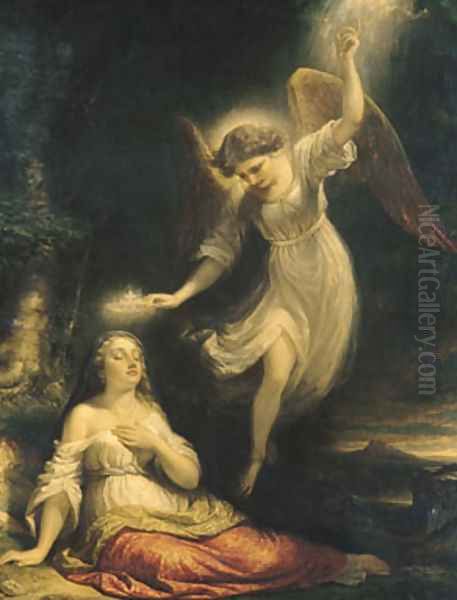
Huntington's European experiences, particularly his engagement with religious and allegorical art, directly influenced one of his most celebrated early works, Mercy's Dream. Painted in 1841 and inspired by John Bunyan's Pilgrim's Progress, the painting depicts Mercy, a character from the allegorical tale, asleep and dreaming of an angelic visitation. Exhibited at the Pennsylvania Academy of the Fine Arts, the work was an immediate popular and critical success. Its blend of literary inspiration, delicate sentiment, and refined execution captivated audiences, and it was widely disseminated through engravings, solidifying Huntington's fame. This painting showcased his appreciation for the Italian Renaissance and Baroque traditions, particularly in its idealized figures and harmonious composition.
Another monumental work that cemented Huntington's reputation was The Republican Court in the Time of Washington, also known as Lady Washington’s Reception Day, completed in 1861. This ambitious historical painting, now in the collection of the Brooklyn Museum, portrays a gathering of prominent figures from America's early republic, centered around Martha Washington. It is a tour-de-force of group portraiture and historical reconstruction, demonstrating Huntington's skill in managing complex compositions and capturing the dignity of his subjects. The painting was highly praised for its patriotic sentiment and meticulous detail.
Throughout his career, Huntington explored a variety of themes. The Florentine Girl (1839) reflects his early Italian travels and interest in picturesque local subjects. Religious and historical themes continued to be prominent, as seen in Early Christian Prisoners (1844) and The Shepherd Boy of the Campagna (1844), both indicative of his Roman experiences. Later works like Sowing the Word (1869) and Philosophy and Christian Kings at Bologna (1878) delved into more overtly religious and philosophical subjects, showcasing his enduring commitment to art with a moral or spiritual dimension.
A Master of Portraiture
While Huntington achieved fame with his allegorical and historical paintings, portraiture formed a consistent and significant part of his oeuvre. In an era before the widespread adoption of photography, painted portraits were essential for commemorating individuals and preserving their likenesses for posterity. Huntington excelled in this genre, producing numerous portraits of distinguished Americans.
His sitters included prominent political figures, such as Presidents Abraham Lincoln, Martin Van Buren, John Quincy Adams, and Rutherford B. Hayes. He also painted leading figures in the military, clergy, and society. Huntington's portraits were generally characterized by a dignified realism, a keen attention to capturing the sitter's likeness and character, and a polished, academic finish. He navigated the expectations of his patrons skillfully, creating images that conveyed both individual personality and social standing. His success in this field placed him among the leading portraitists of his time, alongside contemporaries like George Peter Alexander Healy.
Landscapes and the Hudson River School Influence
Beyond historical scenes and portraits, Daniel Huntington was also an accomplished landscape painter. His early landscapes show the influence of the Hudson River School, the first coherent school of American landscape painting. Artists like Thomas Cole, Asher B. Durand, and later figures such as Frederic Edwin Church and Albert Bierstadt, celebrated the American wilderness as a source of national pride and spiritual inspiration. Huntington shared their appreciation for nature, often imbuing his landscapes with a sense of tranquility and a subtle spiritual undertone.
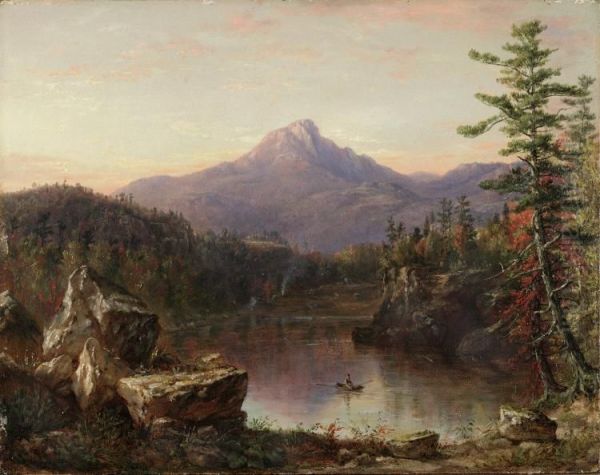
He was particularly fond of the scenery in the White Mountains of New Hampshire, a popular sketching ground for many Hudson River School painters. The region around Chocorua was a favorite, and he often spent summers there, sometimes in the company of fellow artists like Edwin Graves Champney. His painting Chocorua Peak (also known as Mill Pond, Chocorua, New Hampshire) is a fine example of his landscape work, capturing the serene beauty of the area with a delicate handling of light and atmosphere. While perhaps not as focused on the sublime grandeur as some of his Hudson River School peers like Bierstadt or Church, Huntington's landscapes possess a quiet charm and a deep affection for the American scene. His numerous sketchbooks, containing over a thousand drawings, primarily of New York State landscapes, attest to his continuous engagement with nature throughout his life.
Leadership and Institutional Impact
Daniel Huntington was not only a prolific artist but also a significant figure in the institutional framework of the American art world. His most notable role was with the National Academy of Design in New York. Founded in 1825 by artists including Samuel F. B. Morse and Asher B. Durand, the Academy was a crucial institution for art education and exhibition in the United States. Huntington served two long terms as its President, from 1862 to 1869 and again from 1877 to 1887, making him one of its longest-serving leaders.
In this capacity, he championed academic principles, emphasizing rigorous training in drawing and the study of the Old Masters. He worked to maintain the Academy's prominence and uphold traditional artistic standards during a period of evolving tastes. His leadership provided stability and continuity, though some later critics viewed his influence as contributing to a conservative stance within the institution.
Furthermore, Huntington was involved with the Metropolitan Museum of Art, one of America's premier cultural institutions, serving for a time as its Vice President. His engagement with these key organizations underscores his central position in the New York art establishment of the latter half of the nineteenth century. He was also a member of the Century Association, a club for artists and writers, further indicating his integration into the cultural elite.
Artistic Style and Philosophy
Daniel Huntington's artistic style can be broadly characterized as a blend of Romanticism and academic Realism. He was deeply rooted in the traditions of European art, particularly the Italian Renaissance and Baroque periods, which informed his idealized figures, harmonious compositions, and often allegorical or historical subject matter. His technique was meticulous, marked by careful drawing, smooth brushwork, and a polished finish, all hallmarks of academic training.
He remained a staunch advocate for traditional painting techniques and styles throughout his career, even as new artistic movements began to challenge established norms. His approach was conservative, prioritizing narrative clarity, moral uplift, and technical proficiency. This commitment to academic ideals, while earning him respect and patronage during much of his lifetime, also meant that his work appeared increasingly conventional as Impressionism and other modernist trends gained traction towards the end of the nineteenth century and into the twentieth. However, his dedication to craftsmanship and his belief in the ennobling power of art were unwavering.
Contemporaries and Connections
Huntington's long career placed him in contact with a wide array of artists. His teachers, Samuel F. B. Morse and Henry Inman, were foundational influences. His early inspiration, Charles Loring Elliott, remained a respected fellow portraitist. He was a contemporary of the leading figures of the Hudson River School, including Thomas Cole, Asher B. Durand, Frederic Edwin Church, Albert Bierstadt, Sanford Robinson Gifford, and John Frederick Kensett, sharing their milieu even if his primary focus sometimes differed.
In the realm of portraiture, he worked alongside artists like George P.A. Healy. His European travels brought him into contact with movements like the Nazarenes, represented by Overbeck and Cornelius. He formed friendships with artists like Edwin Graves Champney, with whom he sketched in the White Mountains. He also played a role in mentoring younger artists, with Peter Gray Henry being one of his known students. His relationship with the elder statesman of American historical painting, John Trumbull, though from a preceding generation, would have been one of respect for a pioneering figure. This network of teachers, colleagues, and students illustrates his active participation in the artistic community of his time.
Later Years and Legacy
Daniel Huntington continued to paint and remain active in the art world well into his later years. He maintained his studio in New York City and fulfilled commissions for portraits and other works. However, as artistic tastes shifted towards the end of the 19th century, with the rise of Impressionism and other modern movements, Huntington's more traditional, academic style began to be perceived by some as old-fashioned.
Despite this gradual shift in critical favor, his contributions during his lifetime were immense. He played a vital role in shaping American art institutions and in promoting a high standard of artistic practice. While modern art history has sometimes paid less attention to artists of his conservative ilk, there has been a renewed appreciation for the skill, dedication, and cultural significance of figures like Huntington. He left behind a substantial body of work that reflects the aspirations and values of Victorian America. His influence on the New York art scene of the 19th century was profound, helping to establish a professional artistic community and to cultivate public appreciation for the arts.
Notable Collections and Exhibitions
Works by Daniel Huntington are held in the collections of many major American museums. His iconic Mercy's Dream is a prized possession of the Metropolitan Museum of Art in New York, which also holds other works, including sketchbooks like Delaware, East Branch, Walton, 1871. The Republican Court in the Time of Washington is a highlight of the Brooklyn Museum's collection. The National Gallery of Art in Washington, D.C., also includes his work.
Other institutions housing his paintings include the Pennsylvania Academy of the Fine Arts in Philadelphia, where Mercy's Dream first gained acclaim. The Florentine Girl is reportedly in the Bellini Family Museum. His painting The Shepherd Boy found its way to the Centraal Museum in Utrecht, Netherlands. Fragments related to Early Christian Prisoners are noted as being in a museum in Corinth. Even the Gerald R. Ford Presidential Library holds materials related to his work, specifically concerning The Republican Court. His portraits can be found in numerous historical societies, government buildings, and university collections, a testament to the breadth of his commissions and the esteem in which he was held. These holdings ensure that Daniel Huntington's artistic contributions remain accessible for study and appreciation by future generations.