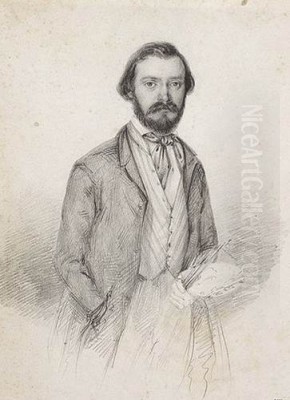
Domenico Induno stands as a significant figure in 19th-century Italian art, a painter whose canvases vividly captured the transition from Romanticism to Realism, the fervor of the Risorgimento, and the intimate moments of everyday life. Born in Milan, his journey from a goldsmith's apprentice to a celebrated artist reflects both his innate talent and the dynamic cultural and political currents of his time. His work offers a rich tapestry of historical narratives, poignant genre scenes, and patriotic declarations, securing his place as a key chronicler of Italian society during a transformative era.
Early Life and Artistic Awakening in Milan
Domenico Induno was born in Milan on May 14, 1815, into a family with modest connections to the court. His initial foray into the world of arts was not directly in painting but as an apprentice to a goldsmith, variously recorded as Luigi Cossa or Luco Cisso. This early training, while not in his ultimate field, likely instilled in him a meticulous attention to detail and craftsmanship that would later manifest in his paintings.
However, Induno's true calling lay in the visual arts of a different scale. His evident artistic talent did not go unnoticed, and he was soon encouraged to pursue formal art education. This pivotal recommendation led him to the prestigious Brera Academy (Accademia di Belle Arti di Brera) in Milan, one of Italy's foremost art institutions. Enrolling at the Brera marked the true beginning of his journey as a painter, placing him in an environment ripe with artistic tradition and burgeoning new ideas.
The Brera Academy: Forging a Painter under Esteemed Masters
At the Brera Academy, Domenico Induno came under the tutelage of several influential artists who would shape his technical skills and artistic vision. Among his principal teachers were Luigi Sabatelli, a prominent figure known for his large-scale frescoes and neoclassical leanings, and Pompeo Marchesi, a renowned sculptor whose classical sensibilities also permeated the academy's teachings. Another important, though perhaps less direct, influence from the Brera faculty was Pelagio Palagi, a versatile artist excelling in painting, sculpture, and architecture, whose work often blended Neoclassicism with Romantic elements.
However, the most profound and lasting influence on Induno's development was undoubtedly Francesco Hayez. Hayez was a leading figure of Italian Romanticism, celebrated for his historical paintings, allegories, and portraits that resonated deeply with the patriotic sentiments of the era. Under Hayez, Induno honed his skills in composition, color, and narrative, initially focusing on historical and biblical subjects, a popular genre championed by his master. Hayez's emphasis on emotional expression and historical accuracy provided a strong foundation for Induno's early career.
Early Success with Historical and Classical Themes
Following the academic tradition, Induno's early works predominantly featured historical and biblical narratives. These paintings showcased his mastery of classical composition, dramatic lighting, and the ability to convey complex stories with clarity and emotional depth. A significant early achievement was his painting Alexander the Great and His Doctor Philippos. This work, completed around 1837, not only demonstrated his burgeoning talent but also won him a prestigious prize that included a scholarship to study further in Rome. This opportunity allowed him to immerse himself in the classical art of the ancient capital, further refining his style.
Another notable work from this period was Saul Anointed King by the Prophet Samuel, commissioned by Emperor Ferdinand I of Austria and exhibited with great success. Such commissions and accolades affirmed his rising status as a painter of historical subjects. These early pieces were characterized by a certain academic polish, a clear narrative structure, and an adherence to the grand style favored by institutions like the Brera. They laid the groundwork for his later explorations, even as his thematic focus began to shift.
The Winds of Change: Revolution and a Turn Towards Realism
The mid-19th century in Italy was a period of intense political upheaval, marked by the Risorgimento, the movement for Italian unification. Domenico Induno was not merely an observer of these events; he was an active participant. In 1848, he, along with his younger brother Gerolamo Induno, who was also a painter, took part in the "Five Days of Milan," a major uprising against Austrian rule.
The failure of this insurrection and the subsequent Austrian crackdown forced the Induno brothers to flee Milan. Domenico sought refuge first in Ticino, Switzerland, and later in Florence, Tuscany. This period of exile and direct engagement with the revolutionary struggle profoundly impacted his worldview and, consequently, his art. The grand historical and biblical themes, while still part of his repertoire, began to give way to subjects more directly connected to contemporary life and the struggles of ordinary people. This marked a significant turn towards genre painting and social realism, or "Verismo" as it came to be known in Italy.
Genre Painting: Capturing the Soul of Everyday Life
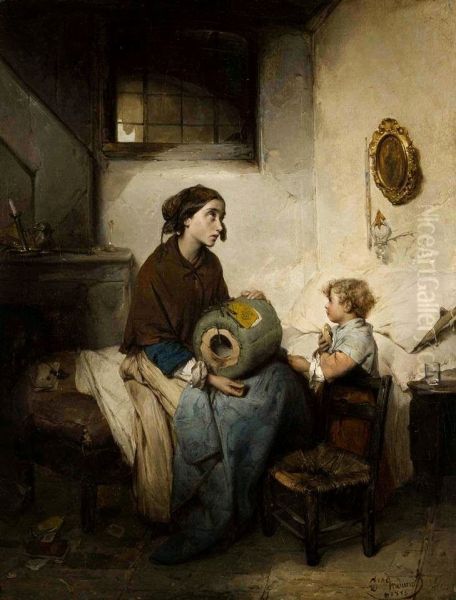
Upon his return to Milan around 1859, after the political climate had shifted, Domenico Induno increasingly dedicated himself to genre painting. His works began to depict scenes of everyday Milanese life, focusing particularly on the experiences of the common people, the artisans, the poor, and families. These paintings were characterized by their empathetic portrayal, narrative richness, and a keen observation of social realities.
Works like La visita alla balia (The Visit to the Wet Nurse) exemplify this phase. Such paintings often told a story, capturing moments of tenderness, hardship, or simple domesticity. Induno's style in these genre pieces combined the narrative clarity learned from his historical painting with a more intimate, emotionally resonant approach. He showed a remarkable ability to convey the dignity and humanity of his subjects, even in their most vulnerable or impoverished states. His palette often became warmer, his brushwork more nuanced, reflecting the textures and atmosphere of interior scenes and humble settings.
Art as a Patriotic Voice: Chronicling the Risorgimento
Domenico Induno's involvement in the Risorgimento continued to fuel his artistic output. He created numerous paintings that directly addressed the themes of Italian unification, patriotism, and the sacrifices made in the struggle for independence. These works served not only as artistic statements but also as powerful pieces of visual propaganda, fostering a sense of national identity and shared purpose.
A prime example is Il bollettino del giorno 14 luglio 1859 che annunzia la pace di Villafranca (The Bulletin of July 14, 1859, Announcing the Peace of Villafranca). This painting captures a specific historical moment, depicting the public reaction to the news of the armistice that, while not fully achieving Italian aims, was a significant step in the unification process. Other works, such as Il garibaldino (The Garibaldian), Il garibaldino a Capua (The Garibaldian at Capua), and Il partenza di Garibaldi per la Sicilia (The Departure of Garibaldi for Sicily), celebrated the exploits of Giuseppe Garibaldi and his volunteer forces, who were iconic figures of the Risorgimento. These paintings often combined the heroism of historical painting with the immediacy of genre scenes, showing soldiers in moments of rest, departure, or quiet reflection.
Masterpieces and Their Enduring Significance
Several of Domenico Induno's works stand out as particularly representative of his artistic journey and impact. Pane e Lacrime (Bread and Tears), exhibited at the Paris Exposition Universelle in 1855, garnered significant acclaim, notably from the French writer and critic Théophile Gautier. This painting, depicting a scene of poverty and quiet suffering, was a powerful example of his social realist concerns and his ability to evoke deep emotion through seemingly simple domestic scenes.
His patriotic works, like those depicting Garibaldi's campaigns or the announcement of the Peace of Villafranca, are significant for their historical documentation and their embodiment of the national spirit. The Departure of the Conscript is another poignant example, capturing the sorrow and anxiety of a family as a young man leaves for war, a common experience during the Risorgimento. His portrait of King Victor Emmanuel II, the first king of a unified Italy, further cemented his status as an artist aligned with the national cause. These works, whether grand historical statements or intimate genre scenes, are united by Induno's skillful narrative technique, his empathetic portrayal of human emotion, and his commitment to representing the realities of his time.
International Recognition and Academic Esteem
Domenico Induno's talent did not go unrecognized beyond Italy's borders. His participation in major international exhibitions brought him considerable acclaim. The praise for Pane e Lacrime at the 1855 Paris Exposition was a significant milestone. He continued to exhibit internationally, including at the Vienna World's Fair in 1873, where he was awarded a gold medal, and again at the Paris World's Fair in 1878.
Domestically, his contributions were also highly valued. In 1860, he was appointed as an art assistant at his alma mater, the Brera Academy, and later became a full Academician. This role allowed him to influence a new generation of artists, passing on the traditions he had learned and the new directions he had forged. His work was admired by critics and the public alike for its blend of technical skill, emotional depth, and relevance to contemporary Italian life.
The Induno Brothers: A Shared Artistic and Patriotic Path
Domenico's artistic journey was closely intertwined with that of his younger brother, Gerolamo Induno (1825-1890). Gerolamo also studied at the Brera Academy, likely under similar influences, including Francesco Hayez. The brothers shared a deep bond, common artistic interests, and a fervent patriotism, fighting alongside each other in the 1848 Milan uprising and both experiencing exile.
While Domenico increasingly focused on genre scenes and social commentary, Gerolamo became particularly renowned for his military paintings, vividly depicting battle scenes and the life of soldiers during the Risorgimento wars. Their artistic paths, though distinct in their primary focus, were complementary. They sometimes collaborated on works, and their shared experiences undoubtedly fueled their respective artistic visions. Domenico further deepened his family ties by marrying Emilia Trezzini, who was the sister of Gerolamo's wife, creating a close-knit family unit dedicated to art and the national cause.
Connections and Contemporaries: Induno in the Italian Art Milieu
Domenico Induno operated within a vibrant and evolving Italian art scene. His primary mentor, Francesco Hayez, remained a towering figure. Other teachers like Luigi Sabatelli and Pompeo Marchesi, and the influence of Pelagio Palagi, provided him with a strong academic grounding. His friendship with Alessandro Durini, a nobleman and fellow artist, also played a role in his social and artistic life.
Beyond his immediate circle, Induno's work can be seen in dialogue with other artistic currents in Italy. While he developed his own brand of realism, the Macchiaioli group in Florence, including artists like Giovanni Fattori, Telemaco Signorini, and Vincenzo Cabianca, were contemporaneously exploring new avenues of naturalism and plein-air painting, often also depicting scenes from the Risorgimento. Fattori, in particular, shared Induno's interest in military themes and the lives of soldiers, though his stylistic approach was different.
In Lombardy, artists like Giuseppe Molteni, also a student of Hayez, excelled in portraiture and genre scenes, sharing some thematic overlaps with Induno. Giovanni Carnovali, known as "Il Piccio," was another contemporary Lombard painter, though his style was more individualistic and less tied to academic norms. In Venice, Antonio Rotta was a prominent genre painter whose depictions of everyday Venetian life paralleled Induno's focus on Milanese society. Even earlier, the work of Scottish genre painter Sir David Wilkie had a wide influence across Europe, popularizing scenes of ordinary life that prefigured the concerns of artists like Induno. Internationally, Induno's social realism found echoes in the work of French painters like Jean-François Millet, known for his dignified portrayals of peasant life, and Gustave Courbet, a leading proponent of Realism.
Later Years and Lasting Legacy
In his later years, Domenico Induno faced the challenge of deteriorating eyesight. Despite this, he continued to paint, driven by his passion and commitment to his art. He participated in the Paris World's Fair of 1878, which was one of his last major public appearances. Domenico Induno passed away in Milan on November 5, 1878, at the age of 63.
His legacy is that of a versatile and empathetic artist who skillfully navigated the artistic and political currents of his time. He successfully transitioned from the grand historical narratives of Romanticism to a more intimate and socially conscious Realism, becoming a key figure in the development of Italian genre painting. His works provide invaluable visual documentation of the Risorgimento, capturing not just the heroic events but also the human cost and everyday realities of a nation in formation. Through his art, Domenico Induno offered a compassionate and insightful portrayal of 19th-century Italian society, leaving behind a body of work that continues to resonate for its artistic merit, historical significance, and profound humanism. He remains an important touchstone for understanding the art and soul of Italy during one of its most pivotal centuries.