Introduction: The Enigmatic Ferrarese Painter
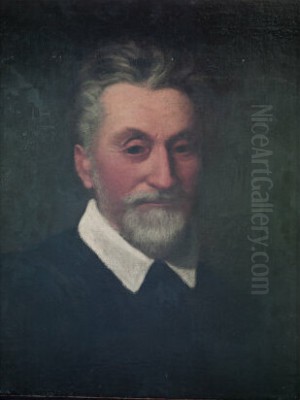
Giovanni di Niccolò di Luteri, far better known to the world as Dosso Dossi, stands as one of the most intriguing and distinctive painters of the Italian High Renaissance. Active primarily in the vibrant cultural milieu of Ferrara, he forged a unique artistic identity, blending the rich colorism of the Venetian school with a highly personal, often fantastical imagination. Born sometime between approximately 1479 and 1486, and passing away in 1542, Dosso Dossi became the leading figure of the Ferrarese School of painting during his lifetime. His long service to the Este Dukes of Ferrara placed him at the heart of courtly life, producing works that ranged from grand mythological scenes and religious altarpieces to intimate portraits and decorative schemes, all marked by his signature blend of poetic charm and visual invention.
Origins and Early Development
The precise details of Dosso Dossi's early life remain somewhat shrouded in uncertainty, contributing to the enigmatic aura that surrounds him. While his birth years are generally placed in the late 1470s or mid-1480s, definitive documentation is scarce. He hailed from the region of Trento, born into a family of some standing; his father, Nicolò di Luteri, served as a treasurer, or 'spenditore', for the Duke of Ferrara, suggesting a pre-existing connection to the Este court that would later define Dosso's career. The name "Dosso" itself is thought perhaps to derive from a family property or a village near his birthplace, a common practice in identifying artists during the period.
His artistic training appears to have begun under the tutelage of Lorenzo Costa, a prominent painter active in both Bologna and Mantua. This apprenticeship likely exposed the young Giovanni to the prevailing styles of the Emilia-Romagna region and the neighboring Lombard artistic centers. Costa himself was influenced by artists like Francesco Francia and the Umbrian master Perugino, suggesting Dossi's early formation involved absorbing the clarity and compositional harmony typical of late Quattrocento Central Italian art, albeit filtered through Costa's somewhat drier style. The first concrete record of Dosso Dossi's activity places him in Mantua in 1512, working within the orbit of the Gonzaga court, another major center of Renaissance patronage, famously associated with Andrea Mantegna and later Giulio Romano.
Court Painter in Ferrara: Service to the Este Dukes
The pivotal moment in Dosso Dossi's career arrived around 1514 when he entered the service of Duke Alfonso I d'Este in Ferrara. This marked the beginning of a long and fruitful relationship with the Este dynasty, which would continue under Alfonso's successor, Duke Ercole II d'Este, lasting until Dosso's death in 1542. Ferrara, under the Este rulers, was a renowned center of art, music, and literature, fostering a sophisticated court culture that demanded elaborate decorations, learned allegories, and luxurious artworks. Dosso Dossi thrived in this environment, becoming the principal court painter.
His duties were diverse, reflecting the multifaceted role of a Renaissance court artist. He was commissioned to create large-scale mythological paintings, religious altarpieces for chapels, portraits of the ducal family and courtiers, designs for tapestries and theatrical scenery, and extensive fresco decorations for the Este palaces and villas. This long tenure provided him with consistent patronage and the opportunity to develop his distinctive style within a supportive, if demanding, context. His work became integral to the visual identity of the Este court during the High Renaissance. The court's literary interests, particularly in epic poetry like Ludovico Ariosto's Orlando Furioso (published in Ferrara), provided fertile ground for Dossi's imaginative interpretations of myth and legend.
Artistic Style: The Venetian Imprint
Dosso Dossi's artistic style is deeply indebted to the Venetian school of painting, which prioritized color (colorito) and light over Florentine and Roman emphasis on drawing and design (disegno). His frequent visits to Venice exposed him directly to the revolutionary works of Giorgione and the young Titian. The influence of Giorgione is palpable in Dossi's evocative landscapes, his use of soft, atmospheric light (sfumato), and his penchant for enigmatic, poetic subjects. Giorgione's masterpieces, such as The Tempest, set a precedent for integrating figures seamlessly into richly rendered natural settings charged with mood, a quality Dossi absorbed and adapted.
The impact of Titian is equally significant, particularly in Dossi's vibrant color palette, dynamic compositions, and increasingly confident handling of paint. Titian's mastery of rich hues, dramatic lighting, and energetic brushwork clearly resonated with Dossi. One can see echoes of Titian's approach to texture, landscape, and even figure types in many of Dossi's works. However, Dossi never simply imitated his Venetian contemporaries like Palma Vecchio or Sebastiano del Piombo. He assimilated their innovations into his own artistic language, creating a style that remained distinctly Ferrarese – often more quirky, decorative, and less classically idealized than that of his Venetian counterparts.
Artistic Style: Roman Echoes and Ferrarese Individuality
While Venice provided the dominant influence, Dosso Dossi also absorbed lessons from the High Renaissance masters active in Rome. Visits to the papal city likely brought him into contact with the monumental works of Raphael and Michelangelo. The influence of Raphael might be discerned in certain compositional structures and a degree of classical grace that occasionally surfaces in Dossi's figures, particularly in his religious works. His brother Battista's training directly under Raphael may have also served as a conduit for these ideas. Michelangelo's powerful dynamism seems less directly influential on Dossi's generally more lyrical style, though the ambition and scale of Roman projects may have inspired his own large-scale commissions.
Despite these powerful influences, Dosso Dossi's art is ultimately defined by its striking individuality. His style often incorporates an element of fantasy, eccentricity, and charm that sets it apart. Art historians sometimes refer to his unique mannerism as embodying "sprezzatura," a term suggesting a kind of effortless grace or nonchalance, but in Dossi's case, often manifesting as slightly unconventional proportions, playful details, and a departure from strict naturalism towards a more imaginative or even cartoonish rendering. His figures can sometimes appear slightly naive or doll-like, contributing to the fairytale quality of many of his mythological scenes. This blend of Venetian color, Roman ambition, and Ferrarese fantasy resulted in a highly personal and instantly recognizable artistic voice.
Thematic Focus: Mythology, Allegory, and Literature
Dosso Dossi excelled in the depiction of mythological and allegorical subjects, themes highly favored by the sophisticated patrons of the Este court. He possessed a remarkable ability to translate complex literary narratives and abstract concepts into compelling visual form. His paintings often draw inspiration from classical mythology, particularly Ovid's Metamorphoses, and from contemporary Italian literature, most notably Ariosto's epic poem Orlando Furioso, which was closely associated with the Ferrara court.
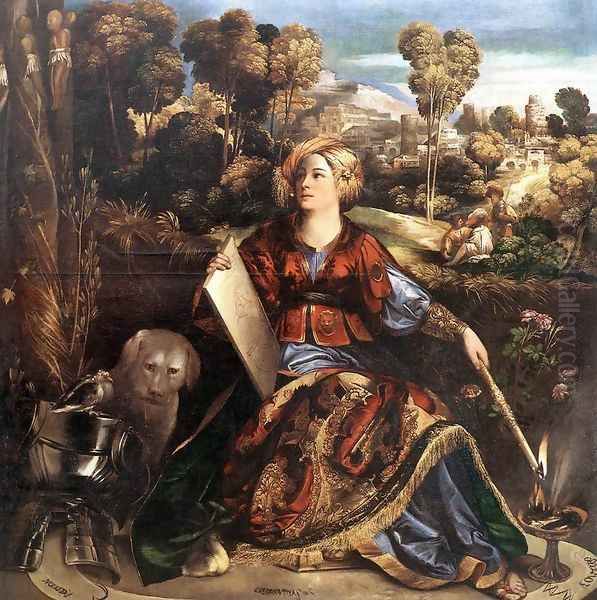
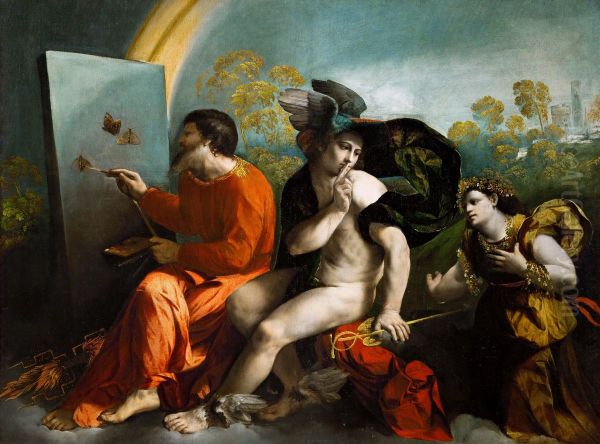
Works like Melissa (also sometimes identified as Circe) directly reference characters and magical themes from Ariosto's poem. Other paintings, such as Jupiter, Mercury and Virtue, present intricate allegories whose precise meanings are still debated by scholars, reflecting the Renaissance fascination with Neoplatonic philosophy, symbolism, and learned visual puzzles. Dossi's approach was rarely straightforwardly illustrative; instead, he imbued these subjects with his characteristic dreamlike atmosphere, rich color, and imaginative details, creating visually sumptuous works that invited contemplation and interpretation. His skill lay in making these often esoteric subjects accessible and enchanting through the sheer beauty and inventiveness of his painting.
Thematic Focus: The Enchanted Landscape
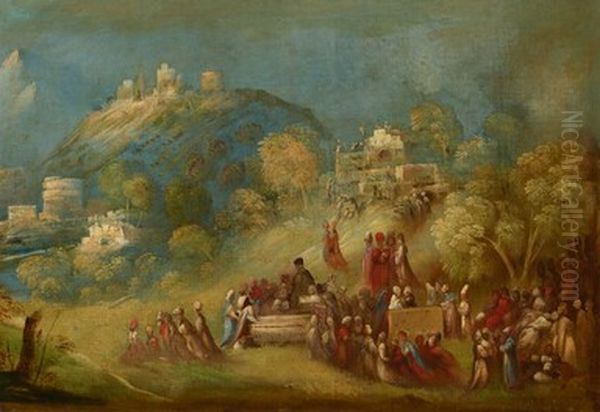
Landscape plays an unusually prominent role in Dosso Dossi's oeuvre, often evolving beyond a mere backdrop to become an active participant in the narrative and mood of the painting. Influenced by the Venetian tradition pioneered by Giorgione and Titian, Dossi developed a highly personal approach to landscape. His natural settings are rarely topographically precise; instead, they are idealized, romanticized, and frequently imbued with a sense of magic or mystery.
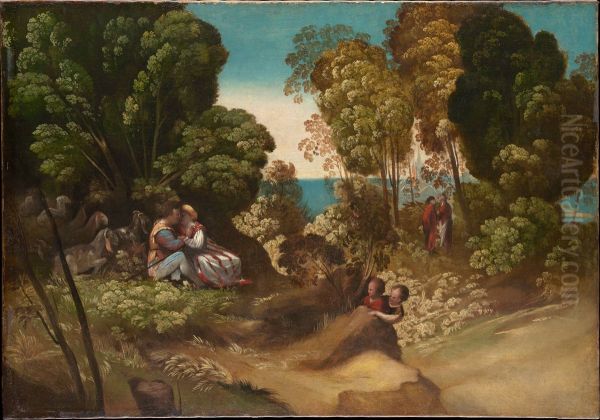
Trees might twist in fantastical shapes, foliage can be rendered with jewel-like intensity, and dramatic lighting effects – sunsets, moonlit scenes, stormy skies – contribute significantly to the emotional impact of the work. These landscapes provide evocative settings for his mythological figures, enhancing the sense of otherworldliness and poetic fantasy. In works like The Three Ages of Man or the background of Melissa, the landscape is rendered with a sensitivity and prominence that anticipates later developments in European landscape painting. Dossi can be considered a key figure in the transition of landscape from a subordinate element to a more independent expressive genre.
Masterworks: Melissa (Circe)
Perhaps Dosso Dossi's most famous painting is Melissa, housed in the Galleria Borghese in Rome. Likely painted in the 1520s, the work depicts a sorceress, generally identified with the benevolent enchantress Melissa from Ariosto's Orlando Furioso, although sometimes interpreted as the more malevolent Circe from Homer's Odyssey. She sits in a lush, magical landscape, surrounded by symbols of her power: a magic circle inscribed on the ground, a flaming torch, and armor presumably belonging to knights she has transformed or will restore. In the background, small figures hint at narrative elements – perhaps knights trapped in animal form or liberated by her spells.
The painting exemplifies Dossi's mature style: rich, vibrant colors dominate the composition, particularly the shimmering fabrics of Melissa's costume and the deep greens and blues of the landscape. The figure herself possesses a captivating, slightly enigmatic presence. The landscape is rendered with characteristic fantasy, featuring gnarled trees and distant, hazy mountains under a dramatic sky. The work's enduring appeal lies in its blend of literary allusion, magical atmosphere, and sheer visual splendor. Questions surrounding its precise subject and even occasional debates about its dating or potential collaboration only add to its mystique.
Masterworks: Jupiter, Mercury and Virtue
Another significant mythological work is Jupiter, Mercury and Virtue, located in the Kunsthistorisches Museum in Vienna. This painting showcases Dossi's ability to handle complex allegorical themes with visual flair. The composition depicts Jupiter, king of the gods, somewhat unusually shown painting butterflies, while Mercury attempts to silence the complaining figure of Virtue, who is being excluded from their divine company. The precise meaning remains elusive, possibly relating to Neoplatonic ideas about the soul, the relationship between art and virtue, or a specific courtly allegory commissioned by the Este.
Stylistically, the painting is notable for its bold composition, strong colors, and the characteristic Dossi blend of grandeur and eccentricity. The figures are robustly modeled, and the interaction between them is dynamic. Jupiter's unconventional activity of painting butterflies adds a touch of whimsy typical of Dossi. The rich textures of fabrics and the atmospheric landscape background further enhance the work's visual appeal. It stands as a prime example of Dossi's engagement with the learned, allegorical tastes of his patrons, translated through his uniquely imaginative lens. Some sources confusingly refer to this subject as Jupiter Painting Butterflies, likely conflating the action within the painting with its title.
Masterworks: Other Notable Paintings
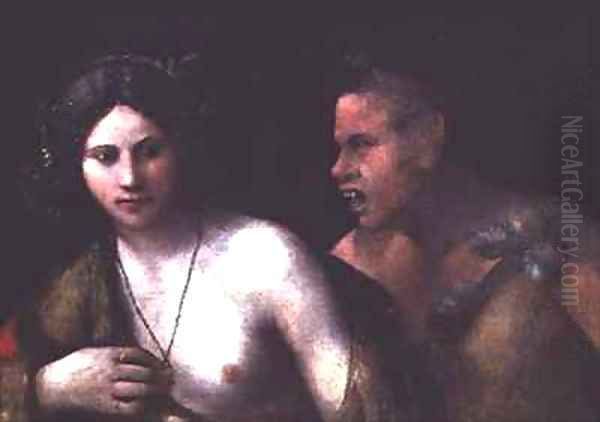
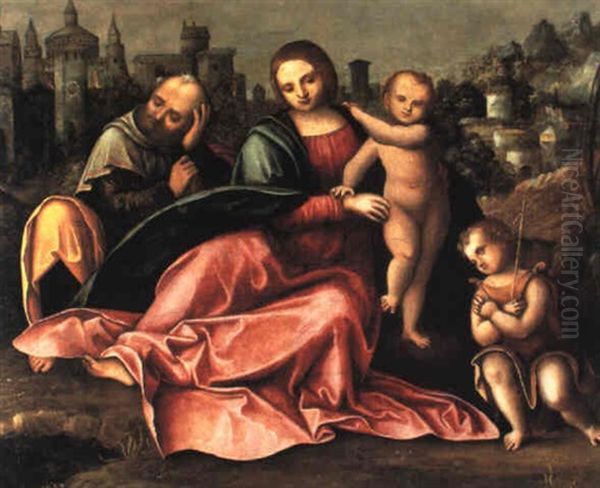
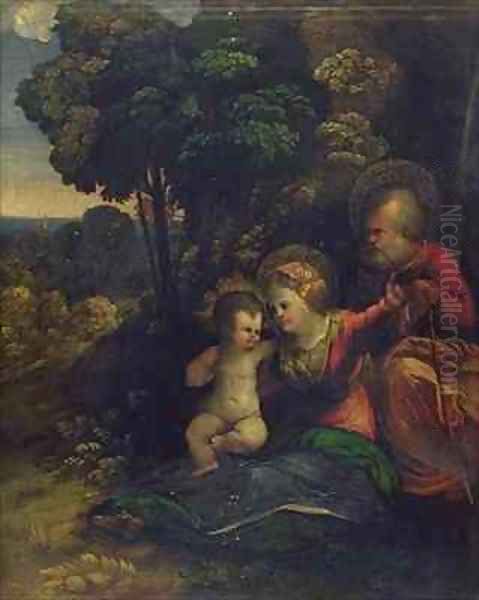
Dosso Dossi's prolific output includes numerous other important works housed in major collections worldwide. The Three Ages of Man (Metropolitan Museum of Art, New York) presents a pastoral allegory on the passage of time, set within a beautifully rendered, idyllic landscape that owes much to Giorgione but possesses Dossi's distinct atmospheric touch. Nymph and Satyr (Pitti Palace, Florence) explores a common mythological theme with characteristic charm and rich coloring. His religious works, such as the Holy Family with Saint John the Baptist or the Madonna and Child with St. John the Baptist, demonstrate his ability to apply his style to devotional subjects, often infusing them with a tender intimacy and vibrant palette.
An early work like Saint George (J. Paul Getty Museum, Los Angeles), likely from the 1510s, shows his developing style, still perhaps closer to his training but already hinting at the dynamism and coloristic richness to come. The enigmatic The Trojans Building the Temple to Venus at Eryx and Making Offerings at Anchises’s Grave (National Gallery of Art, Washington D.C.), part of a series based on Virgil's Aeneid likely painted for Alfonso I's study, showcases his narrative skill on a grand scale, though its specific context and full meaning remain subjects of scholarly discussion. The possible portrait of Lucrezia Borgia (National Gallery of Australia) highlights his activity as a court portraitist. A Personification Of Geometry, known from private collections, demonstrates his engagement with allegorical personifications.
Collaboration with Battista Dossi
Dosso Dossi frequently collaborated with his younger brother, Battista Dossi (born likely before 1500, died 1548). Battista also worked for the Este court in Ferrara, having received training that included a period in Rome working with Raphael. This prestigious apprenticeship equipped Battista with a solid grounding in the High Renaissance classical style. The brothers often worked together on large-scale projects, particularly decorative cycles and altarpieces.
Distinguishing their individual hands within these collaborative works remains a significant challenge for art historians. Generally, Battista's style is considered somewhat more Raphaelesque, perhaps drier and more classically restrained than Dosso's exuberant and imaginative manner. However, their styles could also converge, especially when working closely on the same commission. This collaboration complicates attributions, with some works previously assigned to Dosso now being reconsidered as joint efforts or primarily by Battista, and vice versa. Despite these complexities, their partnership was clearly productive, contributing significantly to the artistic output of the Ferrarese court during the second quarter of the 16th century.
Dosso Dossi and His Contemporaries
Dosso Dossi operated within a rich network of artistic exchange during the Italian Renaissance. His primary artistic dialogue was undoubtedly with the Venetian masters Giorgione and Titian, whose influence fundamentally shaped his approach to color, light, and landscape. His early training connected him to Lorenzo Costa and the artistic traditions of Bologna and Mantua. His visits to Rome brought him into the orbit of the High Renaissance giants Raphael and Michelangelo, whose impact, though perhaps less direct than the Venetians, added a layer of compositional ambition and classical awareness to his work.
Within Ferrara itself, Dossi was the leading figure, but he worked alongside other notable artists associated with the Este court, such as Garofalo (Benvenuto Tisi) and Ortolano Ferrarese, who represented different facets of the local school. His brother Battista, trained by Raphael, provided a direct link to Roman classicism. The broader artistic context included major figures in nearby centers: Correggio in Parma, known for his sensuous style and illusionistic ceilings, and Giulio Romano, Raphael's heir, who dominated the artistic scene in Mantua after Mantegna. Interactions with patrons like Alfonso I d'Este and his sister Isabella d'Este (a major patron in Mantua who employed artists like Giovanni Bellini and Perugino) also placed Dossi within the wider currents of Renaissance courtly taste and artistic commissioning.
Critical Reception and Historical Standing
During his lifetime, Dosso Dossi enjoyed considerable prestige as the principal painter at the Este court. His imaginative style and technical skill were clearly valued by his patrons. However, his posthumous reputation experienced significant fluctuations. The influential 16th-century art historian Giorgio Vasari, in his Lives of the Most Excellent Painters, Sculptors, and Architects, offered a somewhat mixed assessment. While acknowledging Dossi's talent, Vasari criticized his work for a perceived lack of seriousness or "gravity" (gravità), perhaps finding Dossi's imaginative flights and eccentricities less appealing than the High Renaissance ideals of classical balance and decorum.
This critique likely contributed to a period where Dossi was relatively overlooked or underestimated compared to his Venetian and Roman contemporaries. For centuries, he remained a somewhat marginal figure in broader narratives of the Italian Renaissance. It was not until the late 19th and, more significantly, the 20th century that scholars began to re-evaluate his contribution. Major exhibitions and focused research highlighted his originality, his pioneering role in landscape painting, his unique interpretation of mythological themes, and his central importance to the cultural life of Ferrara. Today, he is recognized as a major artist, celebrated for the very qualities – imagination, fantasy, vibrant color, and poetic charm – that perhaps puzzled earlier critics like Vasari.
Mysteries and Unanswered Questions
Despite increased scholarly attention, aspects of Dosso Dossi's life and work remain enigmatic. The precise year of his birth continues to be debated, with estimates ranging across nearly a decade. Details of his early training and travels before settling in Ferrara are not fully documented, relying partly on stylistic analysis and fragmentary records. The exact nature and extent of his collaboration with his brother Battista present ongoing challenges, making definitive attributions for some works difficult.
Furthermore, the complex symbolism embedded in many of his mythological and allegorical paintings resists easy interpretation. While some sources, like Ariosto, are clear, the specific meanings intended by the artist or requested by the patron for works like Jupiter, Mercury and Virtue or the Aeneid cycle often remain speculative. Even the identity of the subject in his famous Melissa is not universally agreed upon. These unresolved questions and ambiguities do not diminish his stature; rather, they contribute to the fascination he holds for art historians and viewers alike, inviting continuous exploration and interpretation of his imaginative world.
Legacy and Collections
Dosso Dossi left a significant legacy as the most prominent painter of the Ferrarese school during the High Renaissance. His unique style, blending Venetian color with local fantasy, influenced subsequent generations of artists in the region. His innovative approach to landscape painting, imbuing it with mood and atmosphere, marked an important step in the genre's development. His work stands as a testament to the vibrant and sophisticated artistic culture fostered by the Este court in Ferrara.
Today, Dosso Dossi's paintings are housed in many of the world's leading museums. Important collections can be found at the Galleria Borghese and Galleria Nazionale d'Arte Antica in Rome; the Galleria degli Uffizi and Pitti Palace in Florence; the Pinacoteca Nazionale in Ferrara; the Galleria Estense in Modena; the Kunsthistorisches Museum in Vienna; the National Gallery in London; the Musée du Louvre in Paris; the Metropolitan Museum of Art in New York; the National Gallery of Art in Washington D.C.; and the J. Paul Getty Museum in Los Angeles, among others. These collections allow audiences worldwide to experience the captivating artistry of this unique Renaissance master.
Conclusion: Ferrara's Poet Painter
Dosso Dossi remains a captivating figure in the history of Italian Renaissance art. As the leading painter of the Ferrarese school for nearly three decades, he skillfully navigated the demands of court patronage while developing a highly personal and imaginative style. Deeply influenced by the color and atmosphere of Venetian painting, yet retaining a unique Ferrarese blend of fantasy, charm, and occasional eccentricity, he created a body of work that continues to enchant and intrigue. His mastery of mythological and allegorical subjects, his innovative approach to landscape, and his vibrant use of color secure his place as a significant and distinctive voice within the rich tapestry of 16th-century Italian art. His paintings offer a window into the sophisticated world of the Este court and the boundless creativity of a truly original artistic mind.