Emil Lindemann (1864-1939) was an Austrian painter whose life and career spanned a period of profound artistic and societal transformation in Europe. Born in Warsaw, then part of the Russian Empire but with strong cultural ties to Poland and the Austro-Hungarian Empire, Lindemann's artistic journey reflects the diverse influences and evolving tastes of the late 19th and early 20th centuries. While not as widely documented as some of his more famous contemporaries, his work offers a glimpse into the pursuits of an artist dedicated to capturing the nuances of landscape, seascape, and the quiet beauty of the natural world.
Early Life and Artistic Milieu
Details regarding Emil Lindemann's early training and artistic formation are not extensively recorded in major art historical surveys, which often focus on the avant-garde or nationally prominent figures. However, his birth in Warsaw in 1864 places him in a city with a burgeoning artistic scene. Warsaw, despite political complexities, was a significant cultural hub. Aspiring artists of this era often sought education at local academies or travelled to major artistic centers like Krakow, Vienna, Munich, or Paris. Given Lindemann's Austrian nationality, it's plausible he received training or spent formative years within the Austro-Hungarian Empire, which boasted prestigious institutions like the Academy of Fine Arts Vienna.
The artistic environment during Lindemann's formative years was rich and varied. The late 19th century saw the dominance of Academic Realism gradually challenged by Impressionism, Post-Impressionism, and Symbolism. By the turn of the century, Art Nouveau (known as Secession in Vienna, Jugendstil in Germany, and Młoda Polska or Young Poland in Polish art) was in full swing, emphasizing decorative qualities, organic forms, and often a melancholic or introspective mood. These movements would have undoubtedly formed the backdrop against which Lindemann developed his own artistic voice.
Artistic Style, Themes, and Influences
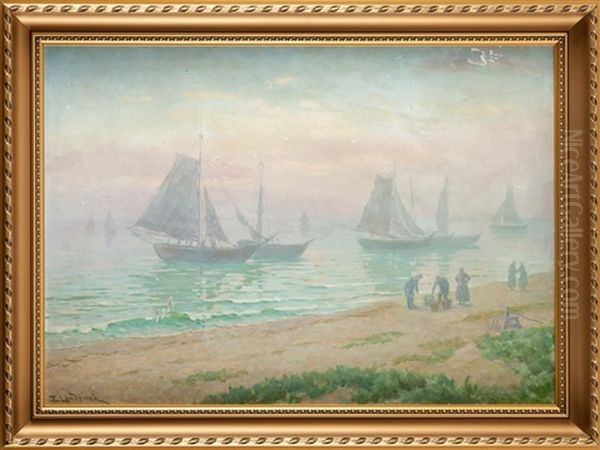
Emil Lindemann's oeuvre, as indicated by his known works, primarily focused on landscapes, seascapes, floral studies, and still lifes depicting natural elements. He worked in both oil and watercolor, mediums popular for their versatility in capturing atmospheric effects and delicate details. His choice of subjects aligns with a strong tradition of landscape and nature painting prevalent across Europe during his lifetime.
The practice of painting en plein air, popularized by the Barbizon School and the Impressionists like Claude Monet, Camille Pissarro, and Alfred Sisley, had become well-established. While it's not explicitly stated whether Lindemann strictly adhered to plein air techniques, the desire to capture the fleeting qualities of light and atmosphere in natural settings was a common artistic pursuit. His seascapes, such as "PORANEK NAD MORZEM," suggest an interest in the changing moods of the sea and sky, a theme explored by countless artists from J.M.W. Turner to Impressionists and later modernists.
His landscape paintings, including those inspired by his travels to locations such as Vicenza and Bicocca in Italy, Krakow and Zakopane in Poland, and Krynica (a spa town in southern Poland, then Austria-Hungary), indicate a peripatetic artist drawing inspiration from diverse European topographies. Zakopane, in particular, was a significant artistic and cultural center for the Young Poland movement, attracting artists like Stanisław Wyspiański, Leon Wyczółkowski, and Julian Fałat, who were captivated by the Tatra Mountains and local folk culture. Lindemann's presence in such locations suggests an engagement with these regional artistic currents.
The mention of "death of nature" or still lifes (nature morte) points towards a more contemplative aspect of his work, perhaps influenced by the Symbolist undercurrents of the era or the long tradition of Dutch Golden Age still life painting. Artists like Odilon Redon explored the mysterious and symbolic aspects of nature, while more traditional still life painters continued to refine the genre.
Representative Works
Two specific works provide concrete insight into Lindemann's artistic output:
"PORANEK NAD MORZEM" (Morning by the Sea)
Created around 1929, this oil painting measures 51.5 x 72 cm. The title itself evokes a classic theme in marine painting – the depiction of the early hours over the ocean, a time often associated with specific light conditions, tranquility, or the awakening of activity. Without viewing the painting, one can surmise it likely focuses on atmospheric effects, the interplay of light on water, and the coastal landscape. Its creation in 1929 places it in the interwar period, a time when many artists were navigating between established traditions and emerging modernist trends. Artists like Max Pechstein of Die Brücke group, for instance, also produced powerful seascapes, though often with a more expressionistic vigor. Lindemann's approach may have been more aligned with late Impressionistic or Realistic traditions.
"Na granicy Węgier" (On the Hungarian Border)
This oil painting, measuring 86 x 113 cm, was created in 1918. This date is significant as it marks the final year of World War I and the impending dissolution of the Austro-Hungarian Empire. A painting titled "On the Hungarian Border" from this specific year could carry multiple layers of meaning, from a straightforward landscape depiction to a more poignant commentary on a shifting geopolitical reality. The work was exhibited in the "Wydawnictwo Artystów" (Artists' Publishing House/Exhibition) in 1918 and again in the "Warszawskich Młodych Artystów" (Warsaw Young Artists) exhibition in 1920. These exhibitions suggest Lindemann was active and recognized within Polish artistic circles, despite his Austrian nationality. The Young Poland movement, with figures like Jacek Malczewski known for his symbolic and patriotic themes, often engaged with national identity and landscape.
Lindemann in the Context of His Contemporaries
To fully appreciate Emil Lindemann's position, it's helpful to consider the broader artistic landscape of Austria-Hungary, Poland, and Europe during his active years.
In Austria, particularly Vienna, the Secession movement, led by figures like Gustav Klimt, had revolutionized the art scene at the turn of the century. While Klimt is known for his ornate, symbolic figures, other Secessionists like Carl Moll were accomplished landscape painters. The subsequent generation saw the rise of Austrian Expressionism with Egon Schiele and Oskar Kokoschka. Lindemann's more traditional focus on landscape and seascape might suggest he operated somewhat outside these avant-garde circles, or perhaps absorbed their influences in more subtle ways, such as in color palette or compositional approaches.
In Poland, the Young Poland (Młoda Polska) movement was a dominant force from roughly 1890 to 1918. This neo-romantic movement encompassed art, music, and literature, emphasizing Polish folklore, history, and the national landscape. Key painters included Stanisław Wyspiański, a multifaceted artist known for his stained glass, portraits, and dramas; Jacek Malczewski, whose symbolic paintings often featured figures from Polish mythology and history set within realistic landscapes; Józef Pankiewicz, who evolved from Realism to Impressionism and Symbolism; and Julian Fałat, celebrated for his winter landscapes and hunting scenes, often in watercolor. Lindemann's exhibition activity in Warsaw and his choice of Polish locations for painting suggest an affinity or connection with this vibrant artistic environment.
Across Europe, landscape painting continued to be a vital genre. The legacy of Impressionism was still strong, with artists continuing to explore its principles. Post-Impressionists like Paul Cézanne, Vincent van Gogh, and Paul Gauguin had already pushed the boundaries of representation, color, and form, influencing subsequent generations. Symbolist painters such as Arnold Böcklin (Swiss-German) and Edvard Munch (Norwegian) imbued landscapes with psychological and mythological significance. Lindemann's work, focusing on direct observation of nature, might have shared more with the enduring realist or impressionist-influenced traditions than with the more radical formal experiments of early modernism or the intense emotionalism of Expressionism, though cross-currents were common.
The interwar period (1918-1939), during which Lindemann produced "PORANEK NAD MORZEM," was characterized by a "return to order" for some artists, a renewed interest in classicism and figuration, while others pushed further into abstraction or Surrealism. Landscape painting remained a constant, offering artists a way to connect with enduring themes of nature and place amidst rapid societal change.
Places of Inspiration: A Painter's Itinerary
The locations where Lindemann chose to paint offer clues to his artistic interests and perhaps his personal connections.
Vicenza and Bicocca (Italy): Italy had long been a magnet for artists from across Europe, drawn by its classical heritage, picturesque landscapes, and unique light. Vicenza, known for Palladian architecture, and Bicocca (a district of Milan, site of a historic battle but also with surrounding countryside) would have offered diverse subjects, from urban scenes to rural vistas.
Krakow (Poland): A historic capital of Poland and a major cultural center, Krakow was central to the Young Poland movement. Its rich architecture, Vistula River, and surrounding landscapes provided ample inspiration.
Krynica (Poland, then Austria-Hungary): A fashionable spa town in the Beskid Mountains, Krynica was known for its scenic beauty and attracted a cosmopolitan clientele. Such locations often became subjects for artists catering to tourists or simply inspired by the picturesque environment.
Zakopane (Poland, then Austria-Hungary): Nestled at the foot of the Tatra Mountains, Zakopane was the heart of a distinctive regional culture and a hub for artists and intellectuals. The "Zakopane Style" in architecture and decorative arts, inspired by local folk traditions, was developed here. The dramatic mountain scenery was a powerful draw for landscape painters.
Lindemann's choice of these diverse locations suggests a broad appreciation for different types of European landscapes, from the Italian countryside to the Polish mountains and urban centers.
Challenges in Assessing Lindemann's Legacy
Emil Lindemann represents a category of artists who, while actively producing and exhibiting during their lifetimes, may not have achieved the widespread, lasting fame of the era's leading innovators. The art historical record tends to prioritize those who broke new ground or became figureheads of major movements. However, the work of artists like Lindemann is crucial for a complete understanding of the artistic ecosystem of the time. They often formed the backbone of local art scenes, participated in exhibitions, and contributed to the prevailing visual culture.
It is important to distinguish Emil Lindemann the painter from other notable individuals with the same surname to avoid confusion. For instance, Ferdinand von Lindemann (1852-1939) was a German mathematician known for proving that π (pi) is a transcendental number. There is no indication of a direct professional link between the painter and the mathematician, despite their overlapping lifespans. Similarly, any references to Lindemanns involved in other fields, such as industry or later 20th-century music (like Till Lindemann of Rammstein), are distinct from the historical figure of Emil Lindemann, the Austrian painter. The information available specifically points to Emil Lindemann (1864-1939) as an artist born in Warsaw, of Austrian nationality, who painted works like "PORANEK NAD MORZEM" and "Na granicy Węgier."
The relative scarcity of detailed monographic studies or extensive inclusion in major art historical narratives means that a full assessment of his influence or the complete scope of his oeuvre remains challenging. His legacy likely resides in the individual works that survive, offering testament to his skill and his engagement with the artistic concerns of his day, particularly in the realm of landscape and nature painting.
Conclusion: A Painter of His Time
Emil Lindemann (1864-1939) was an Austrian artist who navigated the rich and complex artistic currents of Central Europe from the late 19th century through the interwar period. Born in Warsaw, his artistic journey saw him capture the diverse landscapes and seascapes of Italy, Poland, and potentially other parts of the Austro-Hungarian sphere. His known works, "PORANEK NAD MORZEM" and "Na granicy Węgier," demonstrate a commitment to oil painting and an engagement with themes of nature and place, exhibited within Polish artistic circles.
While perhaps not a revolutionary figure in the mold of Klimt, Schiele, or the leading Polish Symbolists like Malczewski, Lindemann was a practitioner of an enduring tradition of representational art. His paintings of seas, landscapes, and natural subjects connected him to a lineage of artists who found profound meaning and beauty in the observable world. He worked during a time when Impressionism had left its mark, Symbolism offered deeper interpretations of reality, and various forms of Realism continued to thrive alongside emerging modernisms. Lindemann's art provides a valuable, if quieter, voice from this dynamic period, reflecting a dedication to craft and a sensitivity to the European environment he depicted. Further research into regional archives and exhibition catalogues of the period might yet reveal more about the life and work of this intriguing artist.