Emilio Sala Frances: A Pivotal Figure in Spanish Art
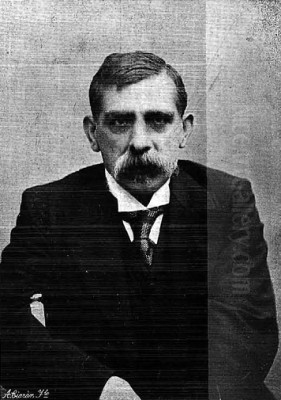
Emilio Sala Frances stands as a significant, if sometimes overlooked, figure in the rich tapestry of Spanish art during the latter half of the 19th century and the dawn of the 20th. A versatile artist, Sala excelled as a painter of historical subjects, genre scenes, landscapes, and portraits, and also made notable contributions as an illustrator and educator. His career spanned a period of profound artistic and social change in Spain, witnessing the enduring legacy of academicism, the rise of Realism, and the burgeoning stirrings of modern artistic expressions. Born in 1850 and passing away in 1910, Sala's life and work offer a fascinating window into the artistic currents that shaped Spanish visual culture of his time.
Early Life and Artistic Awakening in Valencia
Emilio Sala Frances was born on January 20, 1850, in Alcoy, a town in the province of Alicante, Valencia, Spain. His family background was rooted in commerce, which was not uncommon for artists of the period who often had to seek patronage or alternative means of support. Showing an early inclination towards the arts, Sala embarked on his formal artistic training in his home region. He enrolled at the prestigious Real Academia de Bellas Artes de San Carlos in Valencia, an institution that had nurtured many notable Spanish artists.
During his formative years at the San Carlos Academy, Sala studied alongside his cousin, Francisco Pascual, who is sometimes referred to as Francisc o Domingo Marqués, a highly regarded Valencian painter known for his virtuoso brushwork and genre scenes. This early association likely provided both camaraderie and a stimulating competitive environment. The Valencian art scene at the time was vibrant, with a strong tradition of realism and a particular emphasis on capturing the light and character of the region. Artists like Ignacio Pinazo Camarlench, though slightly younger, would also emerge from this fertile artistic ground, contributing to Valencia's reputation as a key center for artistic development in Spain. Sala's initial training would have instilled in him the fundamental principles of academic drawing, composition, and color theory.
Academic Foundations in Madrid and the Roman Experience
Seeking to further his artistic education and establish himself on a national stage, Emilio Sala Frances moved to Madrid. There, he continued his studies at the Real Academia de Bellas Artes de San Fernando, the premier art institution in Spain. The prevailing artistic climate in Madrid was heavily influenced by academicism, with figures like Federico de Madrazo y Kuntz having long dominated the official art scene, emphasizing historical subjects, portraiture, and a polished, meticulous technique. Sala absorbed these academic tenets, honing his skills in draughtsmanship and complex compositions.
A pivotal moment in many 19th-century artists' careers was the opportunity to study in Rome, then considered the crucible of classical and Renaissance art. In 1885, after an unsuccessful attempt to secure a professorship at the "Escuela de Artes y Oficios" (School of Arts and Crafts), Sala applied for and was awarded a scholarship to the Spanish Academy in Rome (Academia Española de Bellas Artes en Roma). This sojourn was immensely influential, allowing him to immerse himself in the masterpieces of antiquity and the Italian Renaissance, further refining his technique and broadening his artistic horizons. In Rome, he was part of a vibrant community of Spanish artists, including the soon-to-be-famous Joaquín Sorolla y Bastida, José Benlliure Gil, and Ricardo Villegas Cordero. This period of study and interaction with fellow artists in the historic setting of Rome was crucial for Sala's development.
Parisian Exposure and Maturing Style
Following his time in Rome, Sala, like many ambitious artists of his generation, was drawn to Paris, the undisputed epicenter of the art world in the late 19th century. The French capital offered unparalleled opportunities for artistic growth, exposure to diverse artistic movements, and participation in the prestigious Salons. While the provided information suggests he studied with Jose Benlliure Gil and Ricardo Villegas Cordero in Paris, it's more probable that they were colleagues with whom he continued to associate and develop, given their shared experiences in Rome. Paris would have exposed Sala to the dominant French academic tradition, exemplified by artists such as Jean-Léon Gérôme and William-Adolphe Bouguereau, known for their highly finished historical and mythological paintings.
The meticulous detail and narrative clarity of French academic painters like Ernest Meissonier might also have resonated with Sala's own inclinations. This period in Paris was instrumental in consolidating his artistic style, blending the rigorous academic training he had received in Spain and Rome with the sophisticated artistic currents of the French capital. He refined his ability to handle complex compositions, imbue his figures with psychological depth, and master the interplay of light and color. His exposure to the international art scene in Paris undoubtedly contributed to the polish and professionalism that characterized his mature work.
Master of Historical Narrative: The Grand Compositions
History painting was considered the noblest genre within the academic tradition, and Emilio Sala Frances made significant contributions in this domain. The 19th century in Spain saw a flourishing of historical painting, often imbued with nationalist sentiments and a desire to celebrate pivotal moments in the nation's past. Artists like Eduardo Rosales Gallinas, with his iconic Isabella the Catholic Dictating her Will, Francisco Pradilla Ortiz, famed for The Surrender of Granada, and Antonio Gisbert Pérez, known for The Execution of Torrijos and his Companions, had set a high standard for the genre. Sala aspired to emulate their success and create works of lasting historical significance.
His most famous work in this genre is undoubtedly Expulsión de los judíos de España (The Expulsion of the Jews from Spain), completed around 1889. This large-scale canvas depicts the dramatic and tragic Edict of Expulsion issued by the Catholic Monarchs, Isabella I of Castile and Ferdinand II of Aragon, in 1492. Sala's painting captures the anguish and despair of the departing Sephardic Jews, rendered with meticulous attention to historical detail in costume and setting, and a powerful sense of emotional drama. The composition is complex, skillfully managing numerous figures and conveying a palpable sense of historical weight. The painting was widely acclaimed, receiving a first-class medal at the National Exhibition of Fine Arts in Madrid in 1878 (though the date for this specific painting's award might be later, aligning with its completion in 1889 and its exhibition at the Paris Universal Exposition of the same year where it also garnered praise). This work cemented Sala's reputation as a leading historical painter of his generation. He also undertook decorative commissions for various palaces and public buildings, further showcasing his skill in large-scale narrative compositions.
A Broadening Canvas: Landscapes, Genre, and Portraits
While historical painting brought Sala considerable acclaim, public taste began to shift as the 19th century drew to a close. The grand narratives of history painting started to lose favor, with a growing interest in more intimate, contemporary subjects. Sala, demonstrating his versatility and adaptability, successfully navigated this change by diversifying his artistic output. He turned his attention increasingly to landscape painting, genre scenes, and portraiture, areas where he also demonstrated considerable talent.
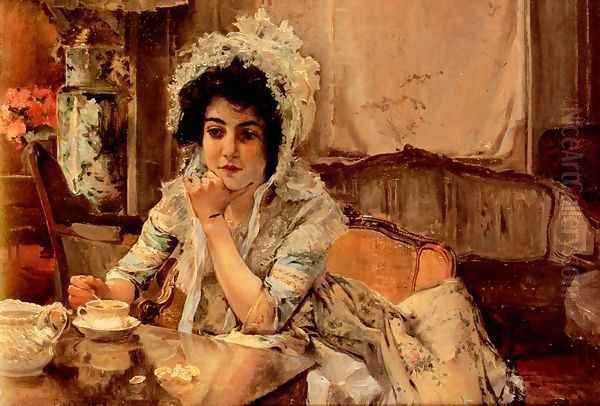
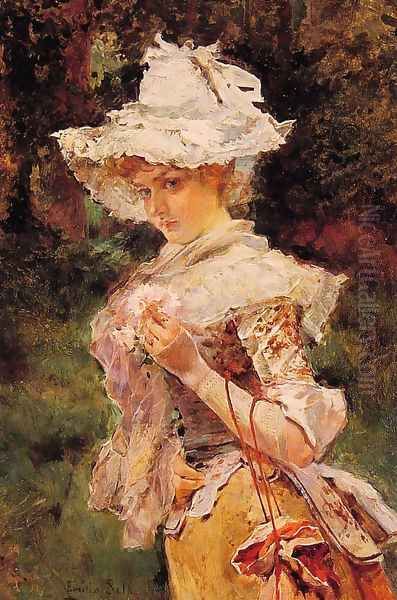
His landscapes often captured the serene beauty of the Spanish countryside, influenced by Realist tendencies and perhaps by the atmospheric concerns of the Barbizon School, to which he might have been exposed during his time in Paris. In his genre scenes, Sala depicted everyday life and customs, often with a charming and anecdotal quality. Works like Tea time and picking flowers, mentioned in the provided information, exemplify this aspect of his oeuvre, showcasing his ability to capture intimate moments with sensitivity and technical finesse. These works, while different in scale and ambition from his historical canvases, reveal his keen observation and his skill in rendering textures, light, and human emotion. His genre paintings can be seen in the broader context of Spanish costumbrismo, a tradition also famously explored by Mariano Fortuny y Marsal, whose dazzling technique and exotic subjects had a profound impact on Spanish art, even after his early death. Sala's portraits, too, were noted for their psychological insight and accomplished execution.
The Art of Illustration: A New Avenue for Expression
Beyond his achievements in easel painting, Emilio Sala Frances made significant and innovative contributions to the field of illustration. In the late 19th and early 20th centuries, the illustrated press and books experienced a boom, creating new opportunities for artists. Sala embraced this medium, recognizing its potential for reaching a wider audience and for exploring different narrative and stylistic possibilities. He became a prominent illustrator, collaborating with some of Spain's most distinguished writers of the period.
His collaborations with literary giants such as Benito Pérez Galdós, one of Spain's most important novelists, and Juan Ramón Jiménez, a future Nobel laureate in Literature, were particularly noteworthy. Sala's illustrations for their works helped to visually interpret and disseminate their literary creations. He was not merely a passive transcriber of text into image; his illustrations often added new layers of meaning and emotional resonance. Furthermore, Sala was an innovator in the technical aspects of illustration, experimenting with woodcuts and photographic reproduction techniques. His efforts in this field were so influential that he is credited with helping to form an "illustration school," inspiring other artists to explore the expressive potential of this medium. This dedication to illustration underscores his forward-thinking approach and his willingness to engage with new artistic forms and technologies.
A Respected Educator: Shaping the Next Generation
Emilio Sala Frances was not only a prolific creator but also a dedicated and influential teacher. He held various academic positions, including a professorship at the Escuela Superior de Pintura, Escultura y Grabado (Higher School of Painting, Sculpture, and Engraving) in Madrid. His reputation as a skilled artist and his comprehensive understanding of academic principles made him a sought-after mentor for aspiring painters. He was known for his emphasis on rigorous drawing, a rich color palette, and a deep understanding of composition.
His impact on his students was profound. María Blanchard (María Gutiérrez Blanchard), who would later become a prominent figure in the Cubist movement in Paris, received her early academic training under Sala. He taught her the importance of precise lines and the expressive use of color, foundational skills that would, paradoxically, serve her well even as she moved into avant-garde idioms. Another notable student, Cecilio Pla y Gallardo, a distinguished painter in his own right, held Sala in the highest esteem, famously referring to him as "the master of all I had." Pla considered Sala's work an exemplary model for young artists of all eras. While perhaps not direct students, emerging artists of the period, such as Ignacio Zuloaga with his distinctively Spanish modernism, or Julio Romero de Torres with his symbolic and sensual portrayals, would have been aware of Sala's prominent position in the Madrid art world and his contributions to academic and illustrative art.
Defining Sala's Artistic Style
Emilio Sala Frances's artistic style is characterized by its academic rigor, technical mastery, and remarkable versatility. At its core, his work is rooted in the academic tradition, with a strong emphasis on correct drawing, balanced composition, and a polished finish. This is particularly evident in his historical paintings, where his ability to manage complex multifigure scenes and convey narrative clarity is paramount. His draughtsmanship was precise, and he possessed a sophisticated understanding of human anatomy and perspective.
However, Sala was not merely a rigid academician. His work also displays strong Realist tendencies, particularly in his attention to detail, his faithful rendering of textures and materials, and his ability to capture the psychological nuances of his subjects. His color palette was often rich and vibrant, used effectively to create mood and enhance the dramatic impact of his scenes. Whether depicting the solemnity of a historical event, the charm of a genre scene, or the character of a sitter in a portrait, Sala infused his work with a palpable sense of life and emotion. He successfully navigated the transition from the strictures of mid-19th-century academicism towards a more personal and expressive form of realism, adapting his style to suit the diverse range of subjects he tackled. His innovative work in illustration also showcased a willingness to explore different graphic qualities and reproductive techniques.
Later Career, Recognition, and Enduring Legacy
Throughout his later career, Emilio Sala Frances remained a productive and respected figure in the Spanish art world. He continued to exhibit his work regularly and received numerous accolades for his contributions. His stature was formally recognized when he was appointed a member of the Real Academia de Bellas Artes de San Fernando, the institution where he had once been a student. This appointment signified his esteemed position among Spain's leading artists and intellectuals.
Emilio Sala Frances passed away in Madrid on April 14, 1910. His death marked the end of a significant chapter in Spanish art. Today, his works are held in major collections, most notably the Museo Nacional del Prado in Madrid, which houses his celebrated Expulsión de los judíos de España. His legacy endures not only through his impressive body of work but also through the students he mentored and the artistic standards he upheld. In the broader context of Spanish art at the turn of the century, Sala can be seen as a figure who, while firmly rooted in the academic tradition, also embraced new avenues of expression and contributed to the evolving visual culture of his nation. He worked during a period when artists like Sorolla were achieving international fame with their luminist paintings, and figures associated with Modernisme, such as Santiago Rusiñol and Ramón Casas, were forging new artistic paths in Catalonia. Sala's career offers a valuable counterpoint, representing the enduring strength and adaptability of the academic-realist tradition in Spain.
Conclusion
Emilio Sala Frances was a multifaceted artist whose contributions to Spanish art in the late 19th and early 20th centuries were substantial and varied. As a master of historical painting, he created powerful narratives that resonated with national sentiment. His genre scenes, landscapes, and portraits demonstrated his keen observational skills and technical versatility. In the realm of illustration, he was an innovator and a key collaborator with leading literary figures, significantly impacting the visual culture of printed media. As an educator, he shaped a generation of artists, instilling in them the principles of academic excellence while encouraging their individual talents.
While perhaps not as widely known internationally as some of his Spanish contemporaries who embraced more radical modernist styles, Emilio Sala Frances remains a crucial figure for understanding the artistic landscape of his era. He exemplified the high standards of academic craftsmanship, combined with a Realist sensibility and a willingness to adapt to changing tastes and new media. His legacy is that of a consummate professional, a dedicated teacher, and an artist who left an indelible mark on the diverse fields of painting and illustration in Spain.