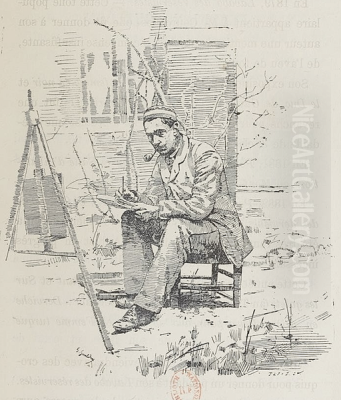
Ferdinand Joseph Gueldry stands as a significant, if sometimes overlooked, figure in late 19th and early 20th-century French art. A Parisian by birth and spirit, his life and work were intrinsically linked to the evolving social and industrial landscapes of his time. While he explored various themes, Gueldry is most celebrated for his evocative and meticulously detailed depictions of river life, particularly the burgeoning culture of rowing and leisure along the Seine and Marne rivers. His canvases offer a vivid window into the Belle Époque, capturing its energy, its pastimes, and its people with a keen observational eye and a skilled academic hand.
Early Life and Artistic Formation in Paris
Born in Paris on May 21, 1858, Ferdinand Joseph Gueldry was immersed from a young age in the artistic capital of the world. His artistic inclinations manifested early, and by the age of thirteen, he was already dedicated to painting. This passion led him to the prestigious École des Beaux-Arts in Paris, the bastion of academic art training in France. There, he had the distinct privilege of studying under Jean-Léon Gérôme (1824-1904), one of the most prominent and influential academic painters of the era.
Gérôme, known for his highly polished historical and Orientalist scenes, instilled in his students a rigorous approach to drawing, composition, and the precise rendering of detail. Gueldry absorbed these lessons well, developing a strong technical foundation that would serve him throughout his career. Gérôme's own mastery of color and ability to capture human anatomy and expression undoubtedly left a mark on his pupil. The environment at the École des Beaux-Arts was competitive and steeped in tradition, emphasizing classical ideals and historical subjects, a stark contrast to the burgeoning Impressionist movement that was simultaneously challenging the academic establishment with artists like Claude Monet (1840-1926) and Edgar Degas (1834-1917).
While Gueldry's later focus would shift towards contemporary life, the discipline and technical prowess gained under Gérôme were crucial. Other notable academic painters of the time, such as William-Adolphe Bouguereau (1825-1905) and Alexandre Cabanel (1823-1889), also upheld similar standards of finish and subject matter, creating a dominant artistic paradigm against which Gueldry would, in his own way, define his unique path by applying academic skills to more modern themes.
The Allure of the River: Gueldry's Signature Theme
Gueldry’s most enduring legacy lies in his captivating paintings of river scenes and the sport of rowing. He possessed a profound passion for the waterways of France, particularly the Seine and its tributary, the Marne, as well as the River Thames in England. These rivers were not just picturesque backdrops but vibrant hubs of social activity and athletic endeavor during the late 19th and early 20th centuries. Rowing, in particular, had gained immense popularity as both a competitive sport and a fashionable leisure pursuit.
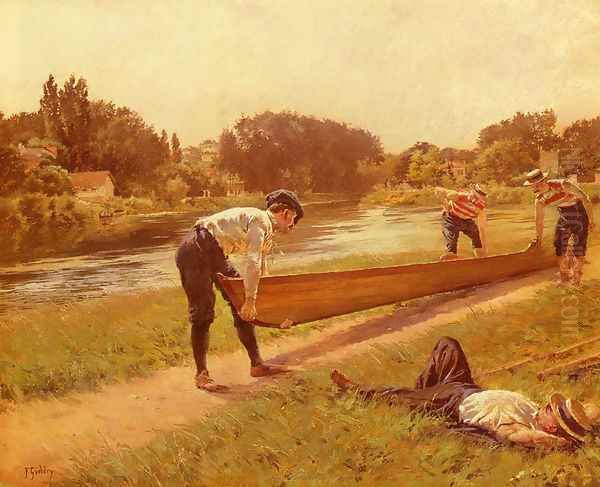
His canvases meticulously document this world. Works like "Rameurs à Joinville" (Rowers at Joinville), reportedly painted in 1881, and "Boating on a Summer Afternoon" exemplify his dedication to this theme. Gueldry’s paintings are characterized by an extraordinary attention to detail, especially in the rendering of boats, oars, and the specific attire of the rowers. He captured the sleek lines of the racing shells, the gleam of varnished wood, and the precise mechanics of the rowing stroke with an accuracy that speaks to a deep, personal understanding of the subject.
This was no mere artistic fancy; Gueldry was himself an avid rower and an active participant in the nautical world. His intimate knowledge allowed him to depict not just the aesthetics of rowing but also its spirit – the exertion, the camaraderie, and the sheer joy of gliding across the water. His scenes often feature rowing regattas, leisurely outings, or moments of repose at riverside clubs. While Impressionists like Pierre-Auguste Renoir (1841-1919) in "Luncheon of the Boating Party" or Gustave Caillebotte (1848-1894) in "Skiffs on the Yerres" also famously depicted riverine leisure, Gueldry's approach often retained a more structured, academic finish, though Caillebotte, in particular, shared Gueldry's keen eye for the specifics of boats and the dynamic human form in motion.
Beyond the Riverbanks: Exploring Other Subjects
While river scenes became his hallmark, Ferdinand Joseph Gueldry’s artistic interests were not solely confined to the water. Early in his career, he also turned his attention to the world of industrial labor, a theme that resonated with the Realist movement championed by artists like Gustave Courbet (1819-1877) and Jean-François Millet (1814-1875), who sought to depict the lives of ordinary people and workers.
One such example is his painting "Le Découpage des Métaux" (The Cutting of Metals), which portrays workers engaged in the physically demanding task of cutting metal in a factory setting. These works demonstrate Gueldry's versatility and his willingness to engage with the social realities of his time, capturing the grit and toil of the industrial age with the same observational acuity he brought to his more idyllic river scenes. This thematic choice placed him in a lineage of artists concerned with the changing face of society due to industrialization.
Perhaps one of his most unusual and striking works is "Blood Drinkers" (Les Biberons de Sang), painted around 1898. This painting takes a dramatic turn away from his more typical subjects, depicting a macabre scene of figures, often interpreted as vampires or ghoulish entities, drinking the blood of a freshly slaughtered bovine in an abattoir-like setting. The work is unsettling and powerful, showcasing a darker, more imaginative side to Gueldry's oeuvre. It reveals an artist capable of exploring themes beyond the academic or the pleasantly picturesque, venturing into the realm of the symbolic or even the horrific, a path less trodden by many of his contemporaries focused on Salon acceptability. This piece highlights his capacity for dramatic narrative and a willingness to confront less conventional subject matter.
An Artist of Action: Gueldry's Deep Involvement in Rowing
Ferdinand Joseph Gueldry's connection to the world of rowing extended far beyond the canvas; he was a true enthusiast and an active participant. This deep personal involvement lent an unparalleled authenticity to his depictions of the sport. He wasn't merely an observer from the riverbank; he understood the mechanics, the culture, and the passion of rowing from firsthand experience.
In 1876, demonstrating his commitment and organizational skills, Gueldry co-founded the Société Nautique de la Marne, a prominent rowing club. This initiative underscores his dedication to promoting and structuring the sport he loved. His expertise was further recognized when he served as an international rowing referee, a position requiring profound knowledge of the rules and nuances of competitive rowing. His participation in the prestigious Henley Royal Regatta, one of the world's most famous rowing events, further cemented his status within the international rowing community.
This active engagement provided him with an intimate perspective that few other artists depicting similar scenes could claim. He knew the strain in a rower's muscles, the precise angle of an oar entering the water, the camaraderie of a crew, and the festive atmosphere of a regatta. This insider knowledge is palpable in his paintings, elevating them from mere representations to vibrant testimonials of a lived experience. His dedication to the sport was publicly acknowledged in 1908 when he was awarded the Chevalier de la Légion d'Honneur (Knight of the Legion of Honour), a prestigious French order of merit, likely recognizing his contributions to both art and sport.
Recognition, Exhibitions, and Accolades
Gueldry's artistic talents did not go unnoticed by the art establishment of his time. He made his debut at the prestigious Paris Salon in 1878. The Salon, organized by the Académie des Beaux-Arts, was the official, state-sponsored exhibition and the primary venue for artists to gain recognition and patronage in 19th-century France. To be accepted into the Salon was a significant achievement for any young artist.
Throughout his career, Gueldry continued to exhibit his work and garner accolades. He received gold medals at the Expositions Universelles (World's Fairs) in Paris in both 1889 and 1890. These international exhibitions were major cultural events, showcasing achievements in art, science, and industry, and winning a medal was a mark of considerable distinction. His success at these events indicates that his detailed, often narrative style, which combined academic skill with contemporary subject matter, found favor with both critics and the public.
A particularly interesting honor came in 1912 when Gueldry participated in the art competitions held as part of the Olympic Games in Stockholm. These competitions, conceived by Pierre de Coubertin, founder of the modern Olympics, aimed to celebrate art inspired by sport. Gueldry won a gold medal for painting, a testament to his preeminence in depicting athletic themes. This unique achievement highlights the intersection of his two great passions: art and sport. His work continued to be exhibited, including a notable showing in Nogent-sur-Marne in 2018, demonstrating enduring interest in his contributions. The high auction price for "Rameurs à Joinville" (reportedly €400,000 at one point) further attests to the market's appreciation of his skill and historical significance.
Gueldry and the Great War: Art in Service of Witness
The outbreak of World War I in 1914 profoundly impacted all aspects of European society, including the art world. Many artists were called to serve, either as soldiers or in other capacities. Ferdinand Joseph Gueldry, then in his mid-fifties, contributed his artistic talents to the war effort. The French government commissioned him to create sketches and drawings documenting the realities of the conflict.
These works were intended to serve as a record of the war, capturing its scenes and, implicitly, its human cost. This role as a war artist placed Gueldry in a tradition of artists who have historically documented conflict, from Jacques Callot in the 17th century to Francisco Goya in the Napoleonic era, and more contemporaneously, artists like Christopher R. W. Nevinson in Britain. Gueldry was part of a broader effort by the French state to utilize art for purposes of record-keeping, propaganda, and national memory.
He was associated with a group of artists working for the Musée de l'Armée (Army Museum) or similar initiatives. Among those involved in war-related art projects were figures like Eugène-Louis Gillot (1867-1925), known for his panoramic works; Jules-Alfred Hervé-Mathé (misspelled as Hématé-Mathurin in some sources, 1868-1953), who undertook missions to the front; Charles Hoffbauer (1875-1957), who created monumental decorative works; and Lucien Jonas (1880-1947), another prolific war artist. Gueldry's contributions, focusing on sketches, would have provided immediate, on-the-ground impressions, valuable for their directness and authenticity in conveying the grim realities faced by soldiers and civilians. These wartime drawings, intended to reveal the "truth" of the war, represent an important, though perhaps less celebrated, facet of his career.
Artistic Style and Technique: A Blend of Precision and Atmosphere
Ferdinand Joseph Gueldry’s artistic style is characterized by a compelling blend of academic precision and a keen sensitivity to atmosphere and the nuances of modern life. Trained in the rigorous tradition of the École des Beaux-Arts under Jean-Léon Gérôme, Gueldry mastered the fundamentals of drawing, perspective, and anatomical accuracy. This foundation is evident in the meticulous detail found in his works, particularly in his depictions of boats, rowing equipment, and the human figure in motion.
Unlike many of the Impressionists who prioritized capturing fleeting moments of light and color with broken brushwork, Gueldry generally maintained a more polished finish and clearly defined forms. His figures are solidly rendered, and his compositions are carefully structured. However, his work is far from being stiffly academic. He possessed a remarkable ability to infuse his scenes with a sense of vitality and atmosphere. His river landscapes, for example, often convey the specific quality of light on water, the gentle sway of riverside foliage, and the palpable energy of a regatta.
His palette, while capable of richness, often favored naturalistic tones that accurately reflected the environments he depicted. In his industrial scenes, a more somber range of colors might prevail, underscoring the grit of the factory, while his boating scenes often sparkle with brighter hues reflecting the sunlit leisure of the Belle Époque. His skill in depicting the human form is notable, capturing not just the anatomy but also the characteristic postures and gestures associated with activities like rowing or factory labor. He shared with artists like Thomas Eakins (1844-1916) in America a profound interest in the human body in action, particularly in the context of rowing, though their stylistic approaches differed. Eakins, for instance, employed scientific observation and photographic studies to achieve his realism.
Legacy and Enduring Appeal
Ferdinand Joseph Gueldry passed away in 1945, leaving behind a significant body of work that continues to resonate with art lovers and historians. His paintings serve as invaluable visual documents of a specific era, particularly the Belle Époque in France, capturing its leisure activities, social customs, and even its industrial undercurrents. His dedication to the theme of rowing has made his work particularly cherished by those interested in the history of the sport.
The Musée de Nogent-sur-Marne, a town intimately associated with the river life Gueldry so often depicted, holds a number of his works, ensuring their preservation and accessibility to the public. His paintings appear in auctions, sometimes commanding significant prices, which indicates a sustained market appreciation for his skill and the historical value of his subjects. The 2018 exhibition in Nogent-sur-Marne further underscores a renewed scholarly and public interest in his contributions.
Gueldry's legacy is multifaceted. He was a skilled academic painter who successfully applied his training to contemporary themes, bridging the gap between traditional technique and modern subject matter. He was a passionate chronicler of river life, whose intimate knowledge of rowing imbued his paintings with an unmatched authenticity. He was also an artist who responded to the call of his nation during wartime, using his talents to bear witness to conflict. While he may not have been a revolutionary innovator in the vein of the Impressionists or Post-Impressionists like Vincent van Gogh (1853-1890) or Paul Cézanne (1839-1906), his work offers a unique and valuable perspective on his time. His paintings invite viewers to step into the vibrant world of late 19th and early 20th-century France, to feel the spray of the river, hear the cheers at a regatta, and appreciate the dedication of an artist who so lovingly documented the world around him. His contemporary, the pointillist Georges Seurat (1859-1891), also famously depicted leisurely scenes along the Seine, such as "A Sunday on La Grande Jatte," offering a stylistic counterpoint to Gueldry's more traditional realism but sharing a focus on Parisian leisure.
In conclusion, Ferdinand Joseph Gueldry was more than just a painter of pretty river scenes. He was an astute observer, a skilled craftsman, and an active participant in the world he depicted. His art provides a rich tapestry of French life at the turn of the century, celebrated for its detailed realism, its vibrant energy, and its heartfelt connection to its subjects. His work remains a testament to a bygone era and the enduring allure of life on the river.