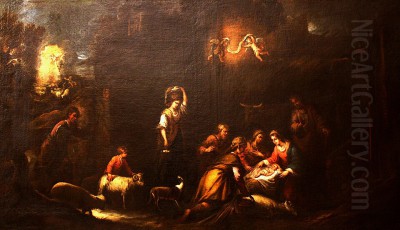
Francisco Antolinez y Sarabia, a notable figure in the vibrant tapestry of Spanish Baroque art, navigated a life marked by intellectual pursuits, artistic dedication, and a characteristically restless spirit. Born in Seville in 1644 and passing away in 1700, his career unfolded primarily in his native city and Madrid, leaving behind a body of work that, while perhaps not as widely known as some of his contemporaries, offers a fascinating glimpse into the artistic currents of 17th-century Spain. His paintings, often characterized by their intimate scale, religious fervor, and a distinctive blend of influences, secure his place among the significant painters of the Sevillian school.
Early Life and a Fateful Decision
Francisco Antolinez y Sarabia was christened in the parish of San Miguel in Seville on October 7, 1644. His familial connections to the art world were significant; he was the nephew of José Antolinez (1635-1675), a prominent Madrid-based painter known for his rich color palette and dynamic compositions, often influenced by Venetian and Flemish masters. This familial tie would later prove influential in Francisco's artistic development.
Initially, however, the young Francisco was not destined for the painter's studio. He embarked on a path of legal studies in Seville, a traditional route for many aspiring young men of the era. It is documented that he pursued a Bachelor of Laws degree, suggesting a keen intellect and a capacity for scholarly endeavor. Yet, the allure of the visual arts, perhaps kindled by his uncle's reputation or an innate passion, eventually proved stronger than the call of jurisprudence. This pivotal decision to abandon law for painting set the course for the remainder of his life.
Artistic Formation: Seville and Madrid
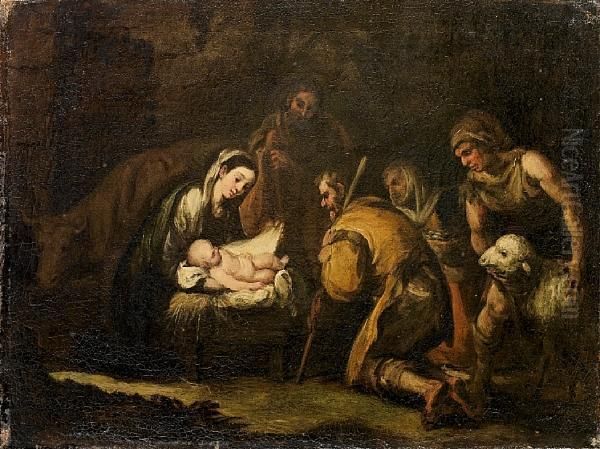
The precise timeline of Antolinez's artistic training contains some ambiguities, common for artists of this period. It is widely believed that he became a student of the preeminent Sevillian master, Bartolomé Esteban Murillo (1617-1682). Studying under Murillo, whose tender religious scenes and masterful depiction of everyday life had captivated Seville, would have provided Antolinez with a superb grounding in technique, composition, and the prevailing tastes of the Andalusian capital. Murillo's influence, particularly his soft modeling of figures and emotive religious narratives, can be discerned in aspects of Antolinez's later work.
Evidence suggests that Antolinez was formally enrolled in the Seville Academy of Art in 1660. This institution, co-founded by Murillo and Francisco de Herrera the Younger, aimed to elevate the status of painting and provide structured training. His presence there further solidifies his connection to the mainstream of Sevillian artistic life.
A significant chapter in his development occurred between approximately 1672 and 1676 when he relocated to Madrid. During this period, he is thought to have worked closely with his uncle, José Antolinez. This Madrid sojourn would have exposed him to the artistic currents of the court, a different environment from Seville. The works of Diego Velázquez (1 церковнославянский6-1660), though Velázquez had passed away by then, still cast a long shadow, and the court was a hub for artists like Juan Carreño de Miranda (1614-1685) and Francisco Rizi (1614-1685). Indeed, some sources suggest Antolinez may have also spent time in Rizi's workshop, which would have further broadened his stylistic vocabulary, as Rizi was known for his large-scale decorative schemes and theatrical compositions.
Return to Seville and Artistic Focus
After his formative years and the Madrid interlude, Francisco Antolinez returned to Seville, where he would spend the majority of his remaining career. It was here that he solidified his reputation, focusing primarily on religious themes, particularly scenes from the life of the Virgin Mary and other biblical narratives. He also gained recognition for his smaller-scale landscapes and, to a lesser extent, portraits.
His artistic output was characterized by a style that, while rooted in the Sevillian tradition of Murillo, also incorporated elements from his Madrid experiences and a broader awareness of European art. The influence of Netherlandish painting, with its attention to detail and atmospheric landscapes, is often cited, as is the impact of the Bolognese school from the early 17th century, known for its classical compositions and expressive figures. This fusion resulted in works that were often described as romantic and executed with a notable freedom of brushwork.
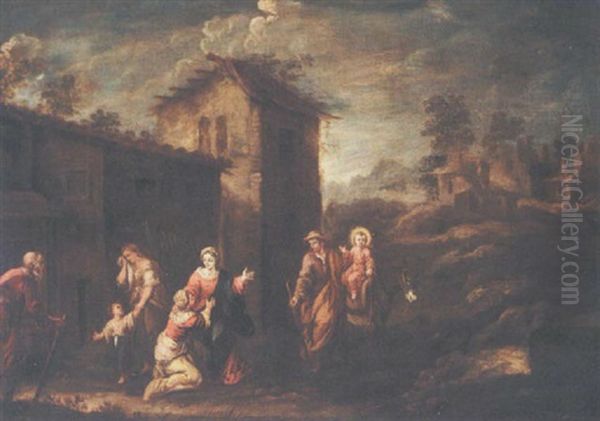
Antolinez was praised by early biographers like Antonio Palomino for his inventiveness, his skillful use of color, and the adeptness of his execution. He often favored smaller canvases, which lent themselves to a more intimate and personal mode of expression. His technique could be concise and rapid, imbuing his paintings with a sense of immediacy and vitality.
Stylistic Characteristics and Thematic Concerns
The art of Francisco Antolinez is firmly situated within the Spanish Baroque, yet it possesses individual traits. His religious paintings, which form the bulk of his known oeuvre, often convey a sincere piety. He depicted traditional subjects such as the Nativity, the Adoration of the Shepherds, and the Immaculate Conception, but often with a personal inflection.
His color palette could range from soft, harmonious tones, reminiscent of Murillo, to more vibrant and contrasting hues that added dynamism to his compositions. He demonstrated a good understanding of light and shadow (chiaroscuro), using it to model figures and create atmospheric depth. His brushwork, often described as free or even "sketchy" by some, contributed to the expressive quality of his work, moving away from the highly polished finish favored by some of his contemporaries.
In his landscapes, which were a less common genre for Spanish painters of the time compared to religious or portrait painting, Antolinez showed an appreciation for nature and an ability to create convincing, often rustic, settings. These works sometimes served as backdrops for biblical scenes, such as his depiction of Adam and Eve, where the landscape plays a crucial role in the narrative. This interest in landscape might also reflect the Netherlandish influence, where landscape painting had achieved independent status much earlier. Artists like Paul Bril or Jan Brueghel the Elder, whose works were known in Spain, could have provided inspiration.
Notable Works
Several key works are attributed to Francisco Antolinez, showcasing his style and thematic preferences. Among his most recognized paintings is the Adoration of the Shepherds, housed in the Seville Cathedral. This work exemplifies his ability to handle a multi-figure composition with a sense of devotion and narrative clarity, likely drawing on the established iconography of the subject but infusing it with his characteristic touch.
Another significant piece is The Birth (Nacimiento), which captures the holy scene with tenderness. The interplay of light, often emanating from the Christ Child, illuminates the faces of the Virgin Mary and surrounding angels, creating a focal point of spiritual intensity. His treatment of drapery is often fluid, and his figures, while not always idealized in the classical sense, possess an emotional resonance.
The theme of the Immaculate Conception, a subject of immense popularity and theological significance in Spain, was also tackled by Antolinez. His interpretations would have been compared to those by Murillo, who was the undisputed master of this theme. Antolinez's versions, while perhaps less ethereal than Murillo's, still convey the doctrinal purity and celestial glory associated with the subject, often employing a warm palette with soft pinks and golds.
His painting Adam and Eve in the Garden of Eden demonstrates his skill in integrating figures within a lush landscape, a genre where he could explore a more naturalistic vein. The depiction of flora and fauna, though perhaps not with the scientific precision of some Northern European specialists, contributes to the overall idyllic yet portentous atmosphere of the scene.
Works by Francisco Antolinez are held in important collections, including the Prado Museum in Madrid and various churches and collections in Seville, attesting to the esteem in which he was held during his lifetime and subsequently.
The Eccentric Scholar: Personality and Anecdotes
Beyond his artistic endeavors, Francisco Antolinez was known for a distinctive and somewhat eccentric personality. Contemporary accounts and later biographers describe him as a man of considerable learning and a remarkable memory. He was reportedly able to produce apt quotations and learned references for almost any occasion, a testament to his earlier legal studies and continued intellectual curiosity. This erudition set him apart from many painters who came solely through the workshop system.
However, this intellectual capacity was coupled with what was described as an "unstable" or "inconstant" temperament and "irregular habits." This aspect of his character seems to have impacted his life choices and career. One particularly telling anecdote, recounted by Palomino, concerns his attempt to enter a religious order. Following the death of his wife, Antolinez, perhaps seeking solace or a different path, decided to become a monk. He initiated the process but ultimately failed to complete his novitiate, his peculiar nature apparently proving incompatible with the disciplined life of a monastery.
Despite his artistic talents and the commissions he received, Antolinez reportedly struggled with financial insecurity throughout much of his life. His attempt to make a living solely through painting, after abandoning his legal career, was fraught with challenges, a common plight for many artists of the period who lacked consistent, high-level patronage. This struggle, combined with his personal eccentricities, paints a picture of a complex individual navigating the demanding world of art in 17th-century Spain.
Artistic Circle and Broader Influences
Francisco Antolinez operated within a rich artistic milieu. In Seville, besides the towering figure of Murillo, other notable painters included Juan de Valdés Leal (1622-1690), known for his dramatic and often macabre vanitas paintings, which offered a stark contrast to Murillo's gentler style. Ignacio de Iriarte (1621-1670), a specialist in landscape painting, was another contemporary whose work in this genre might have intersected with Antolinez's own landscape interests. Mateo Cerezo the Younger (c. 1637-1666), though primarily active in Madrid, also produced works that shared the broader Baroque sensibility.
During his time in Madrid, the artistic environment was dominated by figures who had inherited the legacy of Velázquez. His uncle, José Antolinez, was a respected member of this school. Francisco Rizi, with whom he may have studied, was a prolific painter of altarpieces and frescoes. Claudio Coello (1642-1693) was emerging as one of the last great masters of the Madrid Baroque, known for his complex compositions and rich coloring, as seen in his masterpiece, The Adoration of the Sacred Host (La Sagrada Forma).
The influence of earlier masters was also pervasive. The impact of Venetian painters like Titian (c. 1488/1490-1576) and Tintoretto (1518-1594) on Spanish art, particularly in terms of color and dynamic composition, had been profound since the 16th century. Similarly, Flemish masters such as Peter Paul Rubens (1577-1640) and Anthony van Dyck (1599-1641) were highly influential, their works collected avidly by the Spanish monarchy and aristocracy, providing models for dramatic intensity, rich textures, and elegant portraiture. Antolinez, like many of his Spanish contemporaries, would have absorbed these influences, filtering them through his own artistic lens and the specific demands of his patrons.
Legacy and Position in Spanish Art History
Francisco Antolinez y Sarabia occupies a specific niche in the history of Spanish art. While he may not have achieved the international fame of Velázquez or Murillo, nor the dramatic power of Zurbarán (1598-1664) or Ribera (1591-1652), his contribution is nonetheless significant, particularly within the context of the Sevillian school in the latter half of the 17th century.
His work represents a continuation of the rich artistic traditions of Seville, modified by his experiences in Madrid and his individual temperament. He successfully navigated the dominant genre of religious painting, producing works that were both devout and artistically accomplished. His exploration of landscape, even if secondary to his religious output, also adds an interesting dimension to his oeuvre, reflecting a broader European trend.
The characterization of Antolinez as an erudite yet eccentric figure adds a layer of human interest to his artistic biography. His life, marked by a shift from law to art, financial struggles, and unfulfilled personal aspirations, underscores the often-precarious existence of artists in his time.
While direct, traceable influence on major subsequent artists is not extensively documented, his work contributed to the overall artistic fabric of late 17th-century Spain. Some modern commentators have even suggested that his free brushwork and expressive style might have resonated with later artists, though such connections are often speculative. For instance, the source material mentions Antonio Saura and Antonio de Felipe as contemporary Spanish pop artists who found inspiration in his work, a testament to the enduring, if sometimes unexpected, dialogues art can have across centuries.
Conclusion
Francisco Antolinez y Sarabia was an artist of talent and intellect whose career unfolded against the backdrop of the declining Golden Age of Spanish painting. Born into a Seville teeming with artistic genius and later immersing himself in the courtly atmosphere of Madrid, he forged a style that was both personal and reflective of his era. His religious paintings, landscapes, and the intriguing accounts of his personality provide a valuable window into the life and work of a painter who, though perhaps overshadowed by giants, contributed meaningfully to the rich legacy of the Spanish Baroque. His dedication to his craft, despite personal and professional challenges, resulted in a body of work that continues to be appreciated for its sincerity, skill, and the unique character of its creator.