José Gutiérrez de la Vega: A Pillar of Spanish Romantic Painting
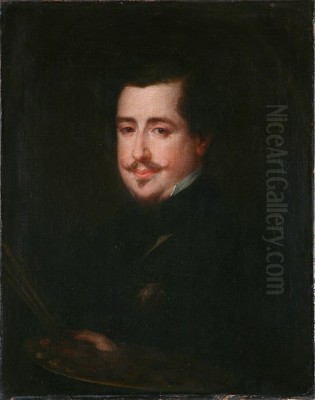
José Gutiérrez de la Vega stands as a significant figure in the landscape of 19th-century Spanish art. A prominent painter of the Romantic era, his contributions spanned portraiture and religious scenes, leaving an indelible mark on the artistic traditions of Seville and Madrid. Born in Seville in 1791 and passing away in Madrid in 1865, his life and career bridged a period of profound social, political, and artistic transformation in Spain. His work, deeply influenced by the Sevillian school and masters like Bartolomé Esteban Murillo, evolved to embrace the burgeoning Romantic sensibilities while also hinting at the nascent realism that would follow.
Early Life and Artistic Formation in Seville
José Gutiérrez de la Vega was born in Seville, the vibrant Andalusian capital, on December 26, 1791. This city, with its rich artistic heritage, particularly from the Golden Age of Spanish painting, provided the foundational environment for his artistic development. Seville was home to the esteemed Real Academia de Bellas Artes de Santa Isabel de Hungría, an institution that played a crucial role in shaping young artists. It was within this milieu that Gutiérrez de la Vega received his initial training, immersing himself in the techniques and traditions of Spanish painting.
The towering influence of Bartolomé Esteban Murillo (1617-1682) was particularly pervasive in Seville, and Gutiérrez de la Vega was no exception to its sway. Murillo's tender religious depictions, his masterful handling of light and color, and his sympathetic portrayal of everyday life left a lasting impression on generations of Sevillian artists. Gutiérrez de la Vega absorbed these lessons, evident in the softness of his brushwork, the warmth of his palette, and the gentle emotionality that often characterized his religious compositions. Early works from this period would have demonstrated a keen understanding of Murillo's legacy, reinterpreting it through the lens of a new century.
His formative years in Seville were not solely about looking backward. The early 19th century was a period of flux. The Napoleonic Wars had ravaged Spain, and the subsequent restoration of the monarchy brought its own set of challenges and changes. Artists were navigating a world where traditional patronage systems were evolving, and new artistic ideas were beginning to filter in from other parts of Europe. This dynamic environment undoubtedly shaped Gutiérrez de la Vega's outlook and his approach to art.
The Transition to Madrid and Professional Ascent
Seeking broader opportunities and a more prominent stage for his talents, José Gutiérrez de la Vega eventually made the pivotal decision to move from Seville to Madrid. The capital city was the epicenter of Spanish political, social, and artistic life. It offered access to royal and aristocratic patronage, a more diverse artistic community, and the prestigious Real Academia de Bellas Artes de San Fernando, a leading institution in the country.
In Madrid, Gutiérrez de la Vega's career began to flourish. He established himself as a skilled painter, gaining recognition for both his religious works and, increasingly, his portraits. While he never attained the official position of a court painter (Pintor de Cámara), a role held by luminaries such as Francisco de Goya (1746-1828) before him and later by figures like Federico de Madrazo y Kuntz (1815-1894), he did receive significant commissions from the aristocracy and the burgeoning bourgeoisie. His ability to capture a likeness while imbuing his subjects with a sense of dignity and Romantic sensibility made him a sought-after portraitist.
His involvement with the Real Academia de Bellas Artes de San Fernando was significant. He not only exhibited his works there but also served as a professor, contributing to the education of a new generation of artists. This academic role underscores his respected position within the Madrid art establishment. Furthermore, he was an active member of the Liceo Artístico y Literario de Madrid (Artistic and Literary Lyceum), a key institution for the dissemination of Romantic ideas and a meeting place for artists, writers, and intellectuals. His participation in such circles highlights his engagement with the cultural currents of his time and his contribution to the development of Spanish Romanticism.
Artistic Style: Romanticism, Murillo's Legacy, and Goya's Echoes
José Gutiérrez de la Vega's artistic style is firmly rooted in Spanish Romanticism, yet it carries the distinct imprint of his Sevillian origins and the enduring influence of Bartolomé Esteban Murillo. Romanticism in Spain, as elsewhere in Europe, emphasized emotion, individualism, the glorification of the past and nature, and a departure from the strictures of Neoclassicism. Gutiérrez de la Vega's work embodies many of these characteristics, particularly in its expressive qualities and its focus on human sentiment.
The legacy of Murillo is perhaps the most discernible thread in his stylistic tapestry. This is evident in the delicate modeling of figures, the soft, sfumato-like blending of tones, and the warm, often golden, light that bathes his canvases. His religious paintings, in particular, often evoke Murillo's tenderness and piety, presenting sacred figures with a human accessibility that resonated with contemporary audiences. He adopted Murillo's loose brushwork, which allowed for a sense of immediacy and vibrancy.
While Murillo's influence was paramount, one can also detect subtle echoes of Francisco de Goya, especially in the freedom and ease of his brushwork. Goya, a towering figure whose career spanned Neoclassicism, Romanticism, and prefigured modern art, had revolutionized Spanish painting. While Gutiérrez de la Vega did not delve into the darker, more critical aspects of Goya's oeuvre, he seems to have absorbed lessons from Goya's painterly technique and his ability to capture psychological depth in portraiture. This is particularly noticeable in the way he could convey the personality of his sitters beyond mere physical representation.
His color palette was typically rich and harmonious, often employing deep reds, blues, and ochres, balanced by luminous whites and subtle flesh tones. He demonstrated a fine understanding of texture, skillfully rendering fabrics like silks, velvets, and lace, which added to the opulence and realism of his portraits. Over time, especially in his later career, there is a discernible shift towards a greater degree of realism, a trend that was gaining momentum in European art during the mid-19th century. This evolution shows his responsiveness to changing artistic currents, moving from a more idealized Romanticism to a more direct observation of the world.
Portraiture: Capturing the Elite of an Era
Portraiture formed a significant part of José Gutiérrez de la Vega's output and was a key area where he gained considerable acclaim. In 19th-century Spain, as in much of Europe, portraits were not merely records of appearance but also statements of social status, wealth, and identity. Gutiérrez de la Vega catered to a distinguished clientele that included members of the aristocracy, high-ranking military officers, prominent intellectuals, and affluent members of the bourgeoisie.
One of his most notable commissions in this genre was the portrait of Queen Isabella II. Although he was not an official court painter, his depiction of the monarch, such as the one created for the Banco de Isabel II, showcases his ability to handle grand-scale official portraiture. In such works, he would typically portray the Queen seated, adorned with royal regalia, including the crown and scepter, conveying majesty and authority while still retaining a degree of human warmth, a hallmark of his style. These portraits were crucial for the dissemination of the royal image and played a role in the visual culture of the monarchy.
Beyond royalty, his portraits of other individuals reveal his skill in capturing both the external likeness and the inner character of his sitters. Works like the Retrato de don Adolfo de los Ríos and the Retrato de don Félix José Reinoso (also sometimes referred to as Renau) exemplify his approach. He often employed conventional poses – three-quarter views or full-length figures – but infused them with a Romantic sensibility through his handling of light, color, and the expressive gaze of the subject. The meticulous rendering of attire and accessories not only added to the visual richness of the paintings but also provided important clues about the sitter's social standing and profession.
His portraits of women were particularly admired for their elegance and sensitivity. He had a talent for depicting the delicate textures of fabrics and the softness of skin, creating images that were both refined and alluring. The painting titled La Mujer Española (The Spanish Woman) likely falls into this category, celebrating a particular archetype of Spanish femininity that was popular during the Romantic period. These works often went beyond simple likeness, aiming to capture an ideal of beauty or a particular mood.
The portrait of the writer and journalist Mariano José de Larra (1809-1837), a leading figure of Spanish Romanticism known for his sharp social critiques, is another important example. Capturing the likeness of such a prominent intellectual figure would have been a significant undertaking, and the portrait likely aimed to convey Larra's intense personality and intellectual prowess. Such works connected Gutiérrez de la Vega directly to the literary heart of the Romantic movement.
Religious Painting: Faith and Sentiment in the Romantic Age
Religious painting remained a vital genre in 19th-century Spain, a country with a profound Catholic heritage. José Gutiérrez de la Vega made significant contributions to this field, creating works that were both devotional and aesthetically compelling, aligning with the Romantic era's renewed interest in spiritual and emotional expression. His religious compositions often drew upon the rich iconographic traditions of Spanish art but were infused with a contemporary sensibility.
His deep admiration for Murillo is most evident in his religious works. He frequently tackled subjects that Murillo himself had popularized, such as the Immaculate Conception, scenes from the life of the Virgin Mary, and depictions of saints. The Madonna and Child, a recurring theme in Christian art, was a subject Gutiérrez de la Vega returned to, and one such version, sold in 1996, is considered a representative masterpiece. In these paintings, he typically emphasized the tender relationship between mother and child, using soft lighting, harmonious colors, and gentle expressions to evoke feelings of piety and devotion. His ability to convey deep human emotion within a sacred context was a key strength.
Other notable religious works include La Santa Águeda (Saint Agatha), La Santa María de Magdalena (Saint Mary Magdalene), and Santa Cecilia (Saint Cecilia). These paintings of female saints allowed him to combine religious piety with an appreciation for female grace and beauty. Saint Mary Magdalene, often depicted as a penitent, was a popular subject for Romantic artists due to the inherent drama and emotional depth of her story. Saint Cecilia, the patron saint of music, offered opportunities to depict serene devotion and often included musical instruments, adding to the compositional richness.
He also painted more complex narrative scenes, such as El Bautismo de San Juan (The Baptism of Saint John) and La Adoración de los Pastores (The Adoration of the Shepherds). These multi-figure compositions demonstrated his skill in arranging dynamic scenes, managing complex interactions between figures, and creating a cohesive and engaging narrative. La Glorificación de Santa Inés (The Glorification of Saint Agnes) would have been another such ambitious work, likely depicting the saint ascending to heaven or in a moment of divine ecstasy.
The work titled El Luto de San Salomón (The Mourning of Solomon), assuming "Sanomón" is a variation or misspelling of Solomon, would represent an Old Testament theme, showcasing his versatility beyond New Testament subjects. Similarly, El Luto de Santa Rosalinda (The Mourning of Saint Rosalind, or perhaps Saint Rosalia, a more common saint), would focus on themes of grief and piety. San Gabriel (Saint Gabriel), likely depicting the Archangel of the Annunciation, would be another example of his engagement with core Christian iconography. These works collectively highlight his commitment to religious art and his ability to reinterpret traditional themes for a 19th-century audience, emphasizing emotional resonance and painterly beauty.
Other Notable Works and Thematic Explorations
Beyond his primary focus on portraiture and religious scenes, José Gutiérrez de la Vega explored other themes, including genre scenes that captured aspects of contemporary life or historical moments. One such work mentioned is La Boda (The Wedding). This painting was reportedly very popular and frequently copied, suggesting it struck a chord with the public. Genre scenes depicting everyday life, customs, and celebrations were a significant part of Romantic art, often referred to as "costumbrismo" in Spain. Artists like Leonardo Alenza y Nieto (1807-1845) and Eugenio Lucas Velázquez (1817-1870), who was heavily influenced by Goya, excelled in this genre. While Gutiérrez de la Vega is less known as a costumbrista painter compared to these figures, La Boda indicates his engagement with such themes, likely portraying the social rituals and festive atmosphere of a wedding ceremony with a characteristically Romantic charm.
The popularity of La Boda and its subsequent reproductions speak to its accessibility and appeal. Such works often found a market among the growing middle class, who appreciated depictions of familiar life and sentimental narratives. These paintings helped to broaden the audience for art beyond the traditional confines of the church and the aristocracy.
His oeuvre, therefore, presents a multifaceted artist capable of navigating different genres. While his reputation primarily rests on his elegant portraits and his heartfelt religious paintings, works like La Boda suggest a broader interest in the human experience and the social fabric of his time. This versatility allowed him to cater to a wider range of patrons and to engage with different aspects of the Romantic movement's thematic concerns.
Interactions with Contemporaries and the Artistic Milieu
José Gutiérrez de la Vega was an active participant in the artistic life of Madrid, and his career was interwoven with those of his contemporaries. His close friendship and professional association with Antonio María Esquivel (1806-1857) is particularly well-documented. Esquivel, also a native of Seville who later established himself in Madrid, was a prominent Romantic painter known for his portraits, historical scenes, and his influential treatise on painting. Both artists shared liberal sympathies and a dedication to the advancement of Spanish art.
Their collaboration extended to specific projects. For instance, Gutiérrez de la Vega is known to have painted a portrait of Esquivel's wife, Señora de Rivas, in 1831. This work, an oil on canvas measuring 55 x 42 cm, depicts her in a half-length format, looking directly at the viewer, framed by an oval. Such personal commissions underscore the close ties within their artistic circle. Esquivel, in turn, included Gutiérrez de la Vega in his famous group portrait Reunión de poetas (The Contemporary Poets: A Reading by Zorrilla in the Painter's Studio), a testament to Gutiérrez de la Vega's standing among the cultural figures of the era.
Beyond Esquivel, Gutiérrez de la Vega would have interacted with many other leading artists of the period. The Madrid art scene was vibrant, with figures like Federico de Madrazo y Kuntz dominating official portraiture and history painting. Jenaro Pérez Villaamil (1807-1854) was a leading landscape painter of the Romantic era, known for his picturesque views of Spanish cities and monuments. Valeriano Domínguez Bécquer (1833-1870) and his brother, the poet Gustavo Adolfo Bécquer, were key figures in later Romanticism, with Valeriano focusing on costumbrista scenes and portraits.
The influence of earlier masters like Vicente López Portaña (1772-1850), who served as court painter and transitioned from Neoclassicism to a more Romantic style, would also have been part of the artistic discourse. José de Madrazo y Agudo (1781-1859), Federico's father, was another influential figure, primarily associated with Neoclassicism but whose tenure at the Prado Museum and the Academy shaped the artistic landscape. The interactions, rivalries, and collaborations among these artists created a dynamic environment that spurred artistic development. Gutiérrez de la Vega's ability to maintain a successful career amidst such talent speaks to his skill and adaptability. Other notable painters of the broader Spanish Romantic period whose paths or influences might have intersected with his include Carlos Luis de Ribera y Fieve (1815-1891), known for historical paintings, and Francisco Lameyer y Berenguer (1825-1877), who explored costumbrista and Orientalist themes.
Academic Role, Exhibitions, and Lasting Influence
José Gutiérrez de la Vega's contributions to Spanish art extended beyond his own studio practice. His role as a professor at the Real Academia de Bellas Artes de San Fernando in Madrid was significant. In this capacity, he helped to shape the skills and artistic vision of younger artists, passing on the traditions of Spanish painting while also engaging with the new ideas of Romanticism. Academic positions were highly respected and provided artists with a stable platform and a voice in the official art world.
His membership in the Liceo Artístico y Literario de Madrid further integrated him into the cultural life of the capital. The Lyceum was a hub for Romantic intellectuals, hosting exhibitions, lectures, and discussions that were vital for the cross-pollination of ideas between art, literature, and music. His participation underscored his commitment to the Romantic cause and his standing within this influential community.
Throughout his career, Gutiérrez de la Vega's works were exhibited, gaining him recognition and commissions. In more recent times, his art has continued to be studied and appreciated. His paintings are included in important public and private collections in Spain. A notable modern exhibition that featured his work was 2328 reales de vellón: Goya y los orígenes de la Colección Banco de España, held at the Banco de España in Madrid from October 2021 to February 2022. The inclusion of his work in such an exhibition, which explored the foundational pieces of a major institutional collection, highlights his historical importance.
Scholarly attention has also been paid to his oeuvre. Books such as Pintura romántica sevillana (Sevillian Romantic Painting), authored by Ana María Arias de Cossío (1978) and another by Enrique Valdivieso and Jesús Fernández López (2011, often cited as Romantic painting in Seville), delve into the specific context of Romantic art in his native city and undoubtedly discuss his contributions. Enrique Valdivieso, a prominent art historian specializing in Sevillian art, has also written academic papers, such as "APORTACIONES AL CONOCIMIENTO DE JOSÉ GUTIÉRREZ DE LA VEGA" (Contributions to the Knowledge of José Gutiérrez de la Vega), further cementing the artist's place in art historical discourse. These publications and exhibitions ensure that his artistic legacy endures and is understood within the broader narrative of Spanish art.
His influence can be seen in the continuation of a certain lyrical and painterly quality in Spanish art, particularly in portraiture and religious painting. While he may not have been a radical innovator in the vein of Goya, he was a master of his craft who skillfully blended tradition with the spirit of his age, creating works of enduring beauty and emotional depth. He helped to define the character of Spanish Romantic painting, particularly its more serene and graceful aspects.
Final Years and Enduring Legacy
José Gutiérrez de la Vega continued to paint into his later years, adapting to the evolving artistic tastes of the mid-19th century. While Romanticism remained a core element of his style, his later works often show an increased attention to realistic detail, reflecting the broader European trend towards Realism. He passed away in Madrid in 1865, leaving behind a substantial body of work that attests to a long and productive career.
His legacy is that of a quintessential Spanish Romantic painter who excelled in capturing the elegance of his era's elite and the spiritual fervor of its religious beliefs. He successfully navigated the artistic currents of his time, drawing inspiration from the great masters of the Spanish Golden Age, particularly Murillo, while embracing the emotional expressiveness and individualism of Romanticism. His paintings are characterized by their technical skill, harmonious compositions, rich color palettes, and a gentle, often sentimental, mood.
While perhaps not as widely known internationally as some of his Spanish contemporaries like Goya or, later, Joaquín Sorolla (1863-1923) or Ignacio Zuloaga (1870-1945), Gutiérrez de la Vega holds a secure and respected place in the history of Spanish art. His works provide valuable insights into the society, culture, and artistic sensibilities of 19th-century Spain. They remain a testament to his talent and his dedication to the art of painting, admired for their beauty, craftsmanship, and their embodiment of the Romantic spirit. His contribution to the artistic life of both Seville and Madrid, as a painter and an academic, was considerable, and his art continues to be appreciated for its refined elegance and heartfelt expression.