Francesco Zugno (1709–1787) stands as a significant, if sometimes overshadowed, figure in the glittering constellation of 18th-century Venetian painters. Active during the final, vibrant flourish of the Venetian Republic's artistic dominance, Zugno's career was intrinsically linked with the preeminent master of the age, Giovanni Battista Tiepolo. Yet, while deeply influenced by Tiepolo's grandeur, Zugno cultivated a distinct artistic personality, characterized by a refined elegance, a delicate sensibility, and often a subtle, melancholic charm that set his work apart. His oeuvre, spanning religious altarpieces, mythological scenes, historical narratives, and decorative frescoes, offers a fascinating window into the artistic currents and patronage systems of Settecento Venice.
As an artist who navigated the transition from the high Rococo towards emerging Neoclassical sensibilities, Zugno's work embodies a delicate balance. He inherited the luminous palettes, dynamic compositions, and theatrical flair of the Venetian tradition, particularly from masters like Paolo Veronese and his own mentor Tiepolo, but infused them with a more intimate and often gentler emotional register. This article aims to explore the life, artistic development, key works, collaborations, and lasting legacy of Francesco Zugno, placing him within the rich tapestry of his contemporaries and highlighting his unique contribution to European art history.
Early Life and Artistic Formation
Francesco Zugno was born in Venice in 1709, into a city that was still a vibrant hub of artistic innovation and a magnet for patrons from across Europe. Details about his earliest years and family background are somewhat scarce, a commonality for many artists of the period whose fame did not reach the absolute zenith of their peers. However, it is known that he hailed from an established Venetian family. His initial artistic training likely began within a family workshop, a traditional route for aspiring painters, before he formally enrolled in the Accademia di Pittura e Scultura (Academy of Painting and Sculpture) in Venice. This institution, like others across Italy, played a crucial role in standardizing artistic education, emphasizing drawing from casts and live models, and studying the works of past masters.
The most pivotal phase of Zugno's formative period was undoubtedly his apprenticeship and collaboration with Giovanni Battista Tiepolo. This association began around 1730 and lasted for approximately seven years, until 1737. To work in the studio of Tiepolo, then Venice's most celebrated and sought-after painter, was an unparalleled opportunity. Tiepolo's workshop was a bustling enterprise, undertaking vast fresco cycles and large-scale canvases for palaces, churches, and villas throughout Venice, the Veneto, and even further afield in Italy and Germany.
During these years, Zugno would have been immersed in Tiepolo's working methods, absorbing his approach to composition, his mastery of light and color, and his ability to conjure vast, airy spaces populated by dynamic figures. Apprentices like Zugno would typically start with preparatory tasks, grinding pigments, preparing canvases and walls for fresco, and copying the master's drawings. As their skills developed, they would progress to painting less critical areas of compositions, drapery, architectural backgrounds, or secondary figures, always under Tiepolo's direct supervision and often from his designs. This hands-on experience was invaluable, providing Zugno with a profound understanding of both oil painting and the demanding technique of fresco.
The Enduring Influence of Tiepolo and the Emergence of a Personal Style
The impact of Giovanni Battista Tiepolo on Francesco Zugno's artistic development was profound and lasting. Throughout his career, Zugno's work would echo Tiepolo's luminous palette, his preference for silvery light, and his skill in creating complex, multi-figured compositions that often unfolded across expansive, illusionistic skies. Zugno frequently tackled similar subject matter, including grand religious narratives, mythological allegories, and historical scenes, all staples of Tiepolo's repertoire. He learned from Tiepolo the art of dramatic foreshortening, the rendering of sumptuous fabrics, and the creation of elegant, elongated figures that characterized the Rococo ideal.
However, Zugno was no mere copyist. While the Tiepolesque foundation remained evident, he gradually cultivated a more personal and distinct artistic voice. His style, compared to Tiepolo's often heroic and exuberant manner, tended towards a greater delicacy and refinement. There is often a softer, more lyrical quality to Zugno's figures, and a gentler, sometimes even melancholic, emotional tone. His brushwork, while assured, could be more meticulous and less bravura than Tiepolo's. Some art historians have noted a particular "script-like" or calligraphic quality in his rendering of drapery folds and a distinctive way of delineating eyelids, which serve as subtle hallmarks of his hand.
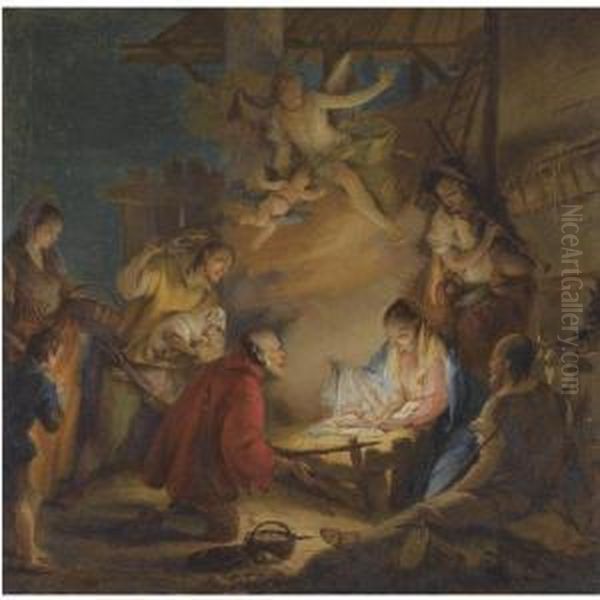
This divergence became more apparent after Zugno left Tiepolo's direct orbit around 1737 to establish himself as an independent master. While he continued to draw inspiration from Tiepolo's solutions to compositional and thematic challenges, he increasingly filtered these influences through his own temperament. His figures, though graceful, often possess a more introspective quality, and his color harmonies, while bright, can exhibit a preference for cooler tones or more subtle modulations. This nuanced approach allowed Zugno to carve out his own niche within the competitive Venetian art scene, appealing to patrons who perhaps sought a slightly less overwhelming and more intimately scaled version of the grand style. His ability to adapt the monumental language of Tiepolo to works of varying scales, including smaller devotional pieces and cabinet paintings, also contributed to his success.
Key Thematic Concerns in Zugno's Art
Francesco Zugno's artistic output encompassed the primary thematic categories prevalent in 18th-century Venetian painting, reflecting the demands of both ecclesiastical and private patrons.
Religious Subjects:
Religious commissions formed a significant part of Zugno's work. He produced altarpieces and decorative cycles for churches in Venice and the surrounding Veneto region. These works often depicted scenes from the lives of Christ, the Virgin Mary, and various saints. In these paintings, Zugno combined the compositional grandeur learned from Tiepolo with a sincere devotional feeling. His figures, while elegant, often convey a sense of piety and humanity. Examples include his works for the church of San Lazzaro degli Armeni in Venice, such as St. Anthony with the Infant Christ, where the tender interaction between the figures is rendered with sensitivity. Other religious works, like The Adoration of the Magi, showcase his ability to handle complex multi-figure compositions with clarity and decorative appeal, often incorporating rich costumes and exotic details that were popular at the time.
Mythological and Allegorical Scenes:
The Rococo era had a strong appetite for mythological and allegorical subjects, which allowed artists to explore themes of love, heroism, and the divine in often sensuous and decorative ways. Zugno contributed to this genre with paintings depicting classical gods and goddesses, and allegorical figures representing virtues, arts, or abstract concepts. These works often adorned the interiors of palaces and villas, contributing to their opulent and cultured atmosphere. His Triumph of Art and the significant ceiling fresco, The Triumph of San Lorenzo Giustiniani in the Palazzo Giustinian Lolin (now part of the Murano Glass Museum), demonstrate his skill in creating dynamic, illusionistic compositions that celebrate their subjects with Rococo grace and vitality. In such works, he often employed a light, airy palette and flowing lines, characteristic of the period's aesthetic.
Historical and Secular Narratives:
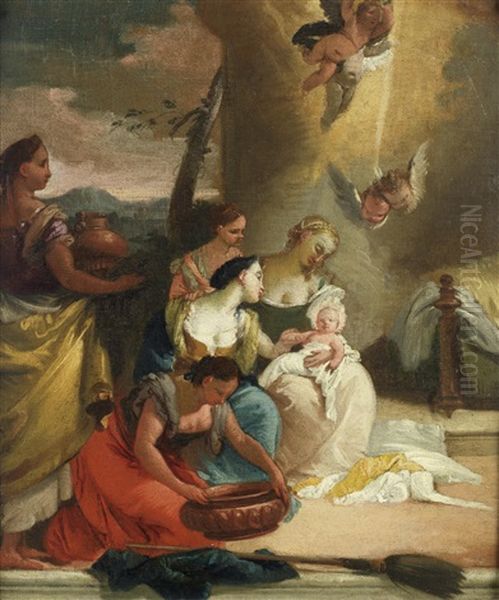
Zugno also painted historical subjects and scenes that, while sometimes drawn from ancient or biblical history, were often imbued with a contemporary, secular sensibility. His painting, The Finding of Moses, is a prime example. While the subject is biblical, the figures are often depicted in fashionable 18th-century attire, and the landscape setting can evoke the Italian countryside rather than ancient Egypt. This blending of the historical with the contemporary was a common feature of Rococo art, making distant stories more relatable and visually appealing to the audience of the day. Works like Esther before Ahasuerus also fall into this category, showcasing Zugno's ability to depict dramatic encounters with a focus on elegant figures and rich settings. Genre-like elements, such as in The Flute Player, demonstrate his versatility in capturing more intimate, everyday moments, albeit still rendered with a characteristic Rococo refinement.
Throughout these varied themes, Zugno maintained a consistent level of craftsmanship and a distinctive stylistic signature that blended Tiepolesque influences with his own more delicate and sometimes introspective approach.
Masterpieces and Major Commissions
Several works and commissions stand out in Francesco Zugno's career, showcasing his artistic capabilities and securing his reputation.
The Finding of Moses:
Currently housed in the National Gallery, London, The Finding of Moses is one of Zugno's most recognized works. This painting exemplifies his ability to blend a biblical narrative with the fashionable aesthetics of the 18th century. Pharaoh's daughter and her attendants are depicted in elegant, contemporary attire, their gestures graceful and their expressions serene. The infant Moses is presented with a tender naturalism. The lush, riverine landscape in the background, more reminiscent of Northern Italy than Egypt, adds to the painting's charm. Interestingly, this work was once attributed to Giovanni Battista Tiepolo, a testament to the quality of Zugno's execution and his absorption of his master's style. However, art historical analysis has firmly established it as Zugno's own, highlighting his characteristic softer touch and specific figural types.
The Triumph of San Lorenzo Giustiniani:
This significant ceiling fresco, originally in the Palazzo Giustinian Lolin in Venice and now a centerpiece of the Murano Glass Museum (Museo del Vetro), is a major example of Zugno's work in large-scale decoration. Created in collaboration with the quadratura (architectural illusionism) painter Francesco Zanchi, the fresco depicts an allegorical triumph of Saint Lorenzo Giustiniani, the first Patriarch of Venice and an ancestor of the commissioning Giustiniani family. Zugno's figures soar gracefully in a light-filled, illusionistic sky, typical of Venetian ceiling painting. The work celebrates both religious piety and aristocratic lineage, demonstrating Zugno's capacity to handle complex allegorical programs with Rococo elegance and dynamism. The successful integration of figures with Zanchi's painted architecture would have created a stunning effect in its original palatial setting.
Frescoes for San Lazzaro degli Armeni:
The Mekhitarist monastery on the island of San Lazzaro degli Armeni in the Venetian lagoon commissioned Zugno for several works. Among these are frescoes depicting scenes from the life of Saint Anthony Abbot and other religious subjects, including the aforementioned St. Anthony with the Infant Christ. These commissions indicate the trust placed in Zugno by important ecclesiastical patrons. Working in fresco demanded speed and confidence, and Zugno's contributions to San Lazzaro demonstrate his proficiency in this challenging medium, adapting his style to the specific architectural and devotional context of the church. These works are significant for their spiritual sincerity and their harmonious integration within the sacred space.
Sleeping Rinaldo (Armida):
This painting, depicting a scene from Torquato Tasso's epic poem Jerusalem Delivered, showcases Zugno's engagement with popular literary themes. The story of the Christian knight Rinaldo enchanted by the sorceress Armida was a favorite subject for artists. Zugno's interpretation likely focused on the romantic and lyrical aspects of the narrative, rendered with his characteristic delicate touch and attention to emotional nuance. Such works appealed to the sophisticated tastes of private collectors who appreciated the blend of literature, mythology, and refined artistry.
Other notable paintings include Sacra Famiglia con San Giovannino (The Holy Family with the Young St. John the Baptist), which demonstrates his skill in creating tender and intimate devotional images, and various altarpieces and easel paintings that found their way into churches and private collections across the Veneto. Each of these works, whether grand public commissions or more intimate private pieces, reflects Zugno's consistent artistic vision and his contribution to the Venetian Rococo.
Artistic Collaborations and the Venetian Milieu
Francesco Zugno's career unfolded within a vibrant and interconnected artistic community in 18th-century Venice. Collaboration was common, especially on large-scale decorative projects.
His most formative collaboration was, of course, with Giovanni Battista Tiepolo. During his seven years in Tiepolo's studio (circa 1730-1737), Zugno not only learned from the master but also contributed to major projects, such as the decoration of the Palazzo Labia in Venice, renowned for Tiepolo's frescoes of Antony and Cleopatra. He likely assisted with frescoes in other Venetian palaces and churches, and perhaps even on projects outside Venice, such as those in Udine. This period provided him with invaluable experience in managing large commissions and working within a team.
After establishing his independence, Zugno continued to collaborate with other artists. A notable partnership was with Francesco Zanchi, a specialist in quadratura – the illusionistic painting of architectural frameworks. Their joint work on the ceiling of the Palazzo Giustinian Lolin, The Triumph of San Lorenzo Giustiniani, is a prime example. Zugno would paint the figures, while Zanchi created the surrounding fictive architecture, a common division of labor that produced spectacular decorative ensembles.
Zugno also worked alongside other figure painters on collective projects. For instance, he participated in the creation of a series of paintings depicting the Stations of the Cross for the church of Santa Maria del Giglio (also known as Santa Maria Zobenigo) in Venice. For this commission, he worked alongside contemporaries such as Gaspare Diziani (1689–1767), a prolific painter of religious and historical subjects, and Jacopo Marieschi (1711–1794), known for his lively historical and mythological scenes, and also a follower of Diziani and Ricci. Such collaborative projects were a feature of Venetian artistic practice, allowing for the swift completion of extensive decorative schemes.
The broader artistic environment of Venice was rich with talent. While Tiepolo was the dominant figure, other important painters were active. Giovanni Battista Piazzetta (1683–1754) was a highly influential figure, known for his dramatic chiaroscuro, rich impasto, and emotionally charged religious and genre scenes. Though his style was more tenebrous than Zugno's, Piazzetta's impact on the Venetian school was significant. Sebastiano Ricci (1659–1734), an older master, had played a key role in reviving the grand decorative tradition in Venice at the turn of the century, paving the way for artists like Tiepolo and, by extension, Zugno. His light-filled, dynamic compositions were a major influence on the Rococo.
Other contemporaries included Giovanni Battista Pittoni (1687–1767), another prominent history painter whose style, like Zugno's, was characterized by elegance and a bright palette, often with a delicate, almost porcelain-like finish to his figures. The celebrated pastellist Rosalba Carriera (1673–1757) achieved international fame for her portraits, capturing the refined sensibility of the Rococo era. While working in a different medium, her success contributed to Venice's reputation as a leading artistic center.
The veduta painters Canaletto (Giovanni Antonio Canal, 1697–1768) and Francesco Guardi (1712–1793) were creating their iconic views of Venice, which, though different in genre from Zugno's work, formed part of the same artistic explosion that characterized the city. Guardi, in fact, was Tiepolo's brother-in-law, further illustrating the interconnectedness of the Venetian art world. Pietro Longhi (1701–1785) specialized in charming genre scenes, offering intimate glimpses into Venetian daily life, providing a contrast to the grand historical and religious narratives of painters like Zugno. Even artists like Giambattista Crosato (1697-1758) and Jacopo Amigoni (1682-1752), who also worked extensively outside Venice, contributed to the overall Rococo decorative style that Zugno was part of.
Zugno's interactions with these artists, whether through direct collaboration, shared commissions, or simply by working within the same artistic milieu, would have provided stimulus, competition, and opportunities for exchange, shaping his own artistic path.
The Nuances of Zugno's Style and Technique
Francesco Zugno's artistic style is a recognizable variant of the Venetian Rococo, distinguished by several key characteristics that reflect both his training and his personal artistic inclinations.
Brushwork and Handling of Paint: Zugno's brushwork is generally refined and controlled, less overtly virtuosic or impastoed than that of some of his contemporaries like Piazzetta, or even Tiepolo in his more vigorous moments. He often favored a smoother application of paint, allowing for delicate modulations of color and a subtle rendering of form. This is particularly evident in the flesh tones of his figures, which often have a soft, almost porcelain-like quality. His distinctive, somewhat calligraphic treatment of drapery folds, with flowing, elegant lines, is another hallmark.
Color Palette: Like many Venetian Rococo painters, Zugno employed a light and airy palette, often favoring pastel shades, silvery blues, pale yellows, rose pinks, and luminous whites. This contributes to the overall elegance and decorative quality of his work. However, he was also capable of using richer, more saturated colors when the subject demanded, particularly in altarpieces or more dramatic historical scenes. His management of color was always aimed at achieving a harmonious and pleasing overall effect, characteristic of the Rococo aesthetic.
Composition and Light: Zugno learned the art of complex, dynamic composition from Tiepolo. His larger works often feature figures arranged in graceful, swirling movements, creating a sense of lightness and animation. He was adept at handling multi-figure scenes, ensuring clarity and balance even within intricate arrangements. Light in Zugno's paintings is typically bright and diffused, avoiding harsh contrasts or deep shadows. This even, luminous lighting enhances the clarity of his forms and contributes to the cheerful or serene mood of many of his works. His skies, particularly in ceiling frescoes, are often vast and filled with a pearly, ethereal light.
Figural Types and Emotional Expression: Zugno's figures are typically elegant and elongated, adhering to the Rococo ideal of grace. They often possess a gentle, somewhat sweet demeanor. Compared to Tiepolo's often heroic or intensely dramatic figures, Zugno's characters tend to exhibit more restrained and subtle emotions. There is frequently a touch of melancholy or wistfulness in their expressions, which lends a particular charm and intimacy to his work. His female figures are often depicted with a delicate beauty, while his saints and heroes possess a refined dignity.
Rococo and Neoclassical Elements: While firmly rooted in the Rococo, Zugno's later works show an awareness of the emerging Neoclassical style, which began to gain traction in the latter half of the 18th century. This might be seen in a slightly greater emphasis on clarity of line, a more ordered approach to composition in some instances, or a more restrained emotional tenor, although he never fully abandoned the decorative grace of the Rococo. This ability to subtly incorporate newer trends while retaining his core style demonstrates his adaptability.
Versatility in Scale and Medium: Zugno was proficient in both oil on canvas and fresco. He could adapt his style effectively from large-scale ceiling decorations and altarpieces to smaller, more intimate easel paintings for private collectors. His bozzetti (preparatory oil sketches) would have also showcased a freer, more spirited handling, typical of such preliminary studies.
Overall, Zugno's style is characterized by its elegance, refinement, and a delicate sensibility. He successfully translated the grandeur of the Tiepolesque manner into a more personal idiom, marked by a lyrical charm and a subtle emotional depth that distinguishes his contribution to Venetian Settecento painting.
Later Career, Legacy, and Historical Evaluation
Francesco Zugno remained active as a painter in Venice throughout much of the 18th century, continuing to receive commissions for churches and private patrons. While he may not have achieved the international superstar status of his mentor, Giovanni Battista Tiepolo, or the widespread fame of view painters like Canaletto, Zugno was a respected and productive member of the Venetian artistic community. He successfully navigated the changing tastes of the period, maintaining a consistent output of quality work.
His role as a teacher is not as extensively documented as that of some other masters, but it is likely that, following common practice, he would have had assistants and pupils in his own workshop, passing on the traditions and techniques he had learned. His influence can be seen in the work of lesser-known painters active in Venice and the Veneto during the latter part of the century.
The historical evaluation of Francesco Zugno has often placed him in the shadow of Tiepolo. This is, to some extent, inevitable given Tiepolo's towering genius and prolific output. However, modern art scholarship has increasingly recognized Zugno's individual merits and his specific contribution to the Venetian Rococo. He is valued for his refined aesthetic, his delicate color harmonies, and the gentle, often melancholic charm of his figures. His ability to synthesize the lessons of Tiepolo with his own more intimate sensibility resulted in a body of work that possesses a distinct and appealing character.
Zugno's paintings are represented in numerous public and private collections today. Besides the National Gallery in London and the Murano Glass Museum in Venice, his works can be found in various Italian museums, particularly in Venice and the Veneto region, as well as in collections across Europe and North America. His altarpieces still adorn some of the churches for which they were originally created, such as San Lazzaro degli Armeni. His easel paintings and bozzetti appear periodically on the art market, attesting to a continued appreciation among collectors.
His legacy lies in his embodiment of a particular facet of the Venetian Rococo – one that emphasized elegance, grace, and a subtle emotional poetry. He was part of the last great generation of Venetian painters who, before the fall of the Republic in 1797, brought a final, dazzling brilliance to the city's long and distinguished artistic history. While Tiepolo represented the grand, heroic voice of this era, Zugno offered a softer, more lyrical counterpoint. His art provides a valuable insight into the diverse artistic expressions of Settecento Venice and stands as a testament to a skilled and sensitive painter who carved his own niche within a highly competitive and extraordinarily gifted artistic environment. He remains an important figure for understanding the full spectrum of Venetian painting in its final golden age.
Conclusion
Francesco Zugno emerges from the annals of art history as a painter of considerable skill and refined sensibility, a worthy representative of the Venetian Rococo. His artistic journey, initiated under the formidable influence of Giovanni Battista Tiepolo, evolved into a distinct personal style characterized by elegance, delicate execution, and a subtle emotional depth. While he masterfully employed the grand compositional schemes and luminous palettes of his mentor, Zugno infused his works with a gentler, often more introspective quality that lent them a unique charm.
His contributions to religious art, mythological scenes, and historical narratives enriched the churches and palaces of Venice and beyond. Works like The Finding of Moses and The Triumph of San Lorenzo Giustiniani demonstrate his ability to handle diverse subjects and scales with aplomb, from intimate easel paintings to expansive frescoes. His collaborations with artists like Francesco Zanchi and his participation in collective projects alongside contemporaries such as Gaspare Diziani and Jacopo Marieschi underscore his integration within the vibrant Venetian artistic milieu.
Though perhaps not as widely celebrated as some of his Settecento peers, Francesco Zugno's artistic legacy endures. His paintings continue to be appreciated for their Rococo grace, their harmonious compositions, and their delicate beauty. He represents an important strand in the rich tapestry of 18th-century Venetian art, a testament to the enduring creativity of a city that, even in its twilight years as a Republic, continued to produce artists of remarkable talent and distinctive vision. Zugno's work offers a captivating glimpse into this final flourish, securing his place as a significant master of his time.