Francisco Bayeu y Subías: A Pillar of Spanish Neoclassicism
Francisco Bayeu y Subías stands as a pivotal figure in the landscape of 18th-century Spanish art. Born in Zaragoza on March 9, 1734, and passing away in Madrid on August 4, 1795, Bayeu's career bridged the waning Spanish Baroque and Rococo sensibilities with the burgeoning Neoclassical movement that would come to define the era of Enlightenment in Spain. He was not only a prolific painter in his own right, particularly renowned for his frescoes and religious compositions, but also a highly influential teacher and arts administrator, most notably as Director of the Royal Academy of Fine Arts of San Fernando. His life and work are inextricably linked with the artistic development of his even more famous brother-in-law and pupil, Francisco Goya.
Early Life and Artistic Formation in Zaragoza
Francisco Bayeu's artistic journey began in his native Zaragoza, a city with a rich artistic heritage. He received his initial training under local masters José Luzán Martínez and later, according to some sources, Juan Andrés Merleín. Luzán, who had himself studied in Naples and was connected to the late Baroque tradition, provided Bayeu with a solid foundation in drawing and painting techniques. This early education in Zaragoza exposed him to the prevailing artistic currents, which still bore the hallmarks of the Baroque style, albeit with emerging Rococo influences characterized by lighter palettes and more graceful forms.
The artistic environment of Aragon, while perhaps not as central as Madrid, was vibrant enough to nurture young talents. Bayeu quickly demonstrated considerable skill, which set the stage for his future ambitions. His formative years were crucial in developing the discipline and technical proficiency that would later allow him to tackle large-scale fresco projects and intricate easel paintings.
Ascent in Madrid and the Royal Academy
Seeking greater opportunities, Bayeu moved to Madrid. His talent did not go unnoticed, and he furthered his studies under Antonio González Velázquez, a prominent painter who had also studied in Italy and was well-versed in the grand tradition of ceiling decoration. A significant early achievement came when Bayeu won a scholarship from the Royal Academy of Fine Arts of San Fernando for a work titled The Tyranny of Geryon in 1758. This success marked his official entry into the competitive art world of the capital.
The Royal Academy of San Fernando, established in 1752, was central to the promotion of Neoclassical ideals in Spain, aiming to elevate the status of artists and standardize artistic training according to principles of order, clarity, and inspiration from classical antiquity. Bayeu's association with the Academy would become a defining feature of his career. He was made an honorary academician of merit in 1758, a testament to his burgeoning reputation.
The Mengsian Influence and Royal Patronage
A turning point in Bayeu's career, and indeed for Spanish art of the period, was the arrival of Anton Raphael Mengs in Madrid in 1761. Mengs, a German painter and art theorist, was a leading proponent of Neoclassicism in Europe, invited to Spain by King Charles III to serve as First Court Painter. Mengs's rigorous, academic style, his emphasis on drawing, idealized forms, and clear compositions, profoundly influenced the artistic direction of the Spanish court and its artists.
Bayeu quickly came under Mengs's sphere of influence, becoming one of his closest collaborators. Mengs recognized Bayeu's talent and entrusted him with significant responsibilities in the decoration of the new Royal Palace of Madrid. This collaboration was instrumental in shaping Bayeu's mature style, steering him firmly towards Neoclassicism. Under Mengs's guidance, Bayeu refined his technique, adopting a more restrained palette, a greater emphasis on linear precision, and a more monumental approach to figure painting.
King Charles III was an enlightened monarch keen on modernizing Spain and using the arts to project an image of grandeur and order. Bayeu benefited greatly from this royal patronage, receiving numerous commissions for frescoes in royal residences, including the Royal Palace of Madrid, the Royal Palace of Aranjuez, the Royal Palace of El Pardo, and the Royal Palace of La Granja de San Ildefonso. He was officially appointed a Painter to the King (Pintor del Rey) in 1767, a prestigious position that cemented his status.
Major Fresco Cycles and Representative Works
Francisco Bayeu's reputation largely rests on his extensive work as a fresco painter. These large-scale decorative schemes, often allegorical or historical in nature, adorned the ceilings and walls of royal palaces and important religious institutions.
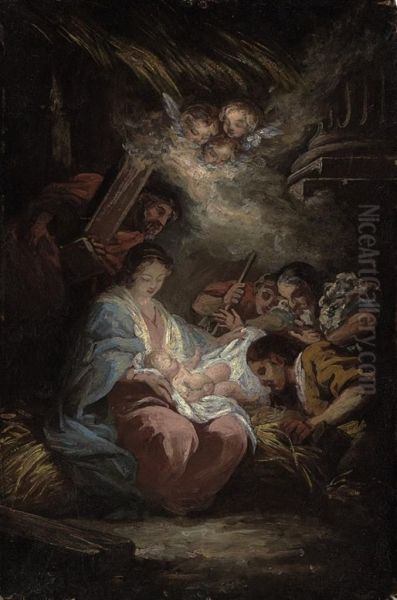
One of his early significant commissions under Mengs's supervision was for the Royal Palace of Madrid. He painted several ceilings, including allegorical scenes like The Surrender of Granada (1763-1764), a theme celebrating Spanish history and royal power. Another notable work from this period is Providence Presiding over the Virtues and Faculties of Man (also referred to as The Apotheosis of Hercules or The Apotheosis of Apollo in some contexts, though titles can vary and sometimes refer to different specific works or sections of larger schemes – The Apotheosis of Apollo (1768) is a recognized title for one of his ceilings). These works showcase his ability to handle complex multi-figure compositions with clarity and a sense of grandeur, characteristic of the Neoclassical ideal.
His frescoes are marked by balanced compositions, often employing pyramidal structures or clear spatial divisions. The figures are typically idealized, with a strong emphasis on anatomical accuracy and graceful, yet dignified, poses. His color palettes, while rich, tend towards the cooler tones favored by Neoclassicists, moving away from the more exuberant warmth of the Baroque or the pastel lightness of the Rococo, a style more associated with contemporaries like Luis Paret y Alcázar.
Beyond the royal palaces, Bayeu also undertook significant religious commissions. He painted frescoes in the Basilica of El Pilar in Zaragoza, a project that famously led to some friction with his then-assistant, Goya, over artistic approaches. For the Charterhouse of Aula Dei, also near Zaragoza, he painted a cycle of eleven frescoes depicting the Life of the Virgin, where Goya also contributed. His work for Toledo Cathedral, including frescoes in the cloister, further demonstrates his mastery in religious narrative.
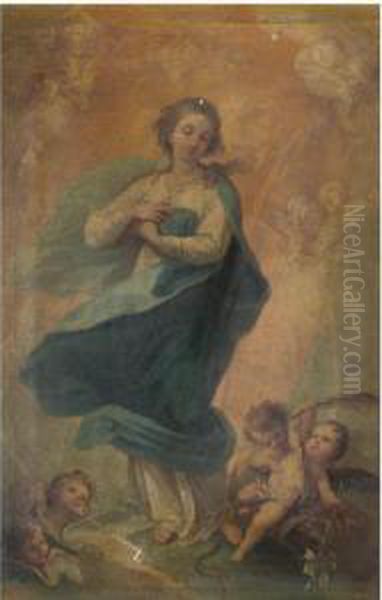
Among his important easel paintings, The Immaculate Conception (c. 1780-1785), created for the oratory of the Royal Palace of El Pardo, is a fine example of his religious art. It displays a clear, pyramidal composition and a serene, devotional quality, reflecting Mengs's influence in its refined execution and idealized depiction of the Virgin. Another significant religious work is The Preaching of Saint Eugene. His portraits, while perhaps less numerous than his decorative works, also adhere to Neoclassical principles of clarity and dignified representation.
Role as an Educator and Director at the Academy
Francisco Bayeu's influence extended beyond his own artistic output. He played a crucial role in arts education and administration through his long association with the Royal Academy of San Fernando. He was appointed Deputy Director of Painting in 1765 and later served as Director of Painting from 1788. He even held the esteemed position of Director General of the Academy in 1788 and was reappointed in 1792.
In these capacities, Bayeu was instrumental in upholding and disseminating the Neoclassical doctrines championed by Mengs. He oversaw the training of a generation of Spanish artists, emphasizing rigorous study of drawing, anatomy, and classical models. His tenure at the Academy helped solidify Neoclassicism as the dominant artistic style in Spain during the latter half of the 18th century. His contemporaries at the Academy included figures like Mariano Salvador Maella, another prominent painter who also served as Court Painter and Director of the Academy, and with whom Bayeu sometimes collaborated and sometimes competed for commissions.
The Bayeu Family of Artists
Francisco was the most prominent member of an artistic family. His two younger brothers, Ramón Bayeu y Subías (1744-1793) and Manuel Bayeu y Subías (1740-c.1809), were also painters. Ramón worked closely with Francisco, often assisting him on large commissions and also producing numerous cartoons for the Royal Tapestry Factory. His style closely mirrored that of his older brother. Manuel became a Carthusian monk but continued to paint, primarily religious subjects for monastic orders, developing a more personal and perhaps less academic style than his brothers. The collaborative nature of large workshop projects in this era meant that the lines between the work of Francisco and Ramón, in particular, can sometimes be blurred, especially in tapestry cartoons.
Relationship with Francisco Goya
The relationship between Francisco Bayeu and Francisco Goya (1746-1828) is one of the most fascinating and significant in Spanish art history. Goya, also from Aragon, came to Madrid and initially struggled to gain recognition. Bayeu, already established and influential, took the young Goya under his wing. Goya worked in Bayeu's studio, learning from him and assisting on projects.
This connection was solidified in 1773 when Goya married Bayeu's sister, Josefa Bayeu y Subías ("Pepa"). This familial tie, combined with Bayeu's professional support, was crucial for Goya's early career. It was through Bayeu's influence that Goya received his first major commissions for tapestry cartoons for the Royal Tapestry Factory of Santa Bárbara. These early works by Goya, while showing his emerging individuality, bear the imprint of Bayeu's style and the prevailing Rococo-to-Neoclassical transitional taste.
While Bayeu remained a steadfast Neoclassicist, Goya's artistic path would eventually diverge dramatically, leading him to explore darker, more personal, and revolutionary themes that transcended stylistic categories. Despite their later artistic differences, and occasional personal and professional disagreements (notably concerning the frescoes at El Pilar), Bayeu's early mentorship provided Goya with an indispensable foothold in the Madrid art world and access to royal patronage. Without Bayeu, Goya's trajectory might have been very different.
Contemporaries and Artistic Context
Bayeu operated within a rich and evolving artistic context. In Madrid, he would have been aware of the lingering influence of earlier Baroque masters and the more recent impact of Italian painters who had worked for the Spanish court, such as Corrado Giaquinto, who preceded Mengs as a dominant force in royal decoration. Giambattista Tiepolo, the great Venetian Rococo master, also worked in Madrid from 1762 until his death in 1770, decorating ceilings in the Royal Palace. While Tiepolo's exuberant, light-filled style was different from the Neoclassicism Bayeu embraced under Mengs, the presence of such a towering figure undoubtedly contributed to the vibrant artistic milieu.
Bayeu's Neoclassicism can be seen as part of a broader European movement. Figures like Pompeo Batoni in Rome (a rival of Mengs), Jacques-Louis David in France (who would become the leading figure of French Neoclassicism), and Angelica Kauffman (a Swiss-Austrian Neoclassical painter active in Italy and England) were all part of this international shift towards classical ideals. While Bayeu's work was primarily for a Spanish audience, it resonated with these wider European trends. His dedication to drawing and preparatory sketches, many of which survive, aligns with the academic emphasis on disegno (design or drawing) central to Neoclassical theory.
Other Spanish contemporaries included the aforementioned Mariano Salvador Maella, who shared a similar career trajectory as a court painter and academician. Luis Meléndez, a master of still life, worked in a different genre but was also active during this period. Later figures who would continue the Neoclassical tradition in Spain, albeit with their own inflections, include José de Madrazo y Agudo and Vicente López Portaña, who became a leading court painter in the early 19th century.
Later Career, Death, and Legacy
Francisco Bayeu continued to be highly productive throughout his later career, maintaining his prominent position in the Spanish art world. He remained dedicated to the Neoclassical principles he had championed, even as new artistic sensibilities began to emerge towards the end of the century, particularly in the work of Goya. His final years were spent fulfilling commissions and his duties at the Academy.
He passed away in Madrid in 1795. At the time of his death, he was a highly respected and honored artist, considered one of the foremost painters in Spain. His legacy is multifaceted. As a painter, he left an extensive body of work, particularly in fresco, that exemplifies Spanish Neoclassicism. His religious paintings adorned numerous churches and convents, contributing to the devotional art of his time.
As an educator and arts administrator, his impact was profound. Through his leadership at the Royal Academy of San Fernando, he helped shape the direction of Spanish art for several decades, promoting an academic, disciplined approach based on classical ideals. He trained and influenced numerous students, ensuring the continuation of the Neoclassical tradition.
Perhaps one of his most enduring, if indirect, legacies is his role in the early career of Francisco Goya. By providing Goya with training, support, and access to patronage, Bayeu helped launch the career of an artist who would go on to become one of the most important and revolutionary figures in the history of Western art.
While Bayeu's own artistic style might today be seen as more conventional or academic compared to the groundbreaking innovations of Goya, his contribution to Spanish art is undeniable. He was a master of his craft, a key figure in the cultural life of Enlightenment Spain, and a vital link in the chain of Spanish artistic tradition, connecting the late Baroque with the full flowering of Neoclassicism and, through Goya, unknowingly paving the way for the art of the modern era. His works are preserved in major Spanish institutions, including the Museo del Prado in Madrid, the Royal Palace, and numerous churches, standing as testament to his skill and his significant place in Spanish art history.