Zacarías González Velázquez: A Luminary of Spanish Neoclassicism
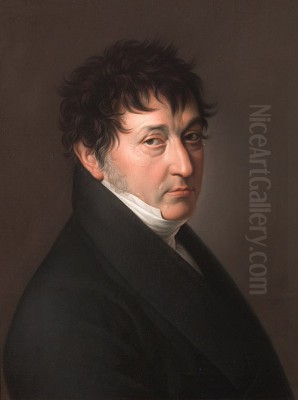
Zacarías González Velázquez, born in Madrid on November 5, 1763, and passing away in the same city on January 30, 1834, stands as a significant, if sometimes overlooked, figure in the rich tapestry of Spanish art. His life and career spanned a tumultuous period in Spanish history, witnessing the final flowering of the Enlightenment under Charles III, the complex reign of Charles IV, the upheaval of the Napoleonic Wars, and the subsequent restoration and troubled reign of Ferdinand VII. As a prolific painter, esteemed academician, and eventual director of the prestigious Royal Academy of Fine Arts of San Fernando, González Velázquez navigated these changing tides, leaving behind a body of work that primarily reflects the prevailing Neoclassical ideals of his time, yet often retains a sensitivity and warmth inherited from earlier Spanish traditions.
Artistic Lineage and Early Formation
Zacarías was born into a veritable dynasty of artists. His father was the respected painter Antonio González Velázquez (1723–1793), who himself had studied in Italy under Corrado Giaquinto and later became Director of the Royal Academy of San Fernando. Zacarías's grandfather, Pablo González Velázquez, was a sculptor, and his uncles, Luis and Alejandro González Velázquez, were also prominent painters and architects, deeply involved in the artistic life of the Spanish court and the Academy. This familial environment undoubtedly provided Zacarías with his initial artistic immersion.
His formal training began under the tutelage of his future brother-in-law, Mariano Salvador Maella (1739–1819). Maella was a towering figure in late 18th-century Spanish art, a contemporary and, at times, a rival of Francisco Goya. Maella, alongside Anton Raphael Mengs (1728–1779) – the German painter who became a dominant force in Spanish Neoclassicism – played a crucial role in steering Spanish art towards the clarity, order, and classical ideals of the Neoclassical movement. Studying with Maella would have instilled in Zacarías a strong foundation in drawing, composition, and the prevailing aesthetic tastes of the court.
Following his apprenticeship with Maella, Zacarías González Velázquez enrolled in the Royal Academy of Fine Arts of San Fernando in Madrid. The Academy, founded in 1752, was the epicenter of artistic training and theory in Spain, promoting a curriculum based on the study of classical antiquity, Renaissance masters, and rigorous anatomical understanding. Here, he would have been exposed to the works and teachings of other leading academicians and further honed his skills. His talent was recognized early, and he began to build a reputation for his meticulous technique and his ability to capture a dignified likeness in portraiture, as well as his proficiency in religious and allegorical subjects.
The Artistic Climate of Late 18th-Century Spain
The late 18th century in Spain was a period of significant artistic transition. The exuberant, decorative Rococo style, championed by artists like Luis Paret y Alcázar (1746–1799), was gradually giving way to the more austere and morally edifying principles of Neoclassicism. This shift was actively promoted by the Bourbon monarchy and influential figures within the Royal Academy, who saw Neoclassicism as a style befitting an enlightened and ordered state.
Painters like Francisco Bayeu y Subías (1734–1795) and his brother Ramón Bayeu (1744-1793), both of whom worked extensively on royal commissions and were influential figures at the Academy, were key proponents of this evolving classical taste, often blending it with lingering Baroque dynamism. The influence of Mengs, though he died in 1779, continued to resonate powerfully, emphasizing clarity of line, idealized forms, and subjects drawn from classical history and mythology. It was within this environment, with its emphasis on academic rigor and classical ideals, that Zacarías González Velázquez matured as an artist. The detailed study of human anatomy, mentioned as a characteristic of his work, was indeed a cornerstone of academic training during this period, essential for accurately depicting the human form in historical, mythological, and religious narratives.
Rise to Prominence and Court Painter
Zacarías González Velázquez's career steadily advanced. His skill and adherence to academic principles earned him respect and commissions. A significant milestone was his appointment as an academician of merit at the Royal Academy of San Fernando in 1790. This was a mark of distinction and placed him firmly within the established art world of Madrid.
His career reached its zenith during the reign of Charles IV (reigned 1788–1808). In 1801, Zacarías González Velázquez was honored with the prestigious title of Pintor de Cámara (Court Painter). This appointment was a testament to his artistic abilities and his standing within the courtly circles. As a court painter, he would have been responsible for a variety of tasks, including official portraits of the royal family and other dignitaries, as well as decorative schemes for royal palaces and religious paintings for royal chapels. This period saw him working alongside other prominent court artists, including the incomparable Francisco Goya (1746–1828) and his own mentor, Mariano Salvador Maella.
Artistic Style: Neoclassicism with Spanish Sensibilities
The predominant style of Zacarías González Velázquez is Neoclassicism. His works generally exhibit the hallmarks of this movement: clarity of composition, precise draughtsmanship, smooth brushwork, idealized figures, and often, a sense of calm and order. He drew inspiration from classical art and Renaissance masters, adhering to the academic principles promoted by the Royal Academy.
However, his Neoclassicism was not always rigidly doctrinaire. Traces of earlier Spanish Baroque traditions, particularly in terms of color, dramatic lighting in some religious scenes, and a certain emotional warmth, can often be discerned in his work. This blend is not uncommon in Spanish Neoclassicism, which often assimilated classical ideals without entirely abandoning the expressive power and rich painterly qualities of the nation's artistic heritage, as seen in the works of masters like Diego Velázquez (1599–1660) – no direct relation, despite the shared surname – and Bartolomé Esteban Murillo (1617–1682).
His detailed study of human anatomy, a fundamental aspect of 18th-century academic painting, informed his figure drawing, lending his subjects a sense of solidity and correctness, even when idealized. While he may not be primarily remembered for groundbreaking anatomical studies in the manner of a medical illustrator, the accurate depiction of the human form was integral to his history paintings, religious scenes, and even his portraits.
Key Works and Thematic Concerns
Zacarías González Velázquez was a versatile artist, proficient in various genres, including religious painting, portraiture, historical subjects, and decorative schemes.
Religious Paintings:
Religious themes formed a significant part of his output, a common expectation for artists of his time, given the continued importance of the Church as a patron.
One of his notable early works is The Virgin Mary with the Head of a Moor (or Mary Magdalene and the Head of an Arab), dated 1793. This painting, possibly a preparatory sketch or a smaller devotional piece, likely refers to a specific iconographic tradition or a local legend. It is described as a study for larger works, Calvary and The Martyrdom of St. Peter, intended for Seville Cathedral, showcasing his engagement with grand religious narratives.
His rendition of The Last Supper, created as a mural for the Gracia Church, would have demanded considerable skill in composition and the depiction of varied human emotion within a solemn and iconic scene.
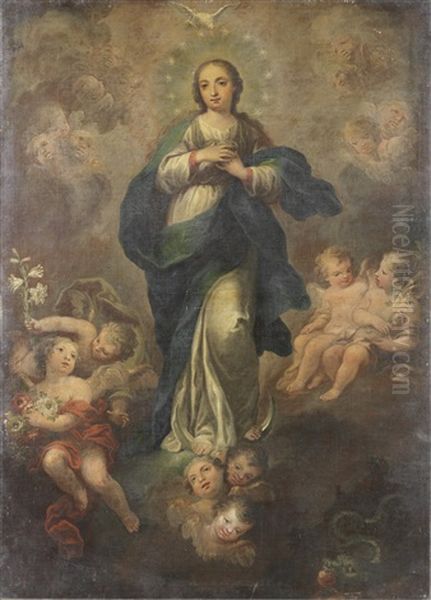
Another significant religious work is The Miracle of St. Casilda. This painting is often cited as an example where Baroque influences, such as dramatic composition and rich coloration, are more apparent, demonstrating his ability to adapt his style to the subject matter and perhaps the preferences of the patron. He also executed works for the Toledo Cathedral, a major ecclesiastical center.
Portraiture:
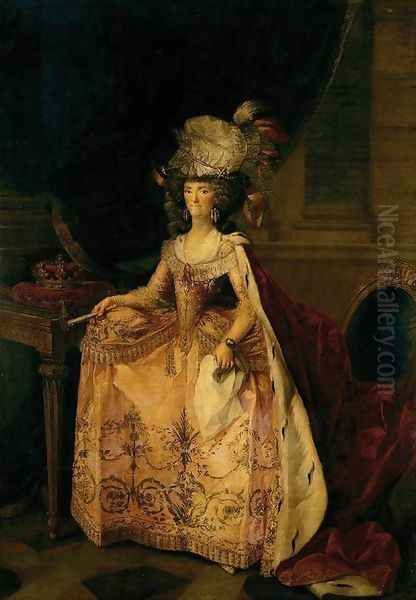
As a court painter, portraiture was a crucial aspect of Zacarías's oeuvre. He painted members of the royal family and other prominent figures. His Portrait of María Luisa of Parma, wife of Charles IV, would have been an important commission. In his portraits, he generally aimed for a dignified and accurate likeness, often imbuing his sitters with the poise and decorum expected of their station, typical of Neoclassical portraiture. These portraits served not just as personal mementos but also as statements of power and status. He also painted portraits of individuals within his family and professional circle, reflecting the social networks of artists at the time.
Historical and Allegorical Works:
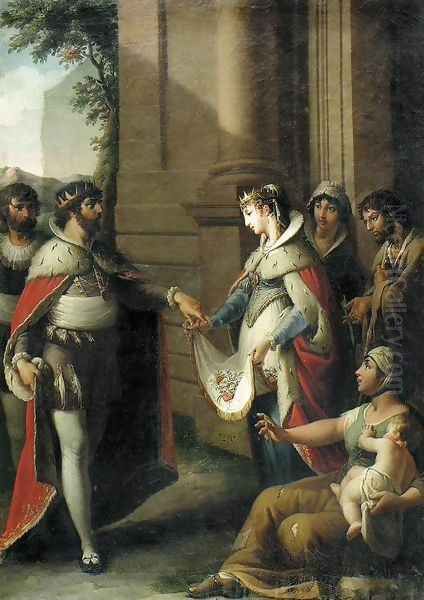
González Velázquez also tackled historical and allegorical subjects. The Union of Spain and Castile is an example of a work with a patriotic or historical theme, likely intended to celebrate national identity or a significant historical event. Such paintings often required complex compositions, a large cast of figures, and a clear narrative, all hallmarks of academic history painting.
Decorative Schemes:
His involvement in decorative projects for royal palaces and other significant buildings was also part of his duties. This could range from large-scale allegorical ceiling paintings to smaller decorative panels. One such project involved a large landscape painting depicting Charles IV and Manuel Godoy (the powerful Prime Minister) hunting in Aranjuez. This work was later engraved by Francisco de Paula Martí (1761–1827), a notable engraver of the period, which helped disseminate the image.
Collaborations and Contemporaries
The artistic world of Madrid was relatively close-knit, and collaborations and interactions among artists were common. Zacarías González Velázquez worked alongside and in the shadow of some of Spain's greatest artists.
His relationship with Mariano Salvador Maella was foundational, as Maella was his teacher and later his father-in-law. They would have shared similar artistic circles and likely collaborated or consulted on various projects.
His contemporary, Francisco Goya, was undoubtedly the most dominant artistic personality of the era. While Goya's artistic trajectory would take him into realms far beyond academic Neoclassicism, during Zacarías's active period, Goya was also a court painter and a member of the Academy. There is a record of González Velázquez participating in the creation of a grisaille painting, St. Elizabeth of Hungary Healing the Sick, which was one of Goya's final commissions as a court painter. Living and working in such proximity to a genius like Goya must have been both inspiring and challenging.
He is also known to have collaborated with Vicente López Portaña (1772–1850). López Portaña, slightly younger, would become the leading court painter after the decline of Goya's royal favor and was known for his polished Neoclassical style and exceptional skill in portraiture. Their joint works would have combined their respective talents.
Collaboration with the engraver Francisco de Paula Martí on the Aranjuez hunting scene highlights how paintings were often translated into prints for wider distribution, a common practice that increased an artist's visibility.
He also worked with Carlos Marrero on some religious pieces, indicating a network of artists specializing in different aspects or sharing large commissions.
Other notable painters of the period whose paths he might have crossed or whose work would have been familiar include José Camarón Bonanat (1731-1803), known for his Rococo charm and later more Neoclassical works, and Gregorio Ferro (1742-1812), another prominent academician and painter to the King. The generation that followed, such as José de Madrazo y Agudo (1781–1859), who became a staunch advocate for Neoclassicism after studying in Paris with Jacques-Louis David, would continue the classical tradition, though Romanticism was also beginning to take hold.
The Royal Academy of San Fernando: A Lifelong Association
The Royal Academy of Fine Arts of San Fernando was central to Zacarías González Velázquez's career. Having entered as a student and risen to become an academician of merit in 1790, he remained deeply involved with the institution. His dedication and standing among his peers led to his appointment as Director of the Academy, a position he held from 1828 to 1831. This was the pinnacle of an academic career, signifying leadership in the artistic education and cultural life of Spain. He also served as a painting teacher for the Bank of San Carlos (a precursor to the Bank of Spain), further contributing to the training of artists.
Challenges, Later Career, and the Napoleonic Era
The period of Zacarías González Velázquez's mature career was marked by profound political instability. The French Revolution (from 1789) sent shockwaves across Europe, and Spain's relationship with France fluctuated dramatically. The Napoleonic invasion of Spain in 1808 and the subsequent Peninsular War (1808–1814) devastated the country and profoundly disrupted artistic patronage and production. Many artists faced difficult choices regarding allegiance and survival.
For court painters like González Velázquez, the situation would have been particularly precarious. The abdication of Charles IV and Ferdinand VII, and the imposition of Joseph Bonaparte as King, created a complex political landscape. After the restoration of Ferdinand VII in 1814, artists had to navigate the new political realities.
Despite these upheavals, González Velázquez continued to work. An exhibition of his works in Salamanca in 1821 is noted, where his paintings were reportedly considered somewhat "avant-garde and controversial." This is an intriguing comment, as Neoclassicism was generally the established norm. It might suggest that in certain provincial contexts, his sophisticated academic style could still appear novel, or perhaps he was experimenting in ways not fully captured by his major known works.
A church decoration project undertaken in 1794 faced interruptions due to economic difficulties, a common issue for large-scale artistic endeavors, especially in uncertain times. However, he is noted to have completed his part of the work, demonstrating his professionalism.
Technique and Craftsmanship
Zacarías González Velázquez was a skilled craftsman, well-versed in the oil painting techniques of his time. His academic training emphasized strong drawing as the foundation of painting. His brushwork was generally smooth and controlled, aiming for a polished finish, especially in official portraits and allegorical works, though a more painterly approach might be evident in sketches or less formal pieces.
His compositions were carefully planned, often based on classical principles of balance and harmony. He had a good understanding of color theory as taught in the academies, and his palette could range from the restrained tones typical of Neoclassicism to richer, more vibrant colors in religious scenes or decorative works. The use of light and shadow (chiaroscuro) was employed to model forms and create a sense of volume, though generally without the dramatic extremes of the earlier Baroque.
The mention of "complex oil techniques" and "multi-layered application" suggests a methodical approach to building up the paint surface, using glazes and opaque layers to achieve depth, luminosity, and richness of texture. While anachronistic terms like "collage" are unlikely to apply in their modern sense, artists of the period were certainly adept at compositional borrowing and creating complex visual narratives through the juxtaposition of figures and symbols. His work Funeral Procession of María Isabel de Braganza (wife of Ferdinand VII, who died in 1818 and was a key figure in the founding of the Prado Museum) is praised for its delicate brushwork and rich colors, showcasing his ability to handle complex multi-figure compositions with sensitivity.
Legacy and Historical Position
Zacarías González Velázquez occupies a respectable place in the history of Spanish art, particularly as a representative of the Neoclassical movement during a pivotal era. While he may not have achieved the revolutionary genius of Goya or the enduring fame of earlier Spanish masters, he was a highly competent, productive, and respected artist who fulfilled important roles as a court painter, a creator of significant religious and public art, and a leader within the Royal Academy.
His work reflects the artistic ideals and tastes of his time, providing valuable insight into the cultural life of the Spanish court and the academic establishment. He successfully navigated the transition from the late Baroque/Rococo sensibilities towards a more dominant Neoclassicism, contributing to the visual culture of Spain through his portraits, religious paintings, and decorative works. His role as an educator and director of the Academy also underscores his commitment to the artistic standards and training of his era.
He is part of a distinguished lineage of Spanish painters who maintained a high level of craftsmanship and artistic integrity. While perhaps not an innovator in the mold of Goya, he was a significant practitioner who upheld and disseminated the prevailing artistic language of his time. His paintings are found in important Spanish collections, including the Prado Museum in Madrid, and continue to be studied for their artistic merit and historical context.
Conclusion
Zacarías González Velázquez was a dedicated and skilled artist whose career unfolded against the backdrop of profound change in Spain. Born into an artistic family, trained by leading figures like Mariano Salvador Maella, and rising to the esteemed position of Court Painter and Director of the Royal Academy of San Fernando, he embodied the ideals of academic Neoclassicism. His extensive oeuvre, encompassing portraits, religious scenes, historical subjects, and decorative works, showcases a mastery of technique and a commitment to the artistic standards of his age. While working alongside giants like Goya, Zacarías González Velázquez carved out his own significant niche, contributing to the rich artistic heritage of Spain and leaving behind a legacy as a key figure of the Neoclassical period. His life and work offer a window into the artistic, cultural, and political currents that shaped Spain at the turn of the 19th century.