George Pyne (circa 1800–1884) stands as a significant, if sometimes overlooked, figure in the rich tradition of British watercolour painting. His particular niche was the depiction of venerable academic and institutional architecture, most notably the ancient colleges of Oxford and Cambridge. Through his meticulous brushwork and keen eye for detail, Pyne not only created aesthetically pleasing works but also preserved a visual record of these iconic structures as they stood in the 19th century. His art offers a window into the enduring allure of Britain's architectural heritage, rendered with a sensitivity that speaks to both his technical skill and his appreciation for his subjects.
Early Life and Artistic Formation
Born around the year 1800, George Pyne was immersed in an artistic environment from a young age. He was the son of William Henry Pyne (1769–1843), himself a notable watercolourist, writer, and a somewhat flamboyant figure known for his book "Wine and Walnuts" and his contributions to Rudolph Ackermann's "Microcosm of London." This familial connection undoubtedly provided George with early exposure to the techniques and professional world of art.
A pivotal influence on Pyne's artistic development was his association with John Varley (1778–1842). Varley was a leading watercolour painter and a highly respected teacher, whose pupils included luminaries such as David Cox, Copley Fielding, John Linnell, and William Turner of Oxford. Pyne not only studied under Varley but also married one of his daughters, further cementing his connection to this influential artistic circle. Varley's systematic approach to landscape composition and his mastery of watercolour washes would have profoundly shaped Pyne's own style, particularly in the handling of light, atmosphere, and architectural form.
Artistic Style and Preferred Medium
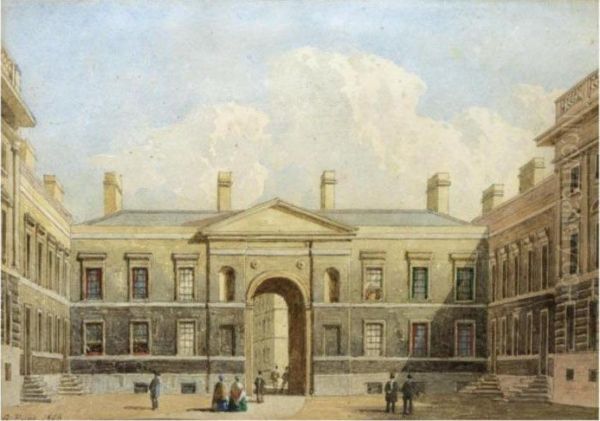
George Pyne predominantly worked in watercolour, a medium that enjoyed immense popularity in Britain during the 19th century, championed by artists like J.M.W. Turner and Thomas Girtin. Pyne developed a distinctive style well-suited to his architectural subjects. He was particularly adept at capturing the varied textures of ancient stone, from the weathered facades of college buildings to the intricate carvings of chapels and gateways. His palette was often subtle, emphasizing the natural hues of stone and brick, enlivened by touches of local colour in foliage or figures.
A characteristic feature often noted in Pyne's work is the rendering of human figures. These figures, typically students, dons, or passers-by, are often depicted with somewhat elongated limbs, particularly their legs. While perhaps a stylistic idiosyncrasy, these figures serve to animate his scenes and provide a sense of scale to the grand architecture surrounding them. Pyne's draughtsmanship was precise, allowing him to render complex architectural details with accuracy, yet his work rarely feels sterile or merely topographical. He possessed a talent for imbuing his scenes with a sense of place and atmosphere, often achieved through the skillful manipulation of light and shadow, a technique honed perhaps through his studies with Varley. He also utilized pencil and white heightening to enhance details and highlights in some of his compositions.
The Hallowed Halls: Oxford and Cambridge
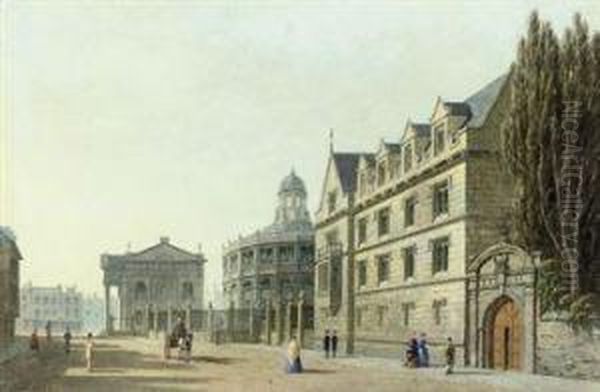
The colleges of Oxford and Cambridge were Pyne's most frequent and celebrated subjects. These ancient seats of learning, with their centuries of history embedded in their quadrangles, chapels, and libraries, offered a wealth of inspiration. Pyne meticulously documented these environments, capturing not just the grand set-pieces but also more intimate corners and views. His works appealed to alumni, current members of the universities, and the wider public fascinated by these historic institutions.
His depictions of Oxford include views of Christ Church, renowned for its magnificent Tom Tower and expansive Tom Quad, as well as New College, with its historic gardens and cloisters. Works such as "Canterbury Quad, Christ Church, Oxford" and "Peckwater Quad, Christ Church, Oxford" are prime examples of his focus. Similarly, his Cambridge scenes would have captured the unique character of colleges like King's, with its world-famous chapel, or St John's, with its iconic Bridge of Sighs. These paintings were more than just architectural records; they evoked the scholarly atmosphere and the picturesque beauty of these university towns. Artists like Samuel Prout and David Roberts also excelled in architectural subjects, but Pyne carved out a specific identity with his sustained focus on these academic institutions.
Representative Works and Other Subjects
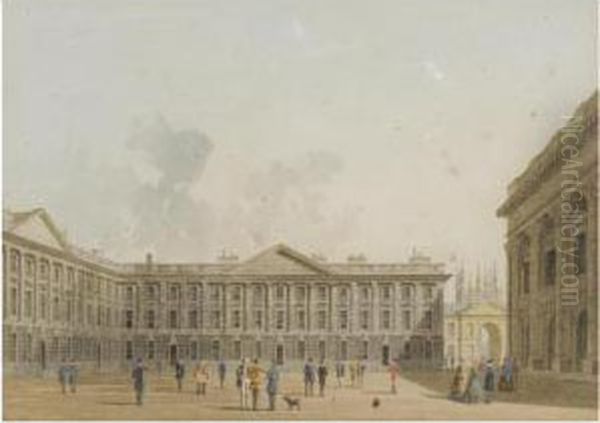
Beyond his extensive work in Oxford and Cambridge, George Pyne also turned his attention to other significant British institutions and landscapes. He is known to have painted views of the Royal Naval College in Greenwich, another complex of historic and architectural importance. His oeuvre also includes landscapes and urban scenes from other parts of Britain.
Among his representative works, several stand out:
"Canterbury Quad, Christ Church, Oxford": This piece would showcase his ability to render the classical architecture of the quadrangle, likely focusing on the interplay of light on the stonework and the sense of enclosed space.
"Peckwater Quad, Christ Church, Oxford": Another view within Christ Church, this would again highlight his skill in depicting grand collegiate architecture.
"Garden of New College, Oxford": This subject suggests a departure into the more picturesque elements of the university, combining architecture with cultivated nature.
"Tom Tower & Christ Church College, Oxford": A classic view, capturing one of Oxford's most recognizable landmarks.
"Floating Harbour, Bristol, looking towards the Prince Street Bridge with St Mary Redcliffe": This work, described as being executed in watercolour, pencil, and white heightening, demonstrates Pyne's interest in maritime and urban landscapes beyond the university towns. It shows his versatility in capturing different types of architectural settings and atmospheric conditions.
"A View of Boppard on the Rhine near Coblenz": This indicates that Pyne, like many British artists of his time such as Clarkson Stanfield or Samuel Owen, may have travelled to the continent, seeking picturesque subjects along the Rhine, a popular destination for artists.
"Cottage at Kenestone Beds": This title suggests a more rustic, rural subject, showcasing a different facet of his artistic interests, perhaps akin to the cottage scenes favored by artists like Myles Birket Foster, albeit likely in Pyne's more precise style.
These works, whether grand institutional portraits or more modest landscapes, consistently display Pyne's careful observation and refined watercolour technique.
Exhibitions and Professional Life
George Pyne was an active participant in the London art scene. He exhibited his works at various prestigious venues, which was crucial for an artist's reputation and livelihood in the 19th century. Records show his participation in exhibitions organized by the Oxford Art Committee and the St. Bartholomew's Art Society.
More significantly, he was associated with the Society of Painters in Water-Colours (often referred to as the O.W.C.S. or later the Royal Watercolour Society), a key institution for promoting the medium. He is noted as having exhibited with them, likely between 1826 and into the 1840s or later, given his lifespan. He also exhibited with the Society of British Artists (S.B.A.), located at Suffolk Street, another important venue for artists who were not members of the Royal Academy. These affiliations placed him within the mainstream of British art practice, alongside contemporaries who were shaping the course of watercolour painting and architectural depiction.
Pyne in the Context of His Contemporaries
To fully appreciate George Pyne's contribution, it is essential to view him within the broader context of 19th-century British art. The era was a golden age for watercolour. Artists like David Cox and Peter De Wint, fellow pupils of John Varley, were renowned for their expressive landscapes. J.M.W. Turner, of course, pushed the boundaries of the medium to unprecedented heights of atmospheric and chromatic brilliance.
In the realm of architectural and topographical art, Samuel Prout was a major figure, celebrated for his picturesque depictions of European cathedrals and cityscapes, often with a slightly romanticized, crumbly texture. David Roberts achieved fame with his views of the Near East and Spain, grand in scale and meticulous in detail. Thomas Shotter Boys was another notable artist in this field, particularly for his lithographs of London and Paris. While Pyne's focus was more specifically on British academic institutions, his work shares with these artists a commitment to accurate representation combined with an aesthetic sensibility. His style, influenced by Varley, was perhaps more controlled and less overtly romantic than some of his contemporaries, but it possessed a quiet dignity and clarity well-suited to his subjects. One might also consider the work of artists like Frederick Mackenzie or Augustus Pugin, who also specialized in architectural renderings, often with an antiquarian interest.
Critical Reception and Market Presence
The art historian Huon Mallalieu, in his comprehensive "Dictionary of British Watercolour Artists," acknowledges George Pyne's technical proficiency. Mallalieu specifically praises Pyne's skill in rendering the texture of old stone, a crucial element in convincingly portraying the ancient college buildings that were his specialty. This commendation from a respected authority underscores Pyne's capabilities as a watercolourist.
In terms of market presence, works by George Pyne continue to appear at auction. For instance, his painting "Floating Harbour, Bristol, looking towards the Prince Street Bridge with St Mary Redcliffe" was offered with an estimate of £400-£600 at Dominic Winter Auctioneers. "A View of Boppard on the Rhine near Coblenz" appeared at Lawrence Auctions with an estimate of £600-£800. A watercolour titled "Cottage at Kenestone Beds" was listed at Parker Fine Art Auctions with an estimate of £150-£250. While these are estimates and not necessarily final sale prices, they indicate a continued, albeit modest, collector interest in his work. His paintings are held in various collections, including at Christ Church, Oxford, and have been exhibited in institutions like the "British Roy PVI" (likely a reference to a Royal institution or exhibition).
Disambiguation: A Note on Other George Pynes
It is important to distinguish George Pyne the artist (c.1800-1884) from other individuals named George Pyne who appear in historical records. For example, a George Pyne (born 1841) served as a sailor in the U.S. Navy during the American Civil War and was awarded the Medal of Honor. This individual is entirely separate from the British architectural painter. Similarly, references to a George Pyne involved with an architectural firm "Gardner, Pyne & Gardner" in the later 19th century likely pertain to a different person, possibly an architect, and should not be confused with the watercolourist who is the subject of this discussion. Such distinctions are crucial for accurate art historical scholarship.
Enduring Legacy
George Pyne's legacy lies in his dedicated and skillful portrayal of Britain's architectural heritage, particularly its revered universities. His watercolours are more than just topographical records; they are imbued with a sense of the history and atmosphere of these unique places. In an era before widespread photography, artists like Pyne played a vital role in disseminating images of important landmarks and shaping public perception of them.
His work provides valuable insights into the appearance of these institutions in the 19th century, capturing details that may have since been altered or lost. For art historians, his paintings offer a case study in the application of traditional watercolour techniques to architectural subjects. For those with an affection for Oxford, Cambridge, or the broader tradition of British watercolour, Pyne's art remains a source of quiet pleasure and historical interest. He may not have achieved the widespread fame of a Turner or a Constable, but within his chosen specialty, George Pyne was a master, leaving behind a body of work that continues to be appreciated for its precision, charm, and historical significance.
Conclusion
George Pyne (c.1800–1884) was a talented British watercolourist who carved a distinct niche for himself as a chronicler of academic and institutional architecture. Influenced by his artist father, W.H. Pyne, and his esteemed father-in-law and teacher, John Varley, he developed a meticulous style well-suited to capturing the grandeur and intricate detail of colleges in Oxford and Cambridge. His works, characterized by their accurate rendering of stone textures and distinctive, elongated figures, offer an invaluable visual record of these historic sites. Exhibiting alongside many prominent artists of his day, Pyne contributed to the rich tapestry of 19th-century British art. While perhaps not as revolutionary as some of his contemporaries, his dedication to his specialized subject matter and his technical skill ensure his enduring, if quiet, place in the annals of British art history. His paintings remain a testament to the timeless beauty of Britain's architectural treasures and the enduring appeal of the watercolour medium.