The annals of art history are rich with talent, yet occasionally, the recurrence of a surname across different disciplines or eras can lead to a fascinating, if sometimes complex, tapestry of identities. The name "Webster" resonates in various artistic fields, from architecture and painting to drama and glass art. This exploration primarily focuses on George Webster (1797-1864), a significant architect hailing from Kendal, Westmorland, whose work left an indelible mark on the landscape of Northern England. We will also navigate the contributions of other notable Websters to appreciate the breadth of artistic endeavor associated with this name, ensuring clarity and historical accuracy.
George Webster (1797-1864): The Architect of Kendal
George Webster, born in Kendal, Westmorland, in 1797, was destined for a life in architecture. He emerged from a lineage deeply rooted in the building trades; his father, Francis Webster, was a respected mason, builder, and architect, known for his craftsmanship, particularly in creating marble chimneypieces and funerary monuments. This familial immersion provided young George with a practical and foundational understanding of materials and construction from an early age, an invaluable asset that would inform his later professional practice.
His upbringing in such an environment meant that George Webster was not merely an academic designer but one who understood the very fabric of buildings. This hands-on heritage likely contributed to the robustness and practicality often seen in his designs, complementing their aesthetic qualities. The North of England, with its distinct stone and rugged landscapes, would become the primary canvas for his architectural expressions.
Early Career and Formative Works
George Webster's prodigious talent manifested early. By the tender age of twenty-one, around 1818, he had already undertaken his first significant commission: the design of Read Hall in Lancashire. This early success was a clear indicator of his capabilities and set the stage for a prolific career. Read Hall, a substantial country house, would have presented a considerable challenge for a young architect, demanding skills in planning, design, and project management. Its successful completion undoubtedly bolstered his reputation and confidence.
Following this, Webster established a thriving practice centered in Kendal, extending his influence across Cumbria and the surrounding regions. His architectural office became a hub of design activity, responsible for a wide array of projects. While country houses formed a significant portion of his oeuvre, his versatility saw him design numerous other structures, including lodges, gatehouses, stables, garden terraces, and various estate buildings, all contributing to the cohesive aesthetic of the properties he worked on.
Architectural Styles and Influences
George Webster's architectural output was characterized by a remarkable stylistic diversity, reflecting the eclectic tastes of the 19th century and his adaptability to different project requirements and client preferences. He was not rigidly wedded to a single style but demonstrated proficiency across several prevailing architectural idioms of his time.
A significant portion of his work, particularly in ecclesiastical architecture, embraced the Gothic Revival style. This movement, which gained considerable momentum throughout the 19th century, sought to revive medieval Gothic forms and spiritual associations. Webster designed at least thirteen churches and undertook alterations to several others. While many of his rural churches were modest in scale, fitting harmoniously into their village settings, he also designed larger, more imposing churches in Kendal itself. Notable examples include St. Thomas's Church (1835-1837) and St. George's Church (1838-1841). These buildings typically featured characteristic Gothic Revival elements such as pointed arches, traceried windows, steeply pitched roofs, and often, prominent towers or spires. His interpretation of Gothic was often robust and well-proportioned, suited to the local stone.
Beyond the Gothic, Webster also adeptly employed Neoclassical and Italianate/Renaissance Revival styles, particularly for his domestic and civic commissions. Neoclassicism, with its emphasis on symmetry, proportion, and classical orders derived from ancient Greek and Roman architecture, lent an air of dignity and permanence to his country houses and public buildings. Elements such as porticoes, pediments, and classical columns or pilasters can be found in these designs. The Italianate style, inspired by Italian Renaissance villas, offered a picturesque asymmetry, often featuring low-pitched roofs, overhanging eaves with decorative brackets, and sometimes towers or loggias.
His ability to blend these styles, or to select the most appropriate one for a given context, was a hallmark of his practice. He was also sensitive to local building traditions and materials, often incorporating vernacular elements that grounded his buildings in their specific Cumbrian settings. This resulted in an architectural portfolio that was both diverse and regionally distinctive.
Key Architectural Achievements
Throughout his career, George Webster was responsible for a significant number of important commissions, particularly large country houses that defined the social and aesthetic landscape of the region. Among his most celebrated works are:
Read Hall, Lancashire: His first major commission, establishing his reputation.
Broughton Hall, North Yorkshire: Likely involved in significant alterations or additions, showcasing his ability to work with existing structures and enhance their grandeur. Country Life archives often feature such houses, and architects like Webster were pivotal in their 19th-century evolution.
Thurland Castle, Lancashire: This project likely involved substantial restoration or rebuilding, possibly in a romantic, castellated Gothic style, a popular choice for historic properties seeking to emphasize their ancient lineage. Architects like James Wyatt or Anthony Salvin were also known for such work, placing Webster in a tradition of country house and castle revivalists.
Eshton Hall, North Yorkshire: Another significant country house commission, further cementing his status as a leading architect for the gentry and aristocracy of Northern England.
These projects, and many others, demonstrated his mastery in planning grand residences that were not only aesthetically pleasing but also functional for the complex social life of the 19th-century elite. He designed not just the main houses but often entire estates, including gate lodges, stables, and landscaped grounds, creating a holistic architectural vision.
Public Life: Mayor of Kendal
Beyond his architectural practice, George Webster was a respected figure in his community. His standing was such that he served as the Mayor of Kendal from 1829 to 1830. Notably, he succeeded his own father in this civic role, indicating the Webster family's prominence and influence in the town. This period as mayor would have involved him in the governance and development of Kendal, offering a different avenue for shaping the urban environment. His business acumen and personal charisma, often praised by contemporaries, would have served him well in this public capacity.
His involvement in civic life underscores a common trait among successful provincial architects of the era, who were often deeply embedded in their local communities, contributing not just through their professional skills but also through public service.
Personal Life and Legacy
George Webster married Eleanor Lovell, who was notably twenty-five years his junior and hailed from Ulverston in Lancashire. The couple had seven children, establishing a significant family. His personal life, like that of many professional men of his era, was intertwined with his career, with his home and office likely being centers of both family and business activity.
He passed away in 1864 at the age of 67, leaving behind a substantial legacy. This legacy was not only in the physical form of the many buildings he designed but also in a rich archive of architectural drawings, business correspondence, and personal records, including travel diaries. These documents, some of which may include unpublished manuscripts detailing his architectural philosophies and experiences, provide invaluable insights into his practice, his design process, the challenges he faced, and the broader architectural world of 19th-century Northern England. Such archives are crucial for art historians and researchers seeking to understand the nuances of architectural practice during this period. His influence on the architectural character of Kendal and Cumbria remains evident today.
Navigating the Websters: Other Notable Figures in Art and Literature
The name Webster, as mentioned, appears in connection with several other distinguished individuals in the arts. To avoid confusion and to appreciate the diverse talents associated with the name, it is pertinent to briefly discuss these other figures, whose lives and works sometimes intersect in historical records or popular understanding.
Thomas Webster (1800-1886): The Celebrated Genre Painter
A contemporary of George Webster the architect, but distinct from him, was Thomas Webster RA, a highly regarded English painter of genre scenes. Born in Pimlico, London, Thomas Webster initially trained as a musician but soon turned to painting, enrolling in the Royal Academy Schools. He achieved considerable success and popularity for his charming and often humorous depictions of everyday rural life, particularly scenes involving children and village activities.
His style was characterized by careful observation, a warm palette, and a gentle sentimentality that appealed greatly to Victorian audiences. Works like "The Village Choir" (1847), "A Dame's School" (1845), and "The Playground" (1852) are exemplary of his focus on the innocence of childhood, education, and communal village life. "The Early Lesson" (1846) is another piece that highlights his interest in educational themes and the tender interactions within families or small school settings.
Thomas Webster was a prominent member of the Cranbrook Colony, an informal group of artists who settled in Cranbrook, Kent, from the 1850s onwards. This group, which included figures like Frederick Daniel Hardy, George Hardy, and John Callcott Horsley, focused on idyllic and nostalgic portrayals of rural English life. Thomas Webster was a central figure in this colony.
His work shows the influence of 17th-century Dutch and Flemish genre painters such as David Teniers the Younger and Jan Steen, who were masters of depicting peasant life and everyday scenes with vivid detail and character. In the British context, his work can be seen in the tradition of earlier British genre painters like Sir David Wilkie and William Mulready. Indeed, Thomas Webster had close connections with Mulready, who was also a leader within the Cranbrook Colony artists' circle and whose meticulous technique and focus on everyday subjects resonated with Webster's own artistic aims. He, in turn, influenced a younger generation of painters, including A.E. Mulready (son of William Mulready).
While Thomas Webster's focus was primarily on human interactions and narrative, the broader artistic landscape of his time included landscape masters like J.M.W. Turner and John Constable, and even the American painter Thomas Cole (a key figure in the Hudson River School), all of whom were exploring different facets of nature and human experience in the 19th century. Thomas Webster's contribution was a specific and cherished vision of English rural identity. He also collaborated with artists like Joshua Cristall, William Havell, and the brothers Cornelius Varley and John Varley in exploring the picturesque landscapes of North and South Wales, which would have informed his understanding of rural settings.
John Webster (c. 1578 – c. 1632): The Jacobean Dramatist
Venturing much further back in time, we encounter John Webster, a towering figure of Jacobean drama. A contemporary of William Shakespeare, Ben Jonson, and Thomas Middleton, John Webster is best known for his dark and powerful tragedies, which explore themes of corruption, revenge, madness, and the complexities of human nature.
His two most famous plays, "The White Devil" (c. 1612) and "The Duchess of Malfi" (c. 1613-1614), are considered masterpieces of English Renaissance drama. These works are characterized by their intense psychological portraits, their poetic and often macabre language, and their unflinching depiction of violence and moral decay in high society, particularly within the Italianate settings he favored. His characters often grapple with overwhelming passions and societal constraints, leading to tragic and often gruesome conclusions.
John Webster's dramatic style is marked by a profound sense of melancholy, a fascination with the grotesque, and a powerful use of imagery. While sometimes criticized by contemporaries and later critics for the perceived sensationalism or "borrowing" from other authors in his "sententiae" or pithy sayings, his ability to create an atmosphere of brooding intensity and to craft memorable, complex characters, especially strong female protagonists like the Duchess of Malfi, is undeniable. His work offers a stark contrast to the more optimistic or romantic strains in Renaissance literature, aligning him more with the "malcontent" tradition and the intellectual currents that questioned established orders. His emotional intensity, while significant, is often considered by scholars to be within the dramatic norms of his era, comparable in its own way to the emotional range found in Shakespeare's tragedies.
Alfred Webster (fl. late 19th – early 20th century): The Glass Artist
The information provided also mentions a "George Webster" as a glass artist, sometimes identified as Alfred Webster. This likely refers to Alfred Webster, son of the notable Glasgow stained-glass artist Stephen Adam. Alfred Webster followed in his father's footsteps and became a distinguished stained-glass artist in his own right, active in the late 19th and early 20th centuries, a period of great flourishing for the craft.
Alfred Webster inherited his father's mature figurative style but developed his own distinct approach. He was known for his innovative use of materials and techniques. He favored Norman Slabs – thick, often subtly colored (pale green or pink) glass with a distinctive texture – for their translucent qualities. He also mastered new acid-etching and abrading techniques to create varied surface effects and enhance the play of light.
His designs often featured figures set against backgrounds of heavily textured, white, marble-like glass, sometimes incorporating intricate micro-mosaics within a single window to create varying scales of detail. This created a rich, layered effect, full of color and vitality. His work, like much stained glass of the Arts and Crafts and Art Nouveau influenced periods, often carried symbolic meaning, exploring themes of creation, spirituality, and human endeavor. The legacy of artists like Christopher Whall or Louis Comfort Tiffany (in America) represents the broader international context of innovation in stained glass during this era, within which figures like Alfred Webster made their mark in Scotland.
George Webster: The Marine Painter (A Distinct Figure)
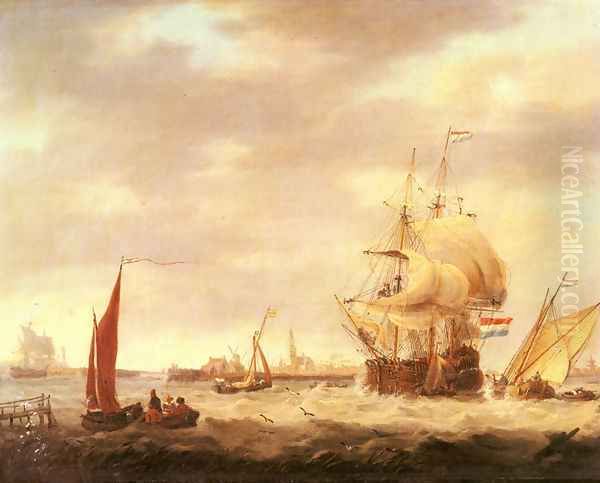
Adding to the complexity of the Webster name in art, there was another George Webster active as a painter, distinct from both the architect and Thomas Webster the genre painter. This George Webster was a marine painter who flourished primarily from the 1820s to the 1850s. While his exact birth and death dates are less definitively established than the architect's, he was a recognized artist in his field.
This George Webster specialized in maritime scenes, including depictions of merchant ships, fishing vessels, and coastal views. He is particularly noted for his paintings of scenes along the River Thames and the Dutch coast, such as the work titled "Merchant ship and fishing vessels off the Dutch coast." His paintings typically exhibit a good understanding of ship construction and rigging, and an ability to capture the atmosphere of the sea and sky.
He exhibited his works at prominent London institutions, including the Royal Academy of Arts (RA), the British Institution (BI), and the Royal Society of British Artists (RSBA) on Suffolk Street. This indicates a degree of professional recognition and engagement with the London art world. His work would have been contemporary with other marine painters such as Clarkson Stanfield and Edward William Cooke, who were also capturing Britain's maritime power and coastal scenery. It is important to distinguish this marine painter from George Webster of Kendal, the architect, to maintain clarity in their respective contributions. The initial information provided did, at one point, conflate the architect with this marine painter, highlighting the ease with which such confusions can arise.
Conclusion: The Enduring Mark of the Websters
George Webster (1797-1864) of Kendal stands as a significant figure in the architectural history of Northern England. His diverse portfolio, ranging from grand country houses like Read Hall and Thurland Castle to important civic and ecclesiastical buildings, demonstrates a mastery of various architectural styles and a deep understanding of his craft, inherited from his family's building tradition. His work not only shaped the physical landscape but also reflected the social and cultural aspirations of his time. His role as Mayor of Kendal further underscores his respected position within his community.
The broader art world also recognizes the contributions of Thomas Webster RA, the genre painter whose charming scenes of rural life captivated Victorian audiences and who played a key role in the Cranbrook Colony; John Webster, the Jacobean dramatist whose powerful tragedies continue to be studied and performed; Alfred Webster, the innovative stained-glass artist from Glasgow; and another George Webster, the marine painter.
Understanding these distinct individuals and their respective fields is crucial for a nuanced appreciation of art history. George Webster, the architect, remains a testament to the enduring power of well-conceived and skillfully executed buildings, his legacy preserved in stone and in the historical records that illuminate his life and career. His contributions, alongside those of the other Websters in their diverse artistic pursuits, enrich our understanding of the creative spirit across different eras and disciplines.