Giuseppe Falchetti: A Master of Italian Landscape and Light
Giuseppe Falchetti (1843-1918) stands as a significant figure in the landscape of 19th and early 20th-century Italian art. Renowned primarily for his evocative depictions of lakeside scenery, Falchetti's work captured the subtle nuances of light and atmosphere, earning him acclaim from both collectors and critics. Though he navigated an art world rich with diverse talents and evolving styles, Falchetti carved a distinct niche for himself through a blend of naturalism, a keen observational eye, and a later embrace of modern techniques like Divisionism. His journey from the Piedmontese town of Caluso to the artistic hub of Turin, and his interactions with prominent artistic currents, shaped a career that left an indelible mark on Italian painting.
Early Life and Formative Influences
Born in Caluso, a commune in the Metropolitan City of Turin in the Piedmont region of Italy, in 1843, Giuseppe Falchetti's artistic inclinations were likely nurtured from a young age. His father, also named Giuseppe Falchetti, was a painter specializing in landscapes and still lifes. This familial environment undoubtedly provided the younger Falchetti with his initial exposure to the world of art, offering an informal apprenticeship and a foundational understanding of composition, color, and technique. While some accounts suggest he did not receive extensive formal art training in his earliest years, the paternal influence was a crucial starting point.
As he matured, Falchetti made the pivotal decision to move to Turin, the capital of Piedmont and a vibrant center for arts and culture in Italy, especially following the Risorgimento. This move placed him in a more dynamic artistic milieu, offering greater opportunities for exposure, learning, and connection with other artists. It was in Turin that he would primarily base his career, becoming an active participant in its artistic life throughout the late 19th and early 20th centuries.
Artistic Development and Academic Grounding
Contrary to some suggestions of a purely autodidactic path, evidence indicates that Giuseppe Falchetti did pursue formal artistic education. He is recorded as having studied at the prestigious Bellini Art Academy (Accademia di Belle Arti di Napoli) in Naples from 1863 to 1869. Naples, at the time, was another major artistic center, and the Academy would have provided him with a rigorous academic training, focusing on drawing from life, classical principles, and the study of Old Masters. This period would have been instrumental in honing his technical skills and broadening his artistic horizons beyond the initial influence of his father.
Even before or during his Neapolitan studies, Falchetti was already making inroads into the Turin art scene. In 1862, he joined the Promotrice delle Belle Arti in Turin, an important society that organized regular exhibitions, providing a platform for artists to showcase their work and gain recognition. His involvement with the Promotrice indicates an early ambition and a desire to engage with the contemporary art world. Throughout his career, Falchetti remained deeply connected to Turin, a city that provided both a home and a consistent source of inspiration for his landscape paintings.
The Allure of the Landscape: Capturing Nature's Essence
Giuseppe Falchetti's most enduring legacy lies in his landscape paintings, particularly his depictions of Italian lakes. He possessed a remarkable ability to capture the serene beauty and the specific atmospheric conditions of these locations. His style is often described as naturalistic, characterized by a faithful representation of the visible world, yet imbued with a poetic sensibility. Collectors and critics lauded his lake views, which often featured tranquil waters reflecting the sky, lush vegetation along the banks, and a delicate interplay of light and shadow.
His works, such as Paesaggio lacustre con figure (Lakescape with Figures), showcase what has been described as a unique "soft painting technique." This approach allowed him to create harmonious and balanced compositions, where the elements of nature blend seamlessly, evoking a sense of peace and timelessness. The figures in his landscapes are often small, integrated into the vastness of nature, emphasizing the grandeur of the environment rather than human dominance over it.
The Canavese area, including Lake Candia, was a recurring subject in his oeuvre. Paintings like Canale di Candia (Candia Canal) and Paesaggio del lago di Candia (Landscape of Lake Candia) are testaments to his deep connection with this region. These works are celebrated for their meticulous detail, their nuanced color palettes, and their ability to transport the viewer to the specific locales they depict. Falchetti’s dedication to landscape painting placed him in a tradition of Italian artists who found profound inspiration in the natural beauty of their homeland, a lineage that includes earlier masters like Giuseppe Canella, known for his cityscapes and landscapes.
An Encounter with Divisionism: The Influence of Giovanni Segantini
A significant development in Falchetti's artistic journey was his engagement with Divisionism. This technique, which emerged in the late 19th century, involved applying small, distinct strokes or dots of pure color to the canvas, relying on the viewer's eye to optically blend them, thereby achieving greater luminosity and vibrancy. While Falchetti's foundational style was naturalistic, he was open to new artistic currents.
His exploration of Divisionism was notably influenced by Giovanni Segantini, one of the leading figures of Italian Divisionism. Falchetti is said to have briefly traveled to Paris, a crucible of artistic innovation, and upon his return to Italy, he became a student of Segantini. From Segantini, he learned the principles of this linear, fragmented brushwork. This technique involved applying pure color in filament-like strokes directly onto the canvas, creating a textured surface and a shimmering optical effect.
This adoption of Divisionist principles marked a stylistic evolution in Falchetti's work, allowing him to explore light and color with a new intensity. While he may not have adopted the technique as dogmatically as some of its pioneers, its influence is visible in the increased vibrancy and textural richness of some of his later paintings. This places him in the company of other Italian artists who experimented with or fully embraced Divisionism, such as Emilio Longoni and Angelo Morbelli, who, like Segantini, used the technique to depict not only landscapes but also social themes.
Notable Works and Thematic Range
While landscapes, especially lakeside scenes, formed the core of Giuseppe Falchetti's output, his thematic range also extended to other subjects, including historical views and still lifes.
One of his significant works is Foro romano (Roman Forum). This painting demonstrates his ability to tackle complex architectural subjects and to evoke the grandeur of antiquity. The depiction of the Roman Forum, with its archaeological ruins, showcases not only his technical skill in rendering architectural details and perspective but also a deep appreciation for history and cultural heritage. Such works connect him to a tradition of veduta painting, or view painting, that was popular in Italy, with artists like Alberto Pisa also known for his evocative cityscapes.
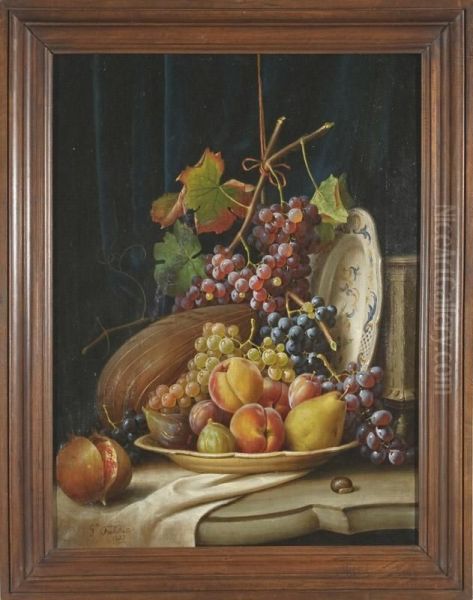
Falchetti also produced still life paintings, referred to in Italian as natura morta. His works in this genre, such as Natura morta con frutta (Still Life with Fruit), dated 1894, demonstrate his versatility. These compositions typically feature carefully arranged objects – fruits, flowers, or household items – rendered with attention to texture, color, and light. The still life genre allowed for a more controlled studio environment where artists could explore formal qualities and the play of light on different surfaces.
His landscape repertoire was diverse, encompassing various moods and times of day. The consistent high quality and appeal of his works ensured their presence in exhibitions and, subsequently, in the art market. Paintings like Canale di Candia have appeared in auctions with significant valuations, reflecting their desirability among collectors.
Contemporaries and the Rich Tapestry of Italian Art
Giuseppe Falchetti practiced his art during a dynamic period in Italian art history. The latter half of the 19th century saw the rise of various movements and artistic individualists who sought new modes of expression. Understanding Falchetti's place requires acknowledging the broader artistic context.
In Tuscany, the Macchiaioli, including prominent figures like Giovanni Fattori and Telemaco Signorini, were revolutionizing painting by emphasizing the use of "macchie" (patches or spots) of color and light to capture immediate visual impressions, often en plein air. While Falchetti's style was generally more polished and less radically impressionistic than the Macchiaioli, the emphasis on direct observation of nature was a shared concern.
Other notable landscape painters of the era, or those whose careers overlapped with Falchetti's, included Andrea Markò, known for his romantic and meticulously detailed landscapes, and Lorenzo Gignous, who also specialized in views of Italian lakes, particularly Lake Maggiore. Carlo Jotti was another contemporary landscape artist. The Neapolitan school, where Falchetti studied, had its own strong traditions, with artists like Achille Vianelli known for his watercolors and landscapes.
The art scene also included painters with vastly different approaches, such as Antonio Mancini, whose portraits were characterized by a thick impasto and a raw, expressive power. The diversity of styles, from the verismo (realism) that influenced many to the emerging Symbolist and Divisionist tendencies, created a rich and sometimes competitive environment. Falchetti navigated this world by remaining true to his primary interest in landscape while selectively incorporating modern influences like Divisionism. Other contemporaries mentioned in art historical records alongside him include Felvia Bisi, Mathias Gabriel Lory, Carlo Verdi, and Bartolomeo Guglielmo, each contributing to the multifaceted art scene of the period.
The Connection with John Singer Sargent
An interesting aspect of Falchetti's career is his connection with the internationally acclaimed American artist John Singer Sargent. Falchetti is noted to have had a friendship and artistic exchange with Sargent. This connection extended to Sargent's major commission to create murals for the Boston Public Library. Sargent, known for his dazzling portraits and vibrant watercolors, embarked on this ambitious mural project, "Triumph of Religion," in the 1890s.
It is documented that Sargent planned to involve other artists in this vast undertaking, or at least sought their input and camaraderie. Giuseppe Falchetti was among those Sargent considered or interacted with in relation to this project. Furthermore, Falchetti's nephew, Alberto Falchetti, also an artist, reportedly benefited from this connection, potentially receiving guidance or influence from Sargent. This association with a figure of Sargent's international stature underscores Falchetti's standing within artistic circles that transcended purely local boundaries.
Recognition, Artistic Circles, and Legacy
Giuseppe Falchetti's work received considerable recognition during his lifetime and continues to be appreciated. His paintings were regularly exhibited and sought after by private collectors. The consistent appearance of his works in auctions, often commanding respectable prices, speaks to their enduring appeal in the art market.
He was also involved in artistic organizations. Falchetti is described as a significant figure, even a "pioneer," within the "Cielo degli Artisti" (sometimes referred to as Circolo degli Artisti) in Turin. Such artists' circles or associations played a vital role in the 19th century, fostering camaraderie, facilitating exhibitions, and promoting artistic discourse. If this refers to the Circolo degli Artisti di Torino, founded in 1847, Falchetti would have been a prominent member in its later, flourishing period, contributing to its activities and prestige. These organizations were crucial for artists to network, share ideas, and collectively advance their interests.
His works found their way into public collections as well, with some pieces reportedly held in institutions like the Galleria Sabauda in Genoa (though primarily housed in Turin, the Galleria Sabauda's collections are extensive). The inclusion of an artist's work in public galleries is a significant mark of recognition and ensures its accessibility for future generations.
Falchetti's influence extended through his dedication to his craft and his ability to adapt and evolve. While he began with a more traditional, naturalistic approach inherited in part from his father, his willingness to explore Divisionism under Segantini demonstrates an artist open to growth and contemporary developments. He successfully synthesized these influences into a personal style that resonated with the public.
Later Years and Enduring Impact
Giuseppe Falchetti continued to paint into the early 20th century, passing away in 1918. He left behind a substantial body of work that primarily celebrates the beauty of the Italian landscape. His paintings serve as more than mere topographical records; they are imbued with a lyrical quality, capturing the soul of the places he depicted. His meticulous rendering of light, his harmonious compositions, and his sensitive portrayal of nature ensure his place among the notable Italian painters of his generation.
His legacy is one of dedication to the genre of landscape painting, a genre he enriched through his technical skill and his perceptive eye. He successfully navigated the transition from 19th-century academic and naturalistic traditions to the more modern sensibilities that emerged at the turn of the century. For art historians and enthusiasts of Italian art, Giuseppe Falchetti remains a painter whose works offer a tranquil yet profound engagement with the natural world, reflecting both the artistic currents of his time and a timeless appreciation for beauty. His contributions to depicting the Italian lakes, in particular, remain a cherished part of Italy's artistic heritage.